
The Trend Perceptron Robot MT5 is a smart trading algorithm designed for MetaTrader 5 that uses trend-following indicators like Moving Averages, RSI, CCI, and a sinusoidal logic mechanism to identify market entries and exits with optimized risk parameters.
==>> Buy this unlimited Trend Perceptron Robot MT5 product here
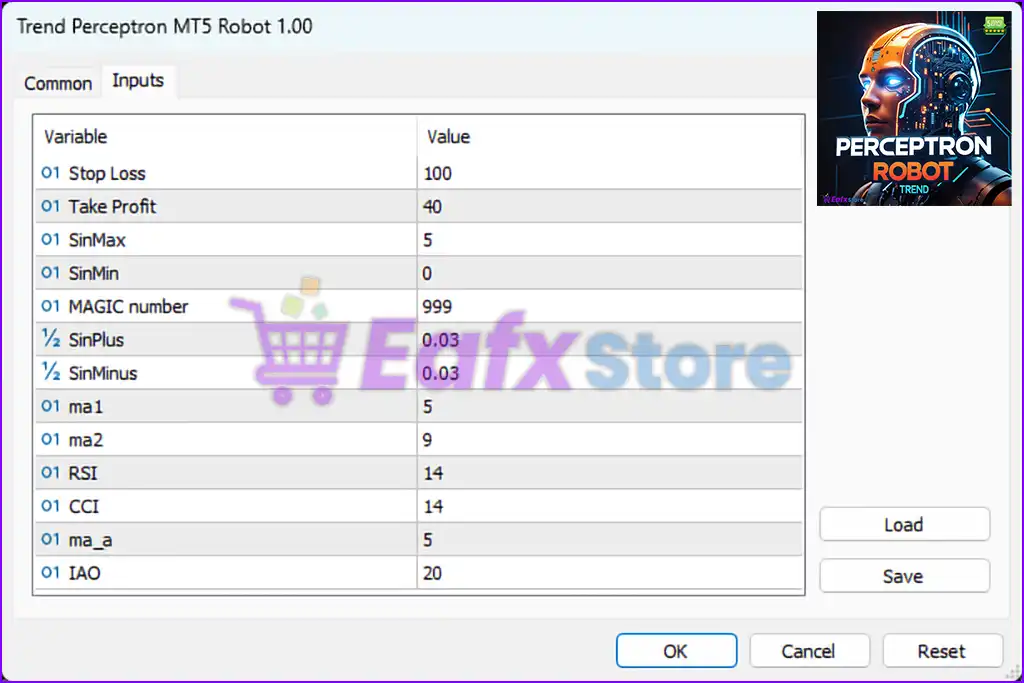
Key Risk and Trade Parameters
| Variable | Value | Description |
|---|---|---|
Stop Loss | 100 | Maximum loss in points per trade. Used for capital protection. |
Take Profit | 40 | Target profit level in points before closing a trade. |
MAGIC number | 999 | Unique ID used to distinguish this EA’s trades from others. |
Sinusoidal Filter Logic (Custom Neural-Like Control)
These parameters define internal signal logic, possibly a sinus-based smoothing or activation function:
| Variable | Value | Description |
|---|---|---|
SinMax | 5 | Upper bound of sinusoidal function signal range. |
SinMin | 0 | Lower bound of signal range. |
SinPlus | 0.03 | Positive deviation allowed in decision function. |
SinMinus | 0.03 | Negative deviation allowed for trade validation. |
🧠 These filters help reduce false entries by applying a mathematical buffer around signal thresholds.
Technical Indicator Settings
The EA uses multiple technical indicators to identify trend direction and confirm signals.
| Indicator | Value | Purpose |
|---|---|---|
ma1 | 5 | Short-term Moving Average (fast MA). |
ma2 | 9 | Long-term Moving Average (slow MA). |
ma_a | 5 | Possibly auxiliary MA or a signal smoothing MA. |
RSI | 14 | Relative Strength Index period for overbought/oversold filters. |
CCI | 14 | Commodity Channel Index period for trend confirmation. |
IAO | 20 | Possibly a custom momentum or oscillator setting. |
✅ Combining these indicators makes the EA responsive to short-term reversals while filtering with long-term momentum.
Summary: Why Use Trend Perceptron Robot?
- Multi-indicator convergence: Uses MA crossovers, RSI, and CCI to increase trade confidence.
- Sinusoidal smart filter: Reduces noise and false breakouts.
- Highly customizable: Each logic layer has parameters that can be tuned for different pairs/timeframes.
- Ideal for trending markets: Especially effective in clean, directional price action.