
The Hedging (Risk Management) strategy is one of the most critical risk management techniques in financial trading. When combined with the power of an Automated Trading Robot (Expert Advisor - EA), this strategy can be executed precisely, rapidly, and automatically, minimizing human emotion and error.
I. What is Hedging? (Risk Mitigation)
Hedging is the act of opening an opposite position to an existing one to protect profits or minimize potential losses caused by adverse price movements.
1. The Core Principle
- Primary Goal: Not to earn additional profit from the opposite position, but to reduce the risk of the initial position.
- Mechanism: When you have a Buy (Long) position, you open a Sell (Short) position of the same volume on the same asset, or vice versa.
2. Two Common Forms of Hedging
| Hedging Form | Description | Application |
| Full Hedge | Opening an opposite position of the same size as the initial position. | Freezes the current profit or loss, temporarily exiting the market without closing the initial position. |
| Partial Hedge | Opening an opposite position of a smaller size than the initial position. | Reduces the degree of risk, allowing the account to still benefit if the market reverses favorably. |
Export to Sheets
II. Applying the Hedging Strategy in Automated Robots
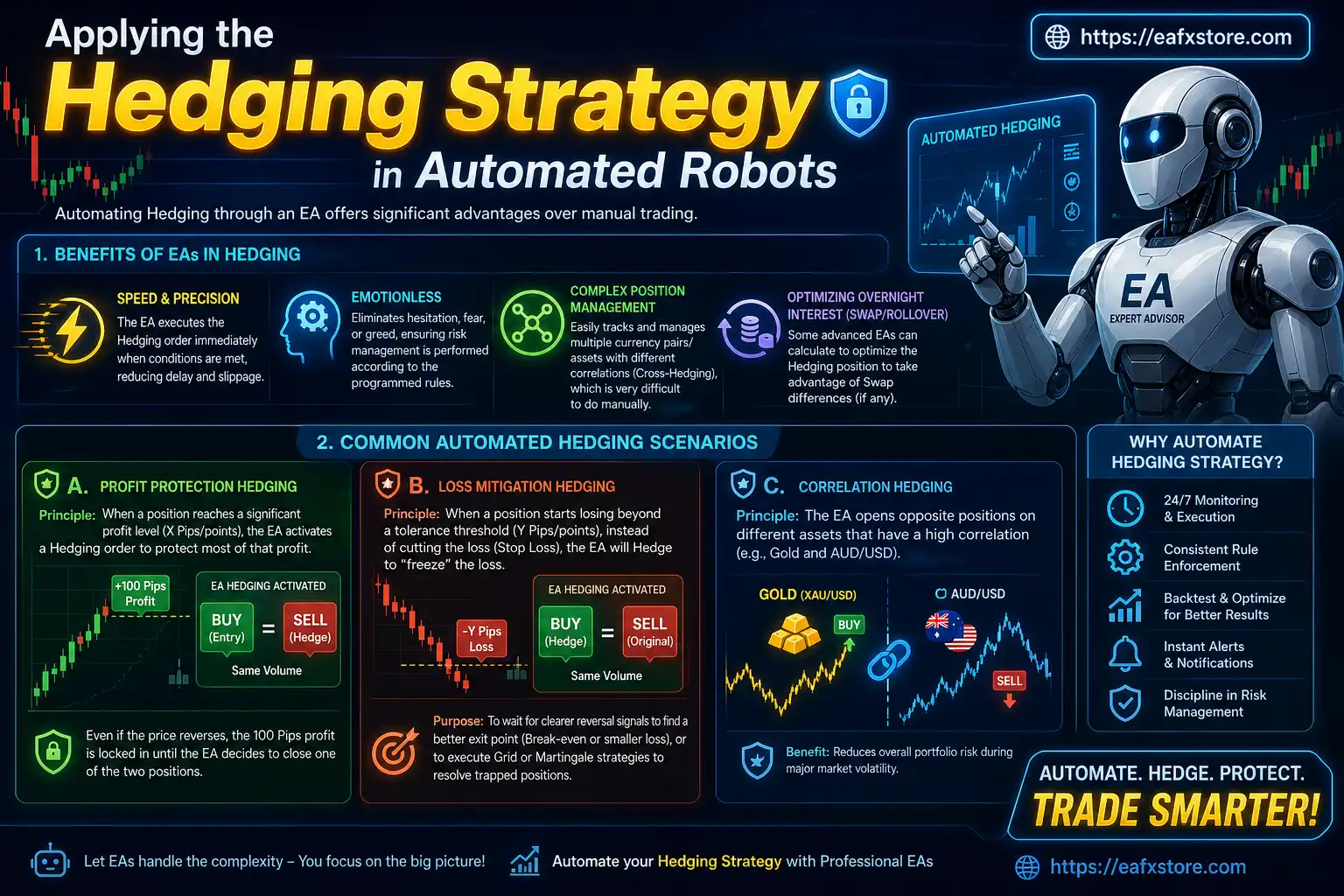
Automating Hedging through an EA offers significant advantages over manual trading.
1. Benefits of EAs in Hedging
- Speed & Precision: The EA executes the Hedging order immediately when conditions are met, reducing delay and slippage.
- Emotionless: Eliminates hesitation, fear, or greed, ensuring risk management is performed according to the programmed rules.
- Complex Position Management: Easily tracks and manages multiple currency pairs/assets with different correlations (Cross-Hedging), which is very difficult to do manually.
- Optimizing Overnight Interest (Swap/Rollover): Some advanced EAs can calculate to optimize the Hedging position to take advantage of Swap differences (if any).
2. Common Automated Hedging Scenarios
A. Profit Protection Hedging
- Principle: When a position reaches a significant profit level (X Pips/points), the EA activates a Hedging order to protect most of that profit.
- Example: A Buy order is currently profitable by 100 Pips. The EA automatically opens a Sell order of the same volume. Even if the price reverses, the 100 Pips profit is locked in until the EA decides to close one of the two positions.
B. Loss Mitigation Hedging
- Principle: When a position starts losing beyond a tolerance threshold (Y Pips/points), instead of cutting the loss (Stop Loss), the EA will Hedge to "freeze" the loss.
- Purpose: To wait for clearer reversal signals to find a better exit point (Break-even or smaller loss), or to execute Grid or Martingale strategies to resolve trapped positions.
C. Correlation Hedging
- Principle: The EA opens opposite positions on different assets that have a high correlation (e.g., Gold and AUD/USD).
- Benefit: Reduces overall portfolio risk during major market volatility.
III. Challenges and Risks of Automated Hedging
While powerful, using Hedging in EAs also carries potential risks, especially with brokers that do not allow Hedging (FIFO - First In, First Out rule).
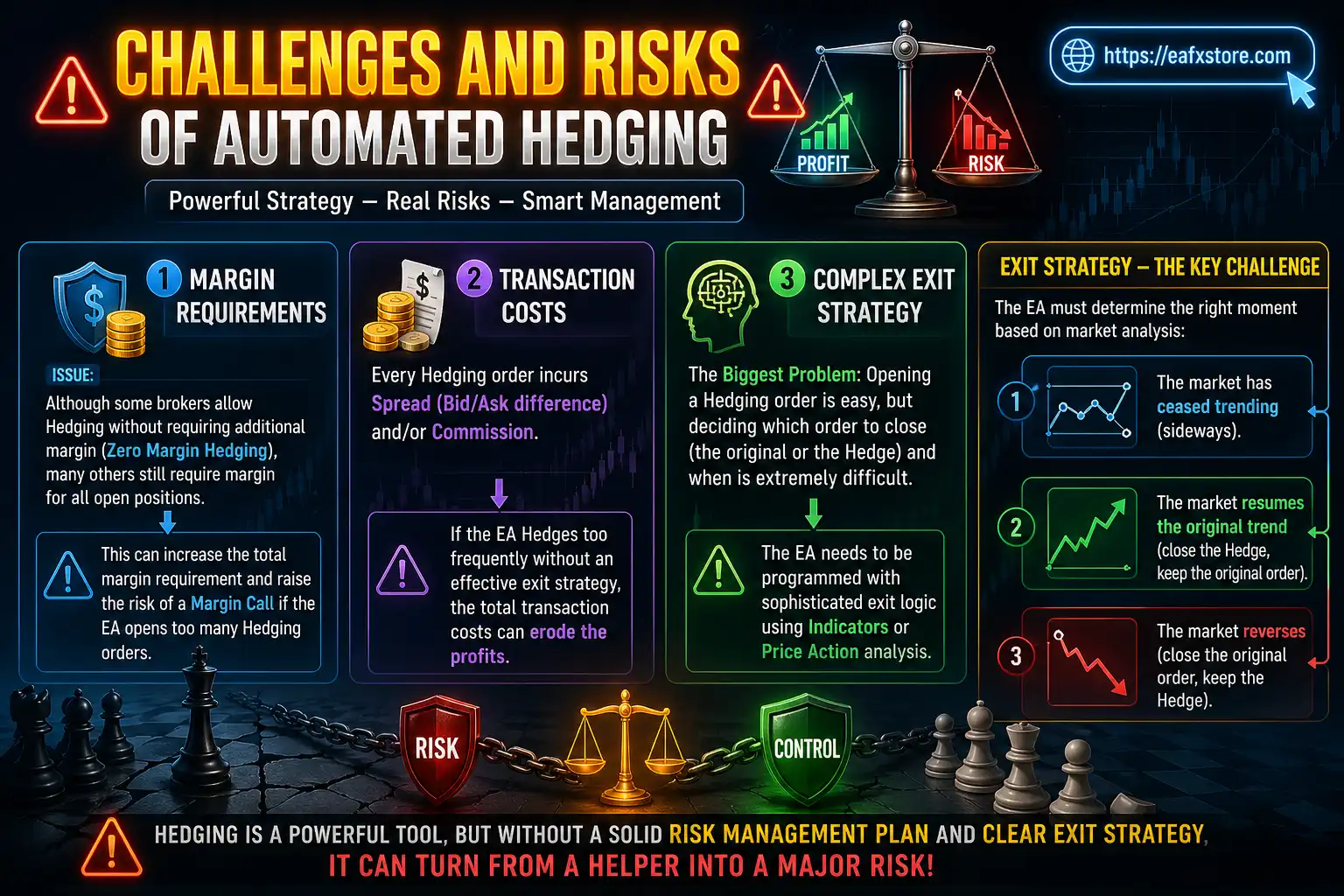
1. Margin Requirements
- Issue: Although some brokers allow Hedging without requiring additional margin (Zero Margin Hedging), many others still require margin for all open positions. This can increase the total margin requirement and raise the risk of a Margin Call if the EA opens too many Hedging orders.
2. Transaction Costs
- Every Hedging order incurs Spread (Bid/Ask difference) and/or Commission.
- If the EA Hedges too frequently without an effective exit strategy, the total transaction costs can erode the profits.
3. Complex Exit Strategy
- The Biggest Problem: Opening a Hedging order is easy, but deciding which order to close (the original or the Hedge) and when is extremely difficult.
- The EA needs to be programmed with sophisticated exit logic, using Indicators or Price Action analysis to determine:
- The moment the market has ceased trending (sideways).
- The moment the market resumes the original trend (close the Hedge, keep the original order).
- The moment the market reverses (close the original order, keep the Hedge).
IV. Designing Optimal Hedging EA Logic
To build a successful Hedging EA, focus on the following key components:
1. Signal Filter (Entry Filter)
The EA should only start Hedging when there is a clear confirmation signal of a change in momentum or trend.
- Example: Using the RSI (Relative Strength Index) crossing over the Oversold/Overbought thresholds or the MACD (Moving Average Convergence Divergence) lines crossing to confirm a reversal.
2. Core Risk Management Mechanism
- Dynamic Lot Sizing: The EA should adjust the trading volume based on the percentage of account risk rather than a fixed lot size.
- Hedging Threshold: Clearly define the number of Pips or percentage of loss/profit for the EA to activate the Hedging order.
3. "Unwind/Resolution" Logic
This is the most critical part, where the EA decides the action to resolve the Hedged positions.
| Resolution Strategy | Description | Application |
| Break-Even Pips | Close both orders when the total profit of the pair reaches 0 (or a small profit to cover fees). | Suitable for sideways markets. |
| Confirmed Reversal (Trend Confirmation) | Close the Hedge order when the main trend is confirmed to resume using technical analysis tools. | Ensures the original position continues to profit with the trend. |
| Position "Leveraging" | Close the losing/Hedge order and increase the volume of the original order when there is a strong breakout signal. (High risk) | Attempts to quickly recoup Hedging costs. |
Export to Sheets
4. In-Depth Backtesting
- Test across different market environments: Test the Hedging EA's performance during periods of strong trends, ranging (sideways), and High Volatility to determine its robustness.
Conclusion
The Hedging strategy, when implemented in an Automated Robot, is a powerful tool for capital protection and disciplined risk management. However, it is not a "risk-free" strategy. Success lies in programming sophisticated exit logic, managing transaction costs effectively and ensuring the EA is configured to comply with the broker's margin rules.