
Unlike many complex technical indicators, Super Trend focuses primarily on price direction and market volatility. Its straightforward buy and sell signals make it popular among forex, stock, cryptocurrency and commodity traders.
What is the Super Trend Indicator?
The Super Trend indicator is a trend-following technical analysis tool that helps identify the current direction of a market. It is displayed directly on the price chart as a line that moves above or below the market price.
When the Super Trend line is below the price, it generally indicates a bullish trend. When the line moves above the price, it usually indicates a bearish trend.
The indicator is particularly useful because it combines price movement with market volatility. This allows traders to filter some market noise and focus on potentially stronger trends.
The Super Trend indicator is commonly used in:
- Forex trading
- Stock trading
- Cryptocurrency trading
- Commodity trading
- Index trading
- Intraday and swing trading

How Does the Super Trend Indicator Work?
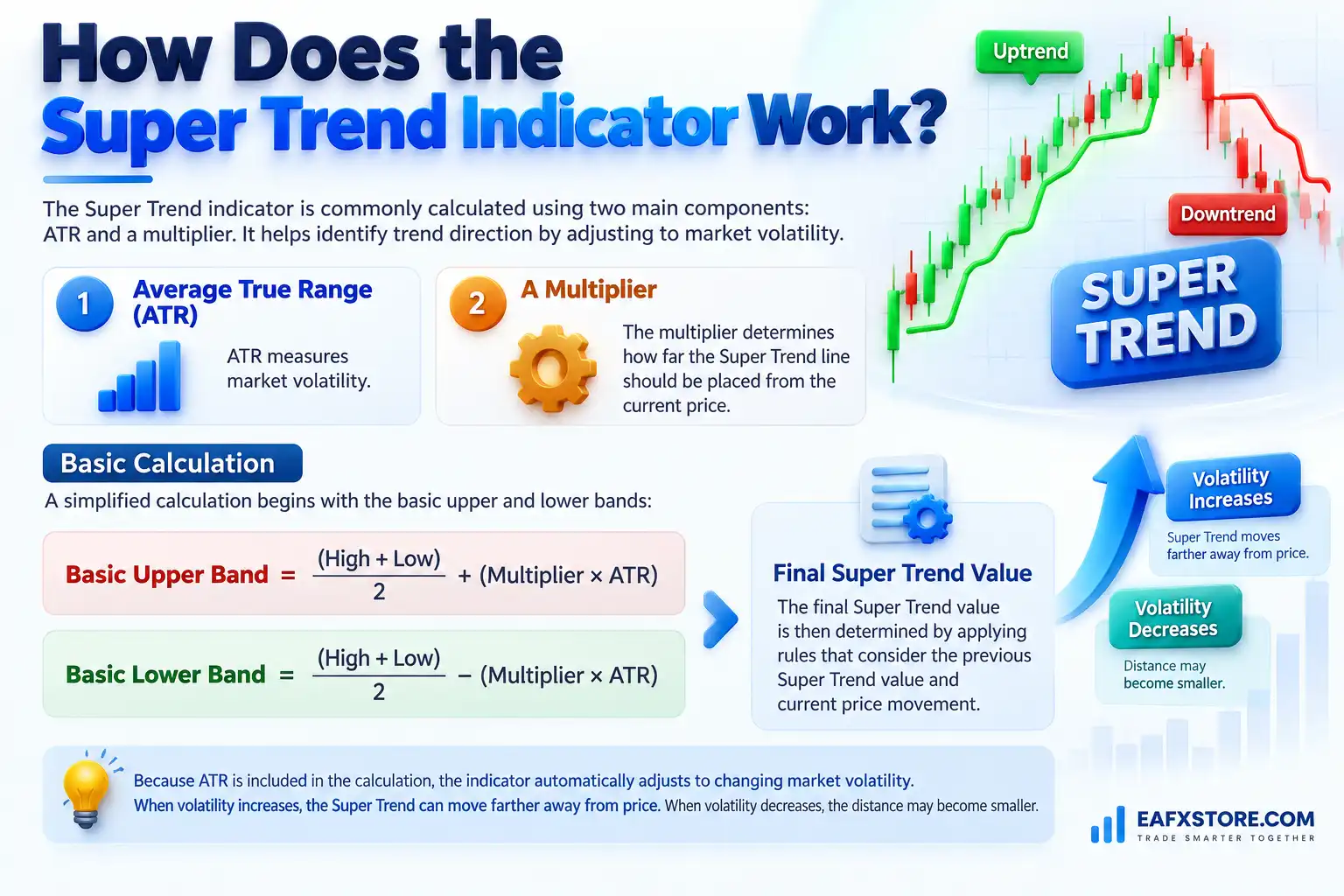
The Super Trend indicator is commonly calculated using two main components:
- Average True Range (ATR)
- A multiplier
ATR measures market volatility, while the multiplier determines how far the Super Trend line should be placed from the current price.
A simplified calculation begins with the basic upper and lower bands:
Basic Upper Band = (High + Low) / 2 + (Multiplier × ATR)
Basic Lower Band = (High + Low) / 2 − (Multiplier × ATR)
The final Super Trend value is then determined by applying rules that consider the previous Super Trend value and current price movement.
Because ATR is included in the calculation, the indicator automatically adjusts to changing market volatility. When volatility increases, the Super Trend can move farther away from price. When volatility decreases, the distance may become smaller.
Super Trend Buy and Sell Signals
One of the main advantages of the Super Trend indicator is its easy-to-understand signals.
Bullish Signal
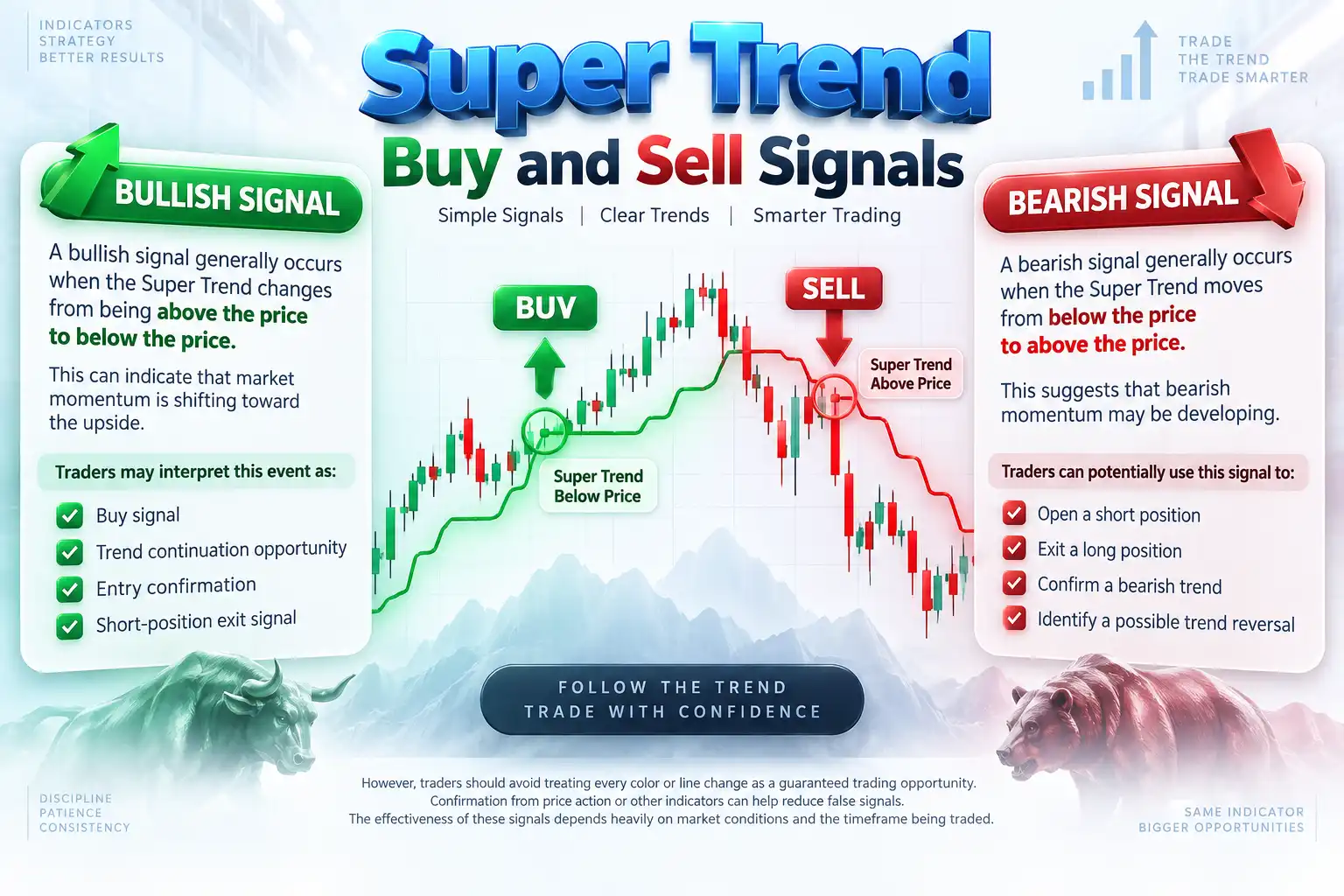
A bullish signal generally occurs when the Super Trend changes from being above the price to below the price.
This can indicate that market momentum is shifting toward the upside.
Traders may interpret this event as a potential:
- Buy signal.
- Trend continuation opportunity.
- Entry confirmation.
- Short-position exit signal.
However, traders should avoid treating every color or line change as a guaranteed trading opportunity. Confirmation from price action or other indicators can help reduce false signals.
Bearish Signal
A bearish signal generally occurs when the Super Trend moves from below the price to above the price.
This suggests that bearish momentum may be developing.
Traders can potentially use this signal to:
- Open a short position.
- Exit a long position.
- Confirm a bearish trend.
- Identify a possible trend reversal.
The effectiveness of these signals depends heavily on market conditions and the timeframe being traded.
Best Super Trend Settings
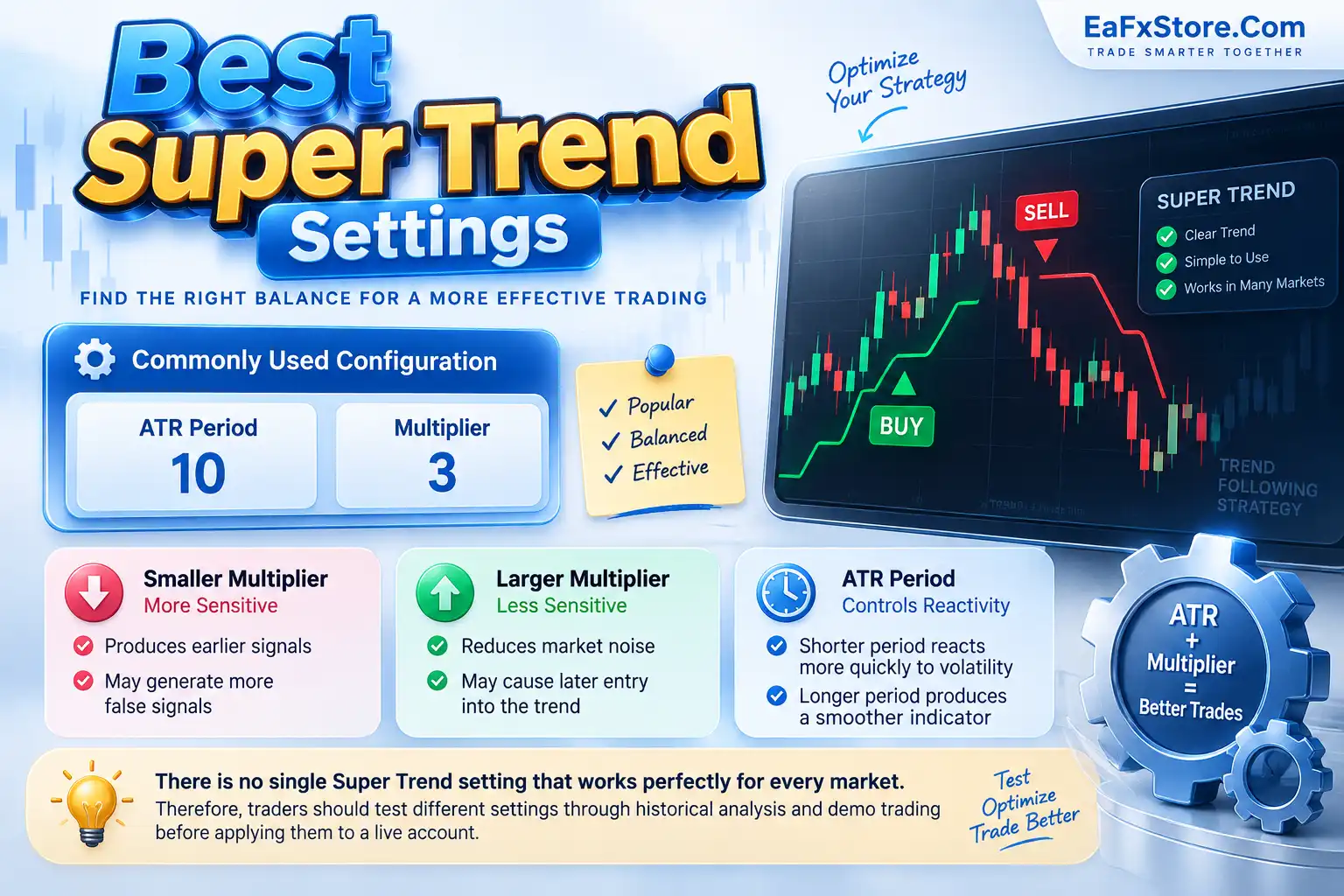
There is no single Super Trend setting that works perfectly for every market.
Two of the most important parameters are the ATR Period and Multiplier.
A commonly used configuration is:
- ATR Period: 10
- Multiplier: 3
These settings can provide a reasonable balance between responsiveness and noise filtering.
A smaller multiplier makes the indicator more sensitive to price changes. This can produce earlier signals but may also generate more false signals.
A larger multiplier makes the indicator less sensitive. This can reduce market noise but may cause traders to enter a trend later.
Similarly, a shorter ATR period reacts more quickly to volatility changes, while a longer period produces a smoother indicator.
Therefore, traders should test different settings through historical analysis and demo trading before applying them to a live account.
How to Use Super Trend in Trading
The Super Trend indicator can be used in several different ways.
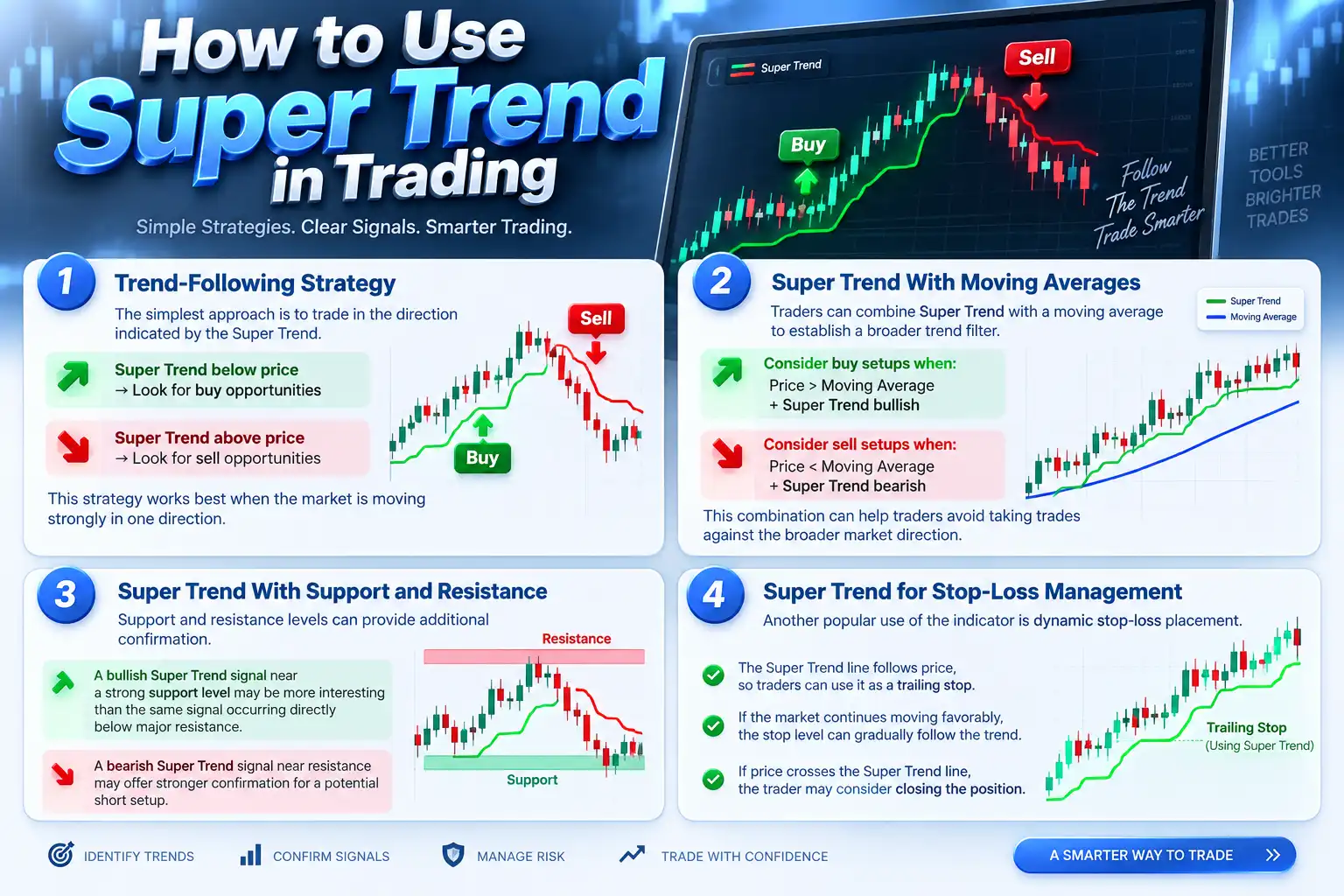
1. Trend-Following Strategy
The simplest approach is to trade in the direction indicated by the Super Trend.
For example:
- Super Trend below price → Look for buy opportunities
- Super Trend above price → Look for sell opportunities
This strategy works best when the market is moving strongly in one direction.
2. Super Trend With Moving Averages
Traders can combine Super Trend with a moving average to establish a broader trend filter.
For example, a trader might only consider buy setups when:
Price > Moving Average + Super Trend bullish
Likewise, sell setups may be considered when:
Price < Moving Average + Super Trend bearish
This combination can help traders avoid taking trades against the broader market direction.
3. Super Trend With Support and Resistance
Support and resistance levels can provide additional confirmation.
A bullish Super Trend signal near a strong support level may be more interesting than the same signal occurring directly below major resistance.
Similarly, a bearish Super Trend signal near resistance may offer stronger confirmation for a potential short setup.
4. Super Trend for Stop-Loss Management
Another popular use of the indicator is dynamic stop-loss placement.
Because the Super Trend line follows price, traders can use it as a trailing stop. If the market continues moving favorably, the stop level can gradually follow the trend.
If price crosses the Super Trend line, the trader may consider closing the position.
Advantages of the Super Trend Indicator
The Super Trend indicator offers several important advantages.
Simple to understand: Its visual design makes bullish and bearish trends easy to identify.
Trend-focused: It helps traders concentrate on the dominant direction rather than reacting to every small price movement.
Volatility-adjusted: The ATR component allows the indicator to adapt to changing market volatility.
Versatile: Super Trend can be applied to forex, stocks, indices, commodities, and cryptocurrencies.
Useful for risk management: The Super Trend line can also serve as a potential trailing-stop reference.
Limitations of Super Trend
Despite its advantages, Super Trend is not a perfect indicator.
The biggest limitation is that it can produce false signals in sideways or highly choppy markets. When price repeatedly moves above and below the indicator, traders may receive multiple losing signals.
Another limitation is that Super Trend is primarily a trend-following indicator. This means it may react after a trend has already started rather than predicting a reversal before it occurs.
For this reason, traders should consider combining Super Trend with other forms of analysis, including price action, support and resistance, volume or another trend filter.
Is Super Trend Good for Beginners?
Yes. Super Trend can be a useful indicator for beginners because its basic interpretation is relatively straightforward.
Instead of trying to understand numerous complicated calculations, beginners can initially focus on three questions:
- Is the Super Trend bullish or bearish?
- Is price moving in the same direction?
- Is there additional confirmation from the market structure?
However, beginners should understand that no indicator can guarantee profitable trades. Proper position sizing, stop-loss management and disciplined execution remain essential.
Final Thoughts
Its greatest strength is simplicity. Traders can use it for trend identification, entry confirmation, trade exits and trailing-stop management. However, it can struggle during sideways markets and should not be treated as a standalone prediction tool.
For better results, consider combining Super Trend with price action, moving averages, support and resistance, or other technical analysis methods. Most importantly, test your chosen settings on historical data and a demo account before risking real capital.
When used as part of a complete trading plan, the Super Trend indicator can become a valuable tool for identifying and managing trend-following opportunities.