

In the highly volatile Forex market, risk management and profit protection are essential for every trader. One of the most effective tools to achieve this is the Trailing Stop. Not only does it help limit losses, but it also allows traders to maximize profits when the market moves in their favor.
This article will help you understand what a Trailing Stop is, how it works, its advantages and disadvantages and how to apply it effectively in real trading.
1. What is a Trailing Stop?
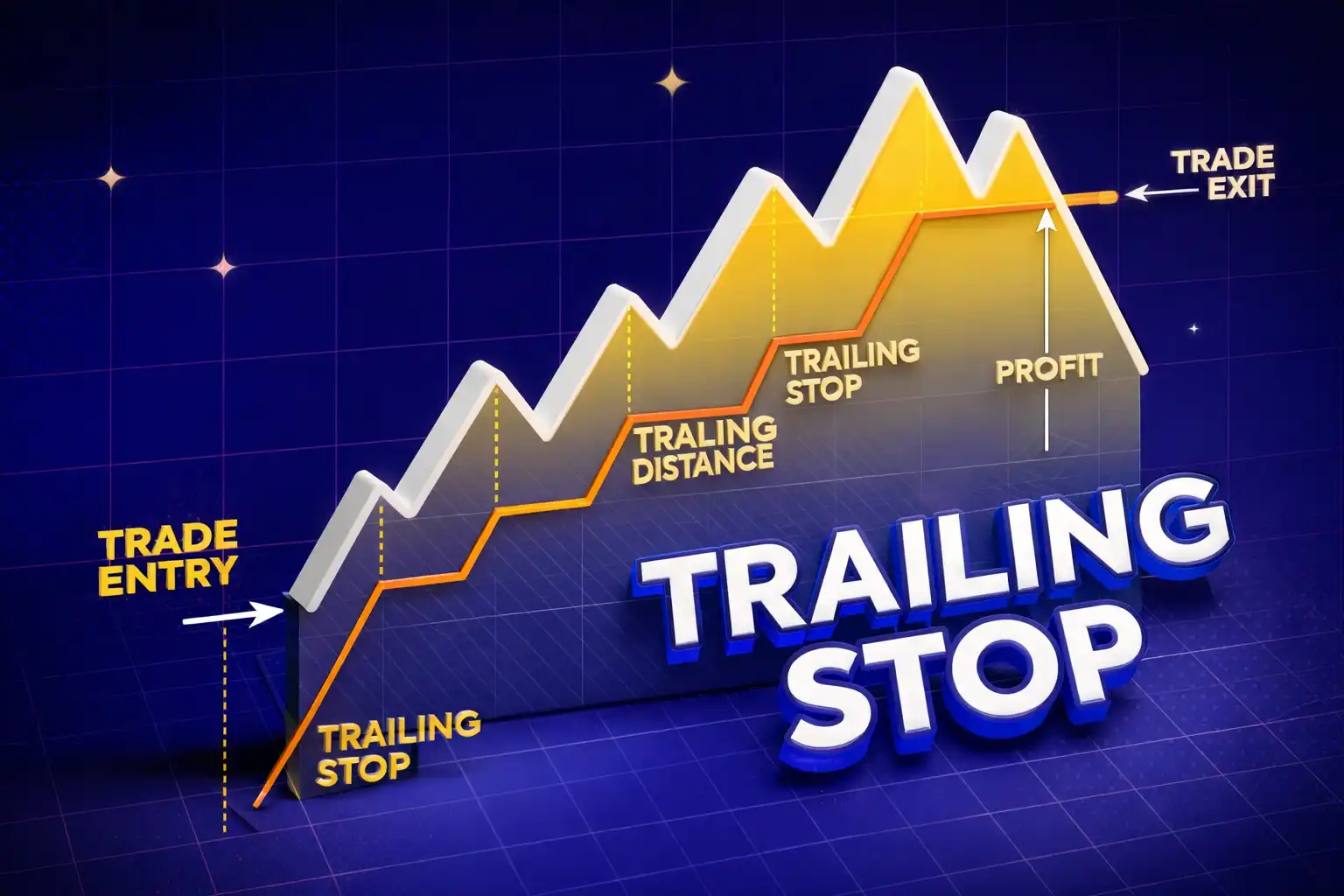
A Trailing Stop is a type of Stop Loss (SL) order that automatically adjusts in the direction of favorable price movement. Unlike a fixed Stop Loss, a Trailing Stop moves along with the price when the market goes in your favor, but remains unchanged when the price reverses.
Example:
- You buy EUR/USD at 1.1000
- Set a Trailing Stop of 50 pips
→ When price rises to 1.1050, the Stop Loss automatically moves to 1.1000
→ If the price continues to rise, the Stop Loss keeps moving up
→ If the price reverses by 50 pips, the trade is closed
This helps you:
- Gradually lock in profits
- Avoid constant monitoring
2. How Trailing Stop Works
A Trailing Stop operates based on a fixed distance (in pips or points) that you define.
Basic mechanism:
- When price moves in your favor → Stop Loss moves accordingly
- When price moves against you → Stop Loss stays in place
Illustration:
- Entry: 1.2000
- Trailing Stop: 30 pips
| Current Price | Stop Loss |
|---|---|
| 1.2000 | 1.1970 |
| 1.2030 | 1.2000 |
| 1.2060 | 1.2030 |
| 1.2040 | 1.2030 (no change) |
→ When price hits 1.2030 again, the trade is closed with profit.
3. Advantages of Trailing Stop
3.1. Automatic profit protection
Trailing Stop helps “lock in” profits as the price moves in your favor without manual intervention.
3.2. Reduced psychological pressure
Traders don’t need to:
- Constantly monitor trades
- Worry about sudden reversals
3.3. Maximizing trends
In strong trends, Trailing Stop allows you to hold trades longer and fully capture price movements.
4. Disadvantages of Trailing Stop
4.1. Easily triggered in choppy markets
If set too tight, small price fluctuations can prematurely close trades.
4.2. Not suitable for sideways markets
In ranging conditions, Trailing Stop often closes trades too early.
4.3. Platform dependency
Some trading platforms require your device to stay on for Trailing Stop to function (e.g., MT4/MT5).
5. When to Use a Trailing Stop?
Trailing Stop is especially effective in the following situations:
5.1. Strong trending markets
- Clear uptrend or downtrend
- Breakouts from consolidation zones
5.2. Trend-following strategies
It helps you stay in trades longer instead of taking profits too early.
5.3. When you cannot monitor the market continuously
A very useful tool for busy traders.
6. How to Set Trailing Stop Effectively
6.1. Based on market volatility
Avoid using the same fixed value in all situations.
Suggestions:
- Low-volatility pairs: 20–30 pips
- High-volatility pairs: 50–100 pips
6.2. Using ATR (Average True Range)
ATR measures average volatility → helps set more appropriate Trailing Stops.
Example:
- ATR = 40 pips
→ Trailing Stop = 1–1.5 ATR (40–60 pips)
6.3. Based on market structure
Place Trailing Stop below:
- Swing lows (for buy trades)
- Swing highs (for sell trades)
This reduces the chance of being stopped out by short-term noise.
7. Trailing Stop vs Take Profit
| Criteria | Trailing Stop | Take Profit |
| Flexibility | High | Low |
| Profit potential | Unlimited | Limited |
| Risk of early exit | Higher | Lower |
| Trend suitability | Excellent | Moderate |
→ Conclusion: Trailing Stop is more suitable for trend-following strategies, while Take Profit (TP) is better for fixed targets.
8. Common Mistakes When Using Trailing Stop
8.1. Setting it too tight
Leads to frequent stop-outs even when the trend remains valid.
8.2. Not adapting to market conditions
Each currency pair and timeframe behaves differently.
8.3. Overusing Trailing Stop
Not always appropriate. In sideways markets, fixed Stop Loss + Take Profit is better.
9. Combining Trailing Stop with Strategy
An effective approach is to combine:
- Initial Stop Loss (to protect capital)
- Trailing Stop (to protect profits)
Example:
- Set a fixed Stop Loss at entry
- Once the trade gains 30–50 pips → activate Trailing Stop
→ This is a method commonly used by professional traders.
10. Conclusion
Trailing Stop is a powerful tool that helps traders:
- Protect profits
- Maximize trends
- Reduce emotional stress
However, to use it effectively, you need to:
- Understand how it works
- Adjust it based on market conditions
- Integrate it into your overall trading strategy
There is no “holy grail” in trading, but when used correctly, Trailing Stop can become a valuable assistant in your Forex trading journey.
Final tip: Practice using Trailing Stop on a demo account before applying it in live trading to find the best setup for your trading style.