
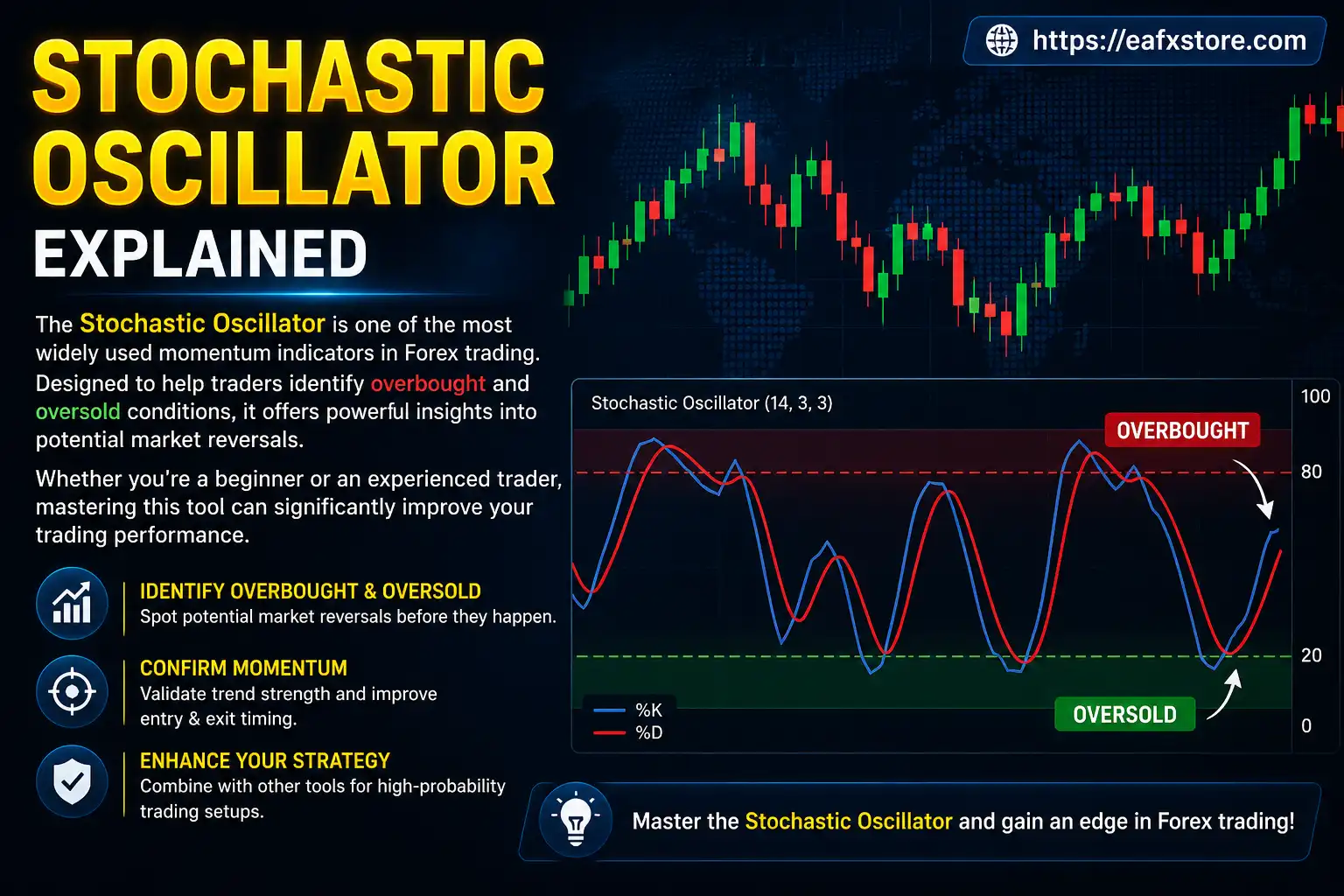
The Stochastic Oscillator is one of the most widely used momentum indicators in Forex trading. Designed to help traders identify overbought and oversold conditions, it offers powerful insights into potential market reversals. Whether you’re a beginner or an experienced trader, mastering this tool can significantly improve your trading performance.
In this guide, you’ll learn what the Stochastic Oscillator is, how it works, and how to use it effectively in your Forex strategy.
What Is the Stochastic Oscillator?
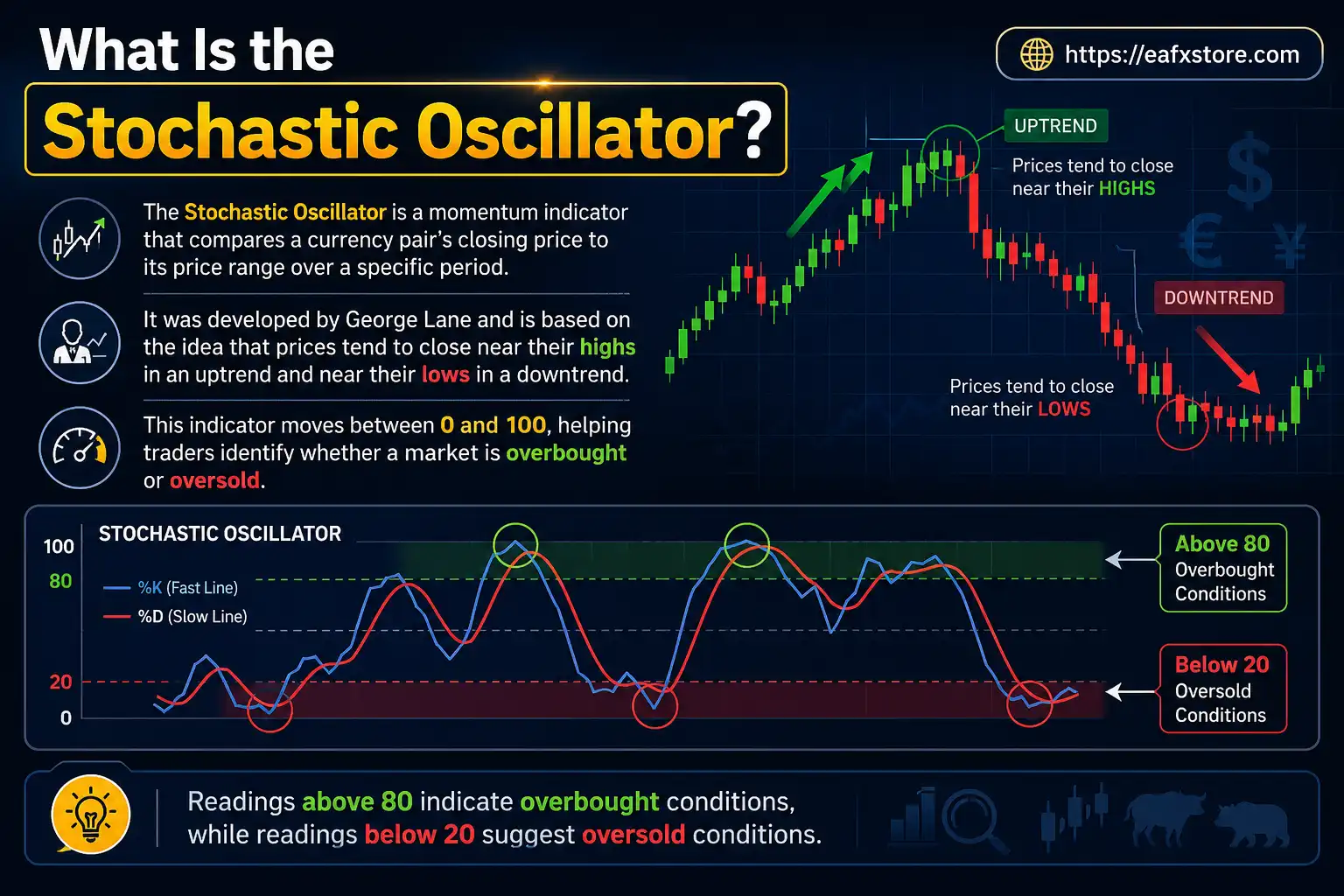
The Stochastic Oscillator is a momentum indicator that compares a currency pair’s closing price to its price range over a specific period. It was developed by George Lane and is based on the idea that prices tend to close near their highs in an uptrend and near their lows in a downtrend.
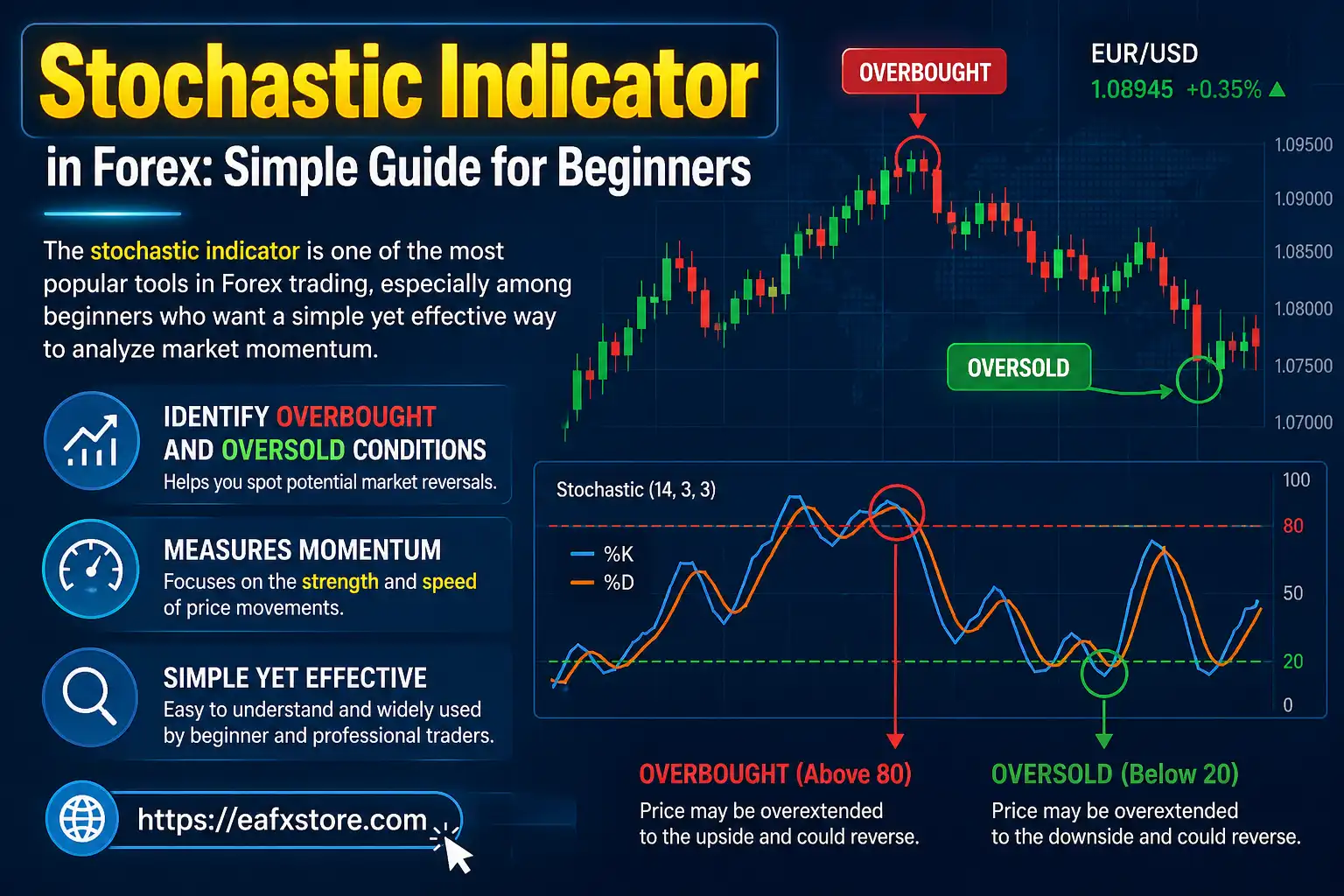
This indicator moves between 0 and 100, helping traders identify whether a market is overbought or oversold. Typically, readings above 80 indicate overbought conditions, while readings below 20 suggest oversold conditions.
How the Stochastic Oscillator Works
The Stochastic Oscillator consists of two lines: %K and %D. The %K line is the main line, while the %D line is a moving average of %K and acts as a signal line.
When these two lines cross, they generate trading signals. The closer the indicator is to 100, the stronger the upward momentum. Conversely, values closer to 0 indicate stronger downward momentum.
The standard settings are usually 14, 3, 3, but traders can adjust them based on their strategy and timeframe.
Key Components of the Indicator
Understanding the components of the Stochastic Oscillator is essential for using it effectively. Here’s a simple breakdown:
| Component | Description |
|---|---|
| %K Line | The main line that reflects current price momentum |
| %D Line | A smoothed version of %K used for signals |
| Overbought Level | Typically above 80 |
| Oversold Level | Typically below 20 |
| Divergence | Occurs when price and indicator move in opposite directions |
Each component plays a role in helping traders interpret market conditions and make informed decisions.
How to Use the Stochastic Oscillator in Forex Trading
Using the Stochastic Oscillator effectively requires more than just recognizing overbought or oversold levels. Traders should combine it with price action and other indicators for better accuracy.
A common approach is to look for crossovers between %K and %D. When %K crosses above %D in the oversold region, it can signal a potential buy opportunity. Conversely, when %K crosses below %D in the overbought region, it may indicate a sell signal.
Another method is to observe how the indicator behaves during trends. In strong trends, the oscillator can remain in overbought or oversold zones for extended periods, so traders should avoid relying solely on these levels.
Identifying Overbought and Oversold Conditions
One of the most popular uses of the Stochastic Oscillator is identifying extreme market conditions.
When the indicator moves above 80, it suggests that the market may be overbought, meaning a price correction could occur soon. On the other hand, readings below 20 indicate oversold conditions, which may lead to a price bounce.
However, it’s important not to assume immediate reversals. Markets can stay overbought or oversold longer than expected, especially during strong trends.
Trading Divergences Like a Pro
Divergence is one of the most powerful signals generated by the Stochastic Oscillator. It occurs when the price action and the indicator move in opposite directions.
For example, if the price forms higher highs while the oscillator forms lower highs, it indicates bearish divergence. This could signal a potential reversal to the downside. Similarly, bullish divergence occurs when price makes lower lows but the oscillator makes higher lows.
Professional traders often rely on divergence as an early warning sign of trend exhaustion.
Best Settings for Forex Trading
While the default settings (14, 3, 3) work well in many cases, traders often adjust them based on their trading style.
| Trading Style | Recommended Settings |
|---|---|
| Scalping | 5, 3, 3 |
| Day Trading | 9, 3, 3 |
| Swing Trading | 14, 3, 3 |
Shorter settings make the indicator more sensitive, generating more signals but also increasing the risk of false signals. Longer settings provide smoother signals but may lag behind price movements.
Combining Stochastic with Other Indicators
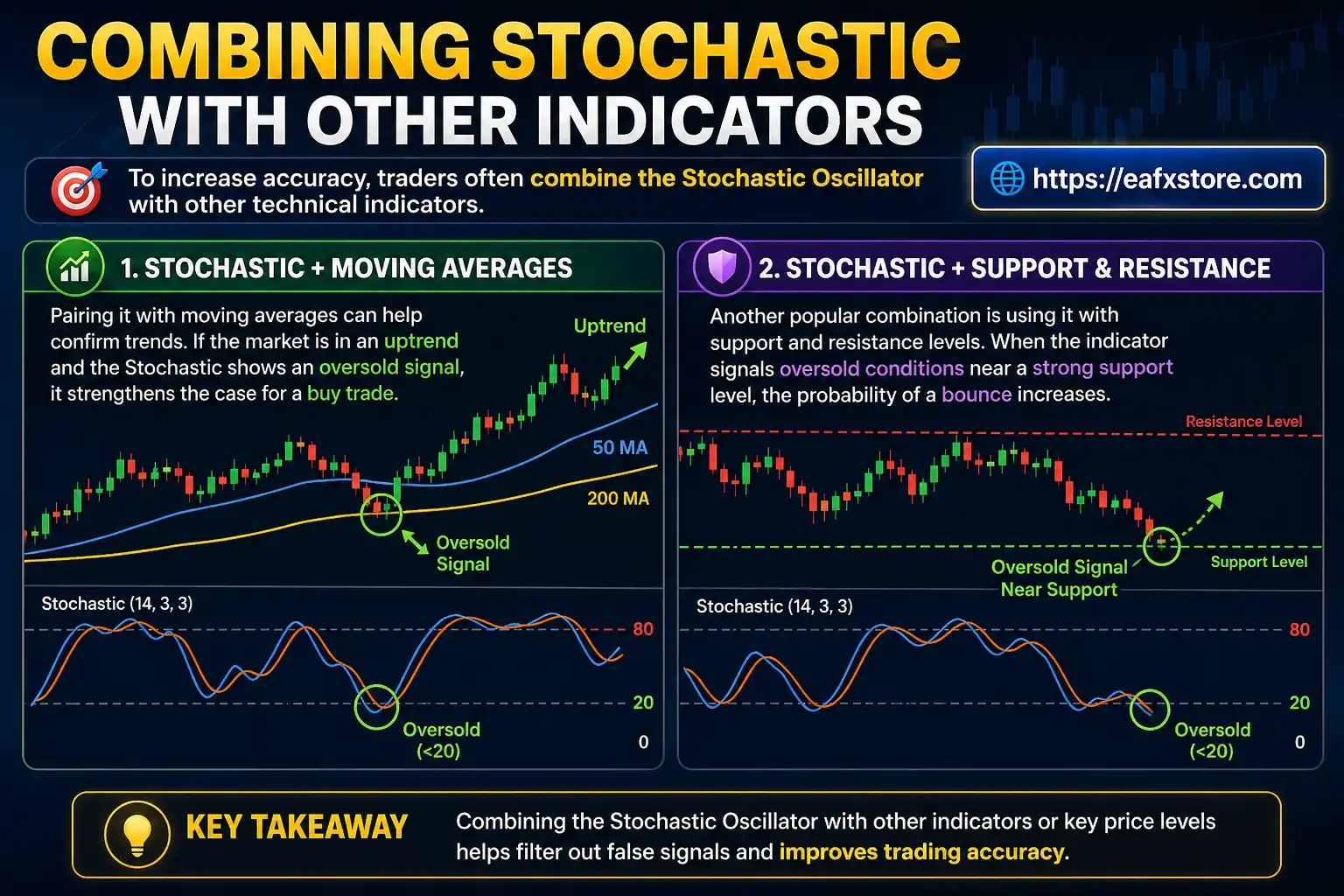
To increase accuracy, traders often combine the Stochastic Oscillator with other technical indicators.
For example, pairing it with moving averages can help confirm trends. If the market is in an uptrend and the Stochastic shows an oversold signal, it strengthens the case for a buy trade.
Another popular combination is using it with support and resistance levels. When the indicator signals oversold conditions near a strong support level, the probability of a bounce increases.
Common Mistakes to Avoid
Many traders misuse the Stochastic Oscillator by relying on it alone or misunderstanding its signals.
One common mistake is selling immediately when the indicator reaches overbought levels. In strong uptrends, the price can continue rising despite being overbought.
Another mistake is ignoring the overall trend. The Stochastic Oscillator works best when used in conjunction with trend analysis.
Lastly, overtrading based on frequent signals can lead to losses. It’s important to wait for confirmation before entering trades.
Final Thoughts
The Stochastic Oscillator is a powerful tool that can help Forex traders identify momentum, reversals and optimal entry points. However, like any indicator, it should not be used in isolation.
By understanding how it works and combining it with other tools such as trend analysis and support/resistance levels, you can significantly improve your trading strategy.
Mastering the Stochastic Oscillator takes practice, but once you do, it can become a valuable part of your trading toolkit—helping you trade Forex with greater confidence and precision.