
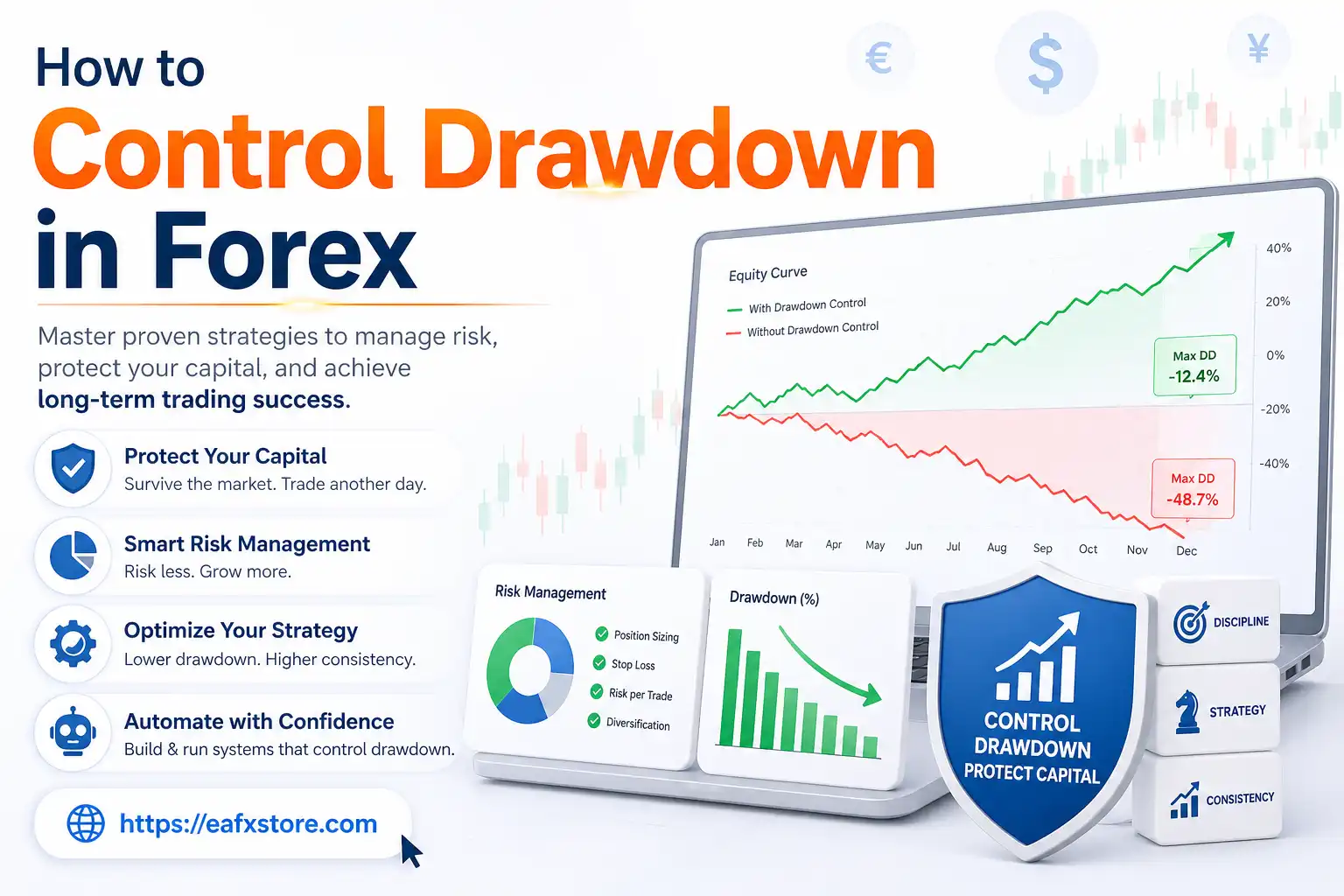
Drawdown is one of the most critical metrics in Forex trading, yet many traders underestimate its impact until it’s too late. Whether you trade manually or rely on automated systems, controlling drawdown is essential for long-term survival and consistent profitability. In this guide, you’ll learn practical strategies to manage drawdown like a professional trader and how to apply them effectively in automated trading systems.
What is Drawdown in Forex Trading?
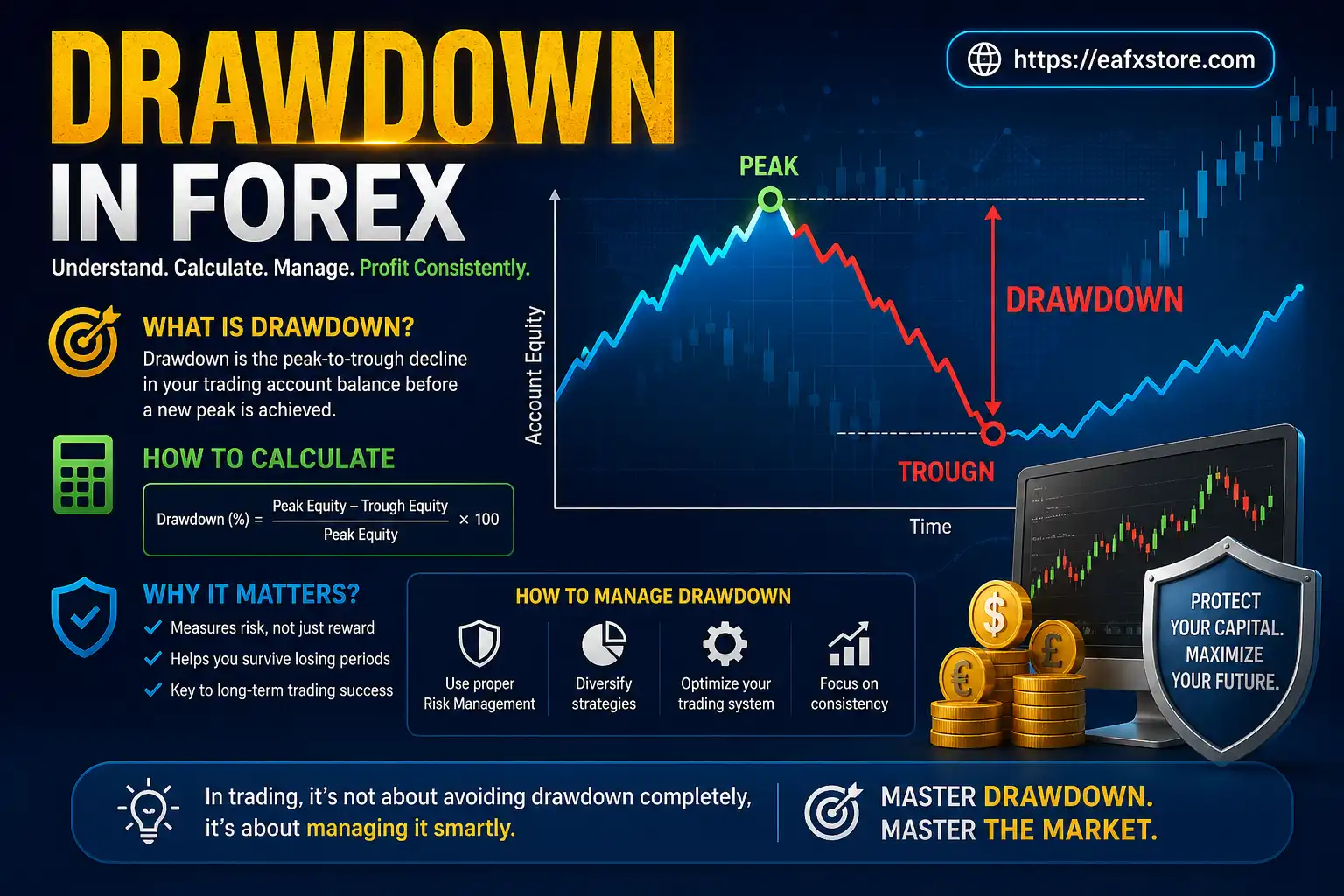
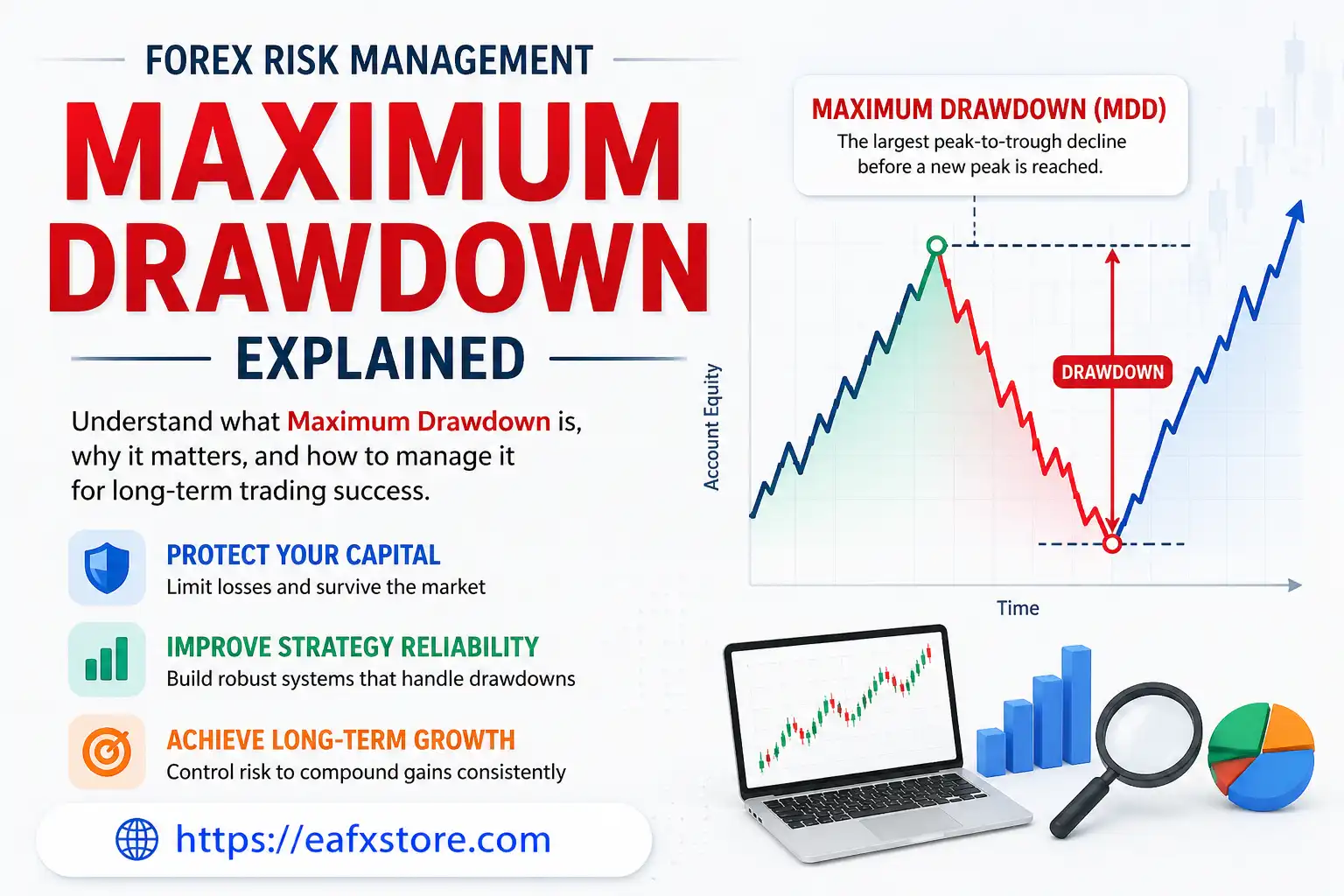
Drawdown refers to the reduction of your trading account from a peak to a trough, usually expressed as a percentage. For example, if your account drops from $10,000 to $8,000, you’ve experienced a 20% drawdown.
Understanding drawdown is crucial because it reflects risk exposure rather than just profitability. A system that generates high returns but suffers large drawdowns is often unsustainable. Professional traders focus on balancing profit and risk, ensuring that drawdowns remain within acceptable limits.
Why Controlling Drawdown Matters
Controlling drawdown is not just about protecting capital—it’s about staying in the game. Large drawdowns require exponentially higher returns to recover. For instance, a 50% loss requires a 100% gain to break even.
Here’s a quick breakdown:
| Drawdown (%) | Required Recovery (%) |
|---|---|
| 10% | 11.1% |
| 20% | 25% |
| 30% | 42.9% |
| 50% | 100% |
This illustrates why professional traders prioritize risk management over aggressive profit-seeking. Keeping drawdown low ensures smoother equity growth and psychological stability.
Key Strategies to Control Drawdown
🎯 Use Proper Position Sizing
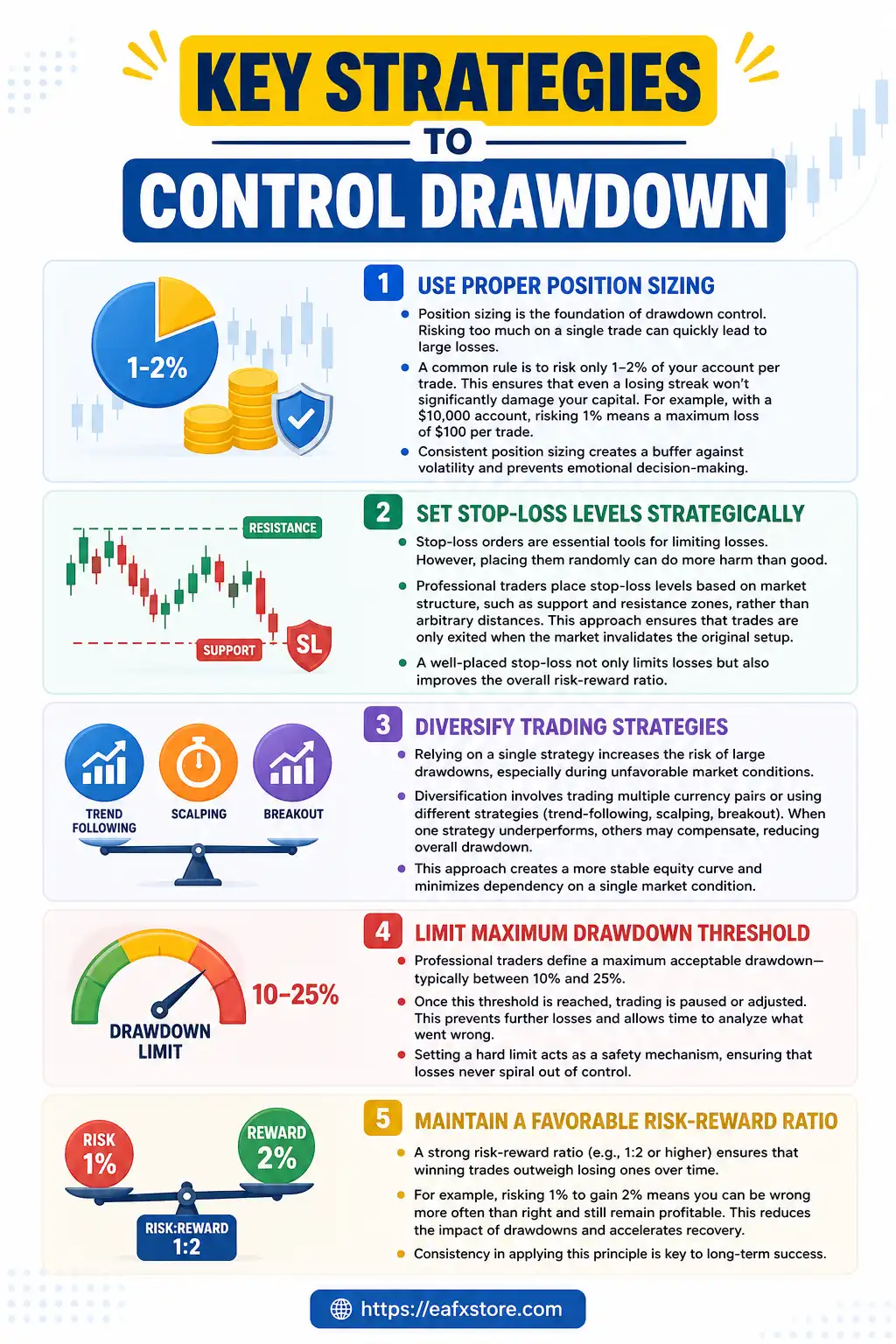
Position sizing is the foundation of drawdown control. Risking too much on a single trade can quickly lead to large losses.
A common rule is to risk only 1–2% of your account per trade. This ensures that even a losing streak won’t significantly damage your capital. For example, with a $10,000 account, risking 1% means a maximum loss of $100 per trade.
Consistent position sizing creates a buffer against volatility and prevents emotional decision-making.
🎯 Set Stop-Loss Levels Strategically
Stop-loss orders are essential tools for limiting losses. However, placing them randomly can do more harm than good.
Professional traders place stop-loss levels based on market structure, such as support and resistance zones, rather than arbitrary distances. This approach ensures that trades are only exited when the market invalidates the original setup.
A well-placed stop-loss not only limits losses but also improves the overall risk-reward ratio.
🎯 Diversify Trading Strategies
Relying on a single strategy increases the risk of large drawdowns, especially during unfavorable market conditions.
Diversification involves trading multiple currency pairs or using different strategies (trend-following, scalping, breakout). When one strategy underperforms, others may compensate, reducing overall drawdown.
This approach creates a more stable equity curve and minimizes dependency on a single market condition.
🎯 Limit Maximum Drawdown Threshold
Professional traders define a maximum acceptable drawdown—typically between 10% and 25%.
Once this threshold is reached, trading is paused or adjusted. This prevents further losses and allows time to analyze what went wrong.
Setting a hard limit acts as a safety mechanism, ensuring that losses never spiral out of control.
🎯 Maintain a Favorable Risk-Reward Ratio
A strong risk-reward ratio (e.g., 1:2 or higher) ensures that winning trades outweigh losing ones over time.
For example, risking 1% to gain 2% means you can be wrong more often than right and still remain profitable. This reduces the impact of drawdowns and accelerates recovery.
Consistency in applying this principle is key to long-term success.
Psychological Discipline and Drawdown Control
Even the best strategies fail without discipline. Emotional reactions—such as revenge trading or overtrading—often worsen drawdowns.
Professional traders stick to their plans regardless of short-term outcomes. They understand that losses are part of the process and focus on long-term performance.
Developing discipline involves:
- Following predefined rules.
- Avoiding impulsive decisions.
- Keeping a trading journal.
This mindset helps maintain control during losing streaks.
Applying Drawdown Control in Automated Trading
Automated trading systems (Expert Advisors or algorithms) can significantly improve drawdown management—if designed correctly.
🎯 Implement Risk Management Algorithms
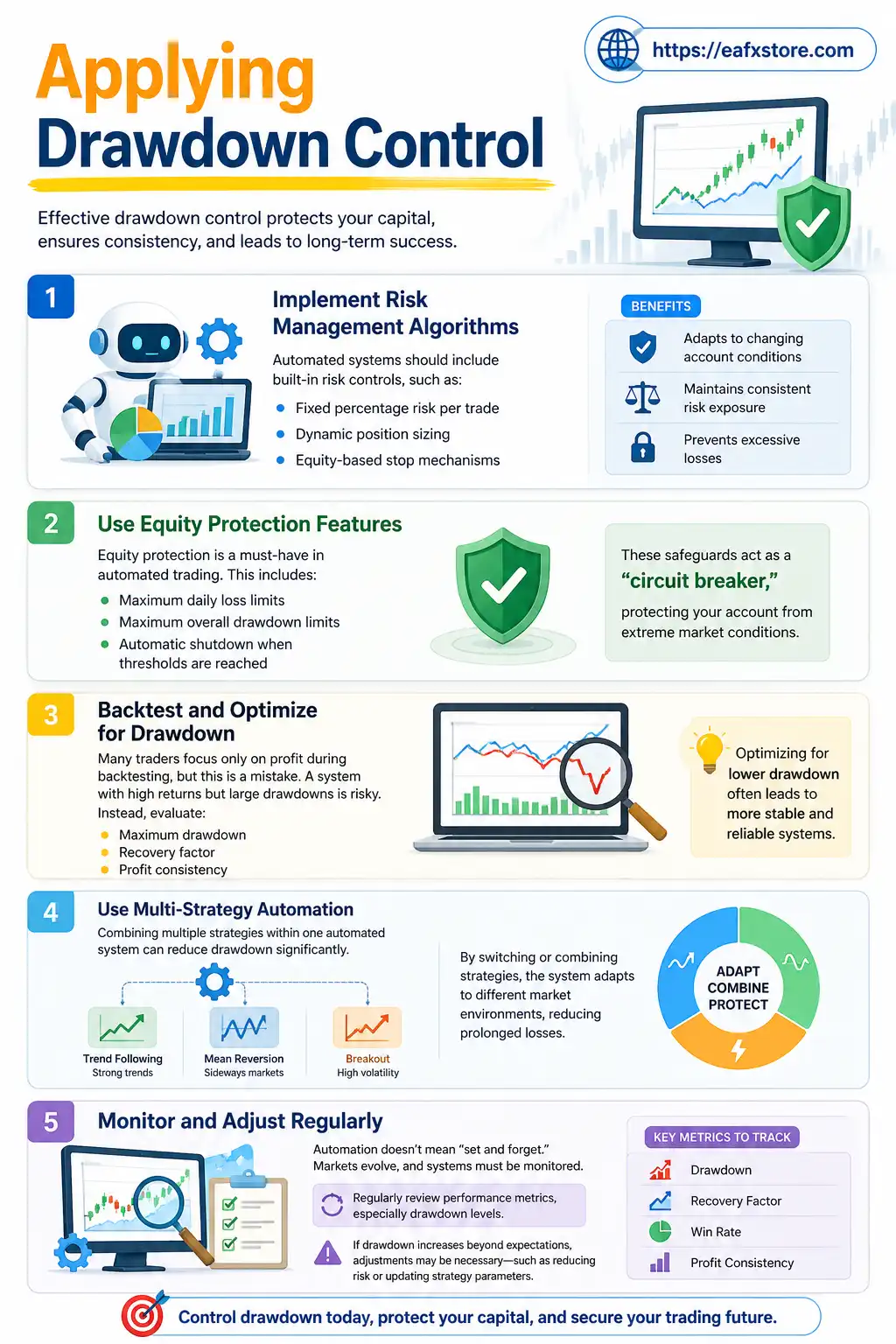
Automated systems should include built-in risk controls, such as:
- Fixed percentage risk per trade.
- Dynamic position sizing.
- Equity-based stop mechanisms.
These features ensure that the system adapts to changing account conditions and prevents excessive losses.
🎯 Use Equity Protection Features
Equity protection is a must-have in automated trading. This includes:
- Maximum daily loss limits.
- Maximum overall drawdown limits.
- Automatic shutdown when thresholds are reached.
These safeguards act as a “circuit breaker,” protecting your account from extreme market conditions.
🎯 Backtest and Optimize for Drawdown
Many traders focus only on profit during backtesting, but this is a mistake. A system with high returns but large drawdowns is risky.
Instead, evaluate:
- Maximum drawdown.
- Recovery factor.
- Profit consistency.
Optimizing for lower drawdown often leads to more stable and reliable systems.
🎯 Use Multi-Strategy Automation
Combining multiple strategies within one automated system can reduce drawdown significantly.
For example:
| Strategy Type | Market Condition |
|---|---|
| Trend Following | Strong trends |
| Mean Reversion | Sideways markets |
| Breakout | High volatility |
By switching or combining strategies, the system adapts to different market environments, reducing prolonged losses.
🎯 Monitor and Adjust Regularly
Automation doesn’t mean “set and forget.” Markets evolve, and systems must be monitored.
Regularly review performance metrics, especially drawdown levels. If drawdown increases beyond expectations, adjustments may be necessary—such as reducing risk or updating strategy parameters.
Common Mistakes That Increase Drawdown
Many traders unintentionally increase drawdown due to poor habits:
- Overleveraging trades
- Ignoring stop-loss rules
- Chasing losses
- Using untested strategies
- Lack of diversification
Avoiding these mistakes is just as important as applying the right strategies.
Final Thoughts
Controlling drawdown is the hallmark of a professional Forex trader. It’s not about avoiding losses entirely—it’s about managing them effectively so they don’t jeopardize your trading career.
By applying proper risk management, maintaining discipline, and leveraging automation wisely, you can keep drawdowns under control and build a sustainable trading system.
In the end, success in Forex trading isn’t determined by how much you make during winning streaks—but by how well you protect your capital during losing ones.