


Introduction to FIFO Rule in Forex
The Forex market is one of the most dynamic financial markets in the world, but it also comes with strict regulations in certain regions. One of the most important rules traders need to understand is the FIFO rule. If you are trading with brokers regulated in the United States, this rule directly impacts how you open and close trades.
Understanding FIFO is essential for beginners because it influences trade management, strategy planning and risk control. In this guide, we will break down the FIFO rule in simple terms so you can apply it confidently in your trading journey.
What Does FIFO Mean in Trading?
FIFO stands for “First In, First Out.” In Forex trading, it means that the first position you open on a currency pair must be the first one you close.
For example, if you open multiple trades on EUR/USD, you cannot close the most recent trade before closing the earlier ones. The system enforces a chronological order.
This rule mainly applies to traders using brokers regulated by U.S. authorities, ensuring transparency and preventing certain trading practices.

Why Was the FIFO Rule Introduced?
The FIFO rule was introduced by the National Futures Association (NFA) as part of regulatory reforms to protect retail traders.
The main goals include:
- Preventing manipulation of trade outcomes
- Reducing risky hedging practices
- Increasing transparency in trading accounts
Before FIFO, traders could selectively close profitable trades while leaving losing ones open, which could distort performance tracking. FIFO ensures a more structured and fair trading environment.

How FIFO Works in Forex Trading
Under FIFO rules, trades are organized based on the order they were opened. When you try to close a position, your trading platform automatically closes the earliest trade first.
Key Principles:
- Same currency pair trades are grouped together
- Oldest trades must be closed before newer ones
- Partial closing follows FIFO order
Simple Table Explanation:
| Trade Order | Entry Price | Lot Size | Status |
|---|---|---|---|
| Trade 1 | 1.1000 | 1 Lot | Must close first |
| Trade 2 | 1.1050 | 1 Lot | Close after Trade 1 |
| Trade 3 | 1.1100 | 1 Lot | Close last |
If you attempt to close Trade 3 first, the system will instead close Trade 1.
Example of FIFO in Action
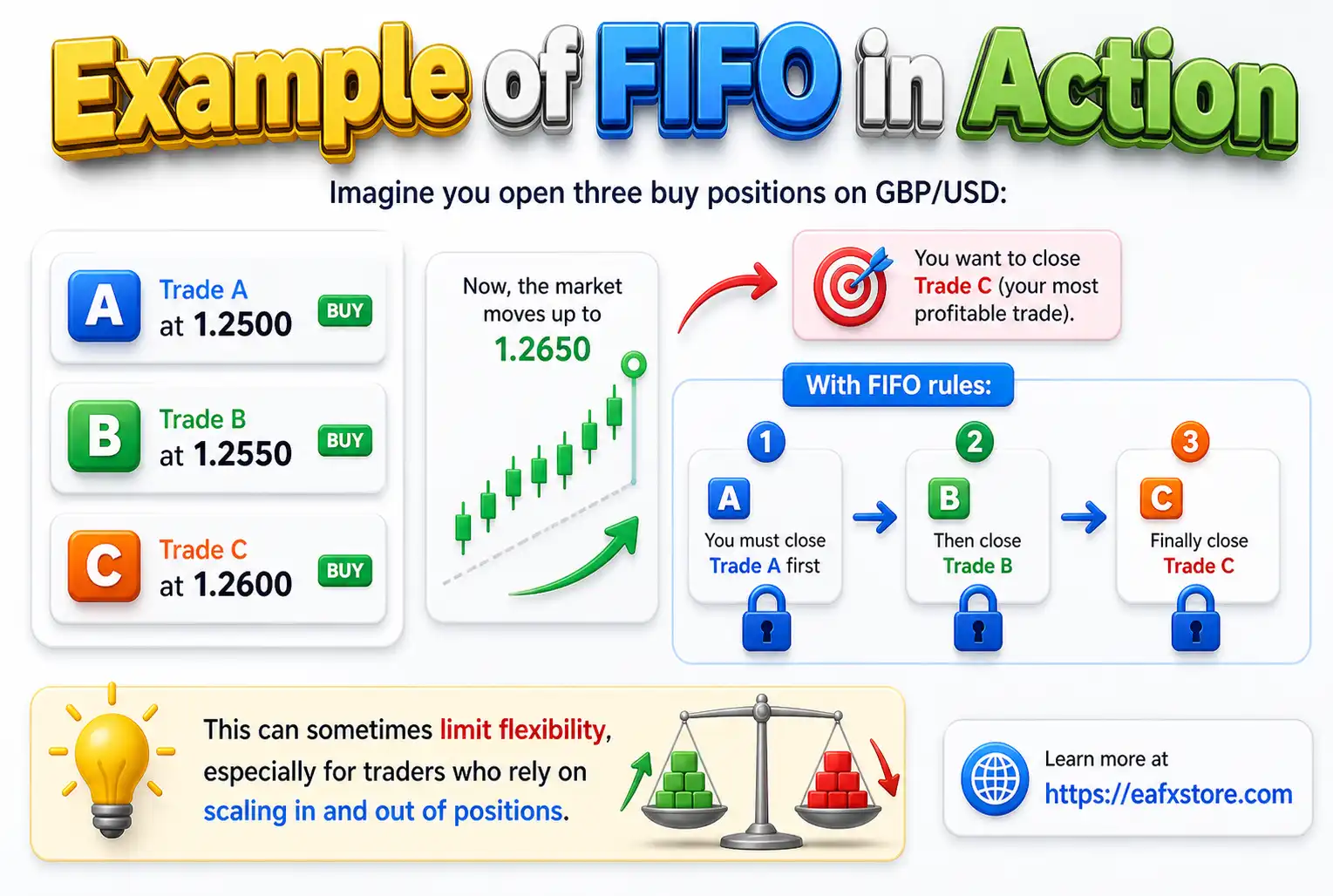
Imagine you open three buy positions on GBP/USD:
- Trade A at 1.2500
- Trade B at 1.2550
- Trade C at 1.2600
Now, the market moves up to 1.2650, and you want to close Trade C (your most profitable trade).
With FIFO rules:
- You cannot close Trade C first
- You must close Trade A, then Trade B, and finally Trade C
This can sometimes limit flexibility, especially for traders who rely on scaling in and out of positions.
Pros and Cons of the FIFO Rule
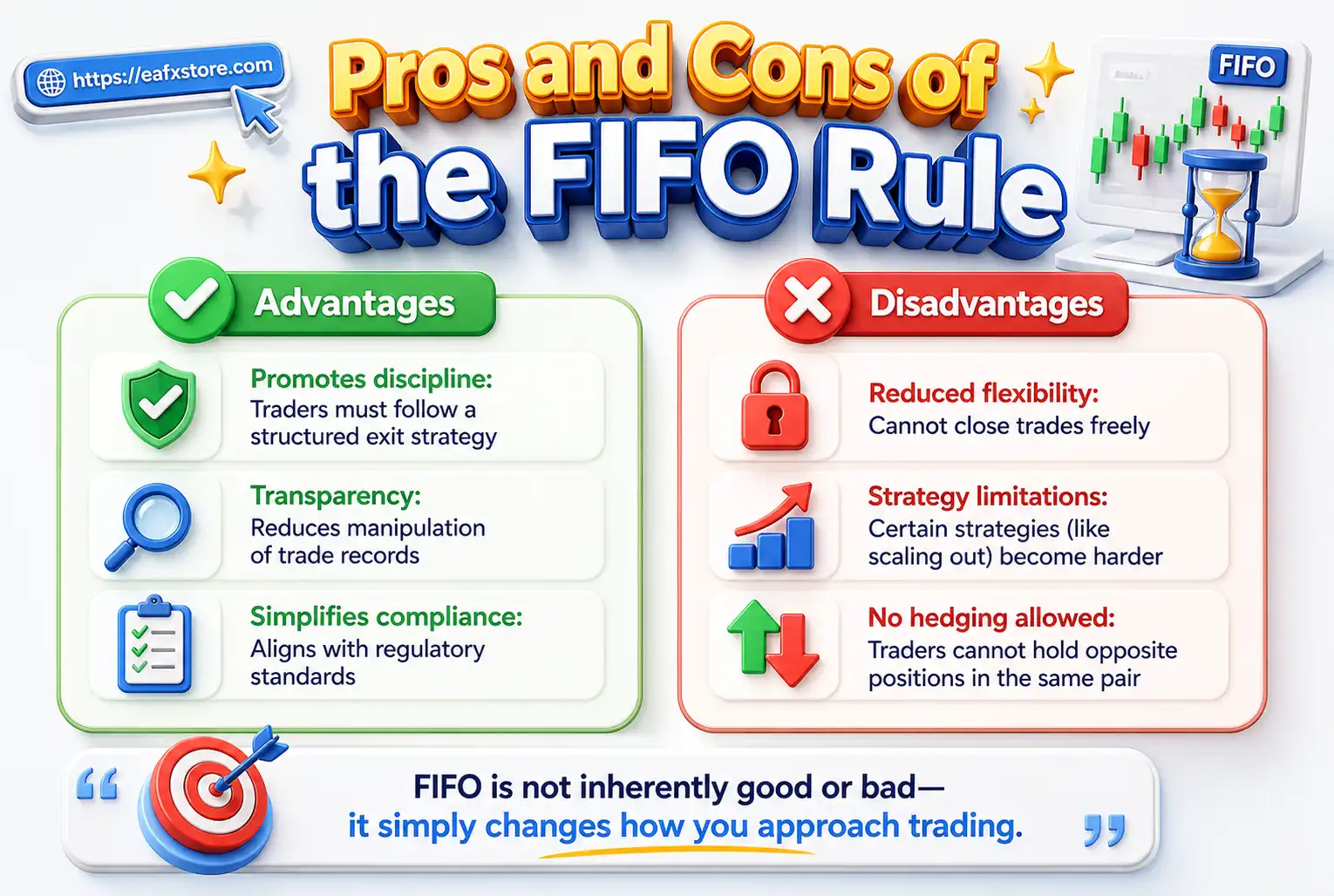
Advantages
- Promotes discipline: Traders must follow a structured exit strategy
- Transparency: Reduces manipulation of trade records
- Simplifies compliance: Aligns with regulatory standards
Disadvantages
- Reduced flexibility: Cannot close trades freely
- Strategy limitations: Certain strategies (like scaling out) become harder
- No hedging allowed: Traders cannot hold opposite positions in the same pair
FIFO is not inherently good or bad—it simply changes how you approach trading.
FIFO vs Hedging: Key Differences
FIFO rules are often discussed alongside hedging because both affect trade management.
| Feature | FIFO Rule | Hedging |
|---|---|---|
| Trade Order | Must close oldest first | No order restriction |
| Opposite Trades | Not allowed | Allowed |
| Flexibility | Limited | High |
| Regulation | Mandatory in U.S. | Restricted under FIFO |
Hedging allows traders to open buy and sell positions simultaneously, while FIFO eliminates that possibility in regulated environments.
How FIFO Affects Your Trading Strategy
FIFO forces traders to rethink how they manage entries and exits. Strategies that rely on multiple entries must adapt.
For example:
- Scalping strategies may need fewer simultaneous trades
- Swing traders may focus on single-entry positions
- Position traders may benefit from simplified trade structures
Instead of layering trades, many FIFO-compliant traders use Stop Loss (SL) and Take Profit (TP) levels more strategically.
Tips for Trading Under FIFO Rules
Adapting to FIFO doesn’t have to be difficult. Here are practical tips:
- Use fewer positions: Avoid opening too many trades on the same pair
- Plan exits in advance: Know your closing order before entering trades
- Use different currency pairs: Diversify instead of stacking trades
- Track trade order carefully: Keep a clear log of entries
- Adjust lot sizes: Instead of multiple trades, scale position size
These adjustments can help you maintain flexibility even within FIFO constraints.
Conclusion
The FIFO rule in Forex trading may seem restrictive at first, but it is designed to promote fairness and transparency. For beginners, understanding this rule early can prevent confusion and costly mistakes.
By adapting your trading strategy and focusing on structured trade management, you can still succeed under FIFO regulations. Instead of seeing it as a limitation, treat it as a framework that encourages discipline and consistency—two key traits of successful traders.
Mastering FIFO is not just about following rules; it’s about becoming a more strategic and controlled trader in the Forex market.