

What is FIFO in Forex Trading?
FIFO, short for First In, First Out, is a rule that requires traders to close their earliest opened positions before closing newer ones on the same currency pair. This regulation is commonly enforced by brokers operating under strict financial authorities, particularly in the United States.
In simple terms, if you open multiple trades on the same pair, you cannot selectively close them in any order you like. Instead, the first trade you entered must be the first one you exit. This rule directly impacts how traders manage positions, especially when using multiple entries or scaling strategies.
Why FIFO Rule Exists in Forex Markets
The FIFO rule was introduced primarily to increase transparency and reduce potential manipulation in trading accounts. Regulators aimed to ensure fair practices by preventing traders from cherry-picking profitable trades while leaving losing ones open indefinitely.
Another reason is to simplify trade reporting and tax calculations. By enforcing a consistent order of closing trades, it becomes easier to track profits and losses accurately. While this rule may feel restrictive, it serves a broader purpose of maintaining market integrity and protecting less experienced traders.

How FIFO Works in Practice
To better understand FIFO, consider the following example:
| Trade Number | Currency Pair | Entry Price | Lot Size | Status |
|---|---|---|---|---|
| Trade 1 | EUR/USD | 1.1000 | 1 lot | Open |
| Trade 2 | EUR/USD | 1.1050 | 1 lot | Open |
| Trade 3 | EUR/USD | 1.1100 | 1 lot | Open |
If you decide to close a position, FIFO requires you to close Trade 1 first, even if Trade 3 is currently more profitable.
This means:
- You cannot close Trade 2 or Trade 3 before Trade 1
- Partial closing must also follow the same order
- All trades must be handled sequentially based on entry time
This structure forces traders to think more carefully about how they enter and manage multiple positions.
FIFO vs Hedging: Key Differences
FIFO often comes into conflict with Hedging strategies, which involve opening opposite positions on the same currency pair.
| Feature | FIFO Rule | Hedging |
|---|---|---|
| Trade Closure | Must close oldest first | No restriction |
| Flexibility | Limited | High |
| Strategy Type | Sequential | Simultaneous positions |
| Regulation | Strict (especially in U.S.) | Restricted under FIFO accounts |
Under FIFO rules, hedging is typically not allowed. Traders cannot hold both buy and sell positions on the same pair simultaneously in the same account. This limitation can significantly impact strategy design.
Advantages of FIFO in Forex Trading
Despite its restrictions, FIFO offers several benefits:
1. Encourages Discipline
Traders are forced to follow a structured approach, reducing impulsive decisions.
2. Simplifies Trade Management
With a clear order of execution, tracking trades becomes easier and more organized.
3. Reduces Overtrading
Since traders cannot freely open and close positions in any order, it discourages excessive trading.
4. Improves Transparency
FIFO ensures that all trades are handled fairly and consistently, which aligns with regulatory standards.

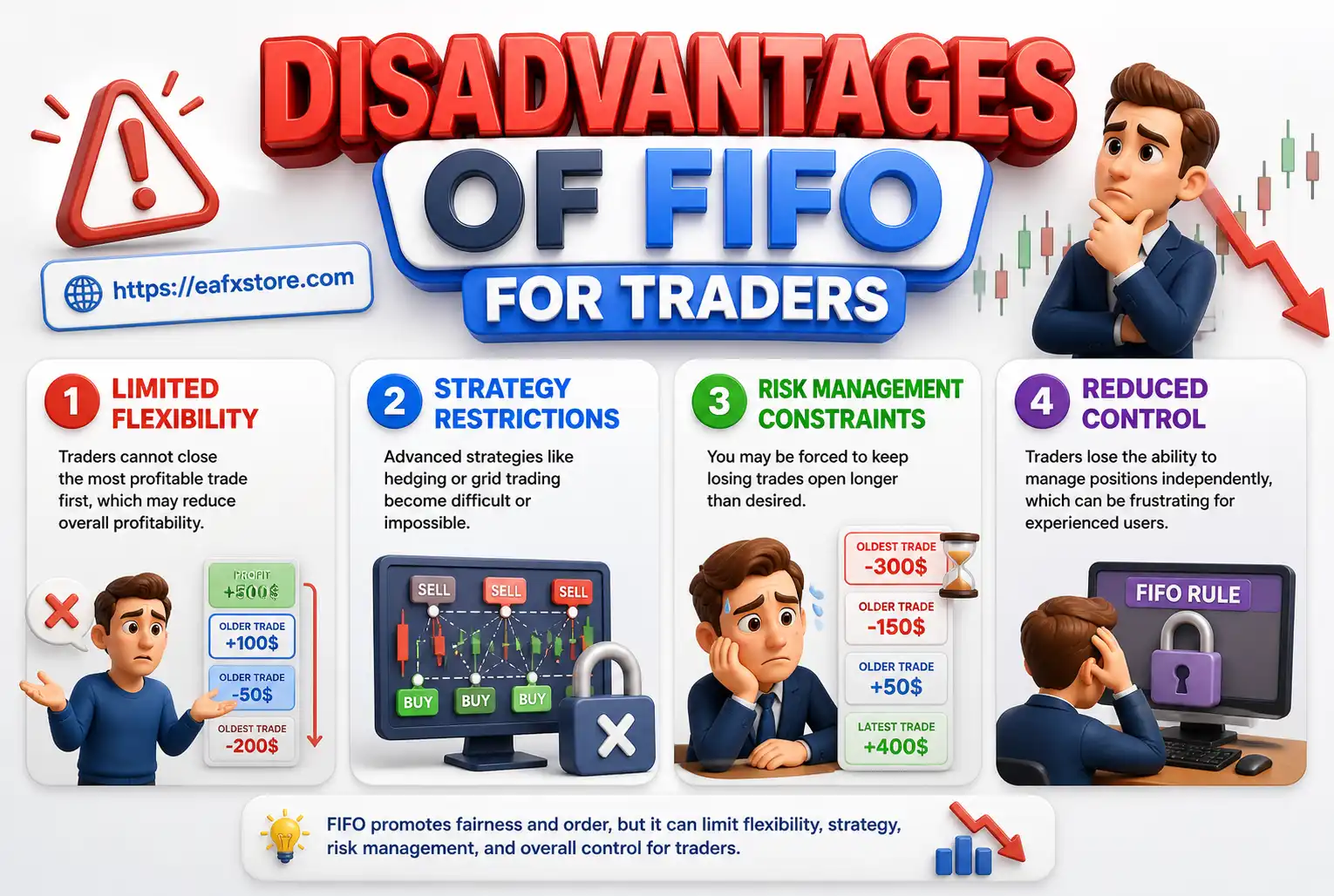
Disadvantages of FIFO for Traders
While FIFO promotes order, it also introduces several challenges:
1. Limited Flexibility
Traders cannot close the most profitable trade first, which may reduce overall profitability.
2. Strategy Restrictions
Advanced strategies like hedging or grid trading become difficult or impossible.
3. Risk Management Constraints
You may be forced to keep losing trades open longer than desired.
4. Reduced Control
Traders lose the ability to manage positions independently, which can be frustrating for experienced users.
How FIFO Affects Trading Strategies
FIFO significantly influences how traders design and execute their strategies.
For example, scalping strategies that rely on quickly entering and exiting multiple trades may become less effective. Similarly, grid trading systems, which involve layering multiple positions at different price levels, can be difficult to manage under FIFO rules.
On the other hand, FIFO tends to favor:
- Single-entry strategies
- Swing trading approaches
- Position trading with clear entry and exit plans
Traders must adapt by focusing on quality over quantity, ensuring each trade is well-planned from the start.

Tips to Trade Effectively Under FIFO Rule
Adapting to FIFO doesn’t mean sacrificing performance. Here are some practical tips:
1. Use Separate Accounts
If possible, use different accounts for different strategies to avoid FIFO conflicts.
2. Focus on Fewer Trades
Instead of multiple entries, aim for high-probability setups with larger conviction.
3. Plan Exit Strategies in Advance
Know exactly when and how you will close trades before entering them.
4. Avoid Overlapping Positions
Try not to open multiple trades on the same pair unless necessary.
5. Use Different Currency Pairs
Diversify across pairs to maintain flexibility while staying compliant.
Conclusion
FIFO in forex trading is a regulatory rule that requires traders to close positions in the order they were opened. While it limits flexibility and restricts certain strategies like hedging, it also promotes discipline, transparency and structured trading.
Understanding how FIFO works is essential, especially if you are trading with brokers that enforce this rule. By adapting your strategies and focusing on well-planned trades, you can still achieve consistent results within FIFO constraints.
Ultimately, success in forex trading is not about avoiding rules but learning how to operate effectively within them.