

What is PropFirm Trading?
PropFirm trading refers to trading with capital provided by proprietary trading firms. Instead of risking your own money, traders use the firm’s funds and share profits based on predefined agreements. This model is attractive for Forex traders who want to scale quickly without large personal capital. However, it comes with strict rules, including drawdown limits, profit targets, and consistency requirements that must be respected.
Understand PropFirm Rules Before Trading
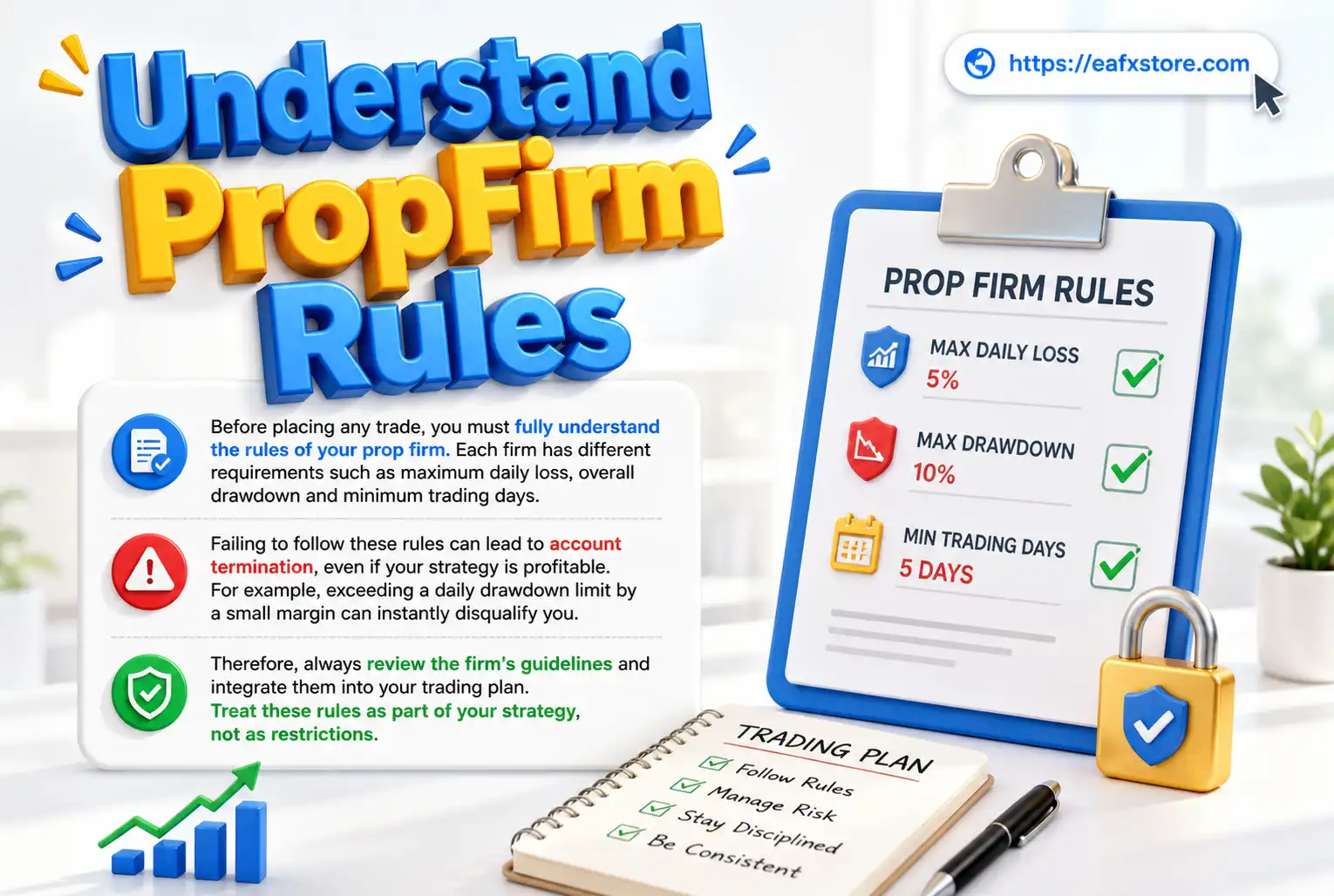
Before placing any trade, you must fully understand the rules of your prop firm. Each firm has different requirements such as maximum daily loss, overall drawdown and minimum trading days.
Failing to follow these rules can lead to account termination, even if your strategy is profitable. For example, exceeding a daily drawdown limit by a small margin can instantly disqualify you. Therefore, always review the firm’s guidelines and integrate them into your trading plan. Treat these rules as part of your strategy, not as restrictions.
Develop a Consistent Trading Strategy
Consistency is one of the most critical factors for success in prop trading. Instead of chasing random trades, you need a well-defined trading system that you can execute repeatedly.
A good strategy includes:
- Clear entry and exit rules
- Defined risk per trade
- Specific market conditions to trade
Consistency does not mean winning every trade. It means applying the same logic and discipline across all trades. Prop firms value consistency because it shows that you can manage risk and generate stable returns over time.
Master Risk Management Techniques
Risk management is the foundation of long-term success in Forex trading, especially in a prop firm environment.
Here is a simple risk management framework:
| Element | Recommendation |
|---|---|
| Risk per trade | 0.5% – 1% of account balance |
| Daily loss limit | Stay below 50% of max allowed |
| Risk-to-reward ratio | Minimum 1:2 |
| Number of trades | Avoid overtrading |
By keeping your risk low and controlled, you protect your account from large drawdowns. Remember, prop firms prioritize capital preservation over aggressive profits.
Control Emotions and Trading Psychology
Emotional control is often the difference between successful and failed traders. Fear, greed, and impatience can lead to poor decisions, especially when trading with firm capital.
For example:
- Fear may cause you to exit trades too early
- Greed may push you to over-leverage
- Revenge trading can destroy your account after a loss
To improve your psychology, focus on discipline and process rather than outcomes. Accept that losses are part of trading and stick to your plan regardless of short-term results.
Focus on High-Probability Setups
Instead of trading frequently, successful prop traders focus on high-probability setups. These are trades where multiple factors align, such as trend direction, key support/resistance levels and strong market structure.
Quality always beats quantity in trading. Taking fewer but higher-quality trades reduces risk and improves consistency. This approach also helps you stay within prop firm rules, especially regarding drawdowns.
Track and Improve Your Trading Performance
Keeping a trading journal is essential for continuous improvement. It allows you to analyze your trades, identify mistakes, and refine your strategy.
Your journal should include:
- Entry and exit points
- Trade rationale
- Risk level
- Outcome and lessons learned
By reviewing your trades regularly, you can spot patterns in your behavior and performance. Over time, this leads to better decision-making and increased profitability.
Common Mistakes to Avoid in PropFirm Trading
Many traders fail prop firm challenges due to avoidable mistakes. Here are some of the most common ones:
- Overtrading: Taking too many trades without clear setups
- Ignoring rules: Violating drawdown limits or trading restrictions
- Lack of discipline: Not following a trading plan
- Risking too much: Trying to hit profit targets quickly
- Emotional decisions: Trading based on feelings instead of logic
Avoiding these mistakes can significantly increase your chances of passing evaluations and maintaining funded accounts.
Final Thoughts
Succeeding in prop firm Forex trading requires more than just technical skills. It demands discipline, consistency and a strong understanding of risk management. By following the tips outlined above—understanding rules, developing a strategy, managing risk, and controlling emotions—you can build a sustainable trading approach.
Remember, prop trading is not about getting rich quickly. It’s about proving that you can trade responsibly and consistently over time. Focus on the process and the results will follow.