
What is a Prop Firm and How Funded Accounts Work
A proprietary trading firm (prop firm) provides traders with access to capital in exchange for a share of the profits. Instead of risking your own money, you trade the firm’s funds after successfully passing an evaluation process.
Most prop firms require traders to complete a challenge where they must hit a profit target while respecting strict risk rules. Once passed, you receive a funded account and can earn payouts based on your performance.
This model has become extremely popular in Forex trading because it allows traders to scale quickly without large personal capital.
Understanding the Evaluation Rules and Objectives
Before attempting to pass a prop firm challenge, it is critical to understand the rules. Every firm has slightly different conditions, but most include:
- Profit target (e.g., 8%–10%)
- Maximum daily drawdown (e.g., 4%–5%)
- Maximum overall drawdown (e.g., 8%–10%)
- Minimum trading days requirement
Here’s a quick comparison table:
| Rule Type | Typical Requirement |
|---|---|
| Profit Target | 8% – 10% |
| Daily Drawdown | 4% – 5% |
| Total Drawdown | 8% – 10% |
| Trading Days | 5 – 10 days |
The goal is not just to make profits but to do so consistently without violating risk limits. Many traders fail because they focus only on profits and ignore risk rules.
Best Trading Strategies to Pass a Prop Firm Challenge
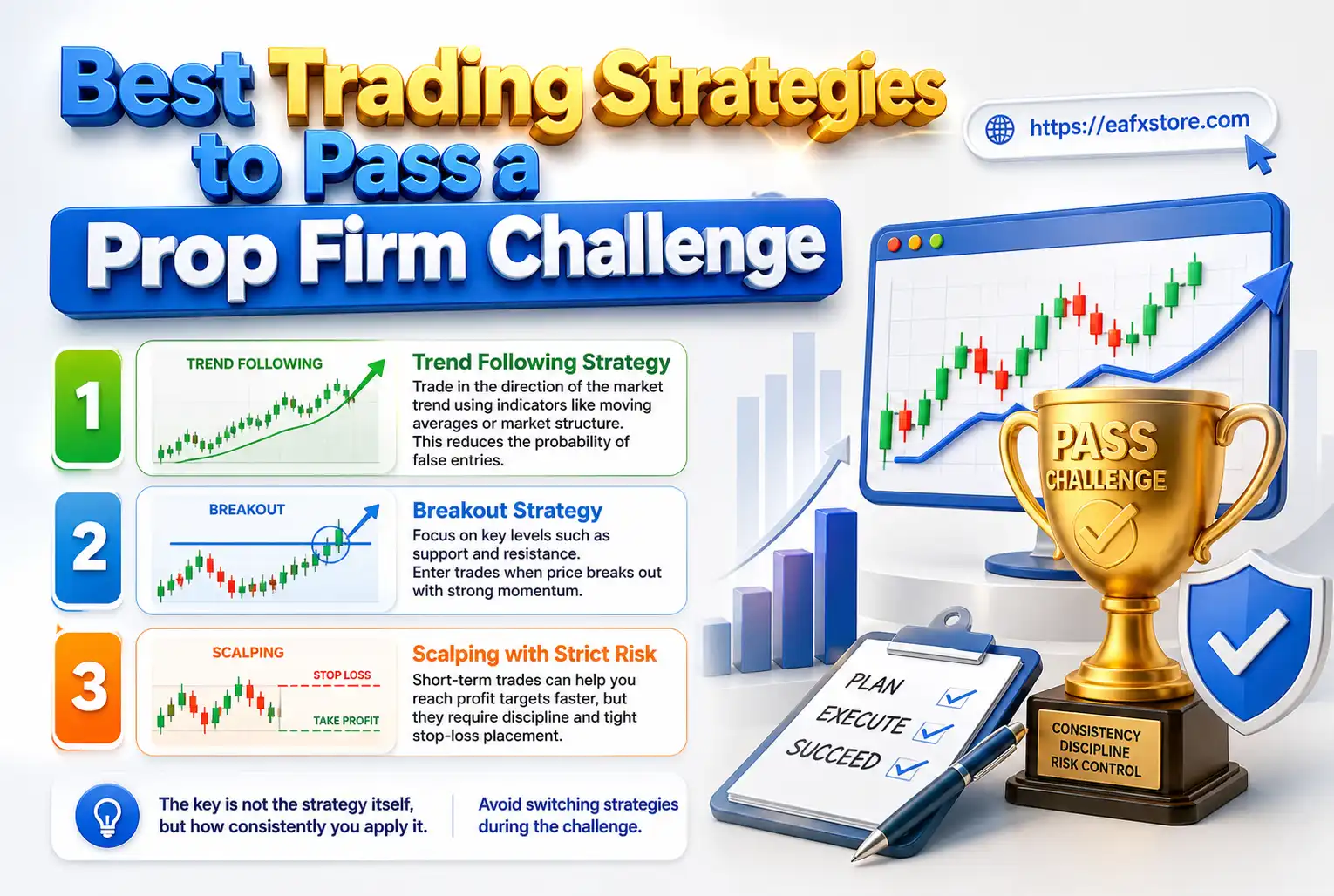
To pass quickly, you need a strategy that balances consistency and risk control. Here are three proven approaches:
1. Trend Following Strategy
Trade in the direction of the market trend using indicators like moving averages or market structure. This reduces the probability of false entries.
2. Breakout Strategy
Focus on key levels such as support and resistance. Enter trades when price breaks out with strong momentum.
3. Scalping with Strict Risk
Short-term trades can help you reach profit targets faster, but they require discipline and tight stop-loss placement.
The key is not the strategy itself, but how consistently you apply it. Avoid switching strategies during the challenge.
Risk Management: The Key to Passing Fast
Risk management is the most important factor in passing a funded account challenge. Even a profitable strategy will fail without proper risk control.
A good rule of thumb is to risk 0.5% to 1% per trade. This allows you to survive losing streaks while still growing your account steadily.
Example risk plan:
| Trade Number | Risk (%) | Result | Balance Impact |
|---|---|---|---|
| Trade 1 | 1% | Win | +1% |
| Trade 2 | 1% | Loss | -1% |
| Trade 3 | 1% | Win | +1% |
Consistency beats aggression. Many traders fail by over-leveraging in an attempt to hit the target quickly.
Common Mistakes That Cause Traders to Fail
Even experienced traders fail prop firm challenges due to avoidable mistakes:
- Overtrading: Taking too many low-quality setups
- Revenge trading: Trying to recover losses quickly
- Ignoring drawdown rules: One mistake can end the challenge
- Lot size inconsistency: Sudden risk increases lead to violations
- Switching strategies: Lack of consistency reduces edge
Avoiding these mistakes alone can significantly increase your chances of passing.
Psychological Discipline and Consistency
Trading psychology plays a major role in passing a funded account. Pressure increases when rules are strict and time is limited.
Key psychological principles:
- Stick to your plan regardless of short-term outcomes
- Accept losses as part of the process
- Avoid emotional decisions after wins or losses
- Focus on execution, not profits
A calm and disciplined mindset is often the difference between passing and failing.
Tools and Tips to Speed Up Your Success
To pass faster, consider using tools and techniques that improve your efficiency:
1. Trading Journal
Track every trade to identify strengths and weaknesses.
2. Risk Calculator
Use position size calculators to maintain consistent risk.
3. Demo Practice
Simulate the challenge conditions before starting the real evaluation.
4. Focus on High-Probability Setups
Quality over quantity always wins in prop firm trading.
5. Trade During Optimal Sessions
Focus on London and New York sessions for better volatility.
Final Thoughts: How to Pass Forex Funded Accounts Efficiently
Passing a prop firm challenge is not about luck or aggressive trading. It is about discipline, consistency and risk management.
To summarize:
- Understand the rules thoroughly
- Use a simple and proven strategy
- Manage risk strictly (0.5%–1% per trade)
- Avoid emotional and impulsive decisions
- Focus on consistency rather than speed
If you approach the challenge like a professional trader rather than a gambler, your chances of success will increase significantly.
The fastest way to pass is not by taking bigger risks—but by making fewer mistakes.