

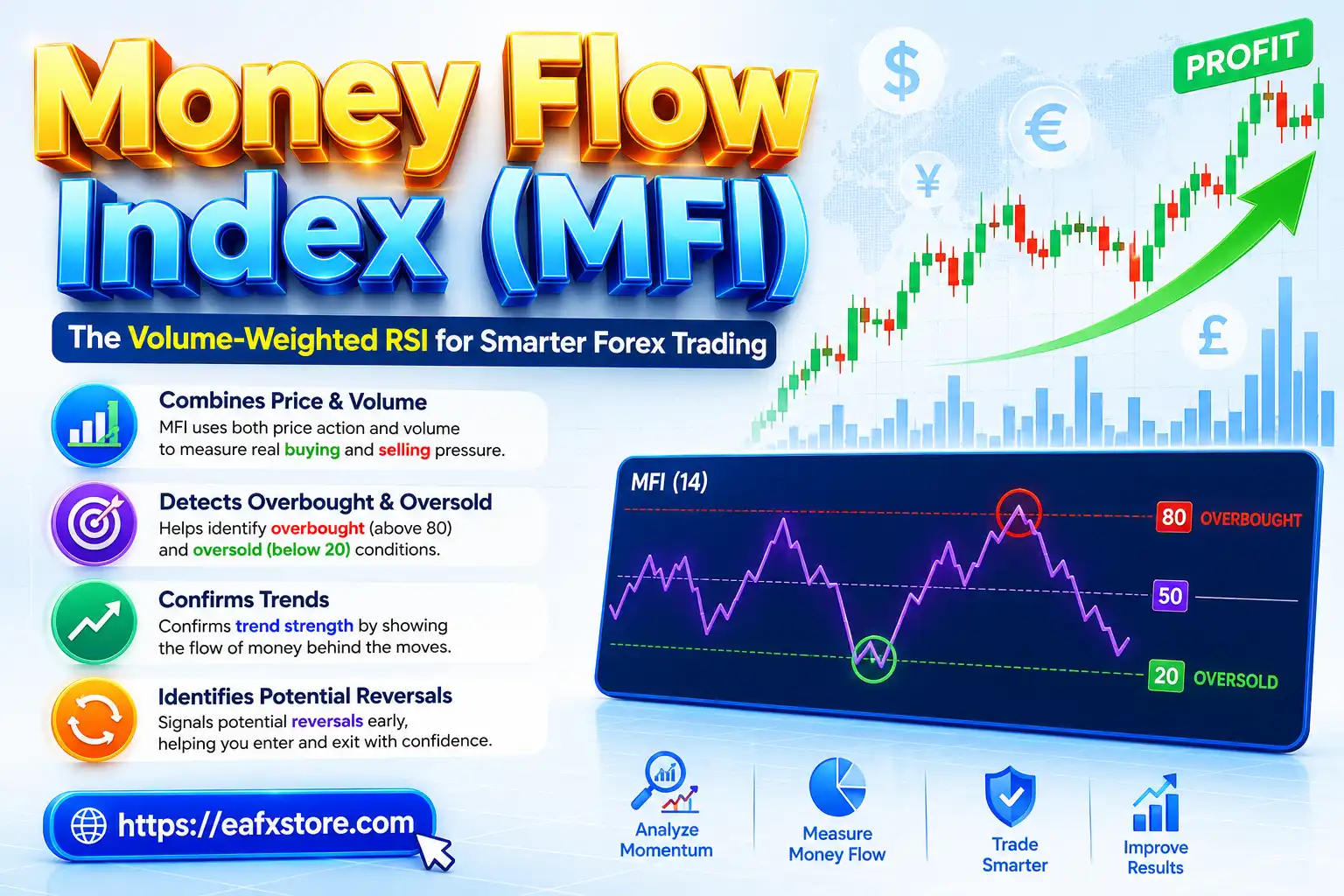
In the fast-paced world of Forex trading, finding the right entry and exit points can make the difference between consistent profits and unnecessary losses. While many traders rely on traditional indicators like RSI or MACD, the Money Flow Index (MFI) stands out because it combines both price action and trading volume to identify market momentum more accurately.
The MFI is often called the “volume-weighted RSI” because it measures buying and selling pressure using price and volume data. For Forex traders, this indicator can help detect overbought and oversold conditions, confirm trends, and identify potential reversals before they happen.
What is the Money Flow Index (MFI)?
The Money Flow Index (MFI) is a technical momentum indicator developed by Gene Quong and Avrum Soudack. It oscillates between 0 and 100 and helps traders measure the strength of money flowing into and out of a currency pair.
Unlike the Relative Strength Index (RSI), the MFI includes volume data, making it more sensitive to market sentiment and institutional activity.
Key Characteristics of MFI:
| Feature | Description |
|---|---|
| Indicator Type | Momentum Oscillator |
| Range | 0 – 100 |
| Main Purpose | Detect overbought and oversold conditions |
| Best For | Forex, stocks, crypto, commodities |
| Default Period | 14 periods |
The indicator becomes especially useful in volatile Forex markets where momentum shifts quickly.
How Does the Money Flow Index Work?
The MFI calculates buying and selling pressure using a combination of:
- Typical Price
- Trading Volume
- Money Flow Ratio
The calculation process includes:
- Calculate the Typical Price
- Multiply it by volume to get Raw Money Flow
- Separate positive and negative money flow
- Calculate the Money Ratio
- Convert the result into the MFI oscillator
The final value helps traders understand whether buyers or sellers currently dominate the market.
MFI Interpretation:
| MFI Value | Market Condition |
|---|---|
| Above 80 | Overbought |
| Below 20 | Oversold |
| Around 50 | Neutral Trend |
| Rising MFI | Strong Buying Pressure |
| Falling MFI | Strong Selling Pressure |
Understanding these levels is crucial for timing Forex entries more effectively.
Why Forex Traders Use the MFI Indicator
The Money Flow Index has become popular among Forex traders because it offers deeper insight into market momentum compared to price-only indicators.

🎯 Detects Overbought and Oversold Markets
When the MFI rises above 80, the market may be overbought and due for a correction. Conversely, readings below 20 often indicate oversold conditions and possible bullish reversals.
🎯 Confirms Trend Strength
A rising MFI confirms bullish momentum, while a declining MFI supports bearish trends. This confirmation helps traders avoid false breakouts.
🎯 Identifies Divergence
One of the strongest MFI signals is divergence between price and the indicator.
For example:
- Price makes a higher high.
- MFI makes a lower high.
This bearish divergence may signal weakening momentum and a potential reversal.
🎯 Improves Entry Timing
Forex traders often combine the MFI with support/resistance zones or candlestick patterns to find high-probability entries.
Best MFI Trading Strategies for Forex
Using the Money Flow Index alone can work, but combining it with other trading concepts produces stronger results.

🎯 MFI Overbought/Oversold Strategy
This is the simplest MFI strategy.
🔄 Buy Signal
- MFI drops below 20
- Price reaches support
- Bullish candlestick appears
🔄 Sell Signal
- MFI rises above 80
- Price hits resistance
- Bearish candlestick appears
This strategy works best in ranging markets.
🎯 MFI Divergence Strategy
Divergence is one of the most reliable MFI setups.
🔄 Bullish Divergence
- Price forms lower lows
- MFI forms higher lows
This indicates sellers are losing momentum.
🔄 Bearish Divergence
- Price forms higher highs
- MFI forms lower highs
This suggests buyers may be weakening.
Traders often use divergence signals before major market reversals.
🎯 MFI Trend Confirmation Strategy
Many traders use the MFI to confirm existing trends.
| Trend Direction | MFI Confirmation |
|---|---|
| Uptrend | MFI stays above 50 |
| Downtrend | MFI stays below 50 |
This method helps traders avoid entering against the dominant market direction.
Common Mistakes When Using the MFI
Although the Money Flow Index is powerful, traders often misuse it.

🎯 Ignoring Market Context
An overbought signal does not always mean the market will reverse immediately. Strong trends can remain overbought for extended periods.
🎯 Using MFI Alone
Relying only on the MFI can generate false signals. Combining it with:
- Support and resistance
- Trendlines
- Moving averages
- Price action
can significantly improve accuracy.
🎯 Trading Every Signal
Not every MFI crossover is worth trading. Focus on high-quality setups aligned with the overall trend.
MFI vs RSI: Which Is Better for Forex Trading?
Many traders compare the Money Flow Index with the Relative Strength Index.
| Feature | MFI | RSI |
|---|---|---|
| Uses Volume | Yes | No |
| Detects Money Flow | Yes | No |
| Sensitivity | Higher | Moderate |
| Best Use | Momentum + Volume Analysis | Pure Price Momentum |
The MFI provides additional insight because it incorporates trading volume, making it more useful for detecting institutional buying and selling pressure.
However, many professional traders use both indicators together for stronger confirmation.
Tips for Using the MFI Successfully
To maximize the effectiveness of the Money Flow Index, consider these practical tips:
- Use the default 14-period setting initially.
- Combine MFI with trend analysis.
- Avoid trading during major news events.
- Focus on high-timeframe confirmations.
- Use stop-loss orders for risk management.
Consistency and discipline remain essential, regardless of the indicator used.
Conclusion
The Money Flow Index (MFI) is one of the most effective momentum indicators for Forex traders seeking smarter entries and better market timing. By combining price action with volume analysis, the MFI provides deeper insight into buying and selling pressure than many traditional indicators.
Whether you use it for spotting overbought conditions, confirming trends, or identifying divergence setups, the MFI can become a valuable addition to your Forex trading strategy.
Like all technical indicators, the best results come from combining the MFI with proper risk management and overall market analysis. Traders who learn to use the MFI correctly can significantly improve their decision-making and trading confidence.
FAQs
❓ What is the best MFI setting for Forex trading?
The default 14-period setting is the most commonly used and works well for most Forex trading strategies.
❓ Is the Money Flow Index better than RSI?
The MFI includes volume data, making it more sensitive to market momentum, while RSI focuses only on price movement.
❓ Can beginners use the MFI indicator?
Yes. The MFI is beginner-friendly and easy to understand, especially when used to identify overbought and oversold conditions.
❓ Does the MFI work on all timeframes?
Yes. Traders can use the MFI on scalping, day trading, swing trading, and long-term trading charts.
❓ Should I use the MFI alone?
No. It is best to combine the MFI with price action, support/resistance, and other technical indicators for stronger trade confirmation.