
Introduction to Momentum Indicators in Forex
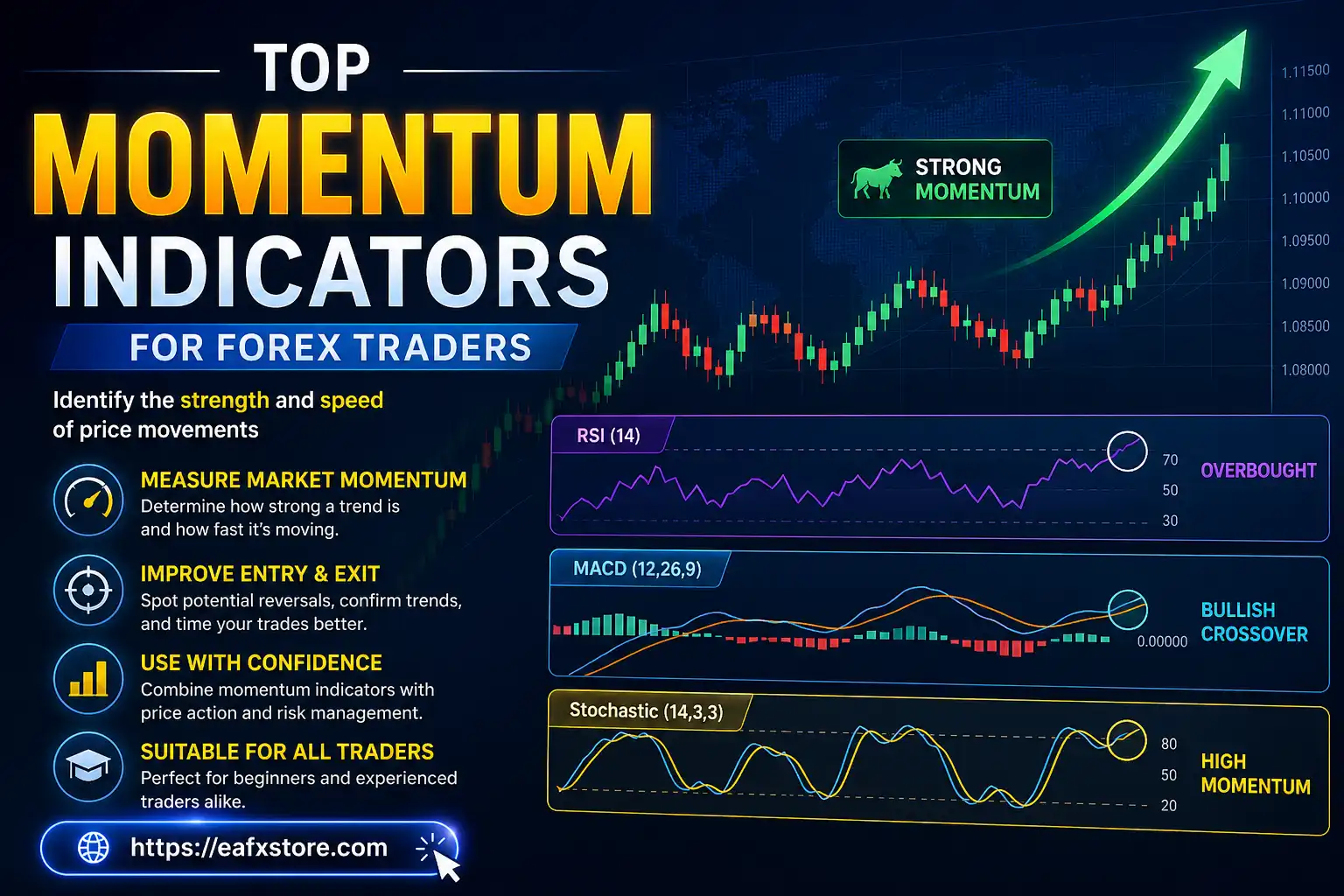
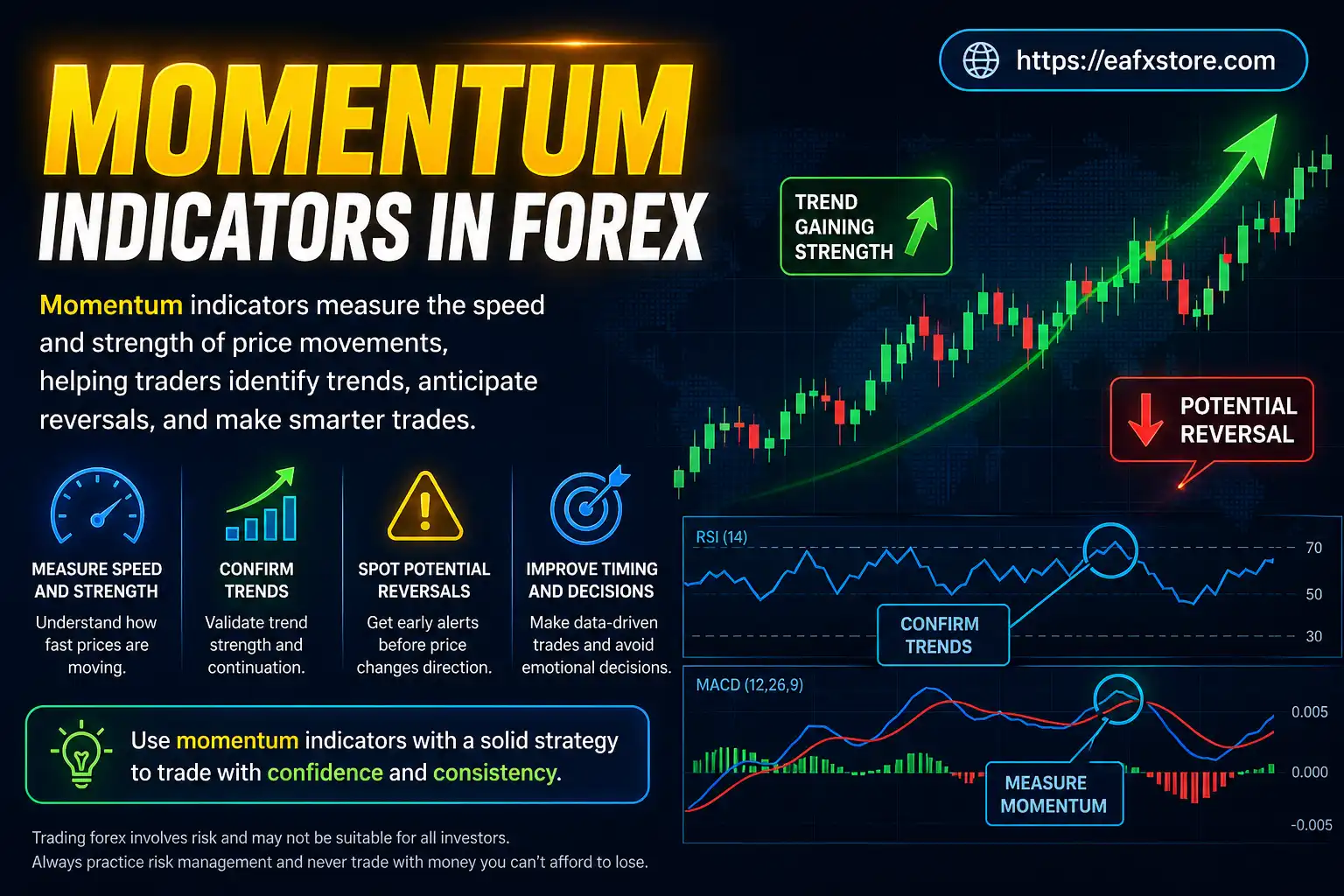
Momentum indicators are essential tools in forex trading that help traders understand the speed and strength of price movements. Instead of focusing solely on price direction, these indicators measure how fast prices are changing, giving insights into whether a trend is gaining strength or losing momentum. For beginners, mastering momentum indicators can significantly improve decision-making and timing in trades.
In the fast-moving forex market, price trends can reverse quickly. Momentum indicators act as an early warning system, helping traders anticipate potential reversals or confirm existing trends. By combining these tools with a basic trading strategy, beginners can avoid emotional decisions and rely on data-driven analysis.
Why Momentum Matters in Forex Trading
Momentum is a key concept because price movements rarely occur randomly. When a currency pair starts trending, it often continues in that direction until momentum weakens. Understanding this dynamic allows traders to enter trades earlier and exit before reversals.
Momentum indicators are particularly useful in identifying overbought and oversold conditions. When a market is overbought, it may be due for a correction. Conversely, an oversold market might signal a potential upward move. These insights are crucial for timing entries and exits more effectively.
Additionally, momentum indicators help filter out false signals. In volatile markets, prices may fluctuate without a clear trend. Momentum tools provide confirmation, reducing the risk of entering trades based on noise rather than meaningful movement.
Most Popular Momentum Indicators for Beginners
There are several momentum indicators widely used in forex trading. Each has its strengths and is suitable for different trading styles.
🎯 Relative Strength Index (RSI)
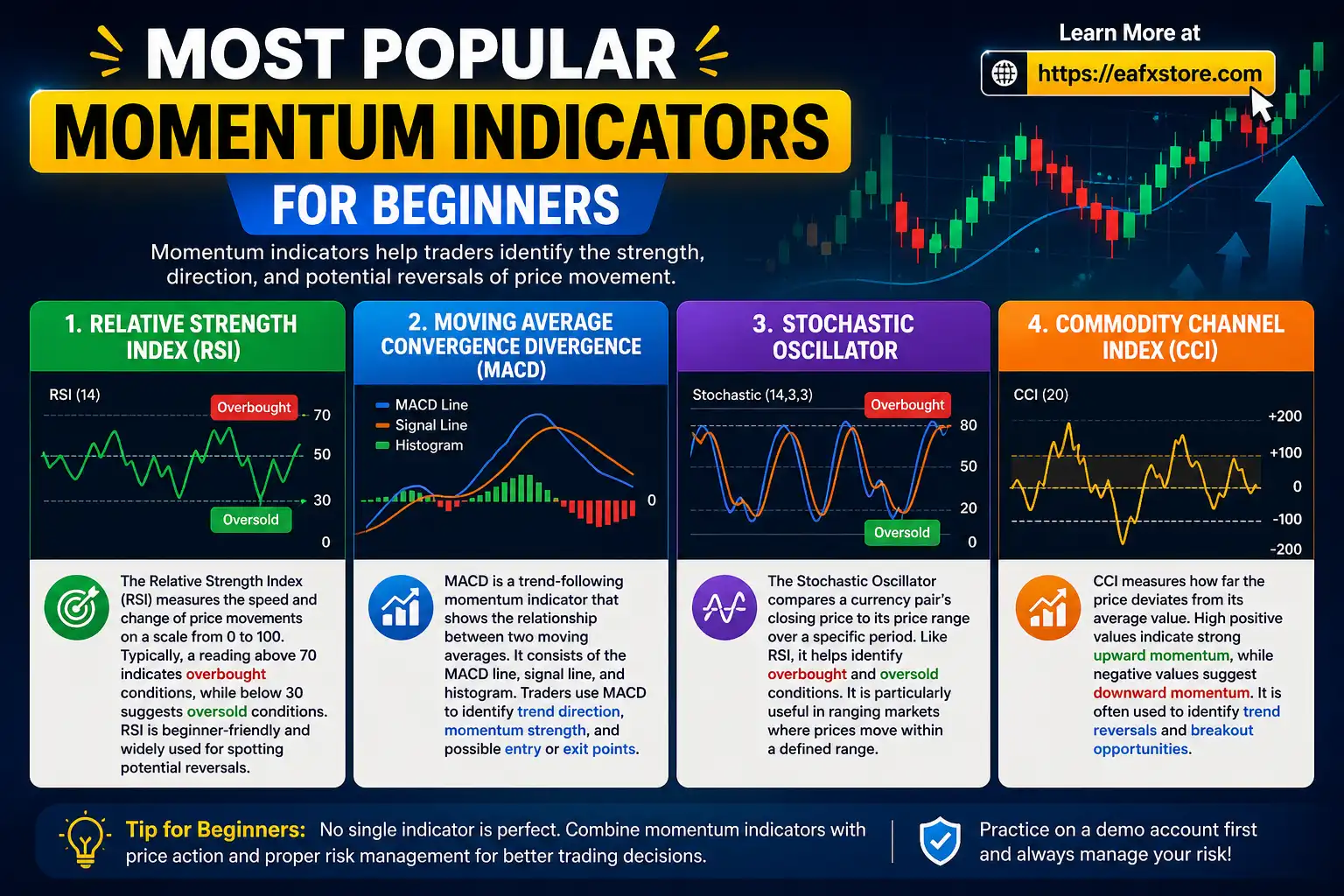
The Relative Strength Index (RSI) measures the speed and change of price movements on a scale from 0 to 100. Typically, a reading above 70 indicates overbought conditions, while below 30 suggests oversold conditions. RSI is beginner-friendly and widely used for spotting potential reversals.
🎯 Moving Average Convergence Divergence (MACD)
MACD is a trend-following momentum indicator that shows the relationship between two moving averages. It consists of the MACD line, signal line, and histogram. Traders use MACD to identify trend direction, momentum strength, and possible entry or exit points.
🎯 Stochastic Oscillator
The Stochastic Oscillator compares a currency pair’s closing price to its price range over a specific period. Like RSI, it helps identify overbought and oversold conditions. It is particularly useful in ranging markets where prices move within a defined range.
🎯 Commodity Channel Index (CCI)
CCI measures how far the price deviates from its average value. High positive values indicate strong upward momentum, while negative values suggest downward momentum. It is often used to identify trend reversals and breakout opportunities.
Comparison of Key Momentum Indicators
| Indicator | Best For | Key Signal | Difficulty Level |
|---|---|---|---|
| RSI | Overbought/Oversold | Above 70 / Below 30 | Easy |
| MACD | Trend & Momentum | Crossovers | Medium |
| Stochastic | Range Trading | Above 80 / Below 20 | Easy |
| CCI | Trend Strength | +100 / -100 levels | Medium |
This table highlights how each indicator serves a different purpose. Beginners should start with one or two indicators and gradually expand their toolkit as they gain experience.
How to Use Momentum Indicators Effectively
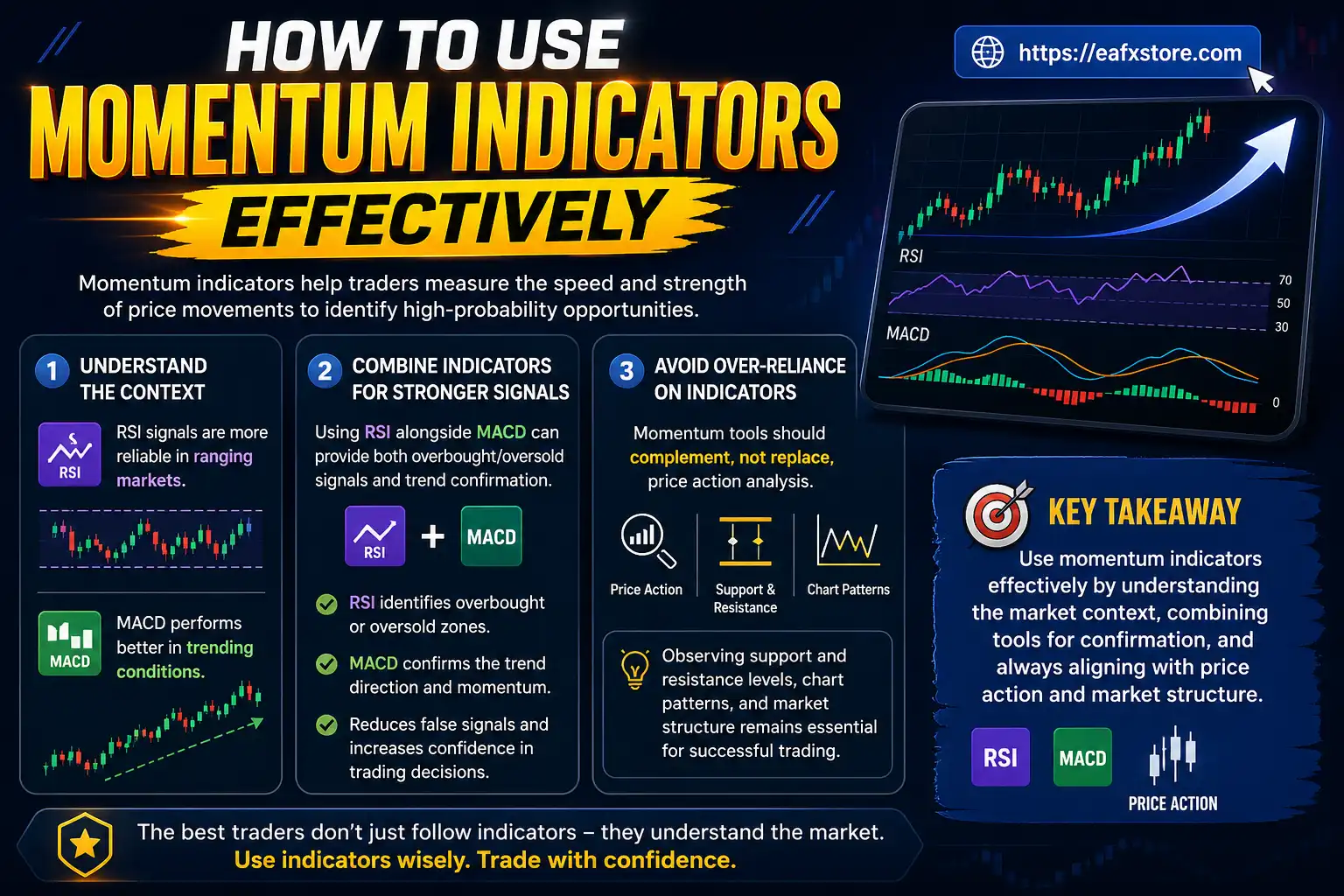
Using momentum indicators effectively requires more than just applying them to charts. Traders must understand the context in which these tools operate. For example, RSI signals are more reliable in ranging markets, while MACD performs better in trending conditions.
One important strategy is combining indicators. For instance, using RSI alongside MACD can provide both overbought/oversold signals and trend confirmation. This reduces the likelihood of false signals and increases confidence in trading decisions.
Another key principle is avoiding over-reliance on indicators. Momentum tools should complement, not replace, price action analysis. Observing support and resistance levels, chart patterns and market structure remains essential for successful trading.
Common Mistakes Beginners Should Avoid
Many beginners misuse momentum indicators, leading to poor trading outcomes. One common mistake is relying on a single indicator without confirmation. This can result in false signals and unnecessary losses.
Another mistake is ignoring market conditions. Indicators behave differently in trending versus ranging markets. Using the wrong indicator for the wrong environment can produce misleading results.
Overtrading is also a frequent issue. Beginners often take every signal generated by an indicator, leading to excessive trades and increased risk. It’s important to filter signals and focus on high-probability setups.
Lastly, failing to manage risk can negate the benefits of momentum indicators. Even the best signals can fail, so proper stop-loss placement and position sizing are critical.
Simple Momentum Trading Strategy for Beginners
A straightforward strategy can help beginners apply momentum indicators effectively. One example is combining RSI and a moving average.
First, identify the trend using a moving average. If the price is above the moving average, look for buying opportunities. If it is below, focus on selling.
Next, use RSI to time entries. In an uptrend, wait for RSI to drop below 30 and then rise again, signaling a potential buying opportunity. In a downtrend, look for RSI to rise above 70 and then fall, indicating a possible sell signal.
Finally, confirm the trade with price action, such as a bullish or bearish candlestick pattern. This adds an extra layer of validation before entering the trade.
Benefits of Using Momentum Indicators
Momentum indicators offer several advantages for forex traders. They provide early signals of trend changes, allowing traders to act before major price movements occur. This can improve entry timing and maximize profit potential.
They also help simplify complex market data. Instead of analyzing raw price movements, traders can rely on clear signals generated by indicators. This is especially useful for beginners who may feel overwhelmed by chart analysis.
Additionally, momentum indicators enhance discipline. By following predefined signals, traders are less likely to make impulsive decisions based on emotions.
Limitations of Momentum Indicators
Despite their benefits, momentum indicators are not foolproof. They are based on historical data, which means they may lag behind current market conditions. This can lead to delayed signals, especially in fast-moving markets.
False signals are another limitation. In highly volatile conditions, indicators may generate misleading signals that do not result in profitable trades. This is why combining indicators and using additional analysis is গুরুত্বপূর্ণ.
Moreover, no indicator works perfectly in all market conditions. Traders must adapt their strategies based on whether the market is trending or ranging.
Conclusion: Building Smarter Trading Habits
Momentum indicators are powerful tools that can help beginners navigate the forex market with greater confidence. By understanding how these indicators work and applying them correctly, traders can improve their timing, reduce risk and make more informed decisions.
However, success in forex trading requires more than just using indicators. It involves continuous learning, disciplined risk management, and adapting to changing market conditions. Start simple, practice consistently and gradually refine your strategy.
With the right approach, momentum indicators can become a valuable part of your trading toolkit, helping you move toward smarter and more consistent trading results.