
Introduction to RNNs in Forex Trading
Recurrent Neural Networks (RNNs) have become a powerful tool in the financial industry, particularly in Forex trading where time-series data plays a crucial role. Unlike traditional machine learning models, RNNs are designed to recognize patterns in sequences, making them ideal for analyzing historical price movements and predicting future trends. In Forex markets, where currency prices fluctuate constantly, the ability to process sequential data provides traders with a competitive advantage. This article explores how RNNs are applied in Forex trading, their benefits, limitations and practical implementation.
What is a Recurrent Neural Networks (RNNs)?
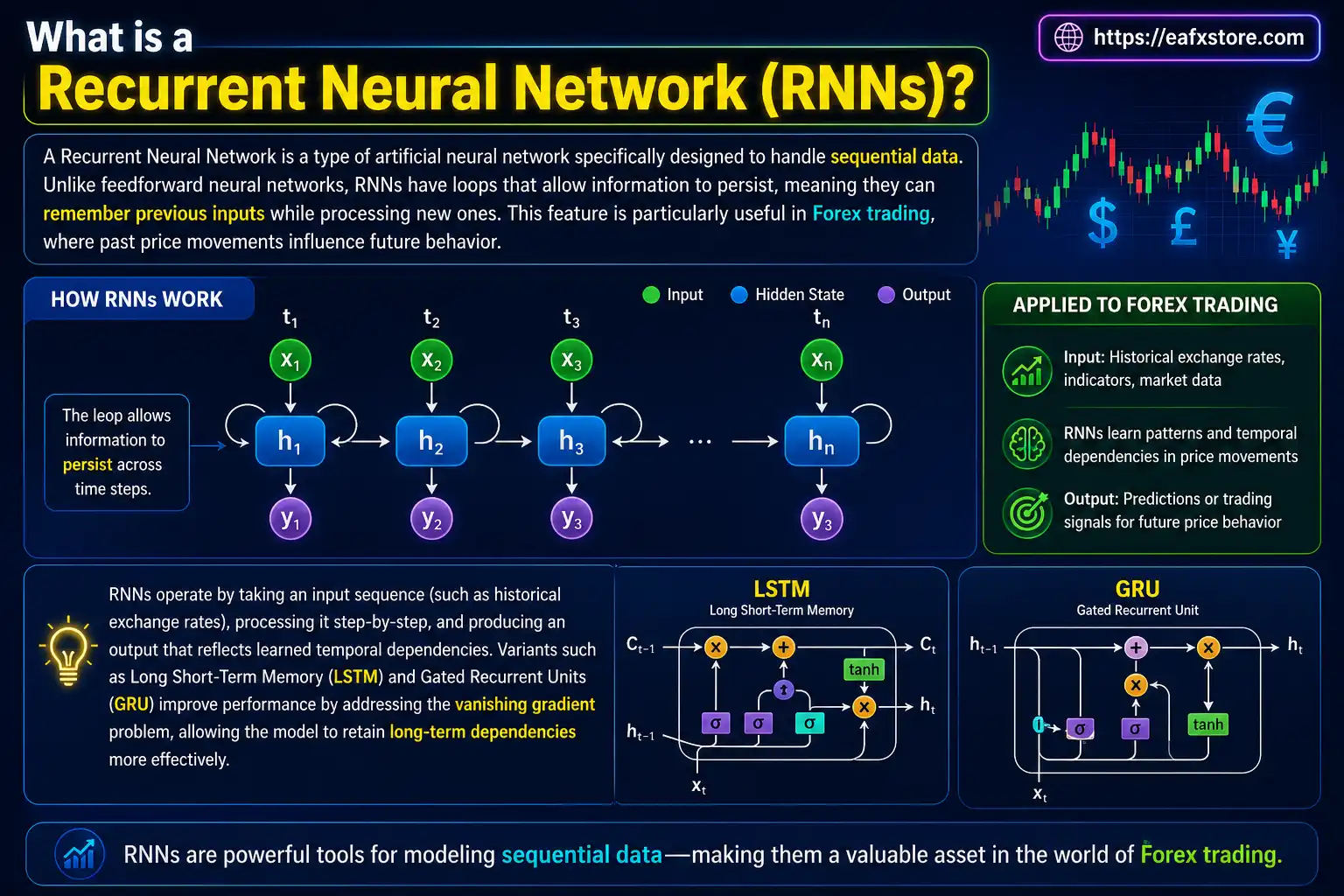
A Recurrent Neural Networks is a type of artificial neural network specifically designed to handle sequential data. Unlike feedforward neural networks, RNNs have loops that allow information to persist, meaning they can remember previous inputs while processing new ones. This feature is particularly useful in Forex trading, where past price movements influence future behavior.
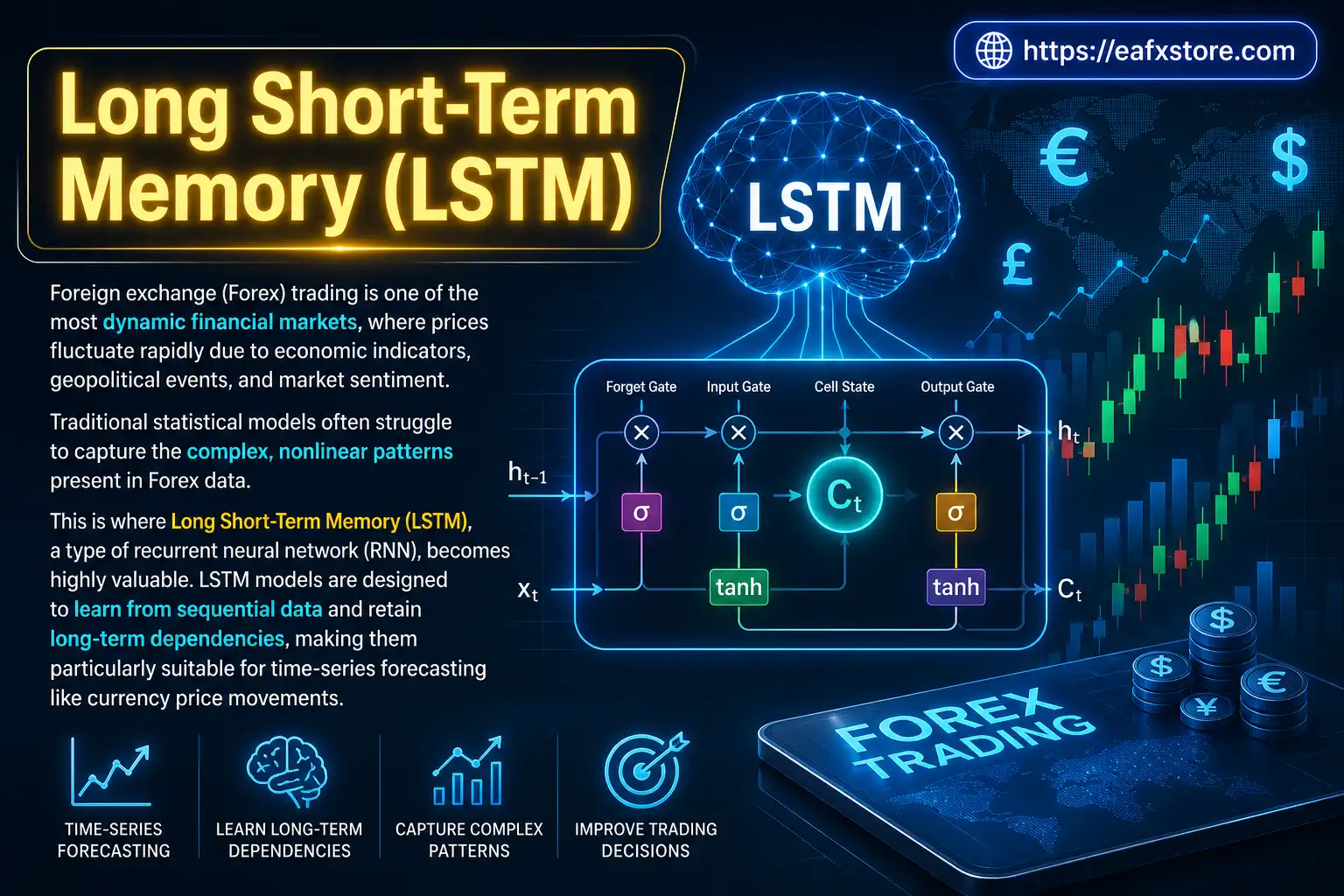
RNNs operate by taking an input sequence (such as historical exchange rates), processing it step-by-step, and producing an output that reflects learned temporal dependencies. Variants such as Long Short-Term Memory (LSTM) and Gated Recurrent Units (GRU) improve performance by addressing the vanishing gradient problem, allowing the model to retain long-term dependencies more effectively.
Why Use RNNs in Forex Trading?
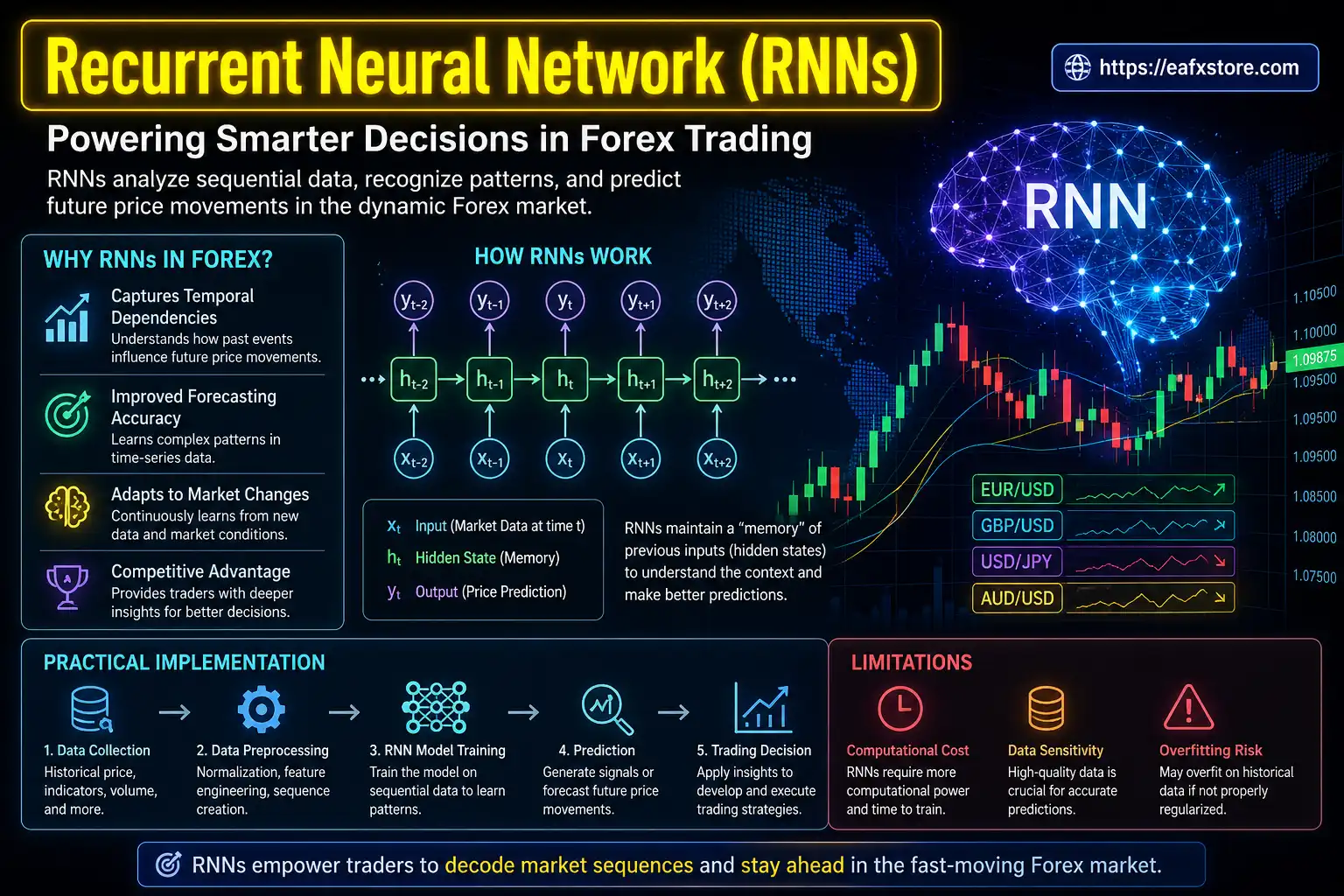
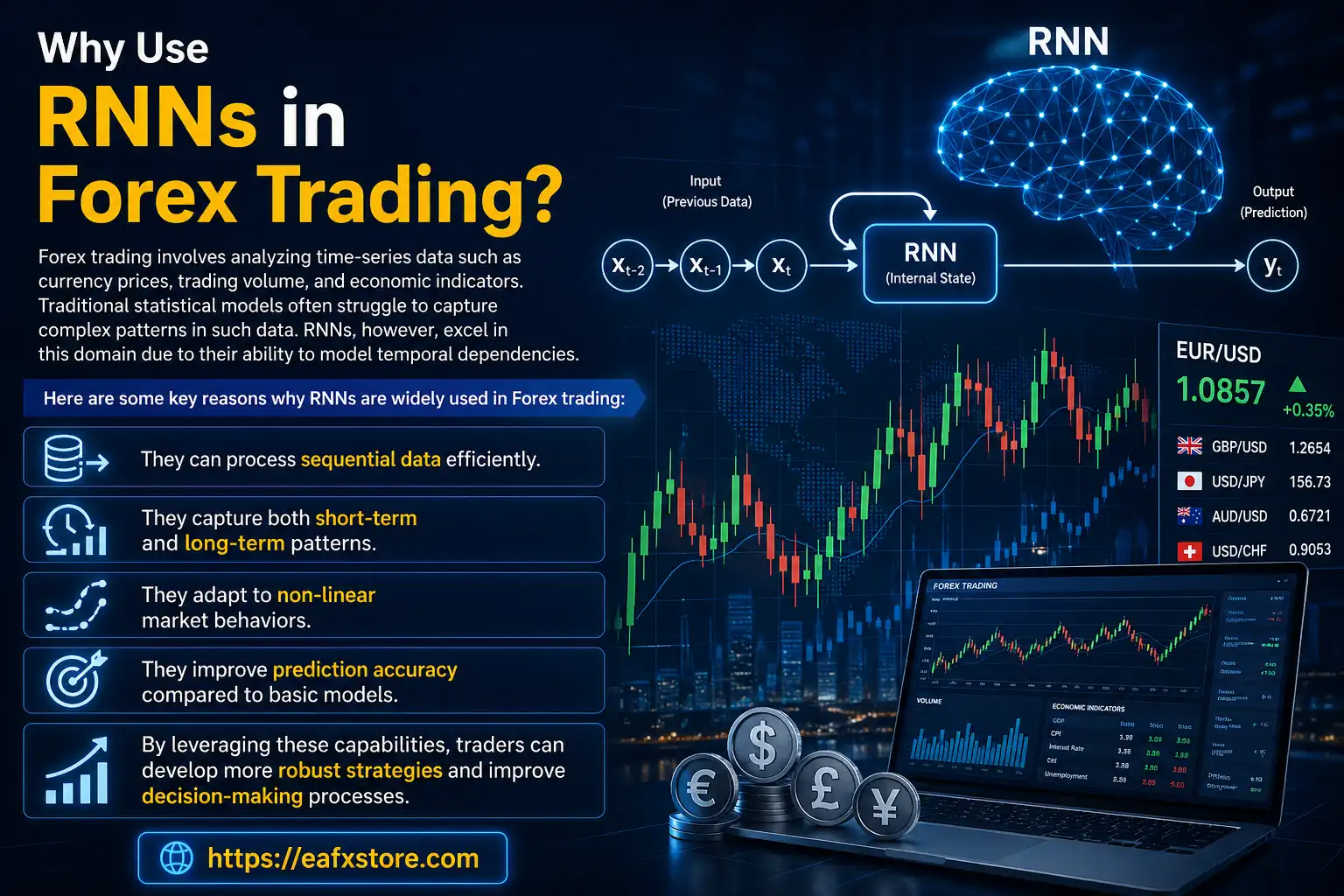
Forex trading involves analyzing time-series data such as currency prices, trading volume and economic indicators. Traditional statistical models often struggle to capture complex patterns in such data. RNNs, however, excel in this domain due to their ability to model temporal dependencies.
Here are some key reasons why RNNs are widely used in Forex trading:
- They can process sequential data efficiently.
- They capture both short-term and long-term patterns.
- They adapt to non-linear market behaviors.
- They improve prediction accuracy compared to basic models.
By leveraging these capabilities, traders can develop more robust strategies and improve decision-making processes.
How RNNs Models Work in Forex Prediction
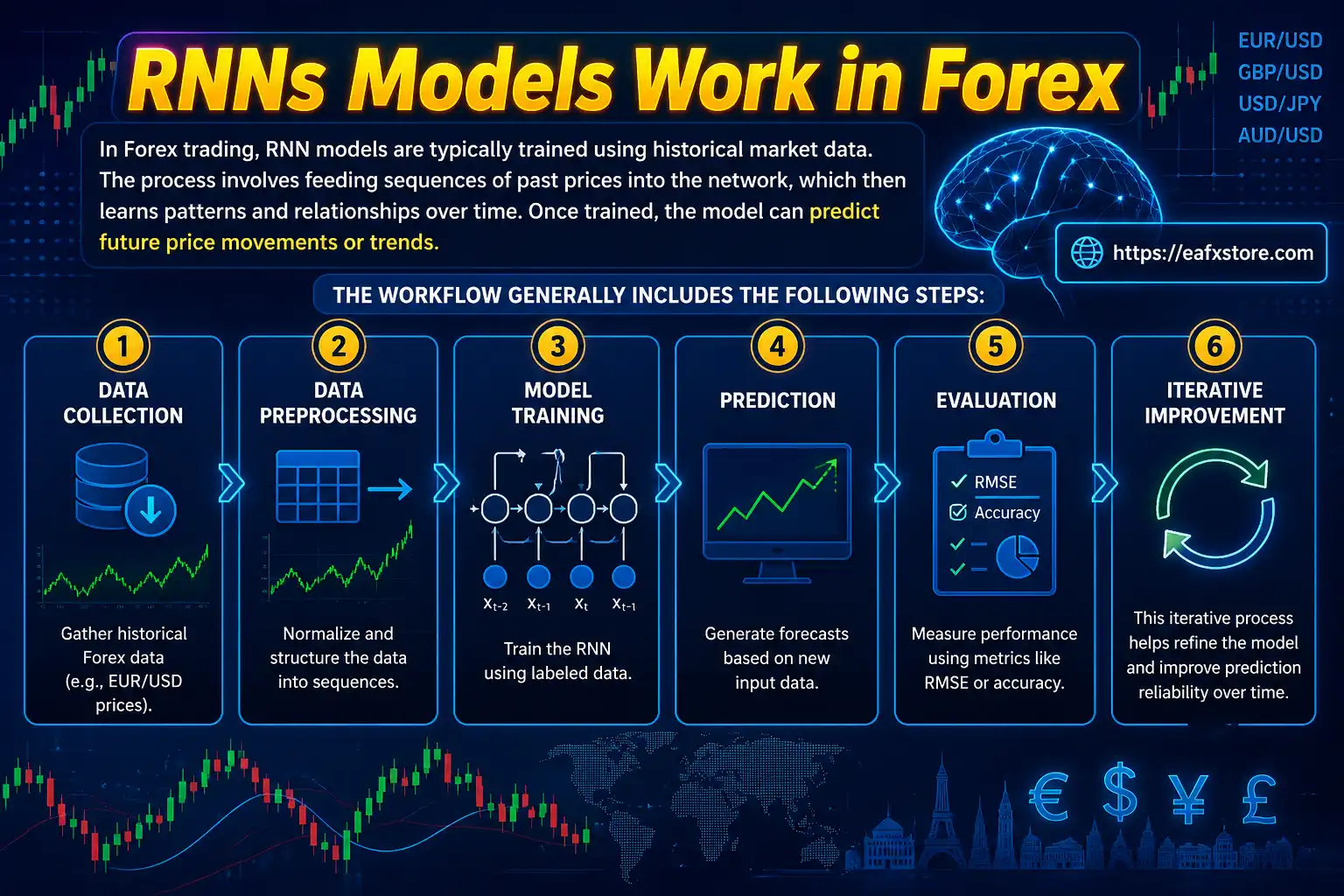
In Forex trading, RNN models are typically trained using historical market data. The process involves feeding sequences of past prices into the network, which then learns patterns and relationships over time. Once trained, the model can predict future price movements or trends.
The workflow generally includes the following steps:
- Data Collection: Gather historical Forex data (e.g., EUR/USD prices).
- Data Preprocessing: Normalize and structure the data into sequences.
- Model Training: Train the RNN using labeled data.
- Prediction: Generate forecasts based on new input data.
- Evaluation: Measure performance using metrics like RMSE or accuracy.
This iterative process helps refine the model and improve prediction reliability over time.
Types of RNNs Architectures Used in Forex
Different RNN architectures are used depending on the complexity of the trading strategy. The table below highlights the most common types:
| RNN Type | Description | Use Case in Forex |
|---|---|---|
| Simple RNN | Basic recurrent structure | Short-term predictions |
| LSTM | Handles long-term dependencies | Trend forecasting |
| GRU | Simplified LSTM with fewer parameters | Faster training and prediction |
| Bidirectional RNN | Processes data in both directions | Improved context understanding |
Each architecture has its strengths, and the choice depends on the specific trading objectives and computational resources available.
Advantages of Using RNNs in Forex Trading
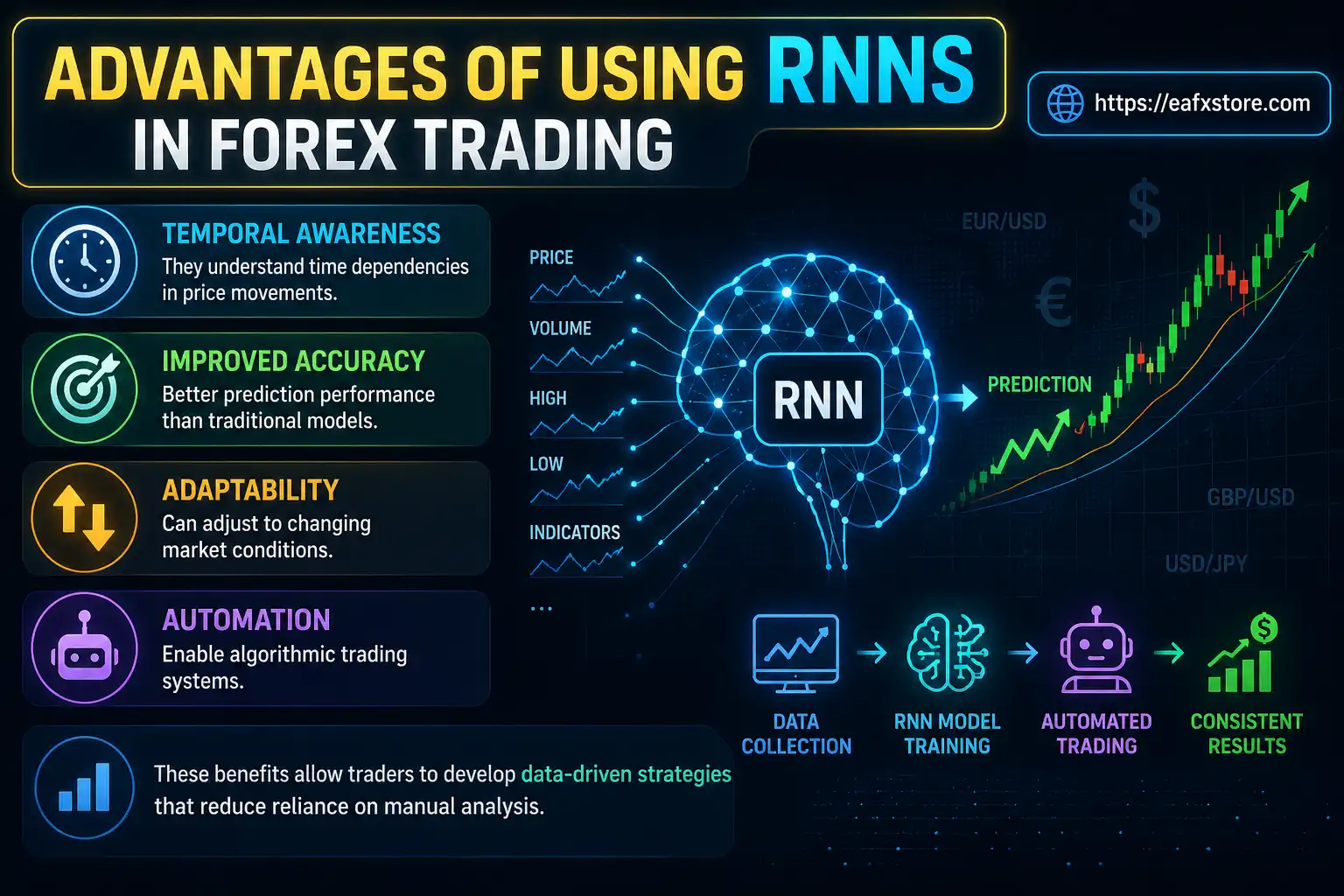
RNNs offer several advantages that make them attractive for Forex traders:
- Temporal Awareness: They understand time dependencies in price movements.
- Improved Accuracy: Better prediction performance than traditional models.
- Adaptability: Can adjust to changing market conditions.
- Automation: Enable algorithmic trading systems.
These benefits allow traders to develop data-driven strategies that reduce reliance on manual analysis.
Challenges and Limitations
Despite their advantages, RNNs also come with certain challenges. One major issue is the vanishing gradient problem, which can limit the model’s ability to learn long-term dependencies. Although LSTM and GRU address this issue, they require more computational power.
Other limitations include:
- High computational cost.
- Risk of overfitting.
- Need for large datasets.
- Sensitivity to noisy financial data.
Additionally, Forex markets are influenced by unpredictable factors such as geopolitical events, which no model can fully capture.
Practical Applications in Forex Trading
RNNs are used in various practical applications within Forex trading:
- Price Prediction: Forecasting future exchange rates.
- Trend Analysis: Identifying bullish or bearish trends.
- Signal Generation: Creating buy/sell signals.
- Risk Management: Estimating potential losses.
For example, an RNN model can analyze past EUR/USD price movements and generate signals indicating when to enter or exit a trade. This automation helps traders respond quickly to market changes.
Best Practices for Implementing RNNs Models
To maximize the effectiveness of RNNs in Forex trading, it is important to follow best practices:
- Use high-quality and diverse datasets.
- Normalize and preprocess data properly.
- Avoid overfitting by using validation techniques.
- Experiment with different architectures (LSTM, GRU).
- Continuously update the model with new data.
Proper implementation ensures that the model remains accurate and relevant in dynamic market conditions.
Future of RNN in Forex Trading
The future of RNNs in Forex trading looks promising, especially with advancements in deep learning and computational power. Hybrid models that combine RNNs with other techniques, such as Convolutional Neural Networks (CNNs) or reinforcement learning, are gaining popularity.
Moreover, the integration of real-time data and AI-driven trading platforms is expected to enhance prediction accuracy and trading efficiency. As technology evolves, RNN-based systems will likely become an essential component of professional trading strategies.
Conclusion
Recurrent Neural Networks have revolutionized the way traders analyze Forex markets. Their ability to process sequential data and capture temporal patterns makes them a powerful tool for predicting currency movements. While challenges such as computational complexity and data requirements exist, the benefits often outweigh the limitations.
By understanding how RNNs work and applying best practices, traders can leverage this technology to improve their strategies and gain a competitive edge in the Forex market. As Artificial Intelligence (AI) continues to evolve, RNNs will play an increasingly important role in shaping the future of Forex trading.