
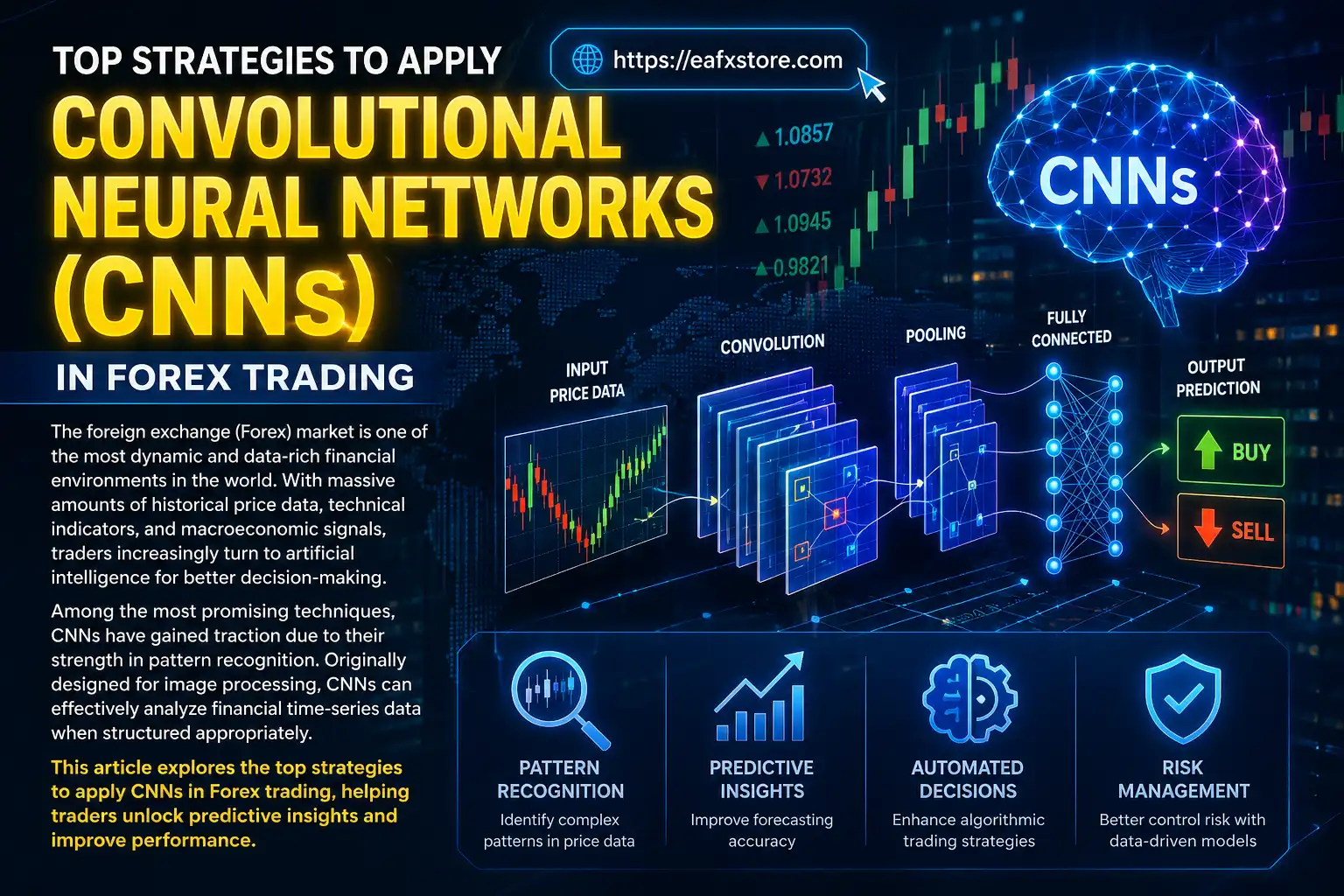
The foreign exchange (Forex) market is one of the most dynamic and data-rich financial environments in the world. With massive amounts of historical price data, technical indicators, and macroeconomic signals, traders increasingly turn to Artificial intelligence (AI) for better decision-making.
Among the most promising techniques, Convolutional Neural Networks (CNNs) have gained traction due to their strength in pattern recognition. Originally designed for image processing, CNNs can effectively analyze financial time-series data when structured appropriately. This article explores the top strategies to apply CNNs in Forex trading, helping traders unlock predictive insights and improve performance.
Understanding CNNs in Forex Context
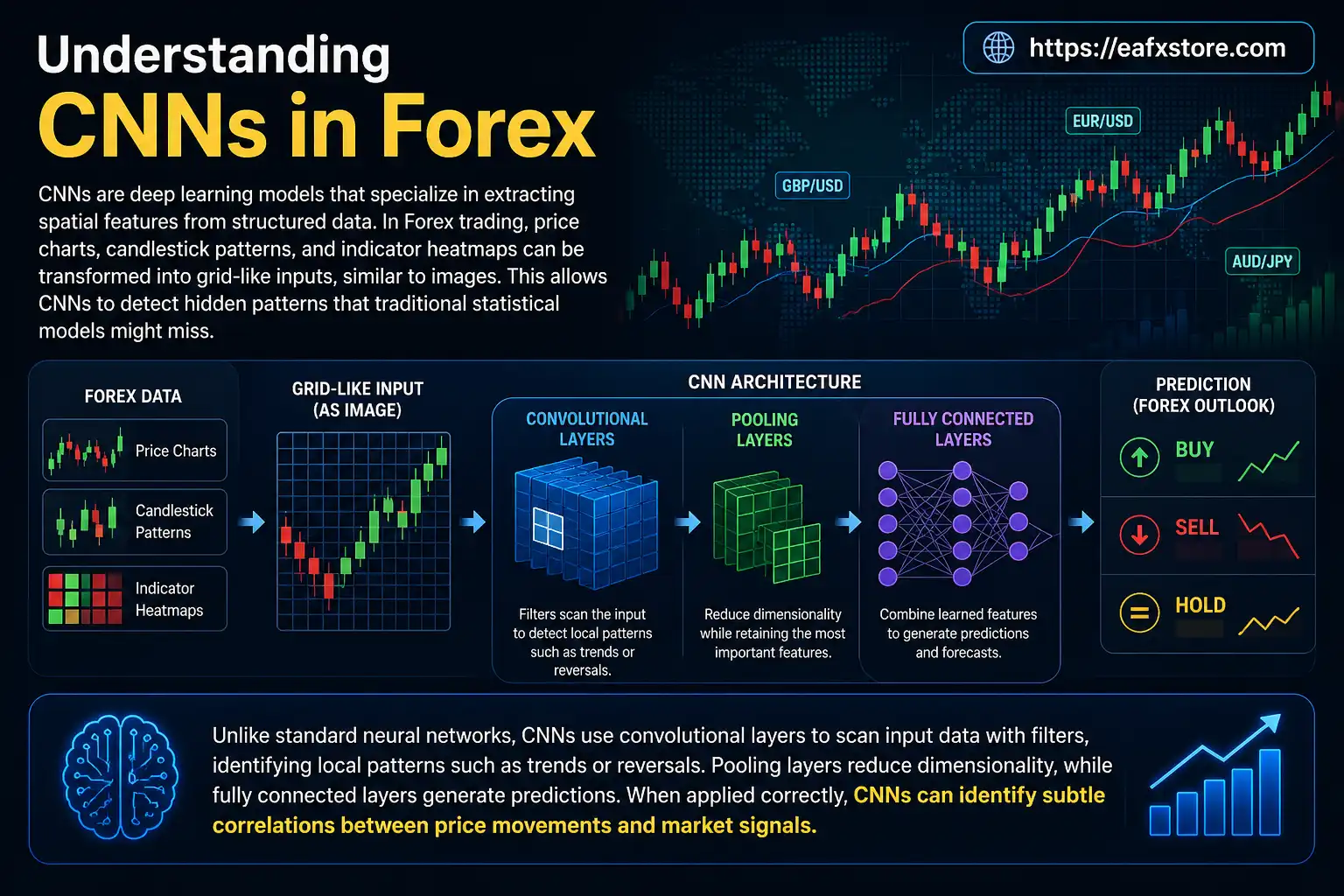
CNNs are deep learning models that specialize in extracting spatial features from structured data. In Forex trading, price charts, candlestick patterns, and indicator heatmaps can be transformed into grid-like inputs, similar to images. This allows CNNs to detect hidden patterns that traditional statistical models might miss.
Unlike standard neural networks, CNNs use convolutional layers to scan input data with filters, identifying local patterns such as trends or reversals. Pooling layers reduce dimensionality, while fully connected layers generate predictions. When applied correctly, CNNs can identify subtle correlations between price movements and market signals.
Transforming Forex Data into CNN-Compatible Inputs
Before applying CNNs, Forex data must be properly formatted. Since CNNs work best with grid-like structures, traders often convert time-series data into image-like representations.
Common approaches include:
- Candlestick chart images.
- Heatmaps of technical indicators.
- Sliding window matrices of price data.
- Gramian Angular Fields (GAF) or recurrence plots.
By transforming raw price data into visual or matrix formats, CNNs can extract meaningful features. This step is crucial because poor data representation leads to weak model performance regardless of algorithm sophistication.
Using CNNs for Price Trend Prediction
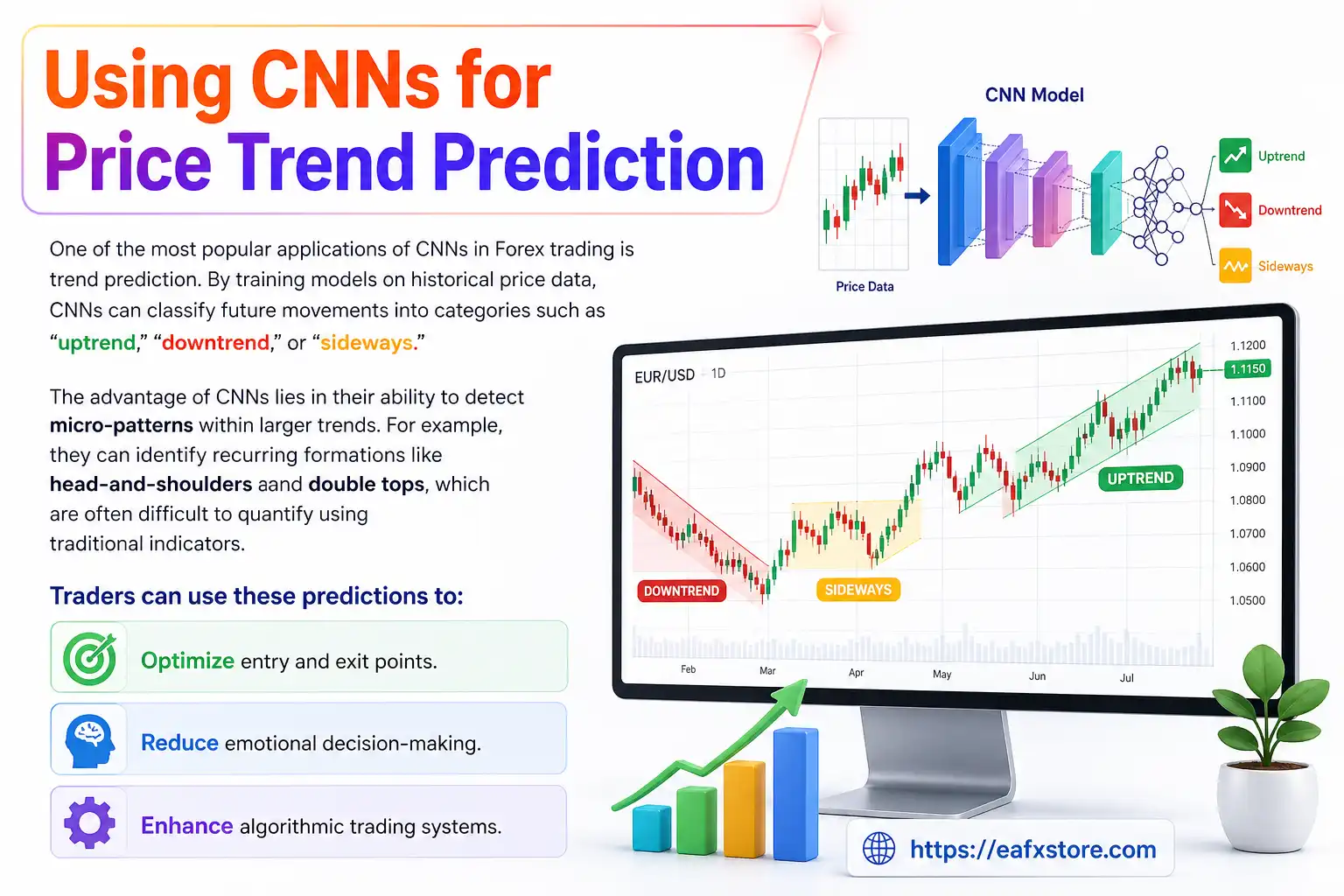
One of the most popular applications of CNNs in Forex trading is trend prediction. By training models on historical price data, CNNs can classify future movements into categories such as “uptrend,” “downtrend,” or “sideways.”
The advantage of CNNs lies in their ability to detect micro-patterns within larger trends. For example, they can identify recurring formations like head-and-shoulders or double tops, which are often difficult to quantify using traditional indicators.
Traders can use these predictions to:
- Optimize entry and exit points.
- Reduce emotional decision-making.
- Enhance algorithmic trading systems.
Combining CNNs with Technical Indicators
CNNs perform even better when combined with technical indicators such as RSI, MACD and Moving Averages. Instead of relying on raw price data alone, integrating multiple indicators provides richer input features.
Below is a simple comparison of input strategies:
| Input Type | Advantages | Limitations |
|---|---|---|
| Raw Price Data | Simple, widely available | Limited feature depth |
| Technical Indicators | Adds market context | May introduce redundancy |
| Image Representations | Ideal for CNN pattern detection | Requires preprocessing effort |
| Hybrid Inputs | Highest predictive potential | More complex model design |
By stacking multiple indicators into multi-channel inputs (similar to RGB images), CNNs can learn relationships across different signals simultaneously.
Applying CNNs for Volatility Forecasting
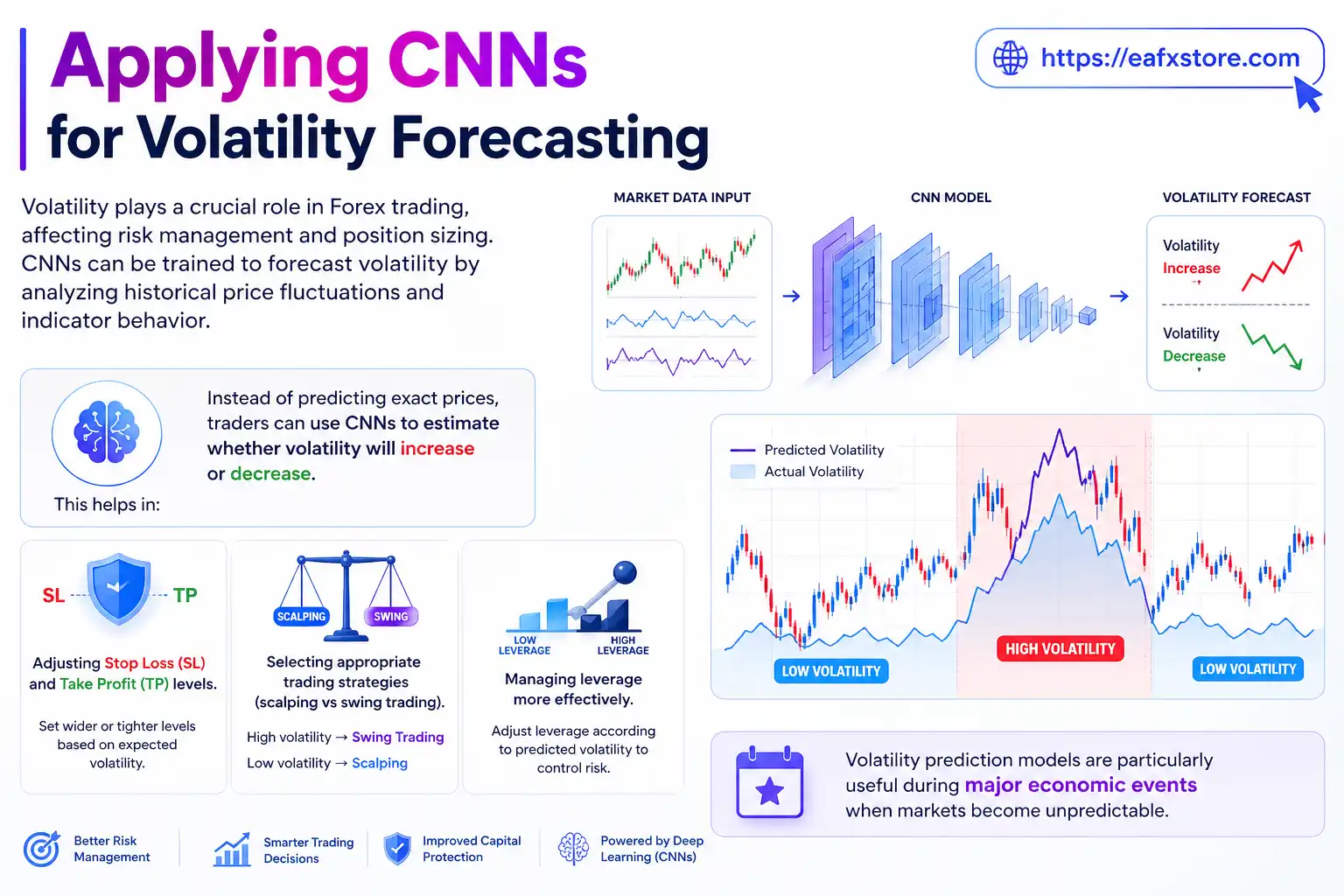
Volatility plays a crucial role in Forex trading, affecting risk management and position sizing. CNNs can be trained to forecast volatility by analyzing historical price fluctuations and indicator behavior.
Instead of predicting exact prices, traders can use CNNs to estimate whether volatility will increase or decrease. This helps in:
- Adjusting Stop Loss (SL) and Take Profit (TP) levels.
- Selecting appropriate trading strategies (scalping vs swing trading).
- Managing leverage more effectively.
Volatility prediction models are particularly useful during major economic events when markets become unpredictable.
Integrating CNNs with Other Deep Learning Models
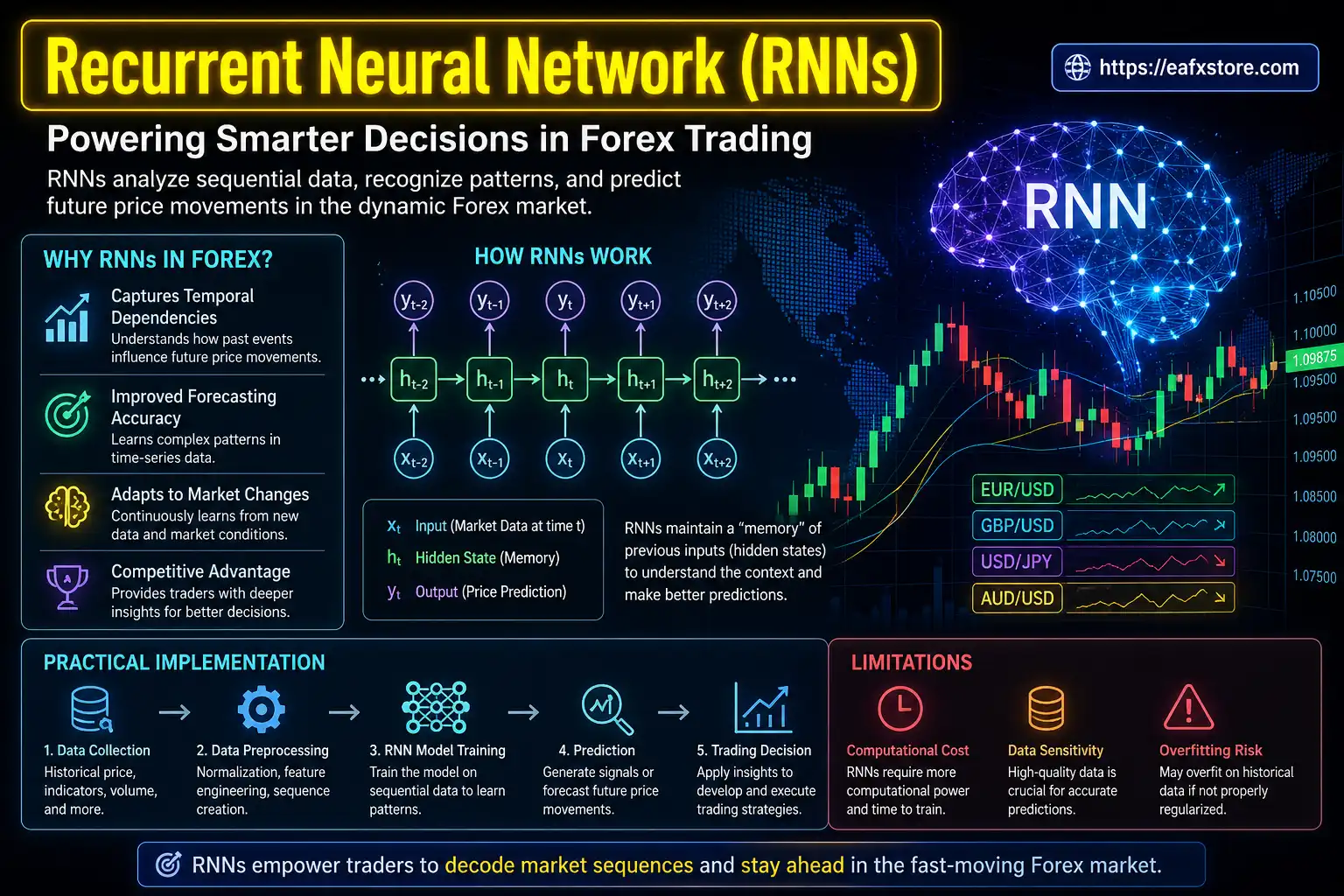
CNNs are powerful, but they become even more effective when combined with other architectures like Recurrent Neural Networks (RNNs) or Long Short-Term Memory (LSTM) networks.
A common hybrid approach is:
- CNN layers extract spatial features from price data.
- LSTM layers capture temporal dependencies.
This combination allows the model to understand both what patterns exist and how they evolve over time. Such hybrid models are widely used in advanced trading systems and often outperform standalone CNNs.
Risk Management and Overfitting Prevention
One of the biggest challenges when applying CNNs in Forex trading is overfitting. Since financial data is noisy and non-stationary, models may perform well on historical data but fail in live markets.
To mitigate this risk, traders should:
- Use cross-validation techniques.
- Regularize models (dropout, weight decay).
- Train on diverse datasets across multiple currency pairs.
- Continuously retrain models with new data.
Proper risk management is essential. Even the most advanced CNN model should not be used without stop-loss rules and capital allocation strategies.
Backtesting and Model Evaluation
Before deploying a CNN-based trading strategy, thorough backtesting is critical. This involves testing the model on unseen historical data to evaluate performance.
Key metrics to consider include:
- Accuracy and precision.
- Sharpe ratio.
- Maximum drawdown.
- Profit factor.
Backtesting ensures that the model is robust and not simply memorizing past data. It also helps traders identify weaknesses and refine strategies before risking real capital.
Real-Time Implementation in Trading Systems
Deploying CNNs in real-time Forex trading requires integration with trading platforms and data feeds. This involves:
- Streaming live market data.
- Running predictions in real time.
- Executing trades automatically or semi-automatically.
Latency and computational efficiency become important factors. Optimized models and hardware (such as GPUs) can significantly improve performance.
Traders should also implement monitoring systems to track model behavior and detect anomalies during live trading.
Challenges and Limitations of CNNs in Forex
While CNNs offer powerful capabilities, they are not a magic solution. Forex markets are influenced by macroeconomic factors, geopolitical events, and unexpected news—elements that CNNs may struggle to interpret.
Key limitations include:
- Sensitivity to data quality.
- High computational requirements.
- Difficulty in interpreting model decisions (black-box nature).
- Need for continuous retraining.
Understanding these challenges helps traders set realistic expectations and avoid over-reliance on automation.
Conclusion
Convolutional Neural Networks represent a significant advancement in Forex trading technology. By leveraging their ability to detect complex patterns, traders can gain deeper insights into market behavior and improve predictive accuracy. From transforming data into image-like formats to combining CNNs with other deep learning models, the possibilities are vast.
However, success with CNNs requires more than just technical knowledge. Proper data preparation, risk management, and continuous evaluation are essential components of any effective strategy. When used thoughtfully, CNNs can become a powerful tool in the modern trader’s arsenal, helping navigate the complexities of the Forex market with greater confidence and precision.