

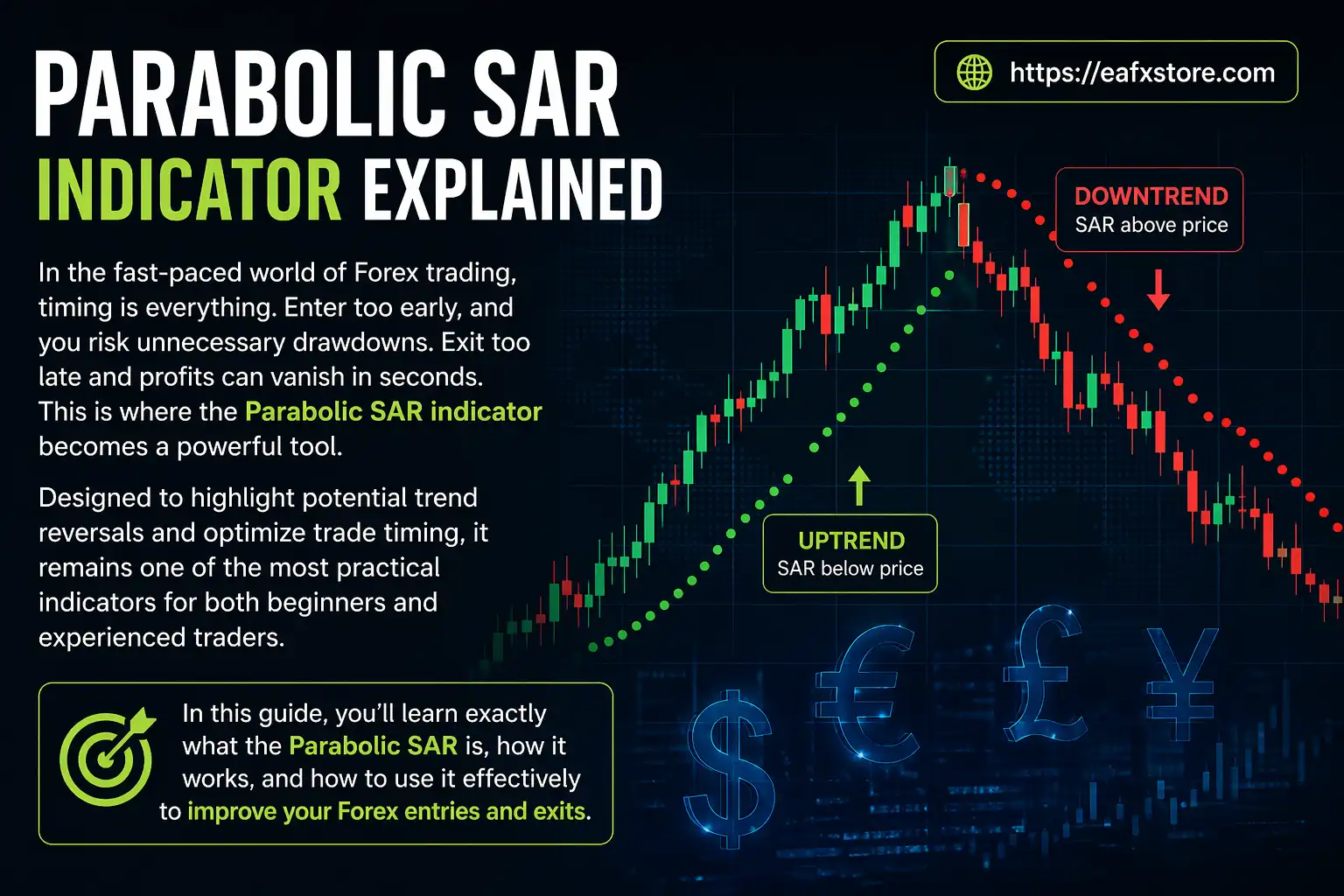
In the fast-paced world of Forex trading, timing is everything. Enter too early, and you risk unnecessary drawdowns. Exit too late and profits can vanish in seconds. This is where the Parabolic SAR indicator becomes a powerful tool. Designed to highlight potential trend reversals and optimize trade timing, it remains one of the most practical indicators for both beginners and experienced traders.
In this guide, you’ll learn exactly what the Parabolic SAR is, how it works, and how to use it effectively to improve your Forex entries and exits.
What is the Parabolic SAR Indicator?
The Parabolic SAR (Stop and Reverse) is a trend-following indicator developed by J. Welles Wilder Jr., the same analyst behind RSI and ADX. Its primary purpose is to identify the direction of a trend and signal potential reversal points.
On a chart, the indicator appears as a series of dots placed either above or below price:
- Dots below price → Uptrend (Bullish signal)
- Dots above price → Downtrend (Bearish signal)
When the dots switch sides, it signals a potential trend reversal, which traders often use as entry or exit signals.
How Does Parabolic SAR Work?
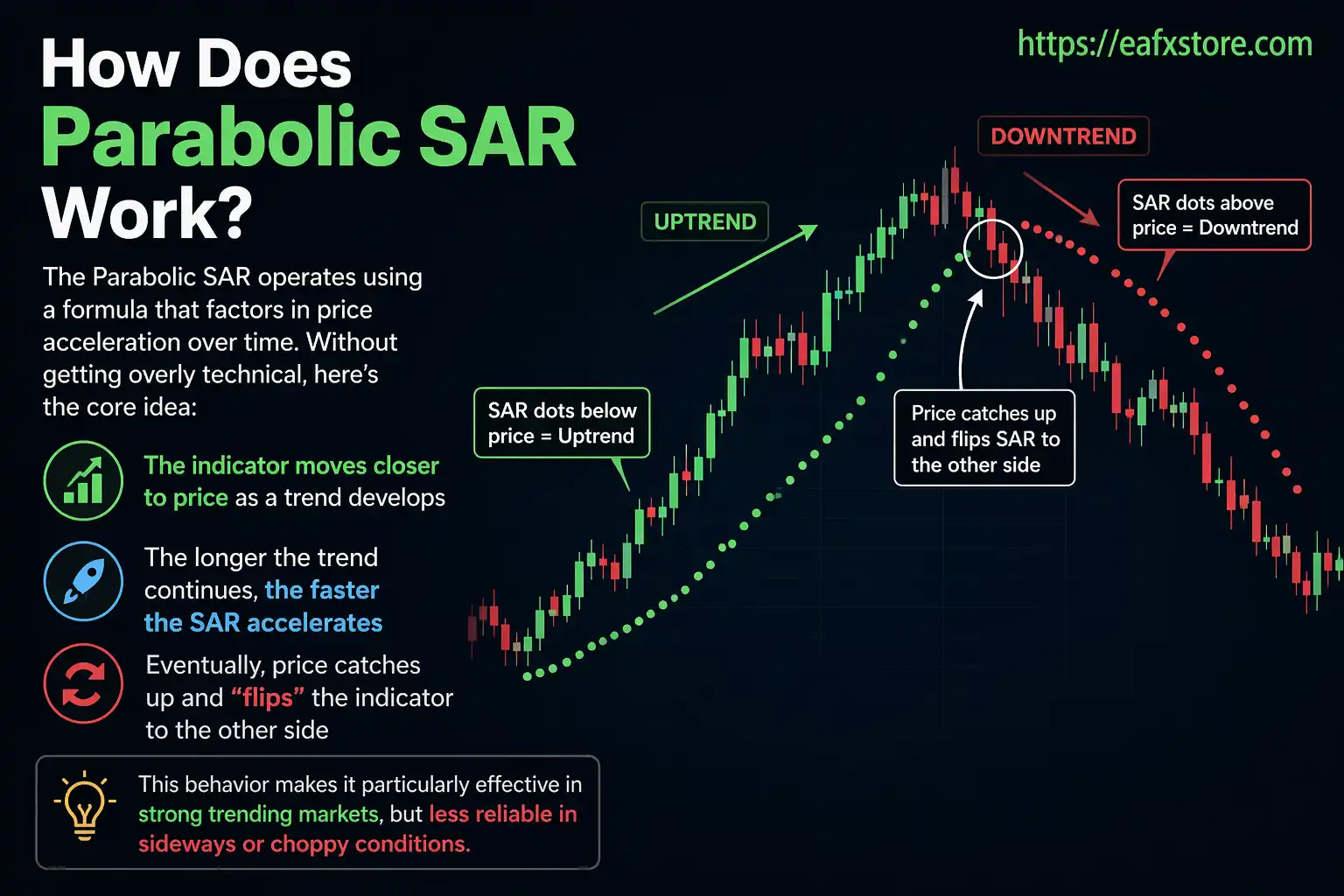
The Parabolic SAR operates using a formula that factors in price acceleration over time. Without getting overly technical, here’s the core idea:
- The indicator moves closer to price as a trend develops
- The longer the trend continues, the faster the SAR accelerates
- Eventually, price catches up and “flips” the indicator to the other side
This behavior makes it particularly effective in strong trending markets, but less reliable in sideways or choppy conditions.
Why Forex Traders Use Parabolic SAR
Forex markets are highly liquid and trend-driven, making the Parabolic SAR especially useful. Here’s why traders rely on it:
1. Clear Entry Signals
When the dots flip from above to below price, it suggests a potential buy opportunity. Conversely, when they flip from below to above, it signals a sell opportunity.
2. Built-in Exit Strategy
The indicator is called “Stop and Reverse” for a reason. It helps traders:
- Exit losing trades quickly
- Lock in profits during trends
3. Trend Confirmation
Parabolic SAR helps confirm whether a trend is still intact or weakening.

How to Use Parabolic SAR for Entries
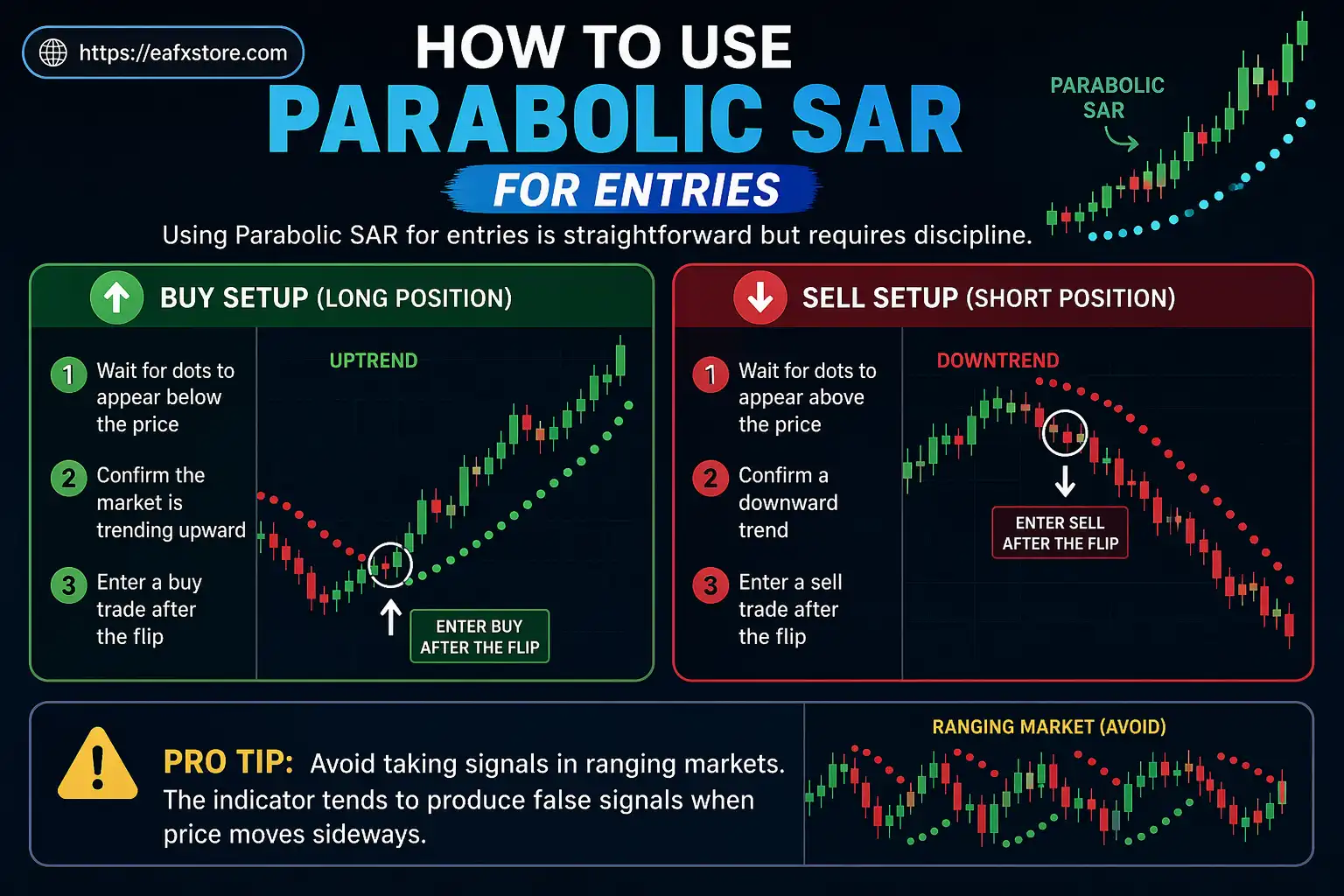
Using Parabolic SAR for entries is straightforward but requires discipline.
Buy Setup (Long Position)
- Wait for dots to appear below the price
- Confirm the market is trending upward
- Enter a buy trade after the flip
Sell Setup (Short Position)
- Wait for dots to appear above the price
- Confirm a downward trend
- Enter a sell trade after the flip
Pro Tip: Avoid taking signals in ranging markets. The indicator tends to produce false signals when price moves sideways.
How to Use Parabolic SAR for Exits
One of the biggest advantages of the Parabolic SAR is its ability to guide exits.
Exit Strategy:
- Stay in the trade as long as dots remain on your side
- Exit when the dots flip to the opposite side
This approach helps you:
- Ride trends longer
- Avoid emotional decision-making
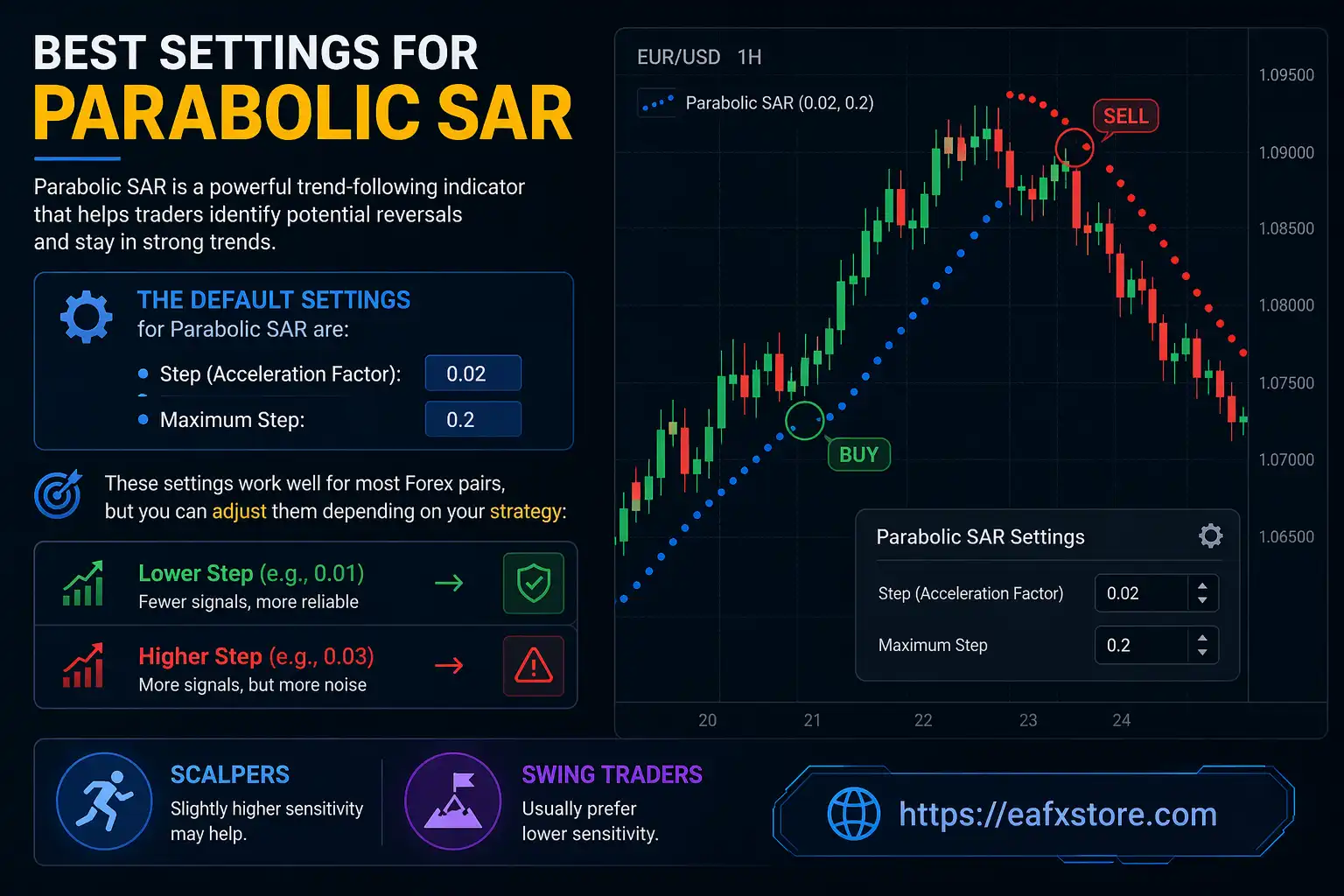
Best Settings for Parabolic SAR
The default settings for Parabolic SAR are:
- Step (Acceleration Factor): 0.02
- Maximum Step: 0.2
These settings work well for most Forex pairs, but you can adjust them depending on your strategy:
- Lower Step (e.g., 0.01) → Fewer signals, more reliable
- Higher Step (e.g., 0.03) → More signals, but more noise
If you’re a scalper, slightly higher sensitivity may help. Swing traders usually prefer lower sensitivity.
Combining Parabolic SAR with Other Indicators
Using Parabolic SAR alone can be risky. Combining it with other indicators improves accuracy.
1. Moving Averages
Use a Moving Average to confirm trend direction:
- Only take buy signals above the MA
- Only take sell signals below the MA
2. RSI (Relative Strength Index)
RSI helps filter false signals:
- Avoid buying when RSI is overbought
- Avoid selling when RSI is oversold
3. ADX (Average Directional Index)
ADX confirms trend strength:
- Use Parabolic SAR only when ADX > 25
Common Mistakes to Avoid
Even though the Parabolic SAR is simple, many traders misuse it. Here are key pitfalls:
1. Trading in Sideways Markets
This is the biggest mistake. The indicator performs poorly in ranging conditions.
2. Ignoring Trend Context
Always analyze the broader trend before acting on signals.
3. Over-Optimizing Settings
Constantly tweaking parameters can lead to inconsistency. Stick to a tested setup.
Practical Example
Imagine EUR/USD is in a strong uptrend:
- Price is making higher highs and higher lows
- Parabolic SAR dots remain below price
You enter a buy trade when the dots first flip below price. As the trend continues, the dots trail behind price, acting as a dynamic stop-loss.
Eventually, the dots flip above price—this is your signal to exit the trade and secure profits.
Is Parabolic SAR Suitable for Beginners?
Yes—but with caution.
The indicator is easy to understand and visually intuitive. However, beginners must learn to:
- Identify trending vs. ranging markets.
- Combine it with other tools.
- Practice risk management.
Used alone, it can lead to false signals. Used correctly, it becomes a powerful addition to your trading toolkit.
Final Thoughts
The Parabolic SAR indicator is a simple yet effective tool for improving Forex entries and exits. Its strength lies in its clarity—it gives traders straightforward signals without unnecessary complexity.
However, no indicator is perfect. To get the most out of Parabolic SAR:
- Use it in trending markets.
- Combine it with confirmation indicators.
- Apply proper risk management.
Master these principles, and you’ll significantly enhance your ability to enter trades at the right time and exit with confidence.