


The Parabolic SAR (Stop and Reverse) is one of the most widely used technical indicators in Forex trading. Developed by J. Welles Wilder, it helps traders identify potential trend direction and optimal entry and exit points. When used correctly, the Parabolic SAR can become a powerful component of a consistent and disciplined trading strategy.
In this guide, you’ll learn what the Parabolic SAR is, how it works, and how to apply it effectively to improve your Forex trading performance.
What is the Parabolic SAR?
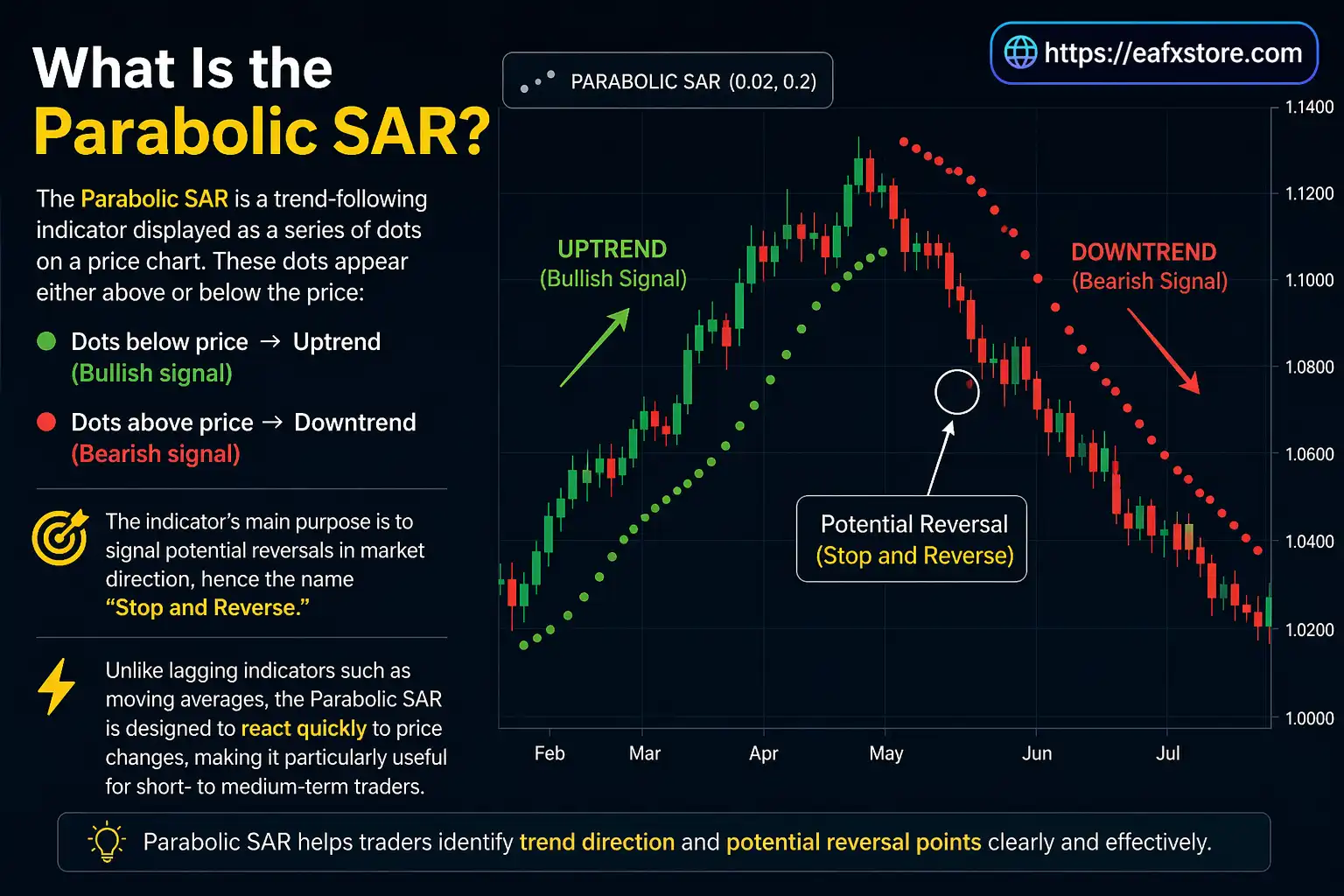
The Parabolic SAR is a trend-following indicator displayed as a series of dots on a price chart. These dots appear either above or below the price:
- Dots below price → Uptrend (Bullish signal)
- Dots above price → Downtrend (Bearish signal)
The indicator’s main purpose is to signal potential reversals in market direction, hence the name “Stop and Reverse.”
Unlike lagging indicators such as moving averages, the Parabolic SAR is designed to react quickly to price changes, making it particularly useful for short- to medium-term traders.
How the Parabolic SAR Works
The Parabolic SAR uses a mathematical formula that factors in price and an “acceleration factor” (AF). While you don’t need to calculate it manually, understanding its behavior is important:
- As a trend continues, the SAR dots move closer to price
- When price reverses, the dots flip to the opposite side
- The longer the trend, the faster the indicator reacts
This tightening effect helps traders lock in profits while minimizing risk.
Key Benefits of the Parabolic SAR
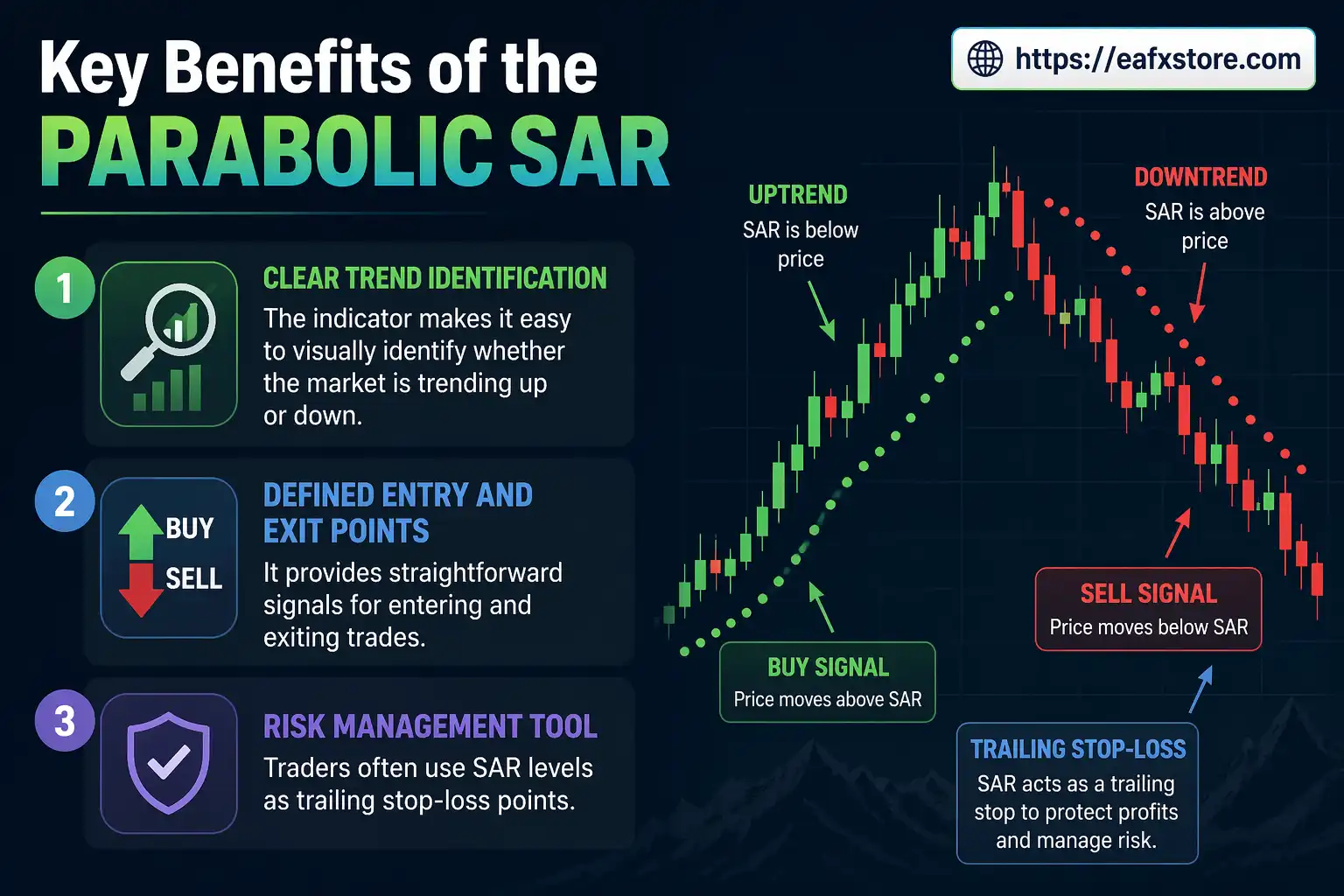
1. Clear Trend Identification
The indicator makes it easy to visually identify whether the market is trending up or down.
2. Defined Entry and Exit Points
It provides straightforward signals for entering and exiting trades.
3. Risk Management Tool
Traders often use SAR levels as trailing stop-loss points.
Limitations You Should Know
No indicator is perfect, and the Parabolic SAR has its weaknesses:
- Performs poorly in sideways or ranging markets
- Can produce false signals during low volatility
- Needs confirmation from other indicators
Because of this, experienced traders rarely use it in isolation.
Parabolic SAR Trading Strategy (Step-by-Step)
Let’s break down a practical strategy you can apply immediately.
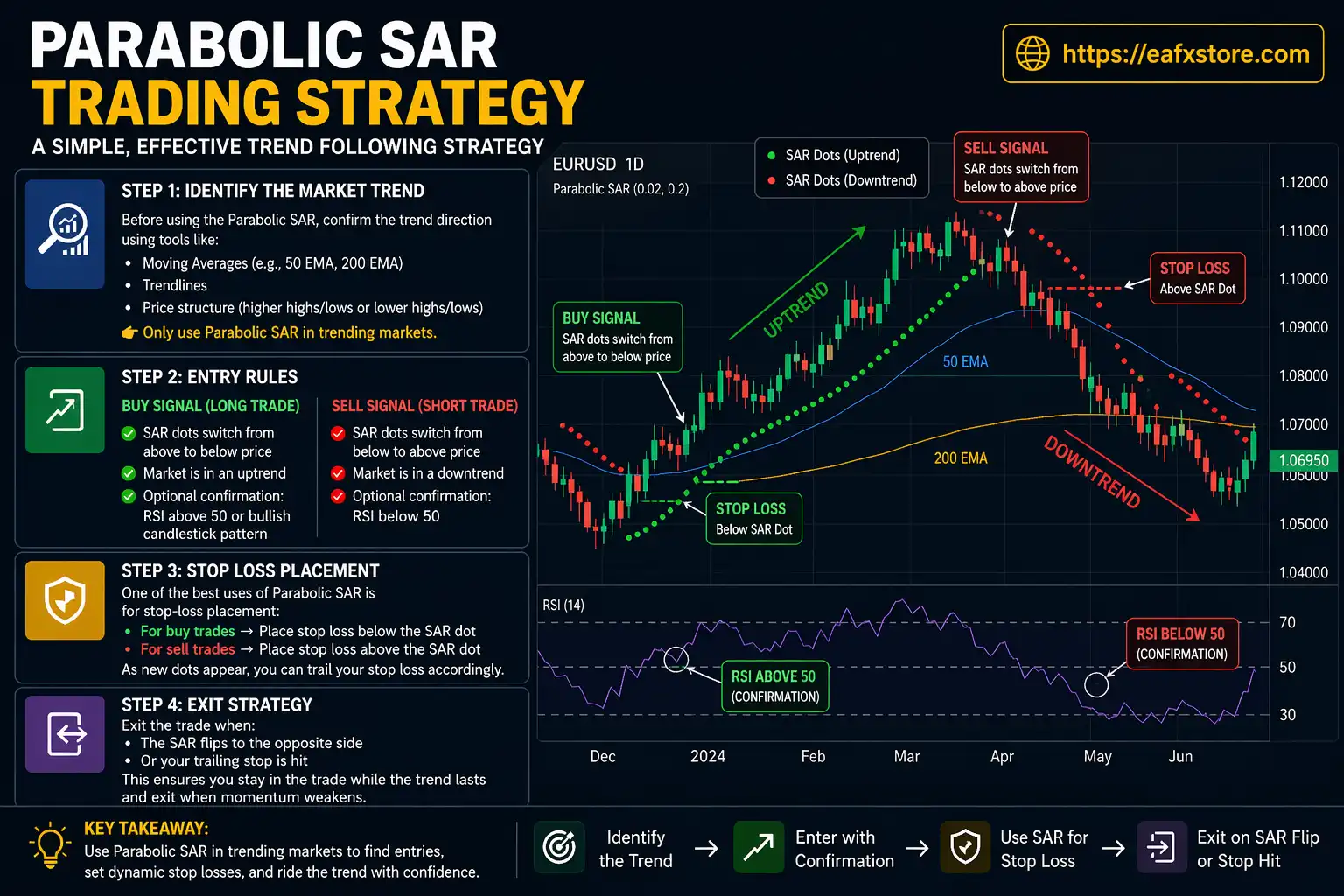
Step 1: Identify the Market Trend
Before using the Parabolic SAR, confirm the trend direction using tools like:
- Moving Averages (e.g., 50 EMA, 200 EMA)
- Trendlines
- Price structure (higher highs/lows or lower highs/lows)
👉 Only use Parabolic SAR in trending markets.
Step 2: Entry Rules
Buy Signal (Long Trade)
- SAR dots switch from above to below price
- Market is in an uptrend
- Optional confirmation: RSI above 50 or bullish candlestick pattern
Sell Signal (Short Trade)
- SAR dots switch from below to above price
- Market is in a downtrend
- Optional confirmation: RSI below 50
Step 3: Stop Loss Placement
One of the best uses of Parabolic SAR is for stop-loss placement:
- For buy trades → Place stop loss below the SAR dot
- For sell trades → Place stop loss above the SAR dot
As new dots appear, you can trail your stop loss accordingly.
Step 4: Exit Strategy
Exit the trade when:
- The SAR flips to the opposite side
- Or your trailing stop is hit
This ensures you stay in the trade while the trend lasts and exit when momentum weakens.
Combining Parabolic SAR with Other Indicators
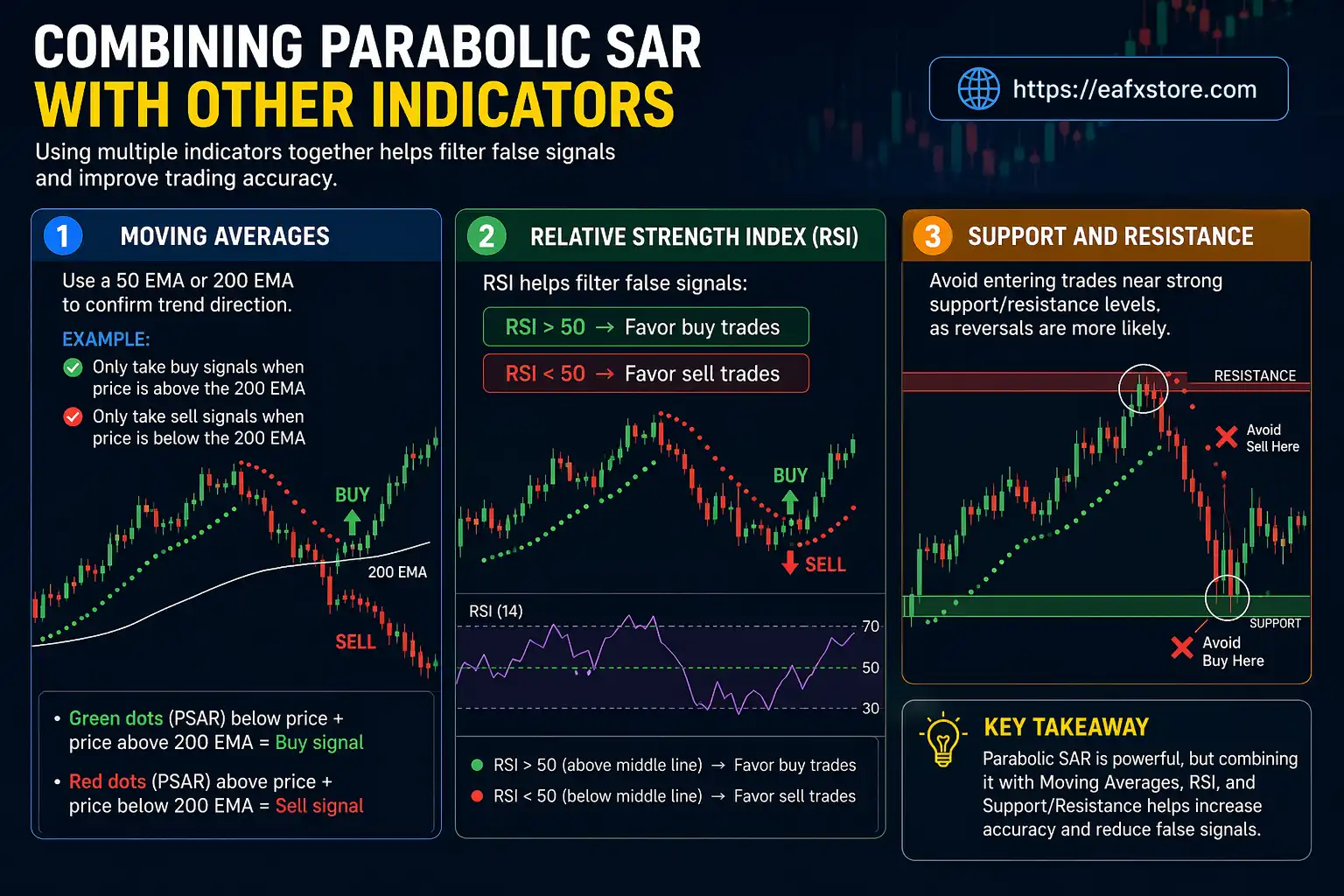
To improve accuracy, combine Parabolic SAR with other tools:
1. Moving Averages
Use a 50 EMA or 200 EMA to confirm trend direction.
Example:
- Only take buy signals when price is above the 200 EMA
- Only take sell signals when price is below the 200 EMA
2. Relative Strength Index (RSI)
RSI helps filter false signals:
- RSI > 50 → Favor buy trades
- RSI < 50 → Favor sell trades
3. Support and Resistance
Avoid entering trades near strong support/resistance levels, as reversals are more likely.
Best Timeframes for Parabolic SAR
The Parabolic SAR works best on:
- H1 (1-hour)
- H4 (4-hour)
- Daily charts
Lower timeframes (like M1 or M5) tend to generate too many false signals due to market noise.
Example Trade Setup
Scenario: EUR/USD Uptrend
- Price is above the 200 EMA
- Parabolic SAR flips below price
- RSI is above 50
👉 You enter a buy trade
👉 Stop loss placed below SAR
👉 Trail stop as SAR moves up
You exit when SAR flips above price, locking in profits.
Pro Tips for Consistent Forex Profits
- Avoid ranging markets: This is where Parabolic SAR performs worst
- Use confirmation tools: Never rely on one indicator
- Stick to a trading plan: Consistency beats randomness
- Backtest your strategy: Validate before risking real money
- Manage risk: Never risk more than 1–2% per trade
Common Mistakes to Avoid
1. Overtrading
Taking every SAR signal without filtering leads to losses.
2. Ignoring Market Conditions
Using SAR in sideways markets results in frequent whipsaws.
3. No Risk Management
Even the best strategy fails without proper stop-loss discipline.
Is Parabolic SAR Good for Forex Beginners?
Yes—but with caution.
The Parabolic SAR is beginner-friendly because of its visual simplicity. However, beginners should:
- Combine it with other indicators.
- Practice on a demo account first.
- Focus on understanding trends.
Final Thoughts
The Parabolic SAR is a powerful tool when used in the right market conditions. It excels in trending environments and provides clear, actionable signals for entries, exits and risk management.
However, consistent Forex profits don’t come from a single indicator—they come from discipline, proper risk management and a well-tested strategy.