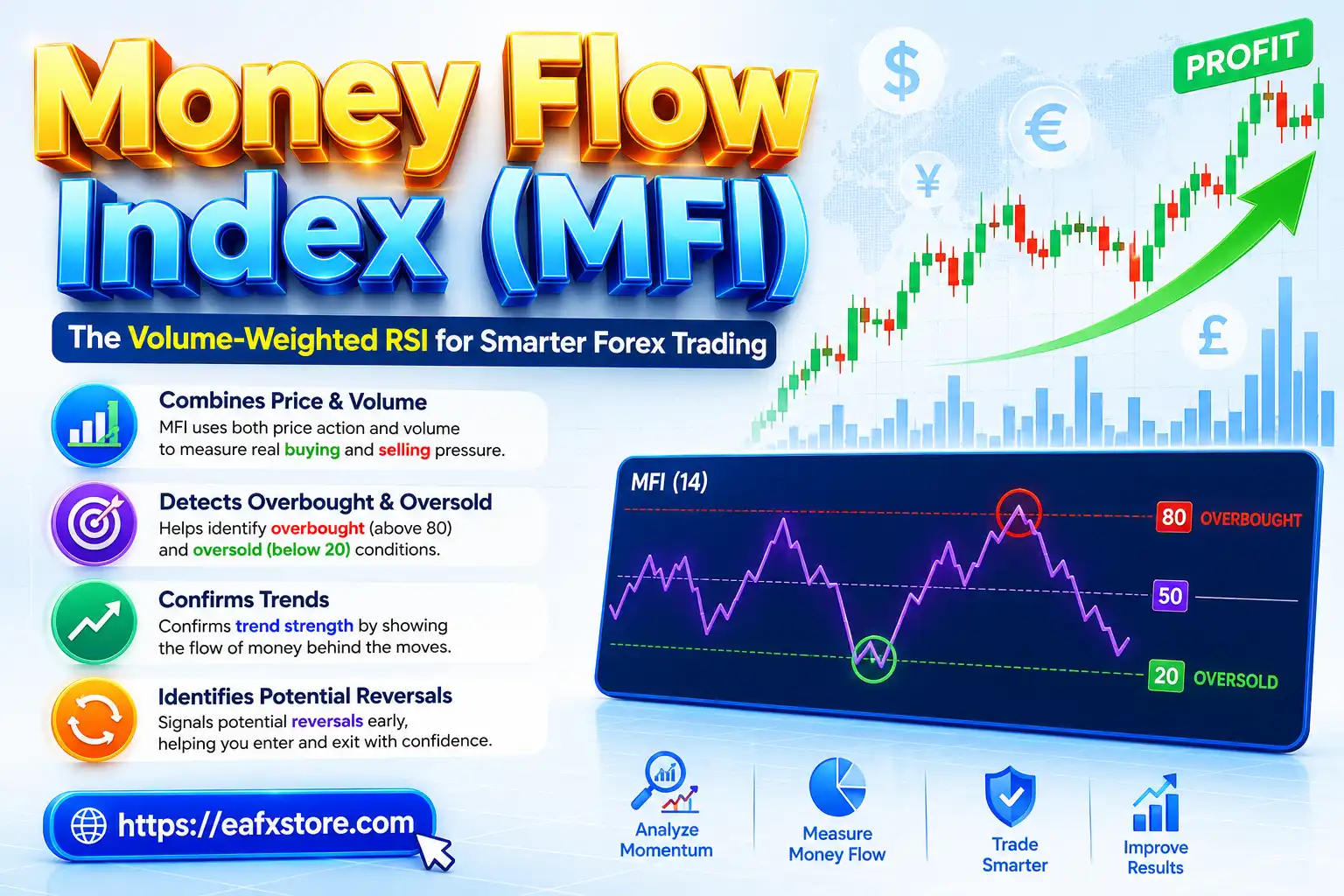


The Forex market is highly dynamic, and traders constantly search for indicators that can improve accuracy and profitability. One of the most effective momentum indicators is the Money Flow Index (MFI). Unlike many traditional indicators, the MFI combines both price action and trading volume, helping traders identify overbought and oversold market conditions more effectively.
What is the Money Flow Index (MFI)?
The Money Flow Index (MFI) is a technical analysis indicator developed to measure the flow of money into and out of an asset. It is often referred to as a volume-weighted Relative Strength Index (RSI) because it includes volume data in its calculation.
The MFI moves between 0 and 100 and helps traders determine whether a currency pair is overbought or oversold.
Key MFI Levels:
| MFI Level | Market Condition |
|---|---|
| Above 80 | Overbought |
| Below 20 | Oversold |
| Around 50 | Neutral Trend |
The indicator is commonly set to a 14-period timeframe, though traders can customize it based on their trading style.
How the Money Flow Index Works
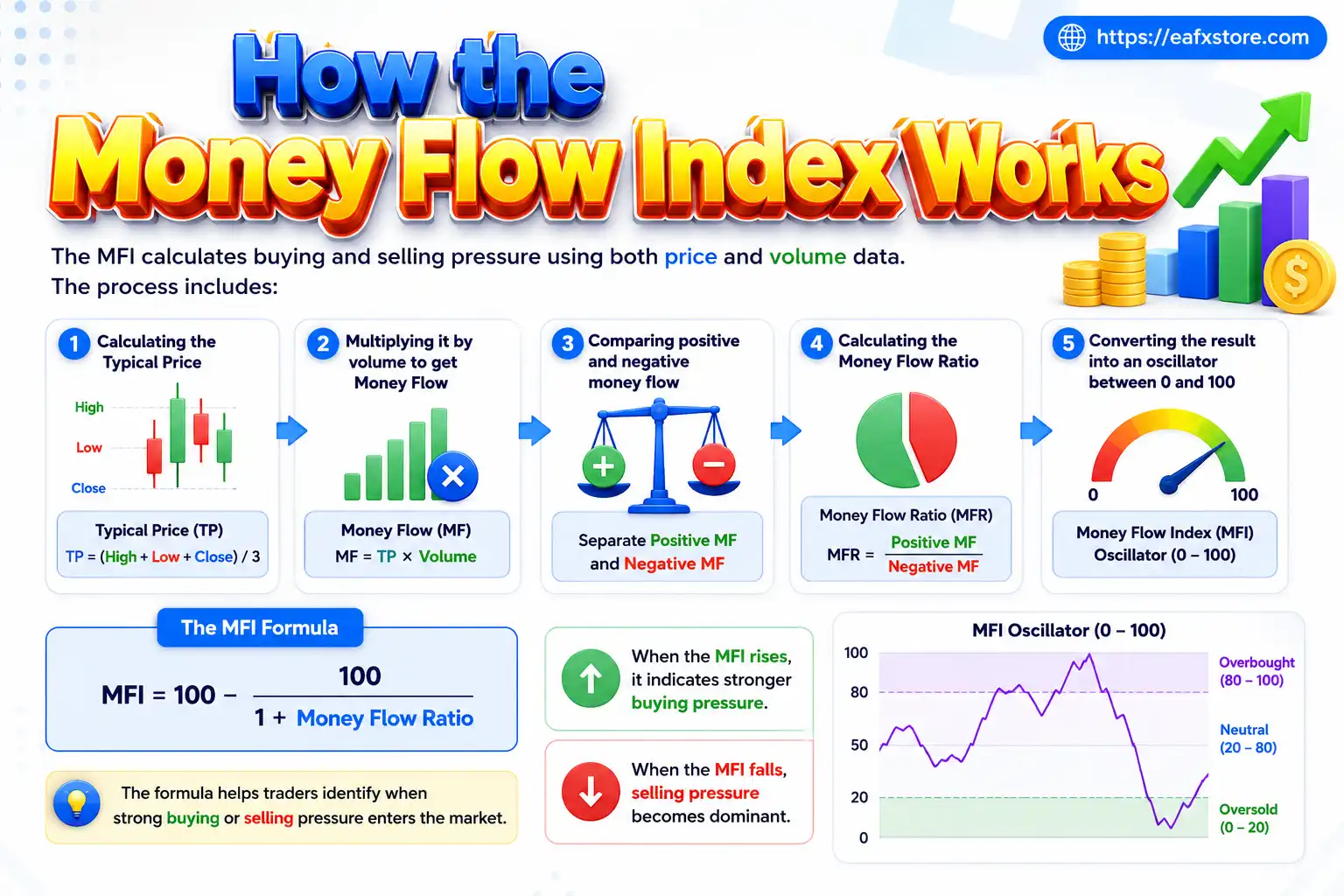
The MFI calculates buying and selling pressure using both price and volume data. The process includes:
- Calculating the Typical Price.
- Multiplying it by volume to get Money Flow.
- Comparing positive and negative money flow.
- Converting the result into an oscillator between 0 and 100.
The formula helps traders identify when strong buying or selling pressure enters the market.
When the MFI rises, it indicates stronger buying pressure. When it falls, selling pressure becomes dominant.
Why MFI Is Important in Forex Trading
The Money Flow Index is valuable because it provides insights beyond simple price movement. Since it includes volume, traders can better understand market strength and potential reversals.
Benefits of Using MFI:
- Identifies overbought and oversold conditions.
- Detects trend reversals early.
- Confirms trend strength.
- Works well with other indicators.
- Suitable for day trading and swing trading.
Forex traders often combine the MFI with support and resistance levels for better trade accuracy.

Best MFI Trading Strategies for Forex
There are several powerful ways to use the Money Flow Index in Forex trading. Below are the most effective strategies.
🔄 Overbought and Oversold Strategy
This is the most popular MFI strategy.
- When the MFI rises above 80, the market may be overbought, signaling a possible sell opportunity.
- When the MFI falls below 20, the market may be oversold, signaling a potential buy opportunity.
However, traders should avoid entering trades immediately. It is better to wait for confirmation from candlestick patterns or trend direction.
Example:
| Signal | Action |
|---|---|
| MFI above 80 | Look for sell setups |
| MFI below 20 | Look for buy setups |
This strategy works best in ranging markets.
🔄 MFI Divergence Strategy
Divergence occurs when price movement and the MFI move in opposite directions.
Bullish Divergence
- Price makes lower lows
- MFI makes higher lows
- Indicates a possible upward reversal
Bearish Divergence
- Price makes higher highs
- MFI makes lower highs
- Indicates a possible downward reversal
Divergence is considered one of the strongest signals because it may reveal weakening momentum before price reverses.
🔄 Trend Confirmation Strategy
The MFI can also confirm whether a trend is strong or weak.
- Rising MFI supports bullish trends
- Falling MFI supports bearish trends
If price rises while the MFI also rises, the uptrend is likely strong. If price rises but the MFI falls, the trend may lose momentum.
Many professional traders combine MFI with moving averages for stronger confirmation signals.
Best Timeframes for Using MFI
The MFI works on multiple timeframes, but the best timeframe depends on your trading style.
| Trading Style | Recommended Timeframe |
|---|---|
| Scalping | 1M – 5M |
| Day Trading | 15M – 1H |
| Swing Trading | 4H – Daily |
Higher timeframes usually produce more reliable signals because they reduce market noise.
Common Mistakes When Using MFI
Although the Money Flow Index is powerful, many traders misuse it. Avoid these common mistakes:
🔄 Ignoring the Trend
Trading against the major trend can lead to unnecessary losses. Always confirm the overall market direction first.
🔄 Using MFI Alone
The MFI should not be your only indicator. Combine it with:
- Support and Resistance
- Trendlines
- Moving Averages
- Candlestick patterns
🔄 Entering Trades Too Early
Overbought does not always mean the market will immediately reverse. Wait for confirmation before entering a trade.
🔄 Risking Too Much Capital
Always use stop-loss orders and proper risk management to protect your trading account.

Combining MFI with Other Indicators
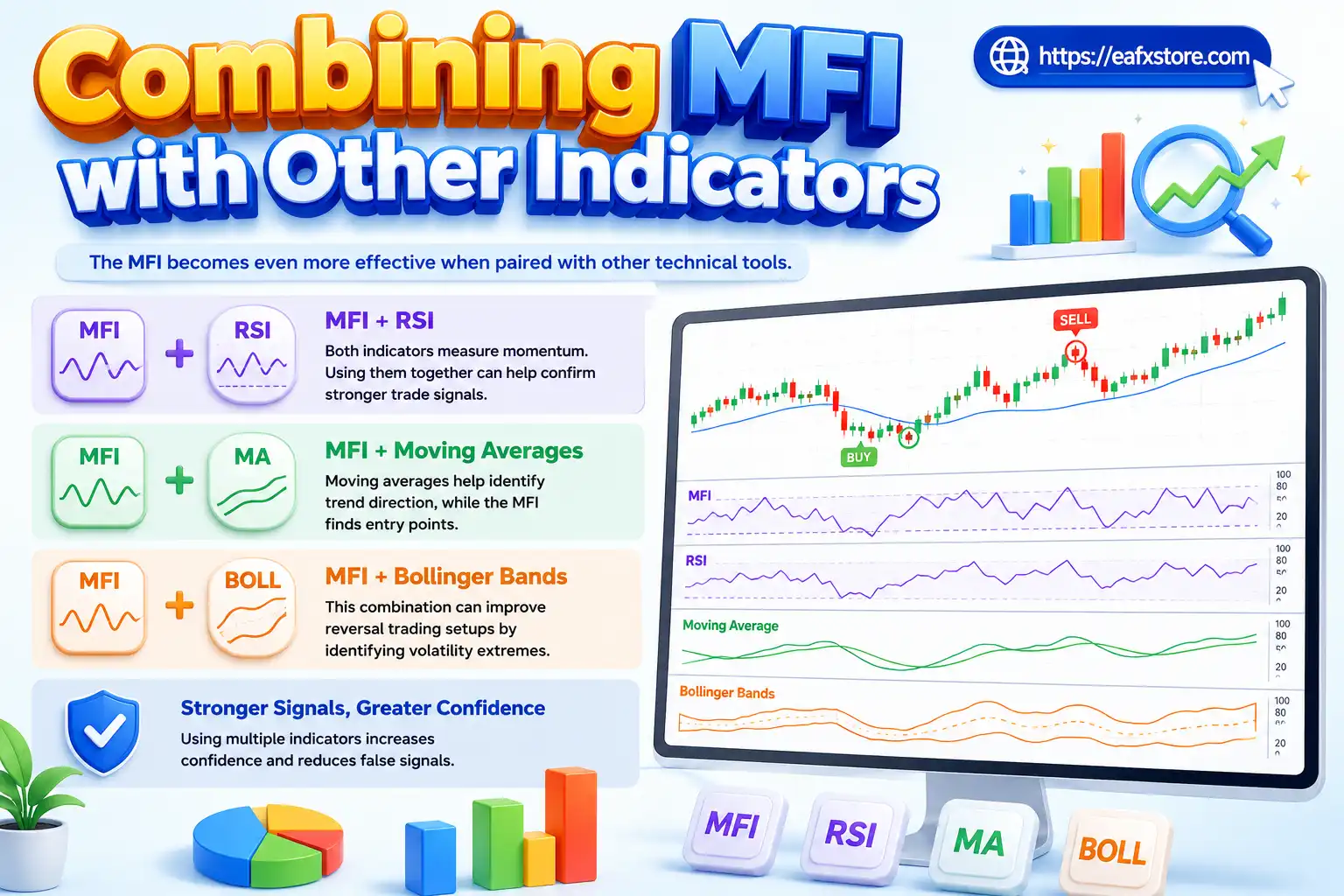
The MFI becomes even more effective when paired with other technical tools.
🔄 MFI + RSI
Both indicators measure momentum. Using them together can help confirm stronger trade signals.
🔄 MFI + Moving Averages
Moving averages help identify trend direction, while the MFI finds entry points.
🔄 MFI + Bollinger Bands
This combination can improve reversal trading setups by identifying volatility extremes.
Using multiple indicators increases confidence and reduces false signals.
Risk Management Tips for MFI Trading
No trading strategy guarantees profits. Proper risk management is essential for long-term success.
Important Risk Management Rules:
| Rule | Recommendation |
|---|---|
| Risk per trade | 1% – 2% of account |
| Stop-loss usage | Always required |
| Risk-to-reward ratio | Minimum 1:2 |
| Emotional trading | Avoid completely |
Successful Forex trading depends more on discipline than on finding a “perfect” indicator.
Conclusion
The Money Flow Index (MFI) is one of the most effective indicators for Forex traders because it combines price momentum with volume analysis. It helps identify overbought and oversold conditions, trend strength and potential reversals.
To maximize profits with the MFI:
- Trade with the trend.
- Wait for confirmation signals.
- Combine MFI with other indicators.
- Use proper risk management.
When used correctly, the MFI can become a powerful part of your Forex trading strategy and help improve overall trading performance.
FAQs
❓ What is the best MFI setting for Forex trading?
The default 14-period setting is the most commonly used and works well for most trading styles.
❓ Is the Money Flow Index better than RSI?
The MFI includes volume data, making it more informative in some market conditions, while RSI focuses only on price momentum.
❓ Can beginners use the MFI indicator?
Yes. The MFI is beginner-friendly and easy to understand, especially when combined with basic support and resistance analysis.
❓ Does MFI work for all currency pairs?
Yes. The MFI can be used on major, minor, and exotic Forex pairs across different timeframes.
❓ Can the MFI predict market reversals?
The MFI can help identify potential reversals, especially when divergence appears, but confirmation from other indicators is recommended.