Before analyzing any pair, you must know the time frame for which you will analyze it. The Forex market consists of many time frames. Knowing each frame and the extent of its impact on the market is very important because each frame has its secrets and strengths that will move the market for a certain period.
The Power of Time Frames
1 – What are the time frames?
The financial markets, specifically the Forex market, consist of several time frames. These time frames show you what happened in the past. For example, if you want to know what happened to the price movement in a previous month, you will open the monthly chart and you will see the opening price and the closing price of the monthly candle. You will also see the highest price and the lowest price.
But if you want to go deeper into the details and want to know what exactly happened during the month through several candles so that you can analyze the pair more accurately, in this case, you can look at the daily or 4-hour frame and these two frames will give you more accurate details and will help you know what exactly happened at the important levels and what was the price reaction from these levels.
2 – Types of time frames
There are many types of time frames that you will find in Forex, starting from the minute to the monthly chart. These frames display the price movement in a specific period of time. For example, if you look at the daily frame, this is the price movement throughout the day and the same thing in the four-hour (H4). Each candle equals 4 hours of continuous movement. The day’s candle consists of 6 four-hour candles, and the month’s candle consists of 30 day candles. That is, each time frame completes the other.
Long-Term Time Frames
Large time-frames such as monthly and weekly are used by investors and long-term traders. The signals from these frames are very strong, as it is difficult to manipulate price movements on large time frames because the price always returns to its natural path.
Traders usually analyze the larger time frames to know the general trend of the pair and to identify important levels. These areas are usually strong and highly respected by the price because these areas were formed over a long period and are highly credible.
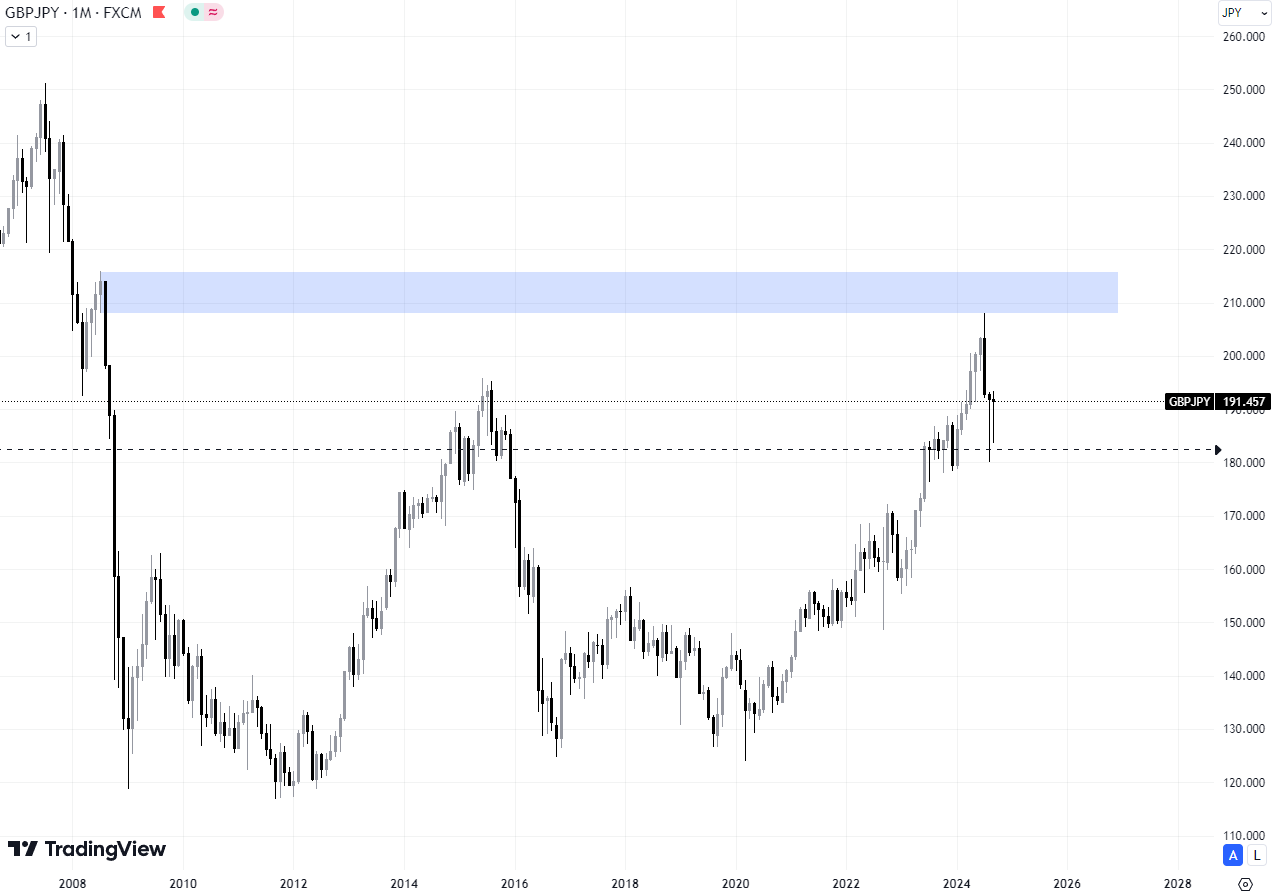
Higher time frame
For example, you can identify important support and resistance levels (supply and demand) that the price may respect and show a reaction if it reaches these areas.
Medium-Term Time Frames
The Medium time frames such as the daily and four-hour (4H) are usually used by the intraday and swing traders, but this does not prevent them from taking a look at the Higher frames in order to be able to know the general trend and important Levels that may help them in determining the appropriate entry area on the daily or four-hours
The daily chart is one of the most important frames that you will use in Forex because it is easy to deal with and easy to read. It is used by banks and large institutions in their analyses (market makers), and you will find The important levels in this frame.
Short-Term Time Frames
The Short time frame starts from the minute to the 4 hours and is used by scalpers and intraday traders. It is also possible to analyze the higher frames to know the important areas to make an appropriate decision based on that and execute the orders in the Lower frames.

As for the daily trader, he uses medium time frames and leaves his trades for a week at most, and the risk ratio in one Trade is somewhat less because the number of his orders is greater than the investor, so the risk ratio maybe 10% or less.
The scalper trader is completely different because he opens many trades throughout the day and usually uses very small time frames such as 5 minutes, 15 minutes, and possibly 1 minute. This type of trader risks a very small percentage of his capital because he opens many orders and to be able to bear this amount of trades, the risk percentage is between 0.5% to 1% in a single trade.
Strategy vs Time frame
Can the strategy be affected by the time frame? Of course yes because there are strategies that work on specific frames and if you try to use the same strategy on more than one frame, this strategy may fail or at least you will not find the same results that you are used to
This does not negate the existence of a strategy that works on all time frames. A good strategy usually works in any frame. It can be formed on any frame you want. This is considered one of the strengths of the strategy. However, the strategy usually gives very good results in a specific frame. If you try to use the same strategy in a different frame, it may give you strange signals and completely different results than before.
Therefore, when choosing the strategy that you will trade on, You should first make sure that the strategy works on all time frames, in this way, you will test it however you want, or whether it works on a specific frame, and in this case you are committed to this frame so that you do not fall into unnecessary losses.
4 – The logic Behind Time frames
The logic behind Time frames
Time frames are one of the most important auxiliary factors used by analysts because each frame helps the analysts to know the previous price movement in a specific period of time. Analysts usually use different time frames to know the trend and find the appropriate levels to enter from.
How do prices move in different time frames?
If you look at the chart on the 5-minute, for example, you will find that the price movement is very fast compared to the daily, and the same thing on the minute compared to the 5-minute. What is the secret of this speed of movement? In fact, the speed is considered the same, so there is no difference in the speed of price movement.
The reason you see prices moving faster as you go down the lower time frame is that the finer details of market movement become more apparent, as momentary fluctuations that are not noticeable on the higher frames become apparent, making the market appear more active and dynamic Especially in News times
It is similar to if you zoomed in on the chart, if you were on the daily chart and wanted to know more precise details of what happened during the day, you would go to the 4-hour chart and watch the last 6 candles (i.e. one-day candle) or go to the hourly chart and watch the last 24 candles…etc.
Each time frame has its strength, but they are almost similar in the method of analysis in terms of drawing the Support and resistance, the trend line, supply and demand Levels, etc. The only difference between them is that the higher the frame you use, the more accurate and powerful information it gives you. This information confirms your analysis, and the Higher the time frame you use, the more accurate your analysis will be.
There are many time frames in Forex and each frame gives you different signals from the other in terms of accuracy and the strength of the area, whether the price will respect it or not, and each frame contains more details than the frame that follows it and vice versa. To choose the appropriate time frame for you, you must first determine your trading plan and whether you are a day trader, scalper, or investor because each trader has the appropriate time frame.