
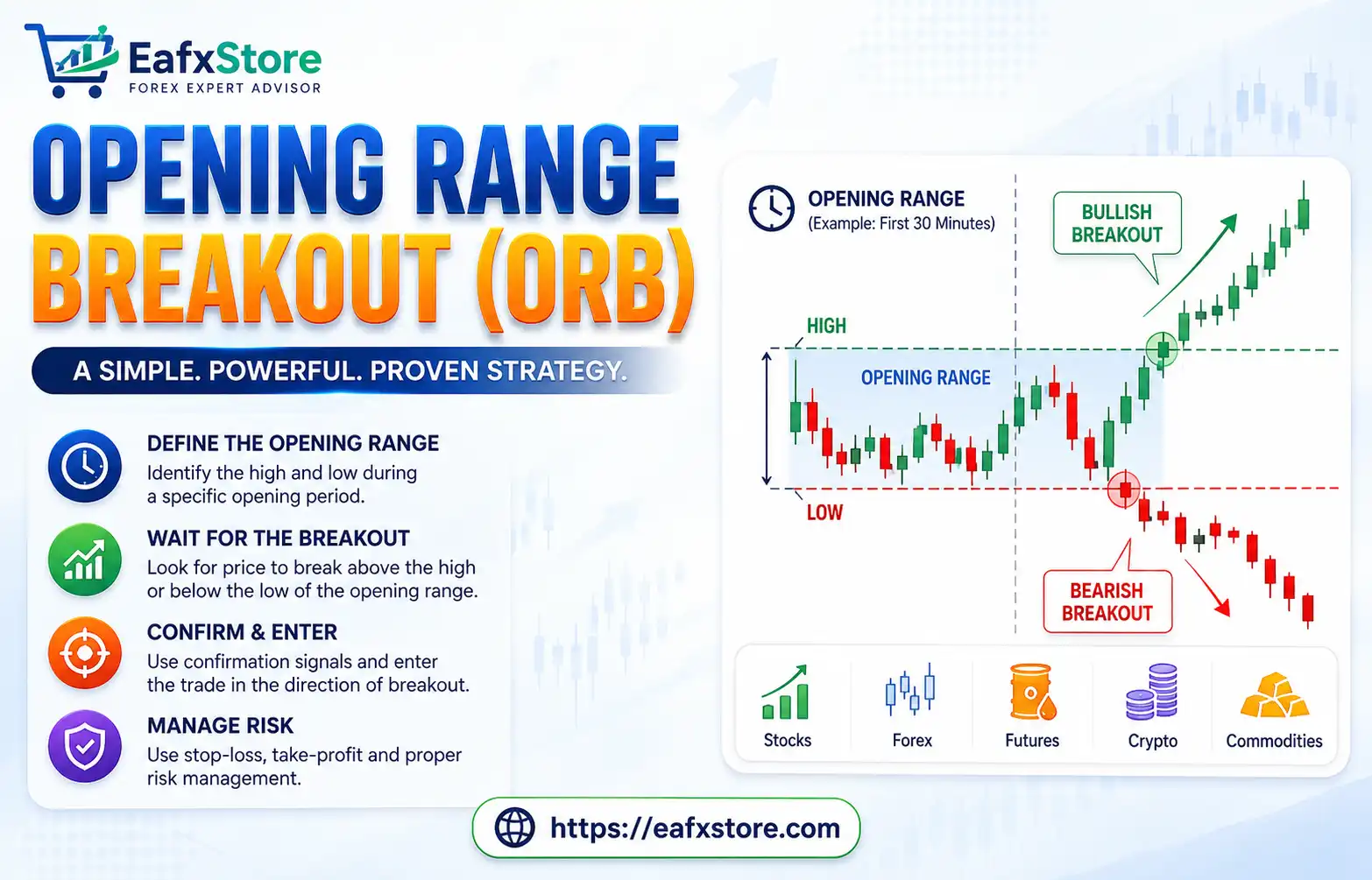
The Opening Range Breakout (ORB) is a popular trading strategy that focuses on price movements during the early part of a market session. Instead of trying to predict the entire market trend, ORB traders identify the high and low established during a specific opening period and then look for a breakout beyond those levels.
Because of its simple structure and clear entry points, the Opening Range Breakout (ORB) strategy is widely used in day trading, scalping, stocks, forex, futures, and other financial markets. In this guide, we will explain what ORB is, how it works, how traders identify breakout opportunities and the key risks to consider.
What is Opening Range Breakout (ORB)?
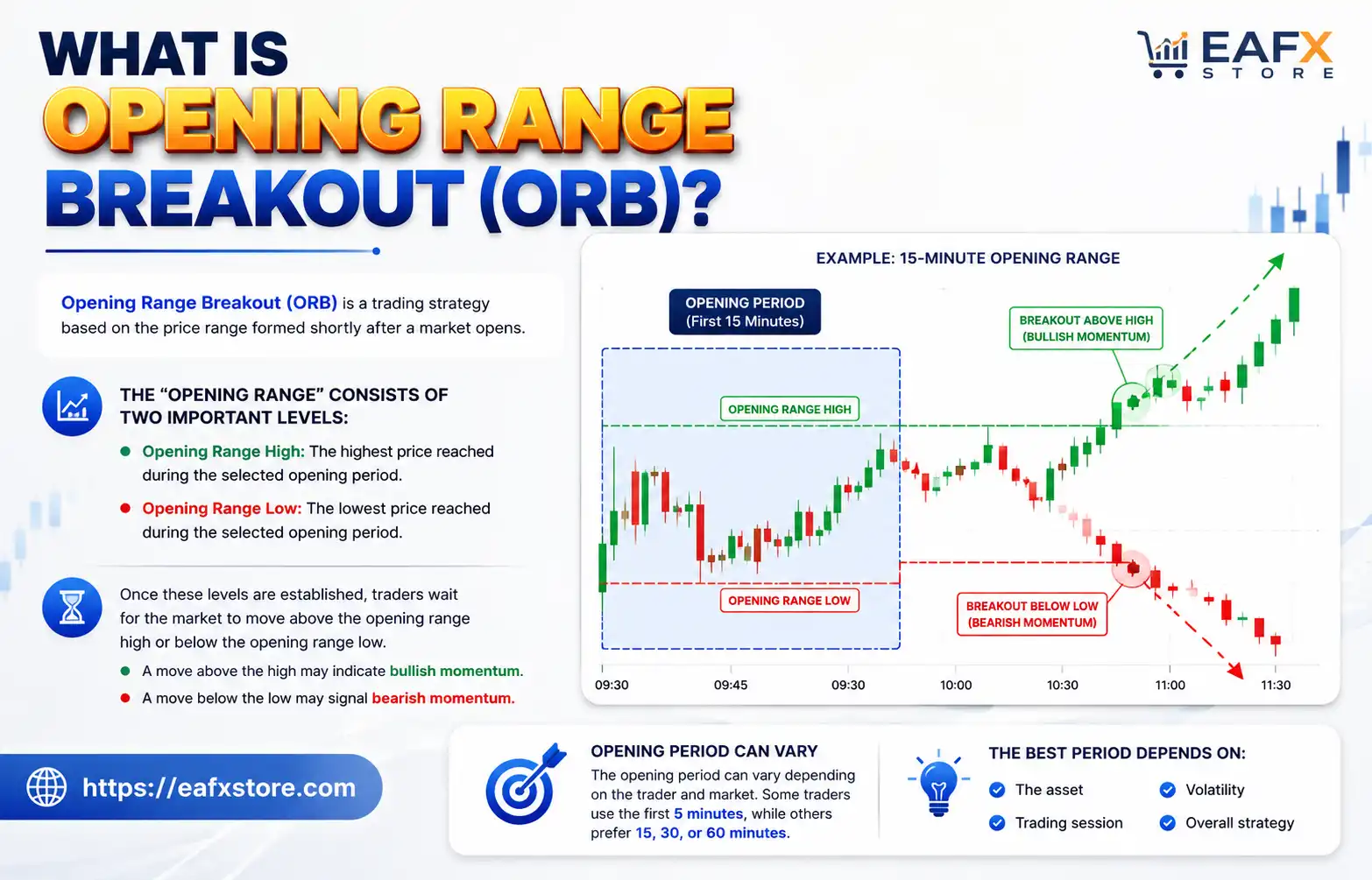
Opening Range Breakout (ORB) is a trading strategy based on the price range formed shortly after a market opens.
The “opening range” consists of two important levels:
- Opening Range High: The highest price reached during the selected opening period.
- Opening Range Low: The lowest price reached during the selected opening period.
Once these levels are established, traders wait for the market to move above the opening range high or below the opening range low.
A move above the high may indicate bullish momentum, while a move below the low may signal bearish momentum.
The opening period can vary depending on the trader and market. Some traders use the first 5 minutes, while others prefer 15, 30, or 60 minutes. The best period depends on the asset, trading session, volatility and overall strategy.
How Does the Opening Range Breakout Work?
The basic ORB strategy follows a relatively simple process.
First, the trader selects a specific market session and opening period. For example, a trader may use the first 15 minutes after the market opens.
During this period, the trader records the highest and lowest prices.
These two prices become the ORB resistance and support levels.
After the opening range is established, the trader waits for a breakout.
If price moves above the opening range high, a trader may consider a long position. If price breaks below the opening range low, a trader may consider a short position.
However, simply touching or briefly moving beyond the range does not always mean a valid breakout. Many traders wait for a candle close outside the range or use additional confirmation such as trading volume, momentum, trend direction, or volatility.
Example of an ORB Trading Setup
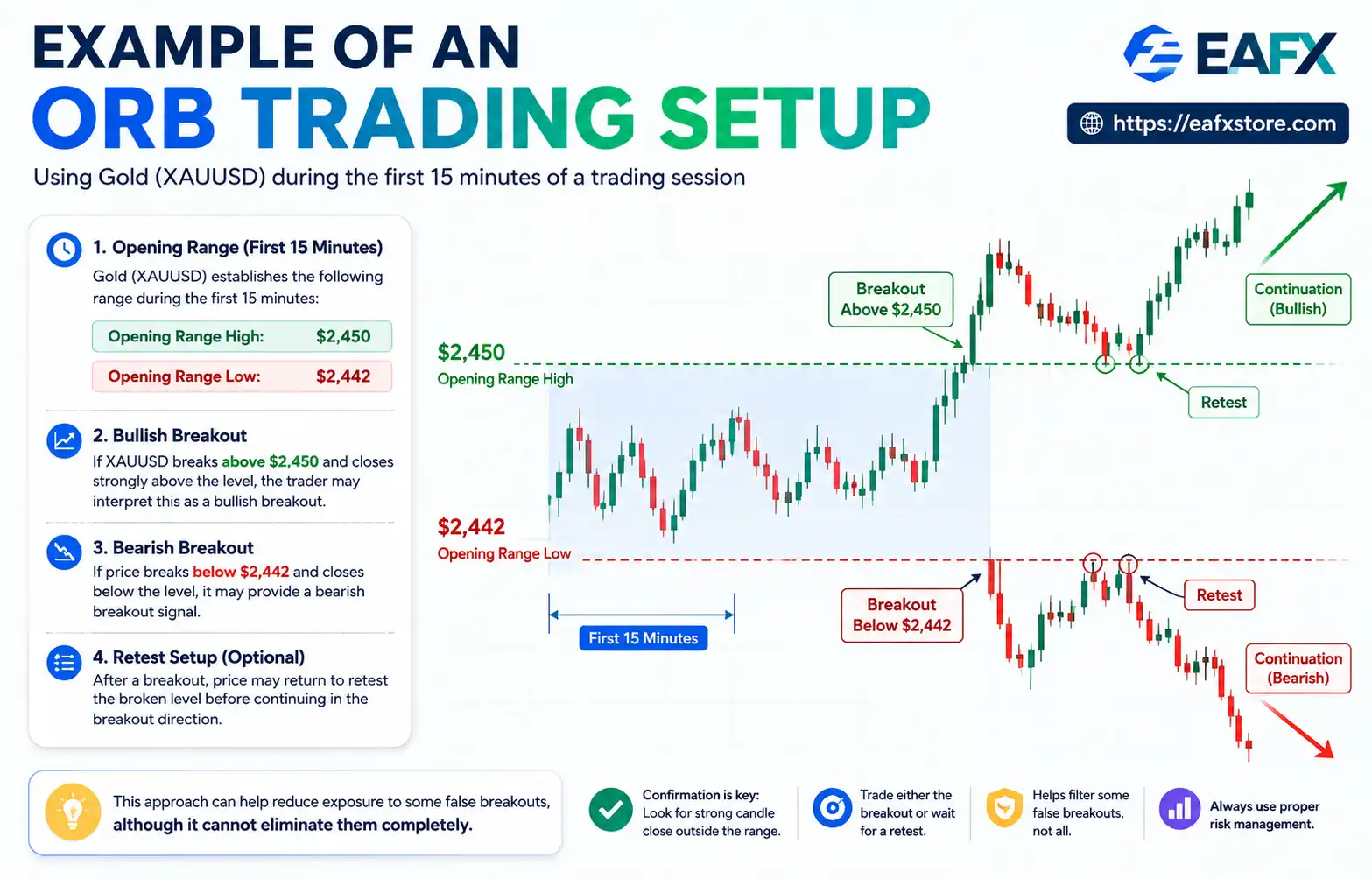
Suppose Gold (XAUUSD) establishes the following range during the first 15 minutes of a trading session:
- Opening Range High: $2,450
- Opening Range Low: $2,442
The trader then waits for price to move outside this range.
If XAUUSD breaks above $2,450 and closes strongly above the level, the trader may interpret this as a bullish breakout.
If price instead breaks below $2,442 and closes below the level, it may provide a bearish breakout signal.
Some traders enter immediately after confirmation, while others wait for a breakout and retest. In a retest setup, price breaks through the opening range and then returns to test the broken level before continuing in the breakout direction.
This approach can help reduce exposure to some false breakouts, although it cannot eliminate them completely.
Why is ORB Popular Among Traders?
One of the biggest advantages of the Opening Range Breakout strategy is its simplicity.
Instead of analyzing dozens of indicators, traders can focus on a few important price levels. The opening range creates a clear framework for identifying potential support, resistance, entries, and exits.
Another advantage is that ORB is based on market momentum.
The beginning of a trading session can experience increased activity as traders react to overnight developments, economic data, institutional orders, and market sentiment. When price moves outside the established opening range with strong momentum, it may indicate that buyers or sellers are taking control.
ORB can also be adapted to different markets and timeframes, making it useful for both manual traders and automated trading systems.
Key Components of an Opening Range Breakout Strategy
A complete ORB strategy usually includes more than simply buying or selling a breakout.
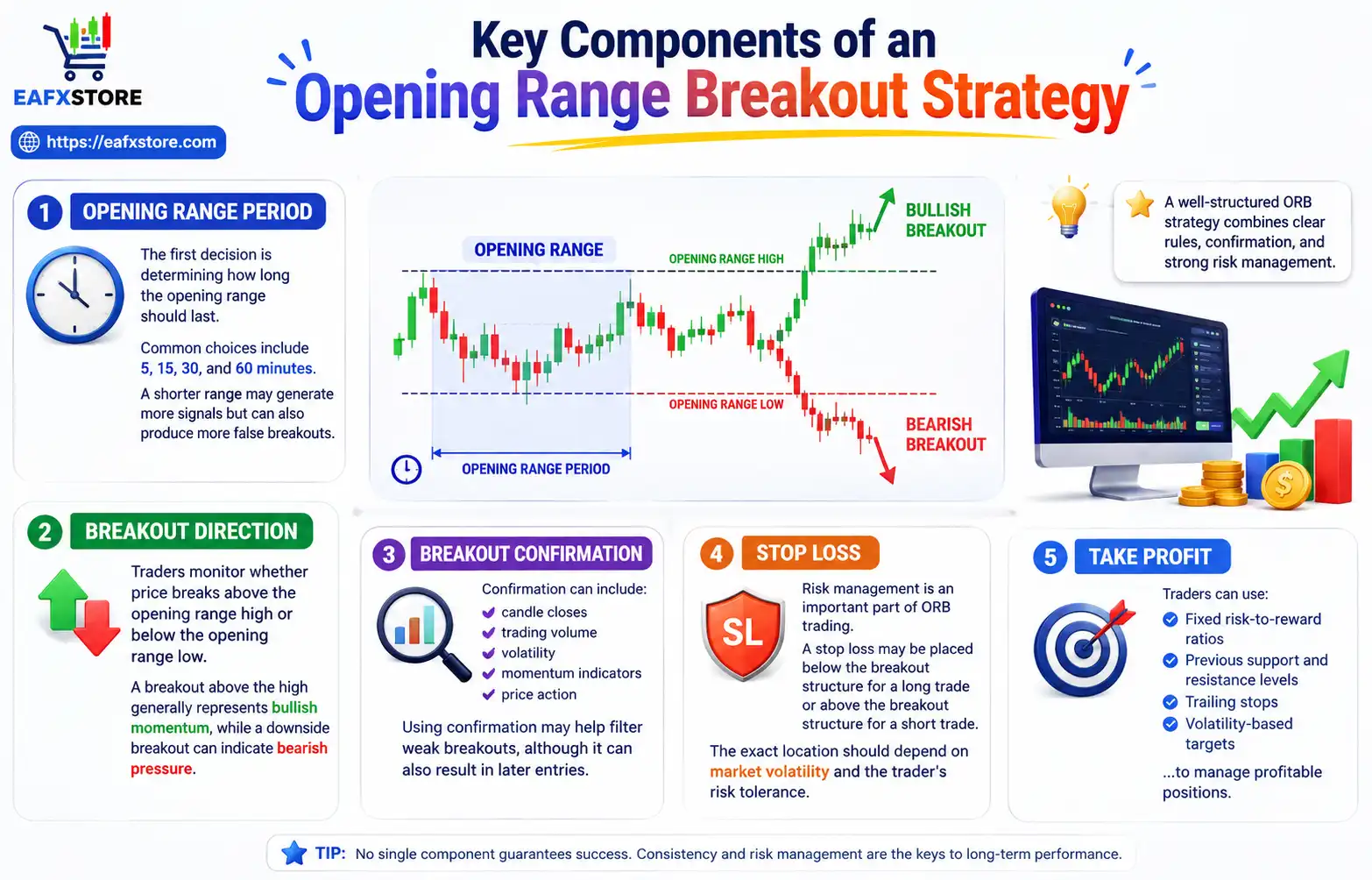
Opening Range Period
The first decision is determining how long the opening range should last.
Common choices include 5, 15, 30, and 60 minutes. A shorter range may generate more signals but can also produce more false breakouts.
Breakout Direction
Traders monitor whether price breaks above the opening range high or below the opening range low.
A breakout above the high generally represents bullish momentum, while a downside breakout can indicate bearish pressure.
Breakout Confirmation
Confirmation can include candle closes, trading volume, volatility, momentum indicators, or price action.
Using confirmation may help filter weak breakouts, although it can also result in later entries.
Stop Loss
Risk management is an important part of ORB trading.
A stop loss may be placed below the breakout structure for a long trade or above the breakout structure for a short trade. The exact location should depend on market volatility and the trader’s risk tolerance.
Take Profit
Traders can use fixed risk-to-reward ratios, previous support and resistance levels, trailing stops, or volatility-based targets to manage profitable positions.
ORB and False Breakouts
One of the biggest challenges of the Opening Range Breakout strategy is the false breakout.
A false breakout occurs when price temporarily moves outside the opening range but then quickly returns inside it.
For example, XAUUSD may move above the opening range high, triggering long entries, before reversing sharply lower. Traders who enter without confirmation may experience a losing trade.
To reduce this risk, traders may combine ORB with:
- Volume confirmation
- ATR volatility analysis
- Moving averages
- Market structure
- Support and resistance
- Higher-timeframe trend analysis
- Candle close confirmation
- Spread and trading-session filters
No filter can guarantee that every breakout will succeed. The goal is to improve trade selection and control risk.
Advantages of Opening Range Breakout
The ORB strategy offers several practical benefits.
Simple trading structure: The strategy is easy to understand because it focuses on clearly defined price levels.
Momentum-based entries: ORB attempts to capture strong movements that occur after price escapes the opening range.
Flexible application: Traders can adapt ORB to different markets, sessions, and opening periods.
Clear risk levels: The opening range provides logical reference points for stop-loss and trade management decisions.
Suitable for automation: Because ORB rules can be clearly defined, the strategy can also be incorporated into Expert Advisors and automated trading systems.
Limitations and Risks of ORB Trading
Despite its advantages, ORB is not a guaranteed-profit strategy.
Market conditions can significantly influence breakout performance. Low-liquidity environments may produce unreliable movements, while extremely volatile sessions can generate large slippage and rapid reversals.
Another limitation is that a narrow opening range may produce frequent breakout signals, many of which can fail. Conversely, a very wide opening range may make the potential risk too large for some traders.
Transaction costs, spreads, commissions, and execution speed can also affect results, especially when ORB is used for short-term trading.
For these reasons, traders should test their strategy using historical data and, where possible, forward testing before committing significant capital.
Is Opening Range Breakout Suitable for Gold Trading?
The Opening Range Breakout (ORB) strategy can be particularly interesting for markets such as Gold (XAUUSD), where volatility can increase significantly during major trading sessions.
Gold can experience rapid price movements around economic releases, central-bank decisions, U.S. market activity, and changes in market sentiment.
An ORB system can use the opening range to identify periods when Gold begins to show strong directional momentum.
However, Gold is also highly volatile. A breakout that looks strong on one candle can quickly reverse. Therefore, traders should consider spread conditions, volatility, position sizing, stop-loss placement, and economic news before trading XAUUSD with an ORB strategy.
Final Thoughts
The Opening Range Breakout (ORB) is a straightforward but flexible trading strategy that uses the early-session price range to identify potential momentum opportunities.
The basic concept is simple: establish the opening range, identify the high and low, wait for price to break one of those levels, and then use appropriate confirmation and risk management before entering a trade.
However, successful ORB trading requires more than simply buying every upside breakout or selling every downside breakout. Market conditions, volatility, false breakouts, trading costs, and risk management can all have a significant impact on performance.
For traders interested in systematic strategies, ORB can also serve as a foundation for more advanced trading systems that combine ATR filters, trend confirmation, volatility analysis, spread protection, and automated risk management.
Ultimately, the goal of an ORB strategy should not be to capture every breakout. Instead, it should focus on identifying higher-quality momentum opportunities while maintaining disciplined and controlled risk.