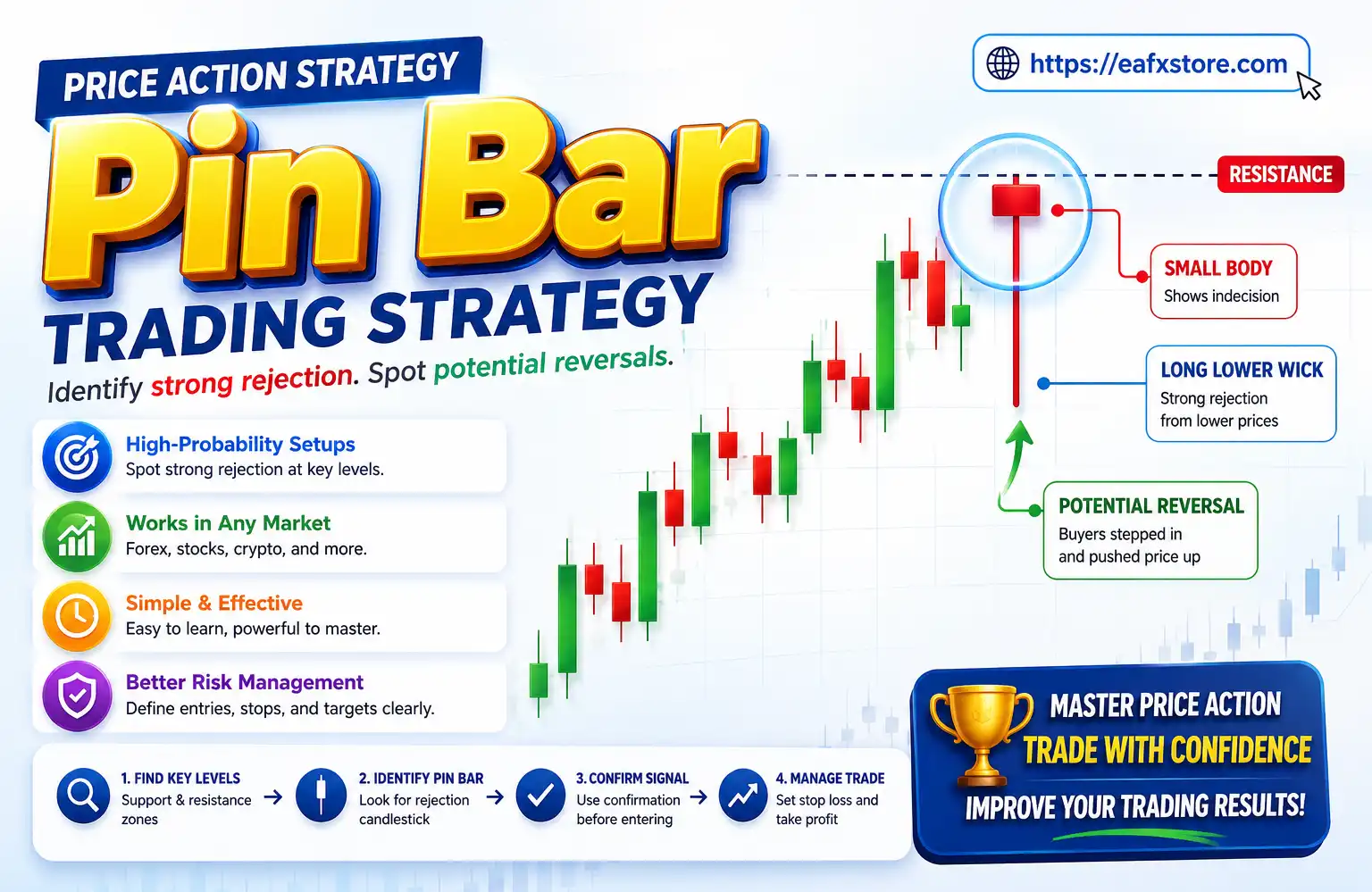

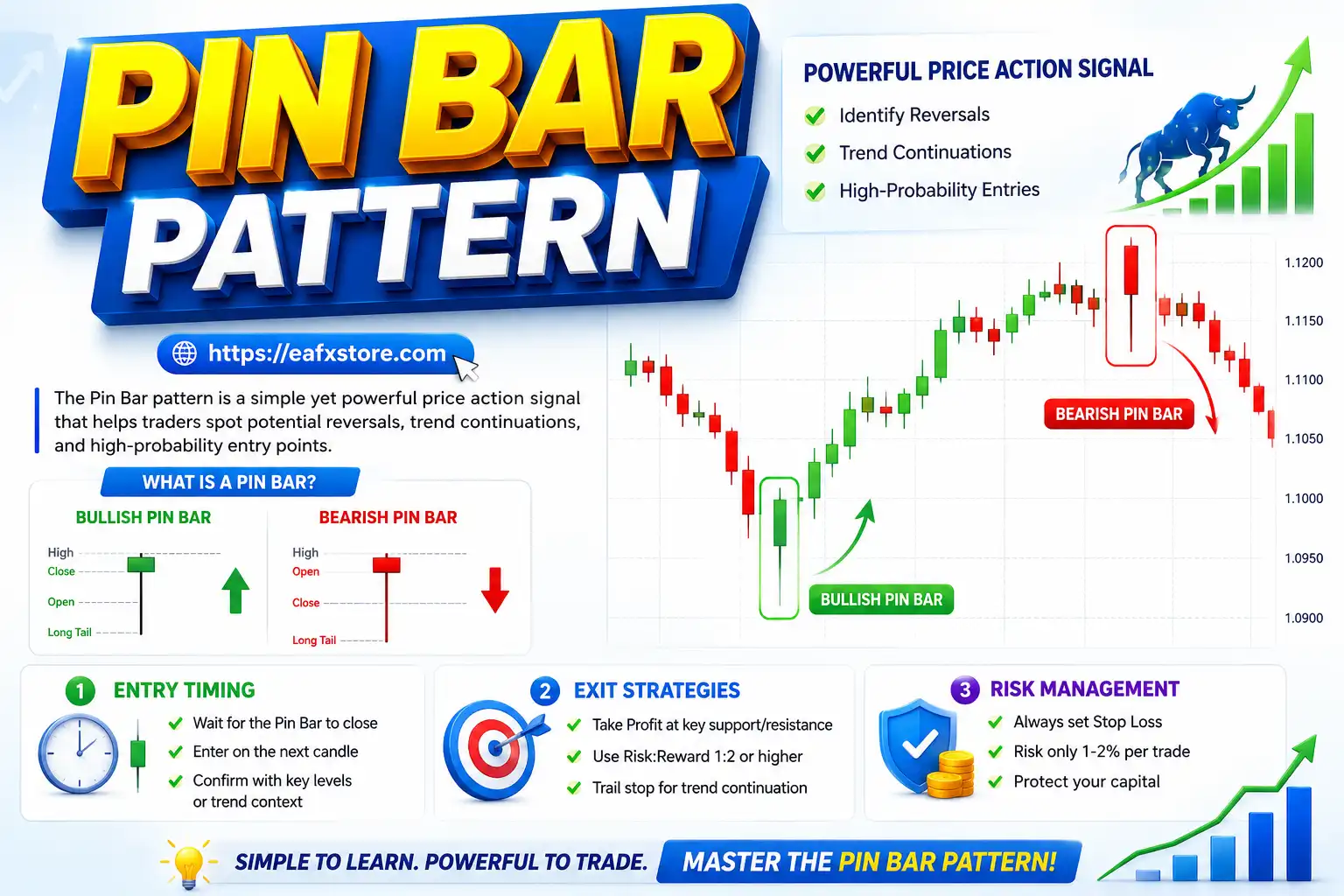
The Pin Bar pattern is one of the most popular price action signals used by forex, crypto and stock traders. Its simplicity and effectiveness make it a favorite among both beginners and experienced traders. When used correctly, a Pin Bar can help traders identify potential market reversals, trend continuations and high-probability entry points.
However, recognizing the pattern alone is not enough. Successful trading also depends on proper entry timing, exit strategies and risk management.
What is a Pin Bar Pattern?
A Pin Bar is a candlestick pattern that indicates a strong rejection of price at a certain level. The term “Pin Bar” comes from “Pinocchio Bar,” referring to the candle’s long wick that suggests the market attempted to move in one direction but quickly reversed.
A typical Pin Bar has:
- A long tail or wick.
- A small body.
- Little or no wick on the opposite side.
The long wick shows rejection from support or resistance levels, while the small body indicates that buyers or sellers lost control during the candle formation. Key Characteristics of a Pin Bar:
| Feature | Description |
|---|---|
| Long Wick | Shows strong rejection |
| Small Body | Indicates weak momentum in one direction |
| Location | Works best near support/resistance |
| Confirmation | Stronger with trend alignment |
A bullish Pin Bar usually appears after a downtrend and suggests buyers are entering the market. A bearish Pin Bar appears after an uptrend and signals potential selling pressure.
Why the Pin Bar Pattern Matters in Trading
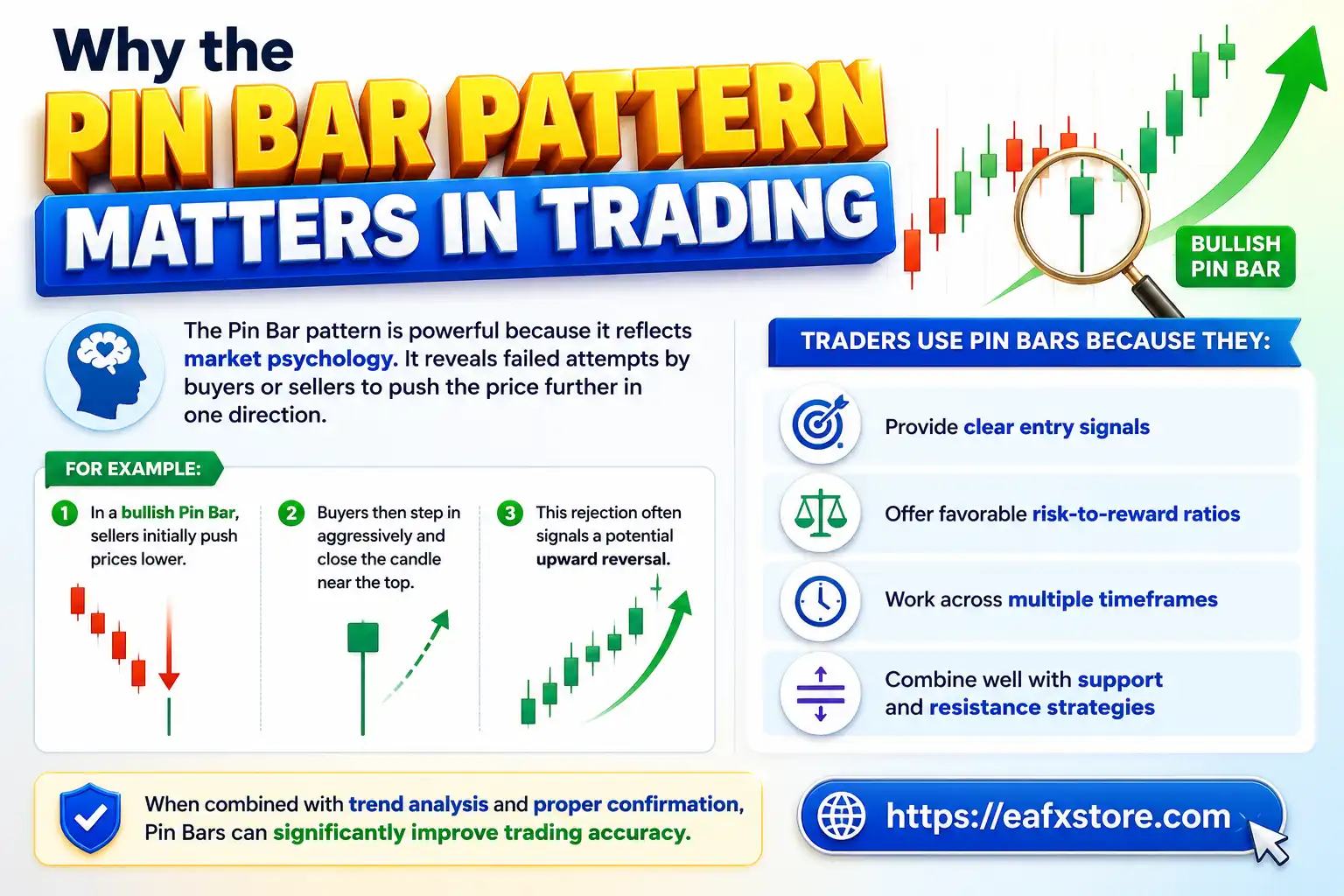
The Pin Bar pattern is powerful because it reflects market psychology. It reveals failed attempts by buyers or sellers to push the price further in one direction.
For example:
- In a bullish Pin Bar, sellers initially push prices lower.
- Buyers then step in aggressively and close the candle near the top.
- This rejection often signals a potential upward reversal.
Traders use Pin Bars because they:
- Provide clear entry signals
- Offer favorable risk-to-reward ratios
- Work across multiple timeframes
- Combine well with support and resistance strategies
When combined with trend analysis and proper confirmation, Pin Bars can significantly improve trading accuracy.
Types of Pin Bar Patterns
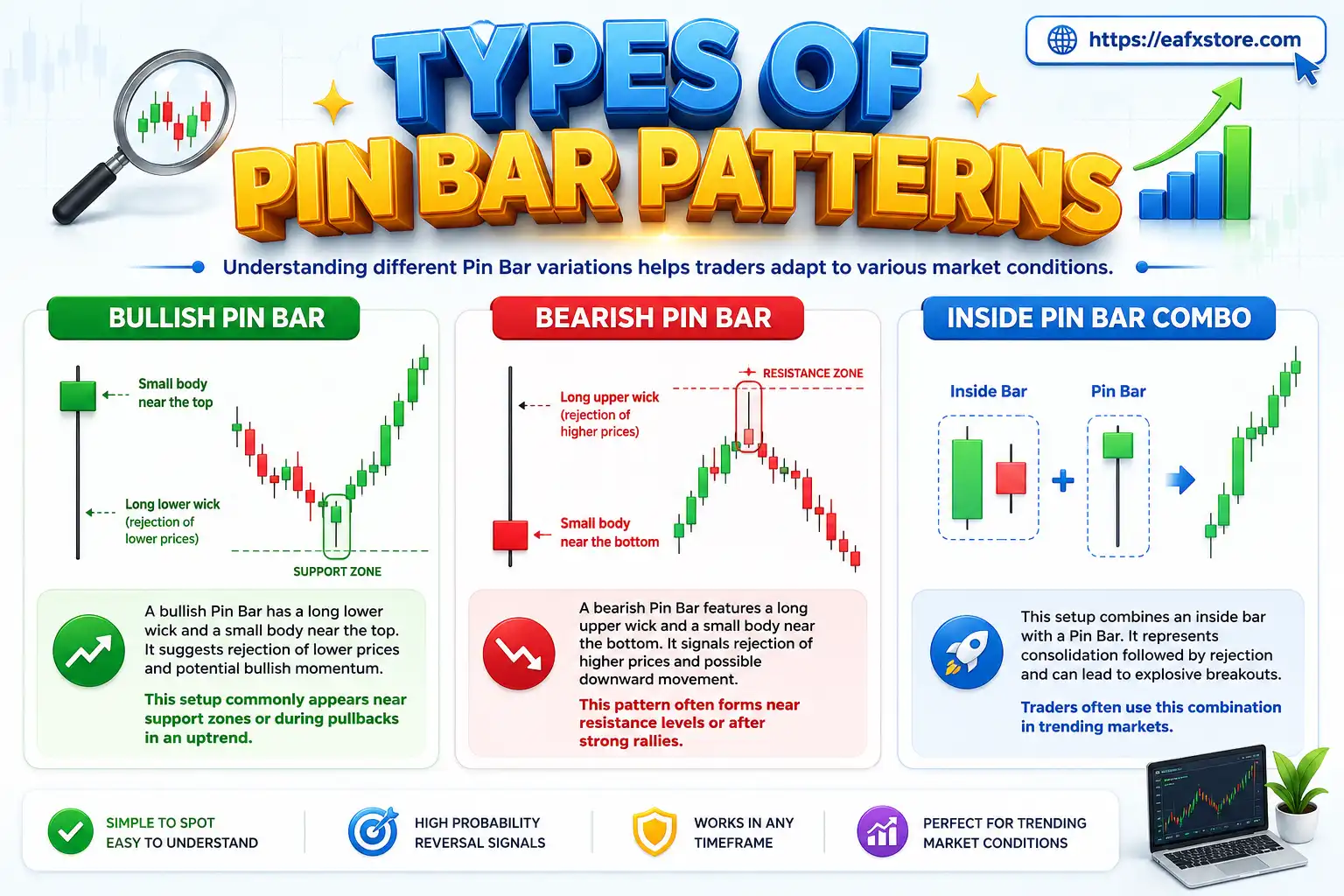
Understanding different Pin Bar variations helps traders adapt to various market conditions.
Bullish Pin Bar
A bullish Pin Bar has a long lower wick and a small body near the candle’s top. It suggests rejection of lower prices and potential bullish momentum.
This setup commonly appears near support zones or during pullbacks in an uptrend.
Bearish Pin Bar
A bearish Pin Bar features a long upper wick and a small body near the bottom of the candle. It signals rejection of higher prices and possible downward movement.
This pattern often forms near resistance levels or after strong rallies.
Inside Pin Bar Combo
This setup combines an inside bar with a Pin Bar. It represents consolidation followed by rejection and can lead to explosive breakouts.
Traders often use this combination in trending markets.
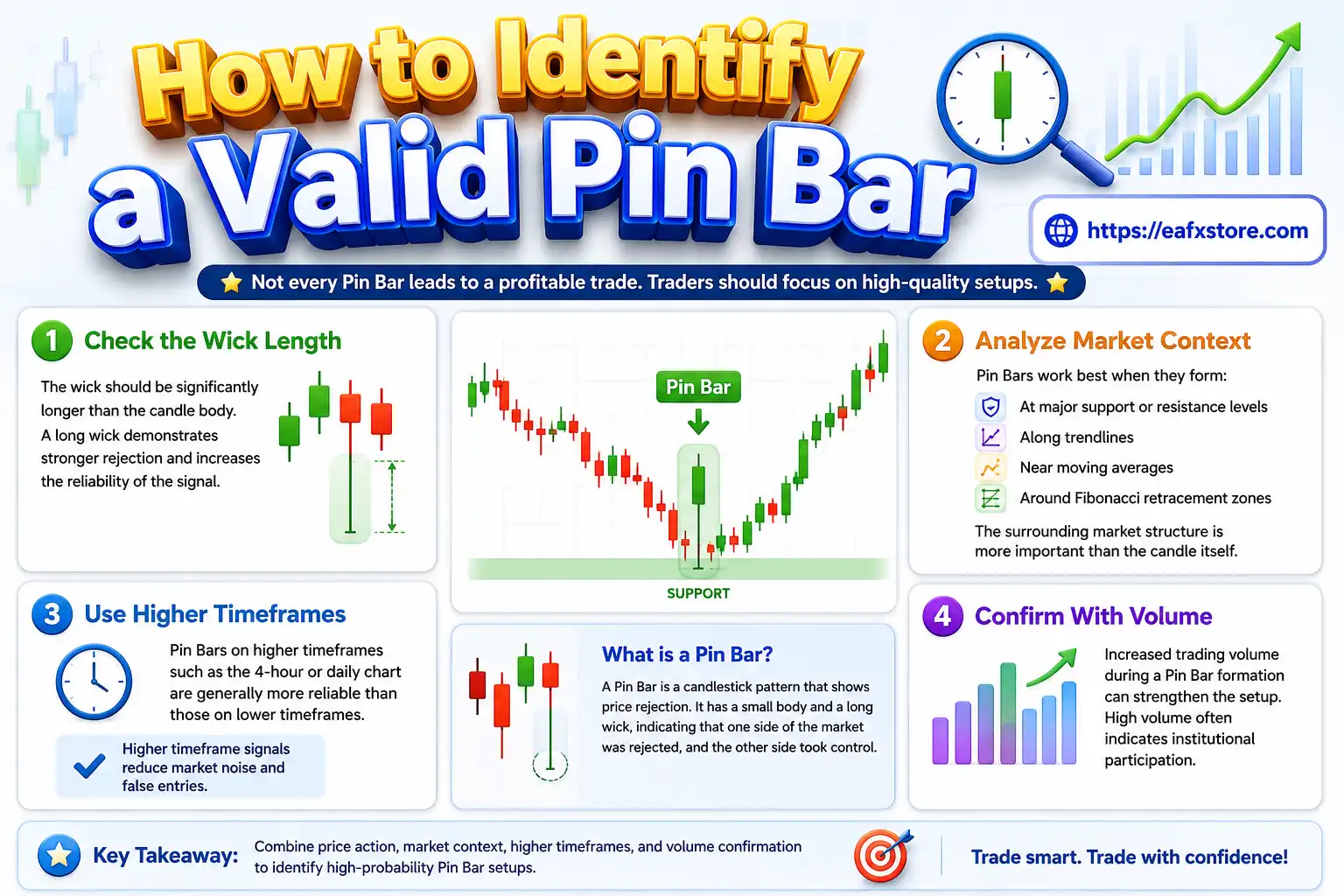
How to Identify a Valid Pin Bar
Not every Pin Bar leads to a profitable trade. Traders should focus on high-quality setups.
Check the Wick Length
The wick should be significantly longer than the candle body. A long wick demonstrates stronger rejection and increases the reliability of the signal.
Analyze Market Context
Pin Bars work best when they form:
- At major support or resistance levels
- Along trendlines
- Near moving averages
- Around Fibonacci retracement zones
The surrounding market structure is more important than the candle itself.
Use Higher Timeframes
Pin Bars on higher timeframes such as the 4-hour or daily chart are generally more reliable than those on lower timeframes.
Higher timeframe signals reduce market noise and false entries.
Confirm With Volume
Increased trading volume during a Pin Bar formation can strengthen the setup. High volume often indicates institutional participation.
Best Entry Techniques for Pin Bar Trading
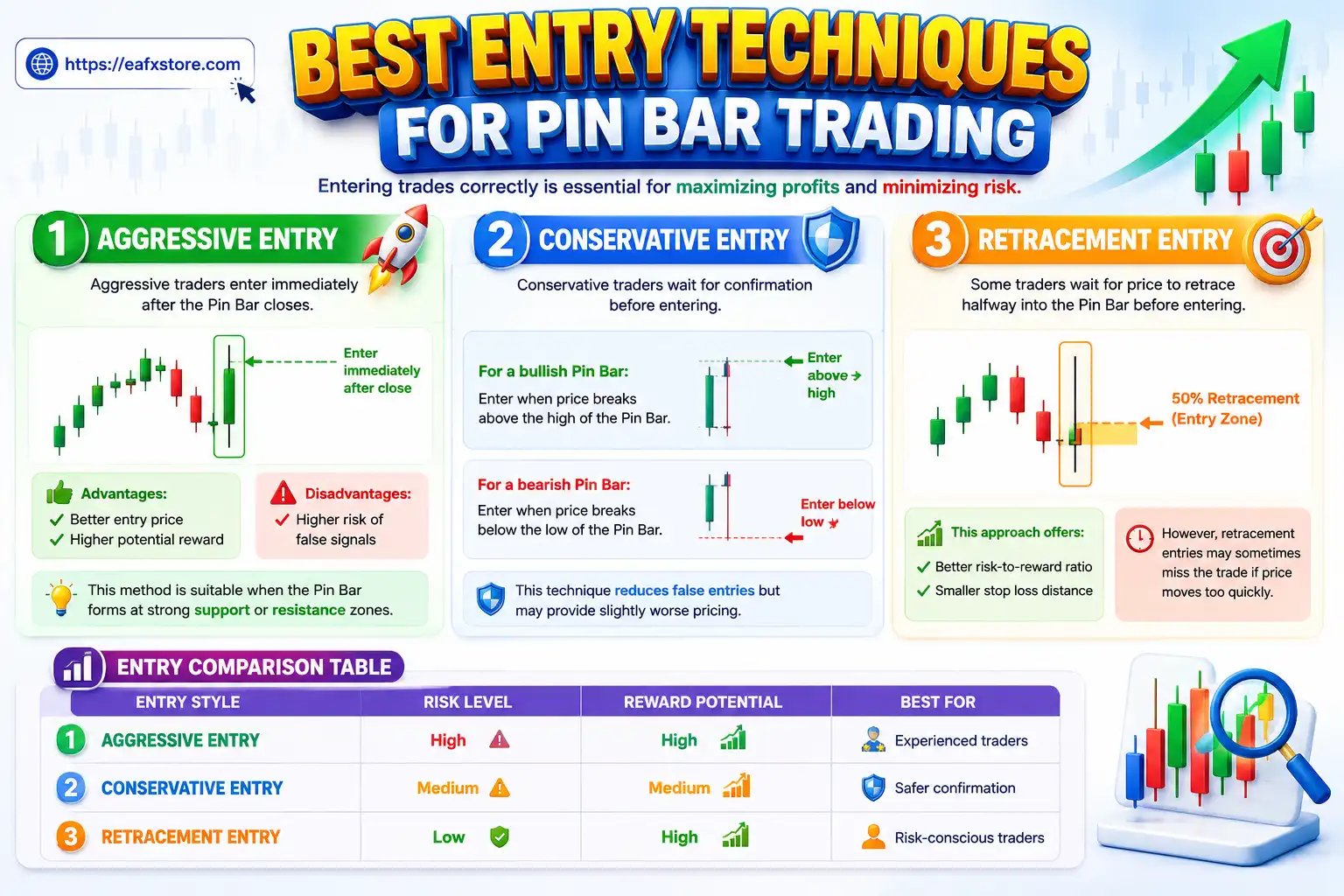
Entering trades correctly is essential for maximizing profits and minimizing risk.
Aggressive Entry
Aggressive traders enter immediately after the Pin Bar closes.
Advantages:
- Better entry price.
- Higher potential reward.
Disadvantages:
- Higher risk of false signals.
This method is suitable when the Pin Bar forms at strong support or resistance zones.
Conservative Entry
Conservative traders wait for confirmation before entering.
For a bullish Pin Bar:
- Enter when price breaks above the high of the Pin Bar.
For a bearish Pin Bar:
- Enter when price breaks below the low of the Pin Bar.
This technique reduces false entries but may provide slightly worse pricing.
Retracement Entry
Some traders wait for price to retrace halfway into the Pin Bar before entering.
This approach offers:
- Better risk-to-reward ratio
- Smaller stop loss distance
However, retracement entries may sometimes miss the trade if price moves too quickly. Entry Comparison Table:
| Entry Style | Risk Level | Reward Potential | Best For |
|---|---|---|---|
| Aggressive Entry | High | High | Experienced traders |
| Conservative Entry | Medium | Medium | Safer confirmation |
| Retracement Entry | Low | High | Risk-conscious traders |
Best Exit Strategies for Pin Bar Trades
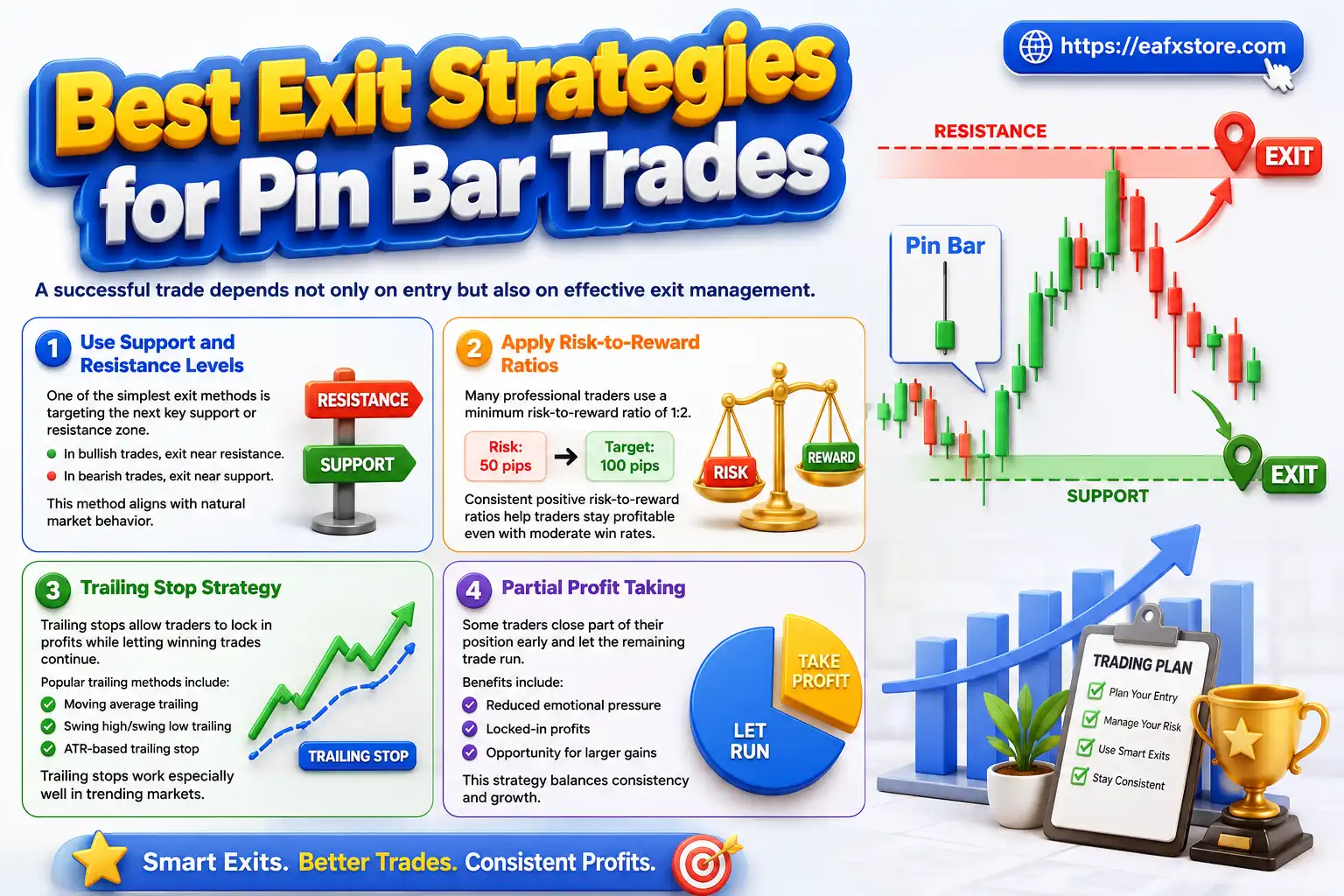
A successful trade depends not only on entry but also on effective exit management.
Use Support and Resistance Levels
One of the simplest exit methods is targeting the next key support or resistance zone.
For example:
- In bullish trades, exit near resistance.
- In bearish trades, exit near support.
This method aligns with natural market behavior.
Apply Risk-to-Reward Ratios
Many professional traders use a minimum risk-to-reward ratio of 1:2.
Example:
- Risk: 50 pips
- Target: 100 pips
Consistent positive risk-to-reward ratios help traders stay profitable even with moderate win rates.
Trailing Stop Strategy
Trailing stops allow traders to lock in profits while letting winning trades continue.
Popular trailing methods include:
- Moving average trailing
- Swing high/swing low trailing
- ATR-based trailing stop
Trailing stops work especially well in trending markets.
Partial Profit Taking
Some traders close part of their position early and let the remaining trade run.
Benefits include:
- Reduced emotional pressure
- Locked-in profits
- Opportunity for larger gains
This strategy balances consistency and growth.
Common Mistakes Traders Should Avoid
Many traders fail with Pin Bars because they ignore important trading principles.
Trading Every Pin Bar
Not all Pin Bars are valid. Weak setups in random market areas often fail.
Focus only on high-probability locations.
Ignoring the Trend
Trading against the overall trend increases risk.
Pin Bars aligned with the dominant trend usually perform better.
Using Tight Stop Losses
Placing stop losses too close to the wick can lead to premature exits.
A stop loss should usually be placed beyond the Pin Bar tail.
Overleveraging
Using excessive leverage can quickly destroy trading accounts.
Even strong setups can fail unexpectedly.
Risk Management Tips for Pin Bar Trading
Risk management is essential for long-term success.
Risk Only a Small Percentage Per Trade
Most professional traders risk only 1% to 2% of their account on each trade.
This approach protects capital during losing streaks.
Maintain Trading Discipline
Following a consistent trading plan helps reduce emotional decisions.
Discipline is often more important than strategy.
Keep a Trading Journal
Recording trades allows traders to analyze mistakes and improve performance over time.
Important journal details include:
- Entry point
- Exit point
- Market conditions
- Emotional state
Conclusion
The Pin Bar pattern remains one of the most effective price action tools for traders across all financial markets. Its ability to reveal price rejection and market sentiment makes it highly valuable for identifying potential reversals and trend continuations.
However, success with Pin Bars depends on more than simply spotting the candle pattern. Traders must combine proper market context, disciplined entry techniques, strategic exits and strong risk management.
By mastering these principles, traders can improve consistency and build a more structured trading approach over time.
FAQs
❓ What is the best timeframe for trading Pin Bars?
Higher timeframes such as the 4-hour and daily charts are generally more reliable because they reduce market noise and false signals.
❓ Can beginners use the Pin Bar strategy?
Yes, the Pin Bar strategy is beginner-friendly due to its simple visual structure and straightforward trading logic.
❓ Do Pin Bars work in forex and crypto markets?
Yes, Pin Bars are effective in forex, crypto, stocks, and commodities because they reflect universal market psychology.
❓ Where should I place my stop loss in a Pin Bar trade?
Most traders place the stop loss slightly beyond the Pin Bar wick to avoid being stopped out by market volatility.
❓ Should I use indicators with Pin Bars?
Indicators such as moving averages, RSI, and support/resistance analysis can improve confirmation and increase trade accuracy.