
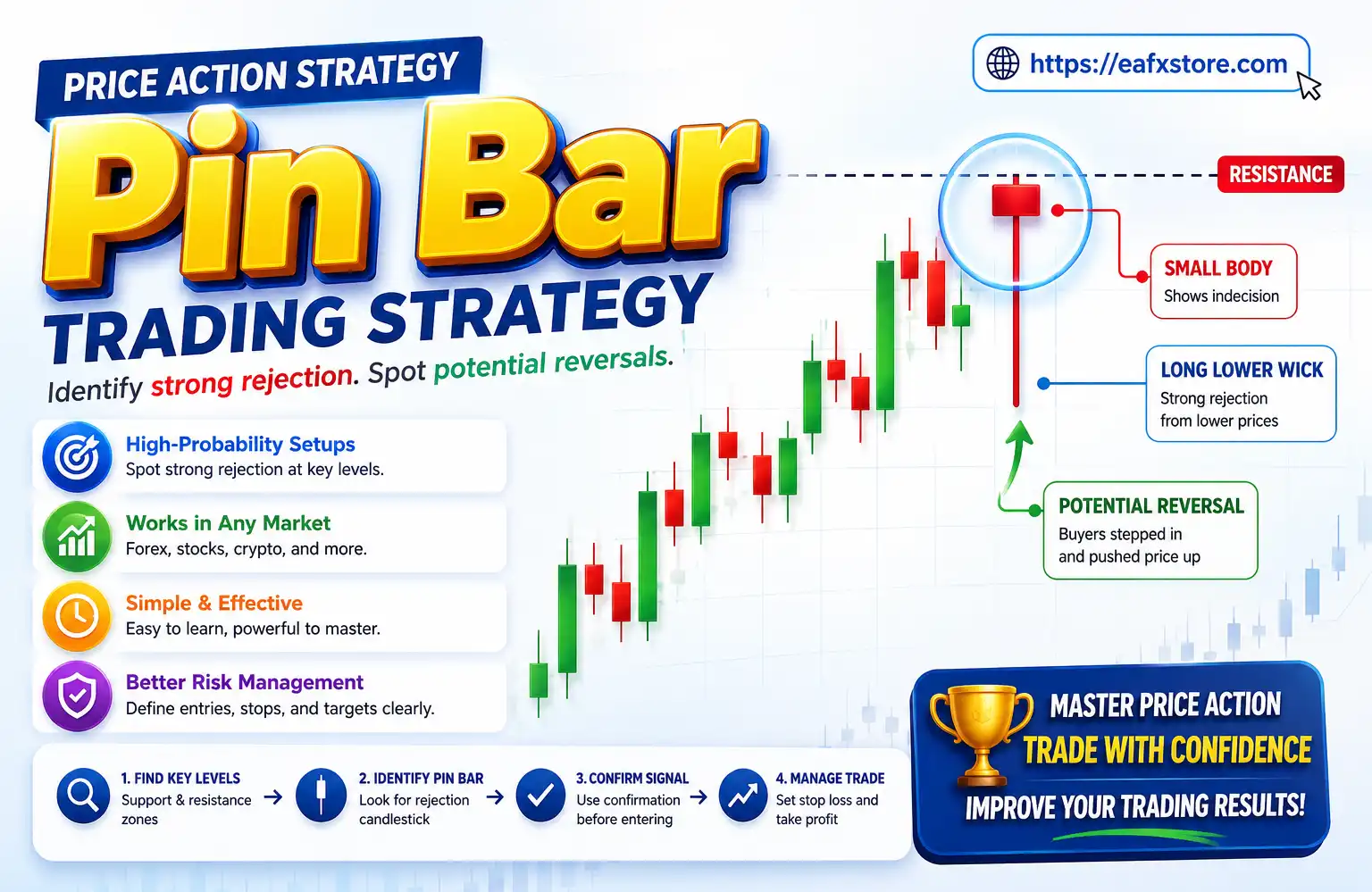
The pin bar trading strategy is one of the most popular price action methods used by forex, stock and crypto traders. A pin bar candlestick can reveal strong rejection from key price levels and often signals a potential market reversal. Because of its simplicity and effectiveness, traders frequently use pin bars to identify high-probability entry opportunities.
However, not every pin bar leads to a profitable trade. Understanding how to identify valid pin bar setups, market context and confirmation signals is essential for improving trading accuracy.
What is a Pin Bar in Trading?
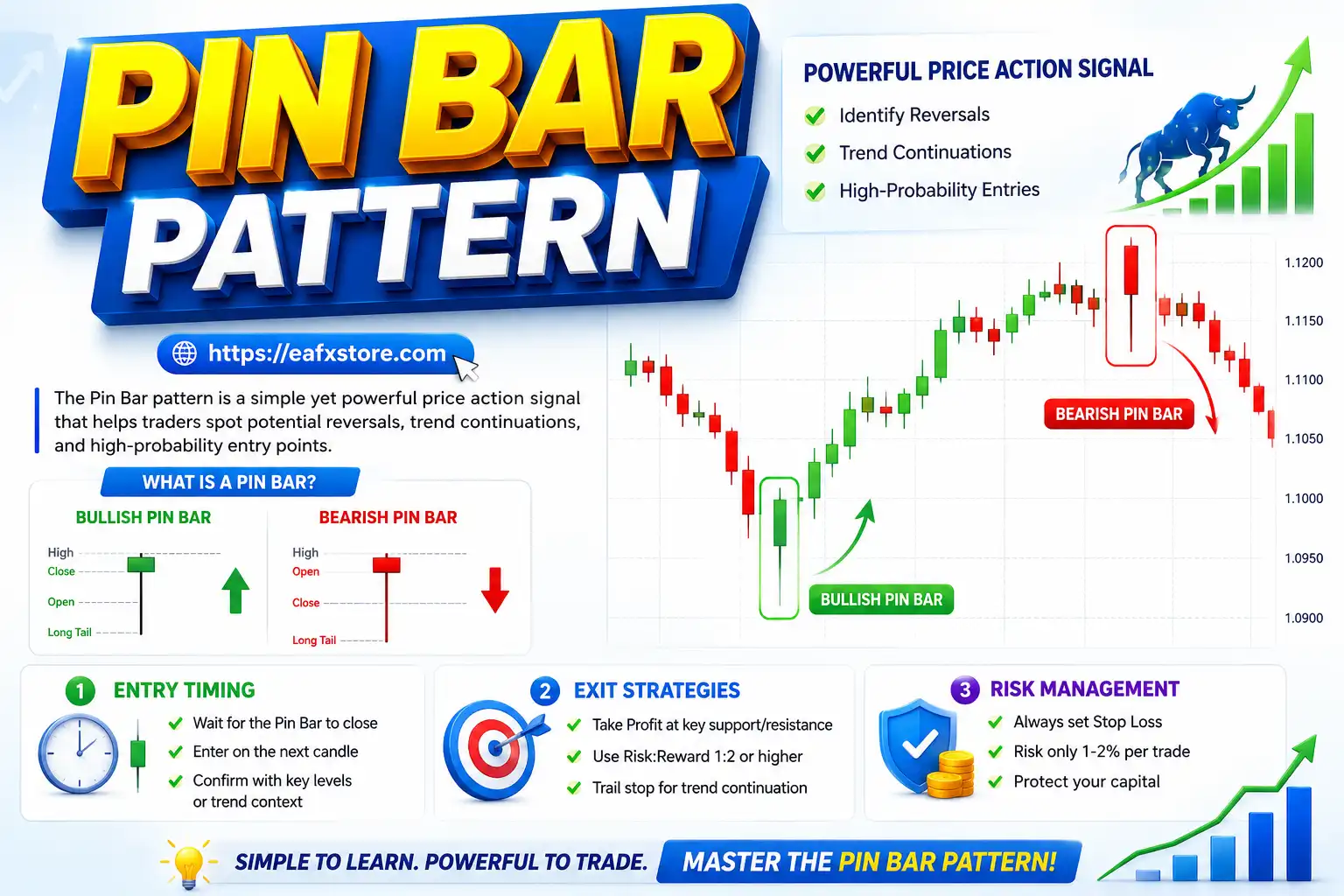
A pin bar is a candlestick pattern that indicates rejection of a specific price level. It usually has a small body and a long wick. The long wick shows that price attempted to move in one direction but was strongly rejected before the candle closed. There are two main types of pin bars:
| Pin Bar Type | Signal Meaning |
|---|---|
| Bullish Pin Bar | Suggests potential upward reversal |
| Bearish Pin Bar | Suggests potential downward reversal |
A bullish pin bar has a long lower wick, showing buyers pushed price back up after sellers initially controlled the market. A bearish pin bar has a long upper wick, indicating sellers rejected higher prices.
Pin bars are commonly found near support and resistance levels, trendlines, moving averages, and key market zones.
Why Pin Bars Matter in Price Action Trading
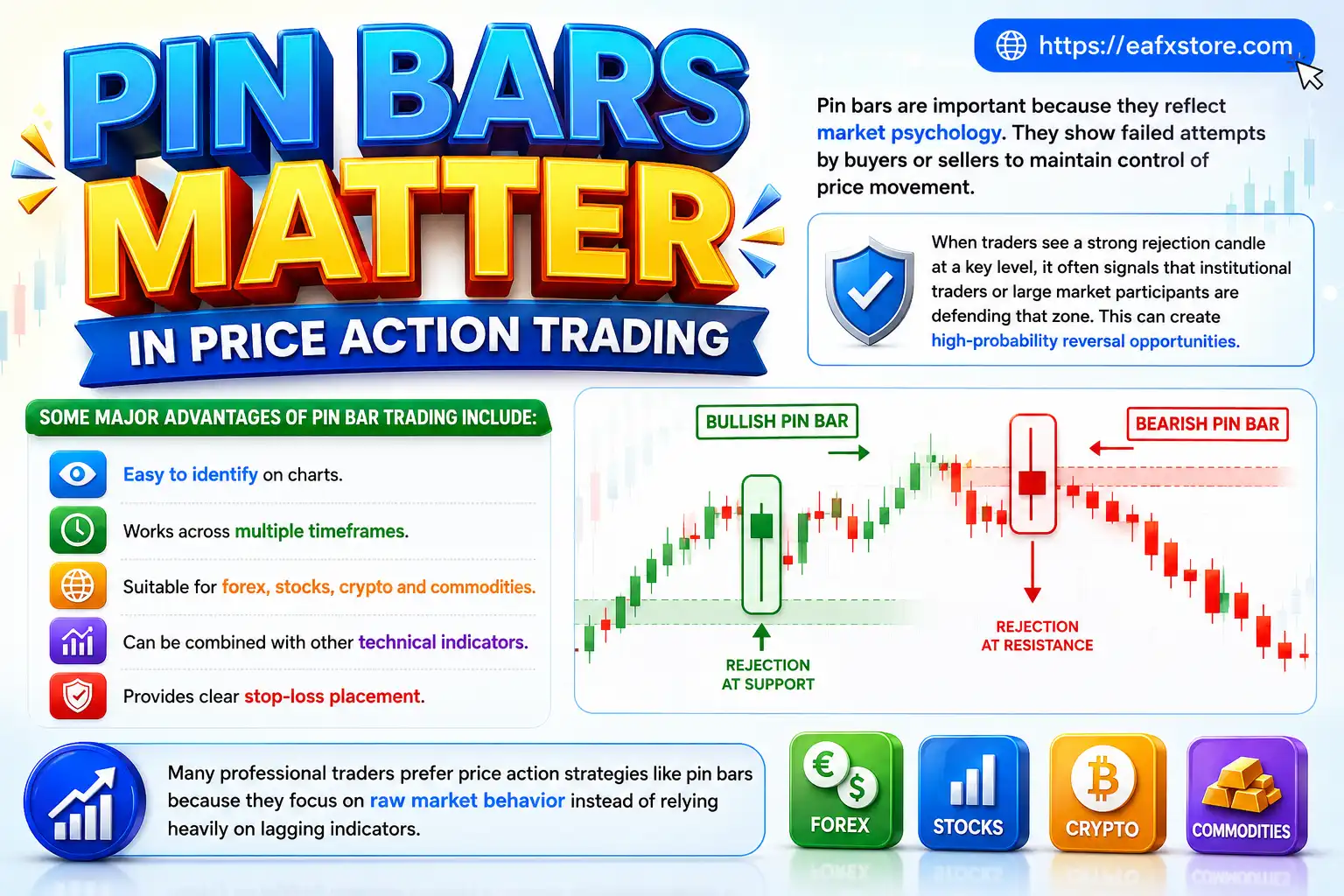
Pin bars are important because they reflect market psychology. They show failed attempts by buyers or sellers to maintain control of price movement.
When traders see a strong rejection candle at a key level, it often signals that institutional traders or large market participants are defending that zone. This can create high-probability reversal opportunities.
Some major advantages of pin bar trading include:
- Easy to identify on charts.
- Works across multiple timeframes.
- Suitable for forex, stocks, crypto and commodities.
- Can be combined with other technical indicators.
- Provides clear stop-loss placement.
Many professional traders prefer price action strategies like pin bars because they focus on raw market behavior instead of relying heavily on lagging indicators.
How to Identify a Valid Pin Bar
Not all pin bars are reliable. Strong pin bar setups usually share several characteristics. Key Features of a High-Quality Pin Bar:
| Feature | Description |
|---|---|
| Long Wick | The wick should be much longer than the body |
| Small Candle Body | Indicates strong rejection |
| Close Near One End | Shows momentum shift |
| Appears at Key Levels | Support, resistance, or trend zones |
| Clear Market Context | Trend or reversal confirmation |
A valid bullish pin bar should have:
- A long lower tail.
- Small upper wick.
- Closing price near the candle high.
A valid bearish pin bar should have:
- A long upper tail.
- Small lower wick.
- Closing price near the candle low.
The larger the rejection wick, the stronger the potential reversal signal.
Types of Pin Bar Signals
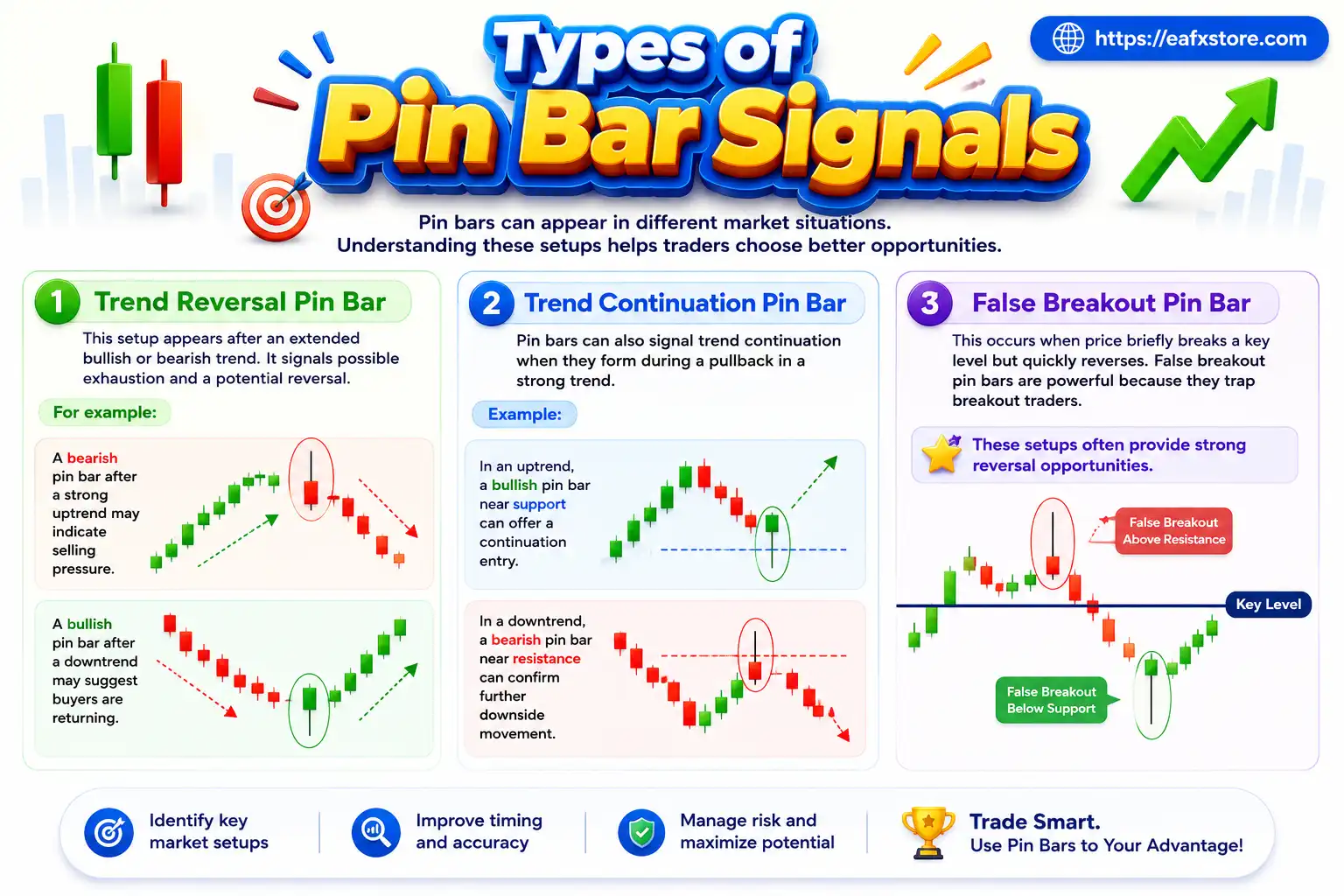
Pin bars can appear in different market situations. Understanding these setups helps traders choose better opportunities.
Trend Reversal Pin Bar
This setup appears after an extended bullish or bearish trend. It signals possible exhaustion and a potential reversal.
For example:
- A bearish pin bar after a strong uptrend may indicate selling pressure.
- A bullish pin bar after a downtrend may suggest buyers are returning.
Trend Continuation Pin Bar
Pin bars can also signal trend continuation when they form during a pullback in a strong trend.
Example:
- In an uptrend, a bullish pin bar near support can offer a continuation entry.
- In a downtrend, a bearish pin bar near resistance can confirm further downside movement.
False Breakout Pin Bar
This occurs when price briefly breaks a key level but quickly reverses. False breakout pin bars are powerful because they trap breakout traders.
These setups often provide strong reversal opportunities.
Best Market Conditions for Trading Pin Bars
Pin bars perform best under specific market conditions. Traders should avoid taking every pin bar signal without analyzing context.
Ideal Conditions for Pin Bar Trading:
| Market Condition | Why It Works |
|---|---|
| Strong Trending Market | Better continuation setups |
| Key Support/Resistance | Strong rejection zones |
| Higher Timeframes | More reliable signals |
| Confluence Areas | Multiple confirmations increase probability |
Higher timeframes such as the 4-hour and daily chart usually produce more reliable pin bar signals than lower timeframes.
Combining pin bars with:
can significantly improve trade quality.
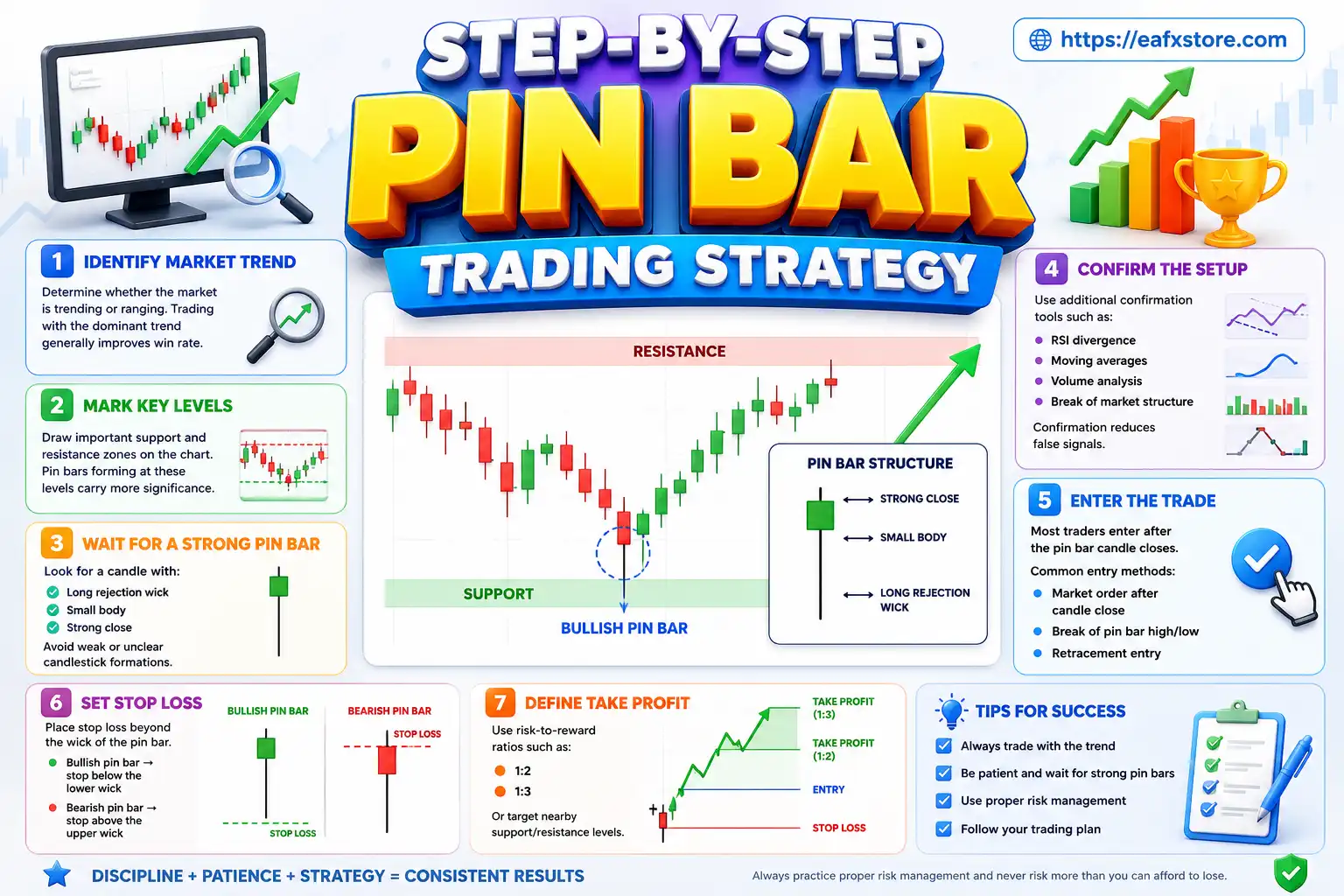
Step-by-Step Pin Bar Trading Strategy
A structured approach is essential for successful pin bar trading.
Step 1: Identify Market Trend
Determine whether the market is trending or ranging. Trading with the dominant trend generally improves win rate.
Step 2: Mark Key Levels
Draw important support and resistance zones on the chart. Pin bars forming at these levels carry more significance.
Step 3: Wait for a Strong Pin Bar
Look for a candle with:
- Long rejection wick
- Small body
- Strong close
Avoid weak or unclear candlestick formations.
Step 4: Confirm the Setup
Use additional confirmation tools such as:
- RSI divergence
- Moving averages
- Volume analysis
- Break of market structure
Confirmation reduces false signals.
Step 5: Enter the Trade
Most traders enter after the pin bar candle closes.
Common entry methods:
- Market order after candle close
- Break of pin bar high/low
- Retracement entry
Step 6: Set Stop Loss
Place stop loss beyond the wick of the pin bar.
Example:
- Bullish pin bar → stop below the lower wick
- Bearish pin bar → stop above the upper wick
Step 7: Define Take Profit
Use risk-to-reward ratios such as:
- 1:2
- 1:3
Or target nearby support/resistance levels.
Risk Management Tips for Pin Bar Trading
Risk management is just as important as identifying strong setups. Important Risk Management Rules:
| Rule | Recommendation |
|---|---|
| Risk Per Trade | 1%–2% of account |
| Use Stop Loss | Always mandatory |
| Maintain Risk/Reward Ratio | Minimum 1:2 |
| Avoid Overtrading | Focus on quality setups |
| Follow Trading Plan | Maintain consistency |
Professional traders understand that preserving capital is more important than chasing profits. Even the best pin bar setups can fail due to unexpected market conditions.
Conclusion
The pin bar trading strategy is a powerful price action method that helps traders identify potential market reversals and continuation opportunities. Its simplicity makes it suitable for beginners, while its effectiveness keeps it popular among experienced traders.
The key to success is not simply spotting pin bars but understanding market context, trend direction and confirmation factors. High-probability setups usually occur at important support and resistance levels with clear rejection signals.
By combining disciplined risk management with proper trade selection, traders can use pin bars to improve consistency and decision-making in financial markets.
FAQs
❓ What is the best timeframe for pin bar trading?
The 4-hour and daily timeframes are generally considered the most reliable because they reduce market noise and false signals.
❓ Can pin bars be used in forex trading?
Yes, pin bars are widely used in forex trading and work well in stocks, crypto, indices, and commodities.
❓ Are pin bars accurate reversal signals?
Pin bars can be highly effective when combined with support/resistance levels and confirmation indicators.
❓ Should beginners use the pin bar strategy?
Yes, the strategy is beginner-friendly because it is simple to understand and easy to identify on charts.
❓ What indicators work best with pin bars?
Popular indicators include RSI, moving averages, Fibonacci retracement, and volume analysis.