
For many traders, the Standard account is the first live account they ever open. It is offered by almost every Forex broker, it is easy to understand, and it usually has no commission. But “no commission” does not mean “no cost”. The broker still earns money on every trade, just in a different way from a RAW account.
This guide explains what a Standard account is, how its pricing works, how it compares with RAW and Cent accounts, and which traders it suits best.
What is a Standard Account?
A Standard account is a trading account where the broker’s fee is built into the spread, the difference between the buy (ask) and sell (bid) price. There is typically no separate commission per trade. You simply see one all-in price and pay the spread each time you open a position.
On major pairs such as EUR/USD, Standard account spreads are often around 1.0 to 1.5 pips in normal conditions, though this varies by broker, pair and time of day.
Do not confuse the Standard account with a standard lot. A standard lot is a position size of 100,000 units of the base currency. On a Standard account you can usually trade much smaller sizes, such as mini lots (0.10) or micro lots (0.01).
How Standard Account Pricing Works
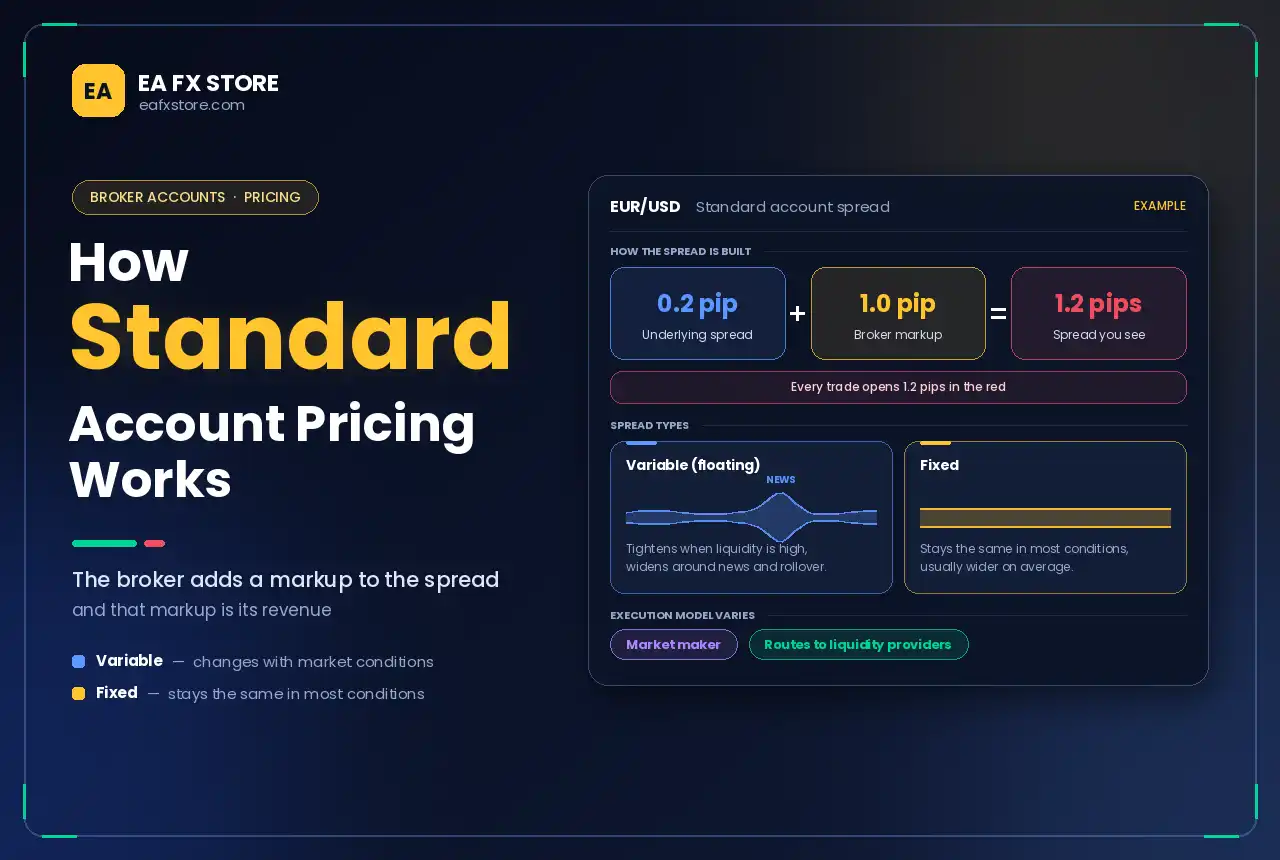
The broker receives prices from its liquidity providers or sets its own quotes, then adds a markup to the spread. That markup is the broker’s revenue.
For example, if the underlying EUR/USD spread is 0.2 pips and the broker adds 1.0 pip of markup, you see a spread of 1.2 pips. Every time you open a trade, you start 1.2 pips in the red.
Spreads on a Standard account can be:
- Variable (floating): they change with market conditions, tightening when liquidity is high and widening around news or at rollover.
- Fixed: some brokers offer fixed spreads that stay the same in most conditions, though they are usually wider on average and may still change in extreme markets.
The execution model behind Standard accounts varies. Some brokers act as market makers, others route orders to liquidity providers. Our comparison of ECN vs market maker explains these models in detail.
Calculating Your Real Cost
The cost of a trade on a Standard account is simple to calculate:
Total cost per lot = spread in pips × pip value
For EUR/USD, one pip on one standard lot is worth about 10 USD. With a 1.2-pip spread:
- 1.00 lot: 1.2 × 10 = 12.00 USD
- 0.10 lot: 1.2 × 1 = 1.20 USD
- 0.01 lot: 1.2 × 0.10 = 0.12 USD
Because there is no commission, the cost scales directly with your position size and the spread at the moment you enter.
Standard vs RAW vs Cent Accounts
| Feature | Standard account | RAW account | Cent account |
| Spread on EUR/USD | Wider, about 1.0–1.5 pips | Tight, from about 0.0–0.3 pips | Usually similar to Standard |
| Commission | Usually none | Yes, per lot | Usually none |
| Pricing | All-in spread | Raw spread + commission | All-in spread |
| Account currency unit | Dollars (or other currency) | Dollars (or other currency) | Cents (1 USD = 100 cents) |
| Best for | Beginners, swing traders | Scalpers, EAs, high volume | Testing strategies with tiny risk |
The figures are typical ranges, not exact quotes. For a detailed look at the commission-based alternative, read our guide to the RAW account.
When does a RAW account become cheaper?
Compare the extra spread you pay on a Standard account with the commission on a RAW account. If the Standard spread is 1.2 pips and the RAW spread is 0.1 pips, the difference is 1.1 pips, or about 11 USD per lot. If the RAW commission is 7 USD per lot round turn, the RAW account is cheaper by about 4 USD per lot. If the commission were higher than 11 USD, the Standard account would win.
Advantages of a Standard Account
- Simple pricing: one number tells you the cost of each trade.
- No commission: useful for traders who prefer not to track separate fees.
- Low minimum deposit at many brokers, making it accessible for beginners.
- Small position sizes, often down to 0.01 lots.
- Widely available: almost every broker offers one, with MT4 and MT5 support.
Disadvantages of a Standard Account
- Higher total cost for active traders, because the markup applies to every trade.
- Less transparency: you cannot easily see how much of the spread is markup.
- Wider spreads hurt short targets: a 1.2-pip spread on a 5-pip target is almost a quarter of the profit.
- Spreads still widen during news releases and at rollover, sometimes significantly.
Who Should Use a Standard Account?
Beginners
The simple, all-in pricing makes it easier to understand trading costs while learning. Combined with micro lots, it lets new traders start with small risk.
Swing and position traders
If you hold trades for days and target 100 pips or more, a 1-pip difference in cost has little impact on overall results. Simplicity can matter more than saving a few dollars per lot.
Low-frequency traders
Traders who place only a few trades a month will not see a large difference in total costs between account types.
When a Standard account is not ideal
Scalpers, high-volume day traders and many Expert Advisors usually perform better on a RAW account, where lower total costs protect small profit targets. Strategies built on precise entries, such as trading liquidity sweeps or breaker blocks on lower timeframes, are also more sensitive to spread.
Running EAs on a Standard Account
Many EAs can run on Standard accounts, but you should check a few things first:
- Read the EA’s recommended account type. Some EAs are designed for RAW or ECN conditions and may underperform with wider spreads.
- Set the maximum spread filter to match Standard account spreads, otherwise the EA may never open trades, or may open them when spreads are abnormally wide.
- Backtest with realistic spreads. Use the average spread of your broker’s Standard account, not an unrealistically low fixed value.
- Avoid trading during news unless the EA is built for it, as spreads can widen sharply.
- Manage risk carefully. Lower costs or higher costs, market risk remains. See our risk management tips.
How to Choose a Standard Account Broker
- Regulation: select a broker supervised by a recognised authority.
- Average spreads: compare typical spreads during your trading hours, not just “from” values.
- Execution quality: look for low slippage and no frequent requotes.
- Swap rates: important if you hold positions overnight.
- Platform support: confirm MT4, MT5 or cTrader availability.
- Minimum deposit and lot sizes: make sure they fit your capital.
Frequently Asked Questions
What is a Standard account in Forex?
It is an account type where the broker’s fee is included in the spread, usually with no separate commission.
Is a Standard account commission-free?
Usually yes, but you still pay a cost through the wider spread on every trade.
Is a Standard account good for beginners?
Yes. Its simple pricing and low minimum deposit make it a common starting point, especially when combined with micro lots.
Should I choose a Standard or RAW account?
Choose Standard for simplicity and longer-term trading; choose RAW if you scalp, trade frequently or run EAs with small targets. Always compare the total cost per lot.
Conclusion
A Standard account offers simple, commission-free pricing with the broker’s fee built into the spread. It is a good fit for beginners, swing traders and anyone who trades infrequently. For scalpers, high-volume traders and many EAs, however, the wider spread can add up quickly. Calculate your total cost per lot, compare it with a RAW account, and choose the account that matches how you actually trade.
Risk warning: Trading Forex and CFDs on margin carries a high level of risk and may not be suitable for all investors. Spread and commission figures in this article are illustrative and vary by broker. This article is for educational purposes only and is not investment advice.