
When you open a trading account with a Forex broker, one of the first choices you face is the account type. Two options appear almost everywhere: a Standard account and a RAW account. The names sound simple, but the cost structures behind them are very different, and choosing the wrong one can quietly eat into your profits, especially if you scalp or run Expert Advisors.
This guide explains what a RAW account is, how its pricing works, how to calculate your real trading cost and which traders benefit most.
What is a RAW Account?
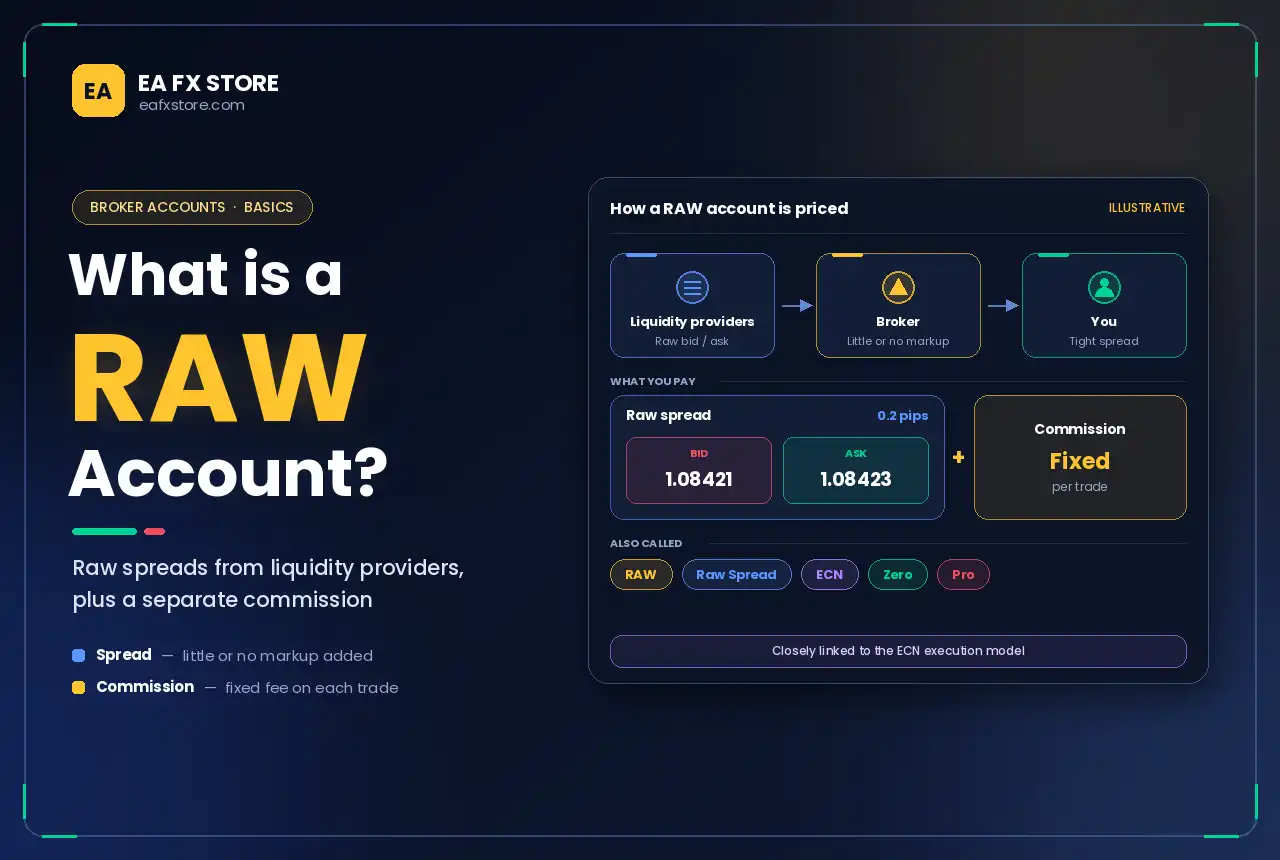
A RAW account is a trading account that gives you access to raw spreads: the bid and ask prices that come from the broker’s liquidity providers, with little or no markup added. Instead of earning money from a wider spread, the broker charges a separate commission on each trade.
Account names vary between brokers. You may see RAW, Raw Spread, ECN, Zero, Pro or similar labels. The idea is the same: very tight spreads plus a fixed commission. RAW accounts are closely linked to the ECN execution model, which we explain in detail in our guide to ECN trading.
How RAW Account Pricing Works
Every trade has a cost. The difference between account types is how that cost is charged.
- Standard account: the broker adds a markup to the spread. EUR/USD might show a spread of around 1.0 to 1.5 pips, and there is usually no commission.
- RAW account: the spread is close to the market price, often from 0.0 to 0.3 pips on major pairs during liquid hours. The broker then charges a commission, commonly quoted per lot per side (when you open and again when you close) or per round turn (open and close combined).
Many brokers charge a commission in the range of about 6 to 7 USD per standard lot round turn, but this varies by broker, account currency and region. Always check the exact figure in your broker’s contract specifications.
RAW vs Standard Account: Cost Comparison
The best way to compare accounts is to calculate the total cost per lot. For EUR/USD, one pip on one standard lot (100,000 units) is worth about 10 USD.
| Item | Standard account | RAW account |
| Typical EUR/USD spread | 1.2 pips | 0.1 pips |
| Spread cost per lot | 12.00 USD | 1.00 USD |
| Commission per lot (round turn) | 0 USD | 7.00 USD |
| Total cost per lot | 12.00 USD | 8.00 USD |
| Total cost in pips | 1.2 pips | 0.8 pips |
The figures are illustrative, but the pattern is typical. In this example, the RAW account saves about 4 USD per lot. For a trader who trades 50 lots a month, that is 200 USD in savings, without changing a single trade.
A simple formula:
Total cost per lot = (spread in pips × pip value) + round-turn commission
Run this calculation with your own broker’s numbers for the pairs you trade most, at the hours you usually trade.
Advantages of a RAW Account
- Lower total cost for most active traders, especially on major pairs.
- Transparent pricing: you see the market spread and the commission separately.
- Tighter entries and exits, which matters when targets are only a few pips.
- Better fit for precise strategies, such as trading reactions at a liquidity sweep or a breaker block, where a tight spread keeps stops and entries accurate.
Disadvantages and Hidden Factors
- Commission is charged on every trade, even losing ones and trades closed at break-even.
- Spreads still widen during news releases, at rollover and in quiet sessions, so “0.0 pips” is not guaranteed.
- Higher minimum deposits may apply compared with Standard or Cent accounts.
- Swap rates may differ between account types, which matters for positions held overnight.
- Commission in your account currency can change slightly with exchange rates if your account is not in USD.
Who Should Use a RAW Account?
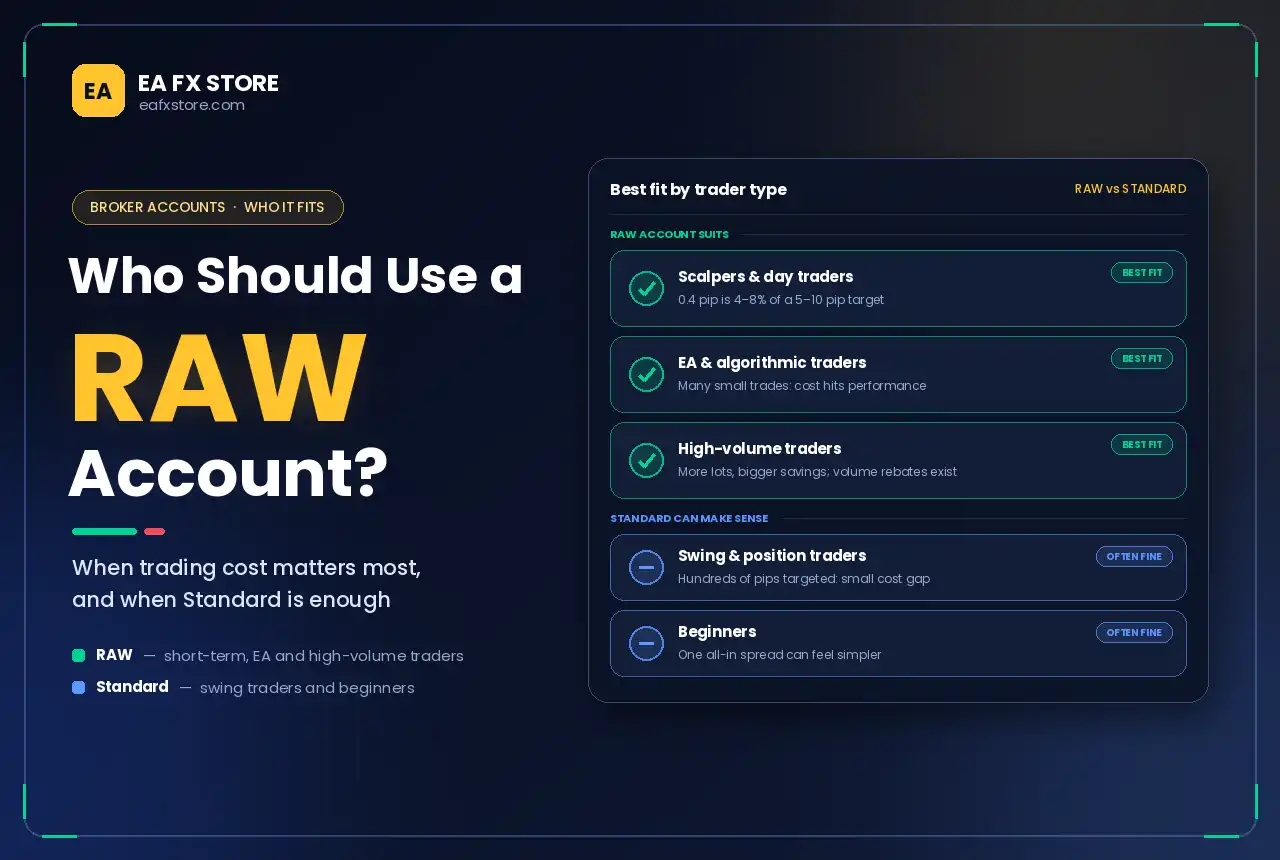
Scalpers and day traders
When your target is 5 to 10 pips, a difference of 0.4 pips per trade is a large share of your profit. RAW accounts usually suit short-term traders best.
EA and algorithmic traders
Most Expert Advisors open many trades with small targets, so trading cost directly affects performance. An EA that is profitable on a RAW account may break even, or lose, on a Standard account with wider spreads. Strategies based on machine learning, such as a deep neural network, are equally sensitive to costs.
High-volume traders
The more lots you trade, the more the cost difference adds up. Some brokers also offer lower commissions for higher monthly volume.
When a Standard account can make sense
Swing and position traders who hold trades for days and target hundreds of pips may find the cost difference small. A Standard account can also be simpler for beginners who prefer one all-in spread.
Running EAs on a RAW Account: Practical Tips
- Include commission in backtests. In the MetaTrader 5 Strategy Tester, set a realistic commission so results reflect real trading costs. In MetaTrader 4, approximate the commission by adding it to the spread or by using an EA input if one is available.
- Test with real spreads. Use variable spreads or tick data rather than a fixed, unrealistically low spread.
- Check the EA’s settings. Some EAs have a maximum spread filter. On a RAW account, set it for raw spread values, not Standard account values.
- Use a VPS close to the broker’s server to reduce latency and slippage.
- Watch for news filters. Even on RAW accounts, spreads can jump sharply around high-impact news.
- Manage risk carefully. Lower costs do not remove market risk. Review our risk management tips before going live.
How to Choose a RAW Account Broker
- Regulation: choose a broker regulated by a recognised authority.
- Commission rate: compare the real round-turn cost, not just the advertised spread.
- Average spreads: check typical spreads during your trading hours, not just the minimum.
- Execution model: understand how orders are filled. Our comparison of ECN vs market maker explains the differences.
- Platform: confirm support for MT4, MT5 or cTrader, and for any EAs you plan to use.
- Minimum deposit and swap rates: make sure they fit your capital and holding period.
Frequently Asked Questions
What is a RAW account in Forex?
It is an account type that offers very tight, near-market spreads with a separate commission charged per trade.
Is a RAW account better than a Standard account?
For most active traders, scalpers and EA users, a RAW account is cheaper overall. Long-term traders may see little difference.
Is the spread on a RAW account always 0.0 pips?
No. Spreads can start at 0.0 pips on major pairs, but they widen during news, rollover and low-liquidity periods.
How do I calculate my cost on a RAW account?
Multiply the spread in pips by the pip value, then add the round-turn commission per lot.
Conclusion
A RAW account separates your trading cost into two clear parts: a raw market spread and a fixed commission. For scalpers, day traders and EA users, this structure is usually cheaper and more transparent than a Standard account. Calculate your total cost per lot with your broker’s real numbers, include commission in every backtest, and choose the account type that matches how you actually trade.
Risk warning: Trading Forex and CFDs on margin carries a high level of risk and may not be suitable for all investors. Spread and commission figures in this article are illustrative and vary by broker. This article is for educational purposes only and is not investment advice.