
If you trade currencies, gold or indices through an online broker, there is a good chance you are trading CFDs without thinking about it. Contracts for difference are the product behind most retail trading platforms, including many MetaTrader 4 and MetaTrader 5 accounts. Understanding what a CFD is, and what it is not, will change how you read your charts, your costs and even your volume data.
This guide explains what CFDs are, how they work, why Forex traders use them and the risks you must manage.
What Is a CFD?
A contract for difference (CFD) is an agreement between you and your broker to exchange the difference in an asset’s price between the moment you open a position and the moment you close it. You never own the underlying asset. When you buy a EUR/USD CFD, you do not receive euros; you simply profit or lose according to how the EUR/USD price moves.
- If you buy (go long) and the price rises, the broker pays you the difference.
- If you sell (go short) and the price falls, the broker pays you the difference.
- If the price moves against you, you pay the difference.
Because you only trade the price change, you can go long or short with equal ease. This flexibility is one of the main reasons CFDs are popular.
How CFD Trading Works in Forex
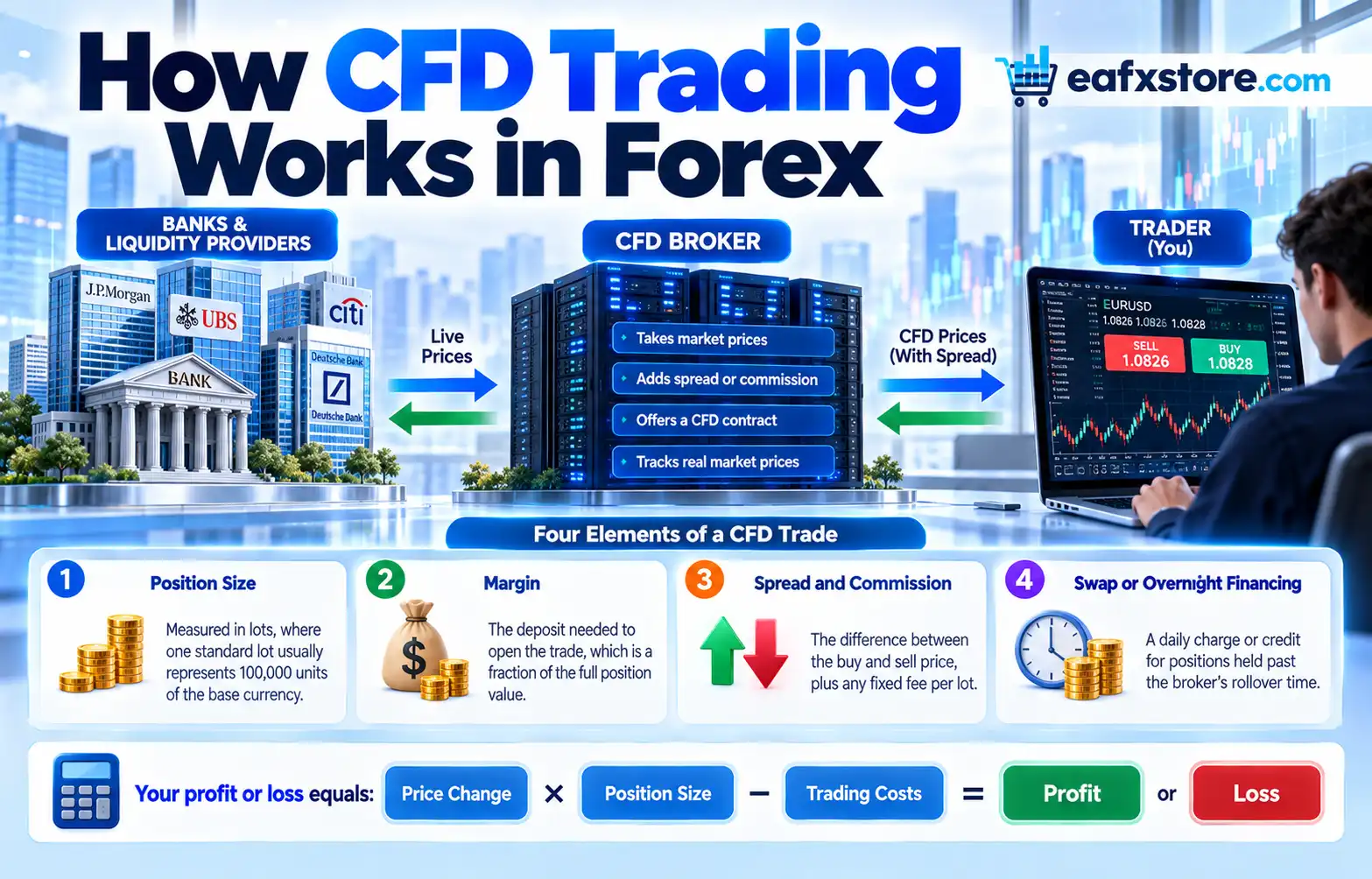
In the spot Forex market, banks and liquidity providers quote prices to each other over a decentralised network. A retail CFD broker takes those prices, adds its own spread or commission, and offers you a contract that tracks them.
A typical CFD trade has four elements:
- Position size. Measured in lots, where one standard lot usually represents 100,000 units of the base currency.
- Margin. The deposit needed to open the trade, which is a fraction of the full position value.
- Spread and commission. The difference between the buy and sell price, plus any fixed fee per lot.
- Swap or overnight financing. A daily charge or credit for positions held past the broker’s rollover time.
Your profit or loss equals the price change multiplied by your position size, minus trading costs.
Leverage: The Double-Edged Sword
CFDs are traded on margin, which means you control a large position with a small deposit. With leverage of 30:1, a 1,000 USD deposit controls a 30,000 USD position. A 1% move in your favour earns about 300 USD, but a 1% move against you loses the same amount.
Regulators treat this seriously. In the European Union and the United Kingdom, for example, retail leverage on major currency pairs is capped at 30:1 and brokers must display a warning showing the percentage of retail accounts that lose money. In the United States, CFDs are not offered to retail traders at all. Always check the rules in your own country and the regulatory licence of your broker.
Why CFDs Matter for Volume Analysis
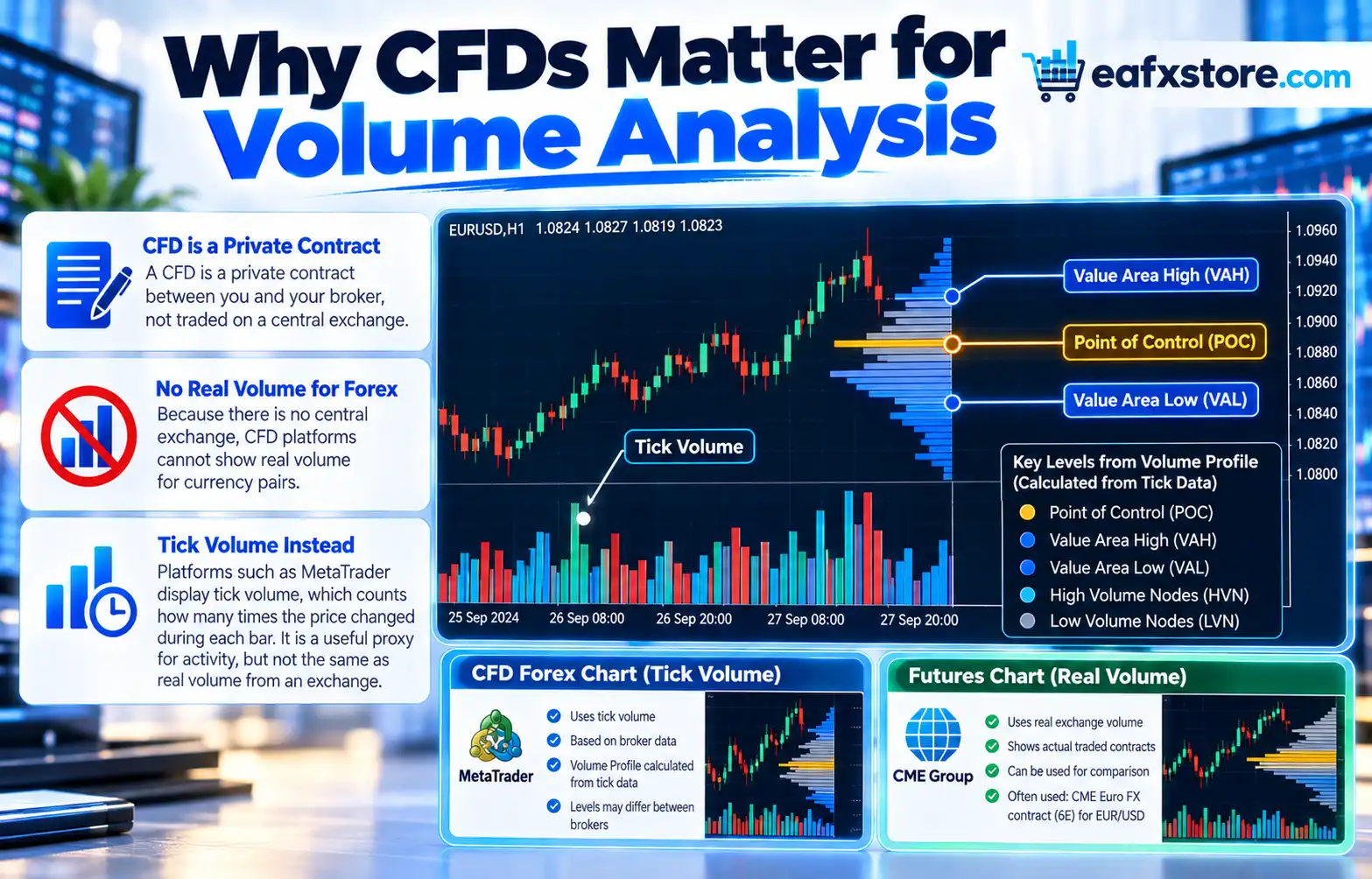
This is where CFDs connect directly to Volume Profile trading. Because a CFD is a private contract between you and your broker, there is no central exchange recording every trade. That has an important consequence: CFD platforms cannot show real volume for currency pairs.
Instead, platforms such as MetaTrader display tick volume, which counts how many times the price changed during each bar. Tick volume is a useful proxy for activity, but it is not the same as real volume from an exchange.
When you build a Volume Profile on a CFD chart, your Point of Control, Value Area High, Value Area Low, High Volume Nodes and Low Volume Nodes are all calculated from tick data supplied by your broker. Two brokers can therefore show slightly different levels on the same pair. Traders who want exchange volume often compare their CFD chart with currency futures, such as the CME Euro FX contract (6E) for EUR/USD.
Advantages of Trading CFDs
- Go long or short easily without borrowing assets.
- Access many markets from one account: currencies, indices, commodities, metals and shares.
- Small starting capital thanks to margin.
- Flexible position sizes, often down to micro lots.
- Nearly 24-hour trading on major currency pairs from Monday to Friday.
Risks of Trading CFDs
- Leverage magnifies losses as well as profits, and fast markets can move beyond your stop-loss.
- Counterparty risk: your contract is with the broker, so its financial strength and regulation matter.
- Costs add up: spreads, commissions and swaps reduce returns, especially for frequent or long-term traders.
- No ownership: you have no rights to the underlying asset.
- Pricing differences: CFD prices and volume data vary slightly from broker to broker.
How to Choose a CFD Broker
Look for a broker regulated by a recognised authority, with transparent pricing, negative balance protection and a clear policy on execution. Test the platform on a demo account, and compare the spreads on the pairs you trade most at the times you usually trade.
Frequently Asked Questions
Are CFDs the same as Forex?
Not exactly. Forex is the market for exchanging currencies; a CFD is one way retail traders speculate on currency prices without exchanging them.
Is MetaTrader Forex trading CFD trading?
With most retail brokers, yes. The currency pairs you trade on MT4 or MT5 are usually offered as CFDs or similar over-the-counter contracts.
Do CFDs have real volume?
No. CFD platforms usually show tick volume, because there is no central exchange that records every currency trade.
Can you lose more than your deposit with CFDs?
It depends on your broker and jurisdiction. Many regulated brokers offer negative balance protection, but you should confirm this before trading.
Conclusion
CFDs make the Forex market accessible to almost anyone, but they come with leverage, costs and data limitations you must understand. Knowing that your chart is built on a CFD, with tick volume rather than exchange volume, helps you use Volume Profile tools realistically. Next, read our guide to OHLC to see how every candle on your CFD chart is built.
Risk warning: CFDs are complex instruments and come with a high risk of losing money rapidly due to leverage. You should consider whether you understand how CFDs work and whether you can afford to take the high risk of losing your money. This article is for educational purposes only and is not investment advice.