
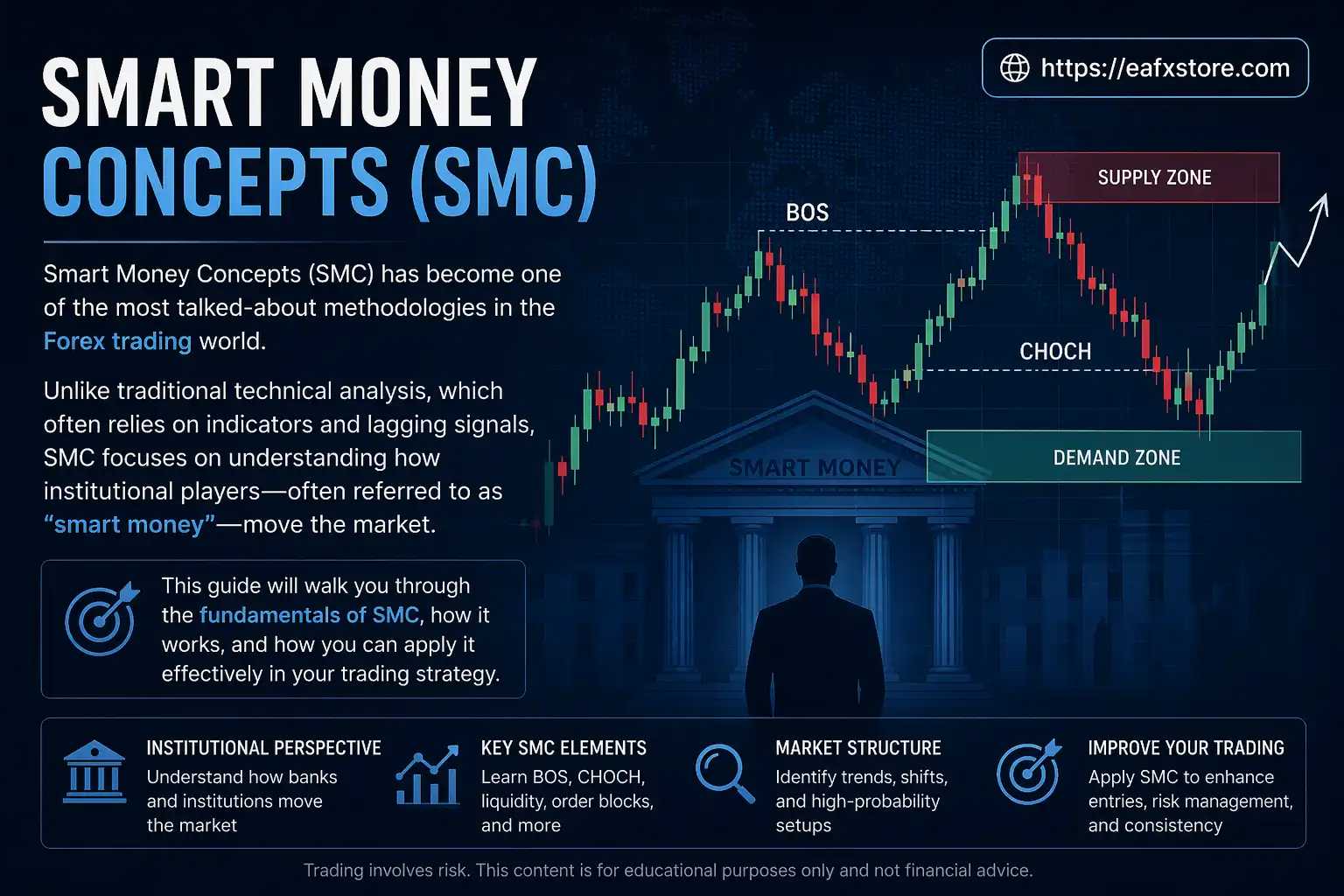
Smart Money Concepts (SMC) has become one of the most talked-about methodologies in the Forex trading world. Unlike traditional technical analysis, which often relies on indicators and lagging signals, SMC focuses on understanding how institutional players—often referred to as “smart money”—move the market.
This guide will walk you through the fundamentals of SMC, how it works, and how you can apply it effectively in your trading strategy.
What Are Smart Money Concepts?
Smart Money Concepts refer to a trading approach that analyzes market behavior based on the actions of large institutions such as banks, hedge funds and market makers. These entities have the capital to influence price movements and their footprints can often be identified through price action.
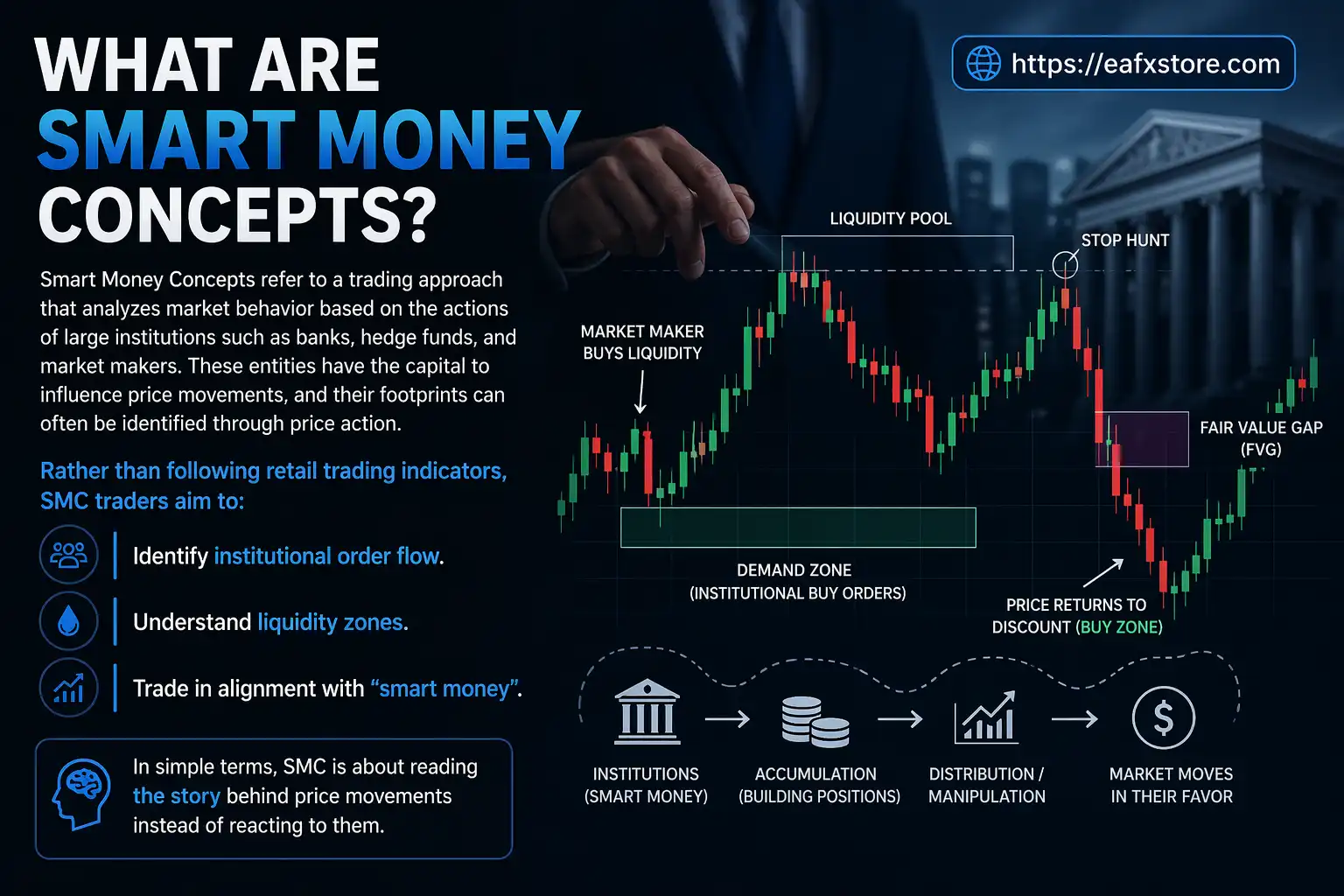
Rather than following retail trading indicators, SMC traders aim to:
- Identify institutional order flow.
- Understand liquidity zones.
- Trade in alignment with “smart money”.
In simple terms, SMC is about reading the story behind price movements instead of reacting to them.
Why Smart Money Moves the Market
The Forex market is highly liquid, but large players still need significant liquidity to execute their orders. This creates predictable patterns in price movement.
Key Reasons:
- Institutions require liquidity to enter/exit trades.
- They often manipulate price to trigger retail stop-losses.
- Market structure shifts when large orders are executed.
This behavior creates opportunities for traders who understand how to interpret it.
Core Components of SMC
To effectively use Smart Money Concepts, you need to understand its core elements.
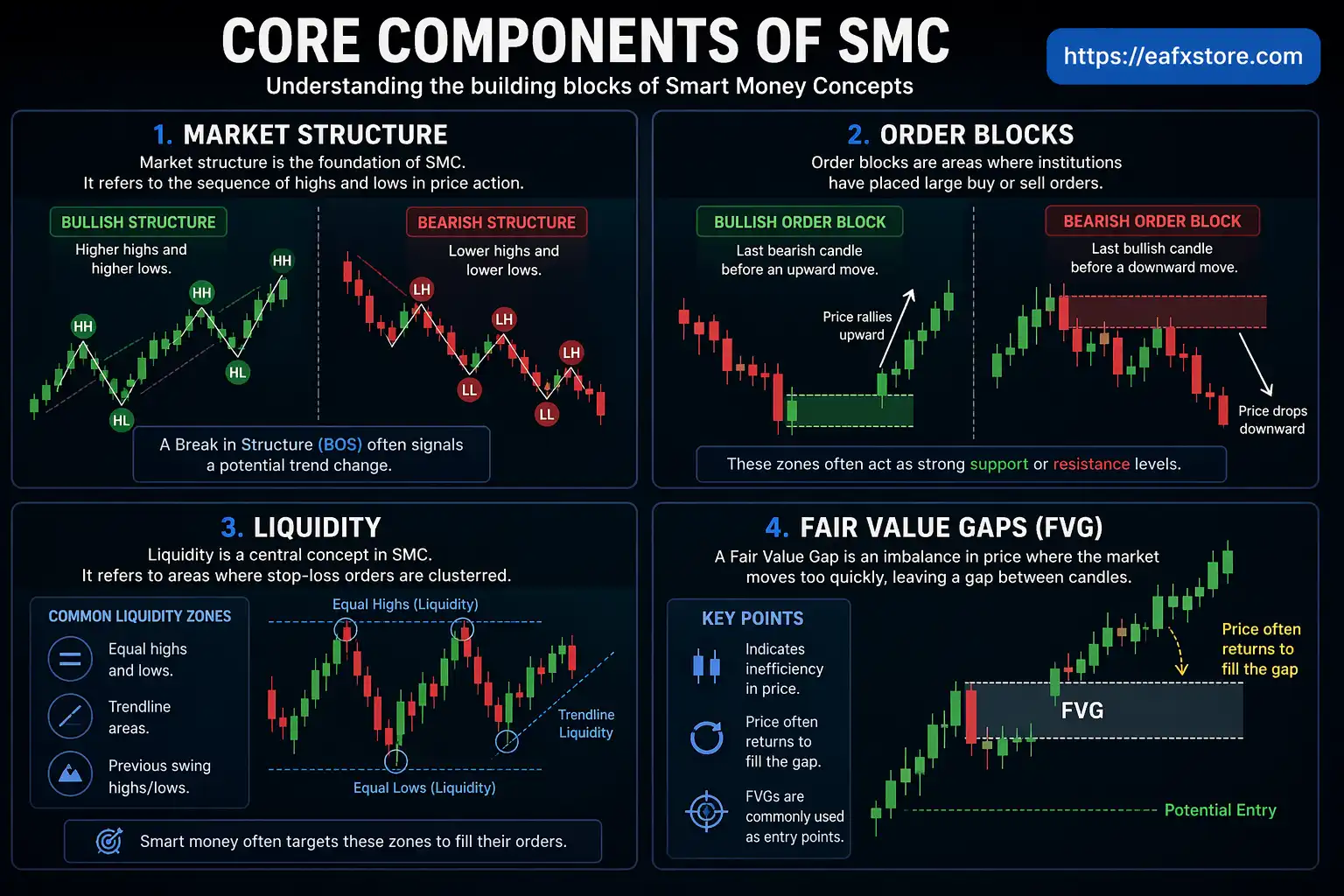
🎯 Market Structure
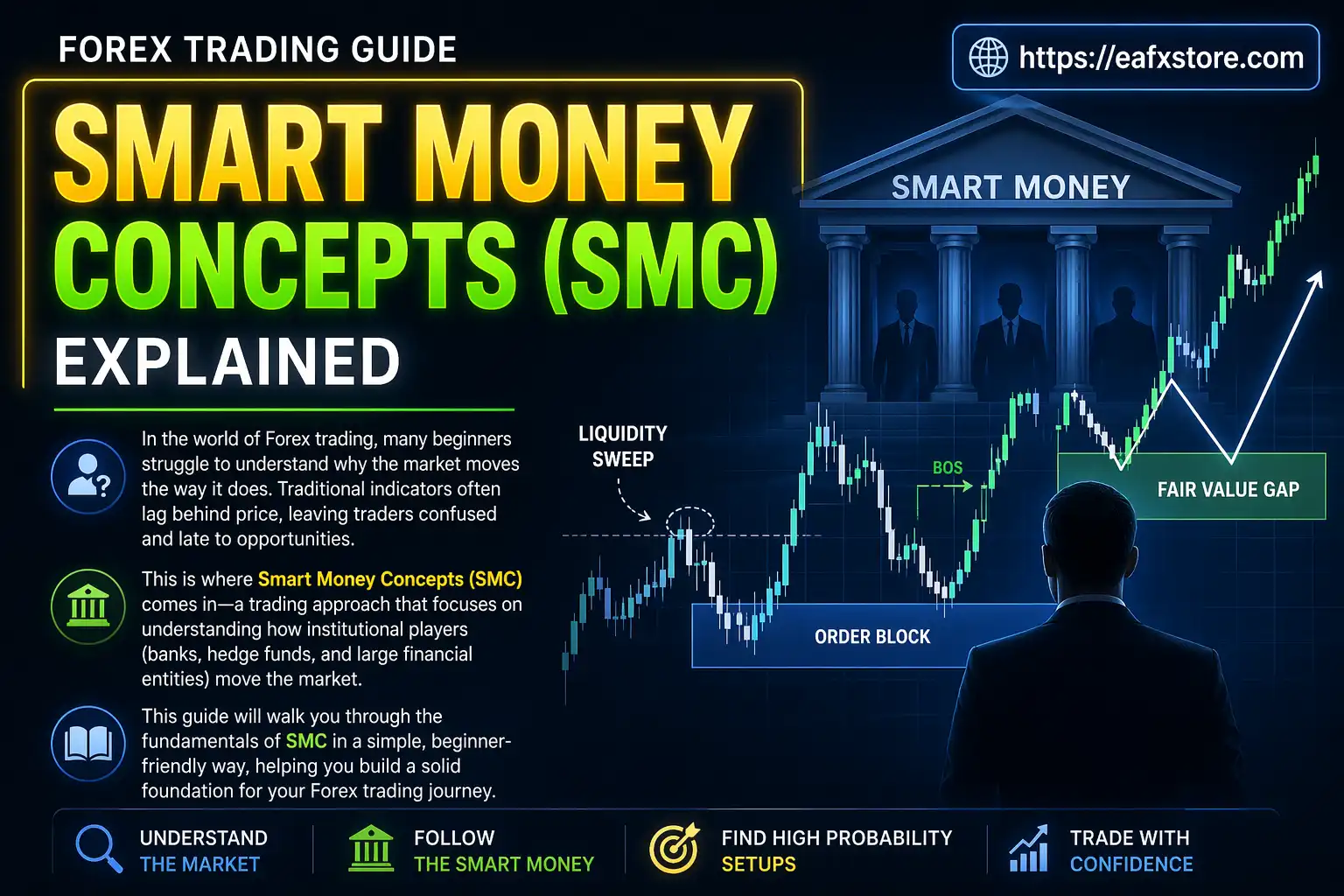
Market structure is the foundation of SMC. It refers to the sequence of highs and lows in price action.
- Bullish structure: Higher highs and higher lows.
- Bearish structure: Lower highs and lower lows.
A Break in structure (BOS) often signals a potential trend change.
🎯 Order Blocks
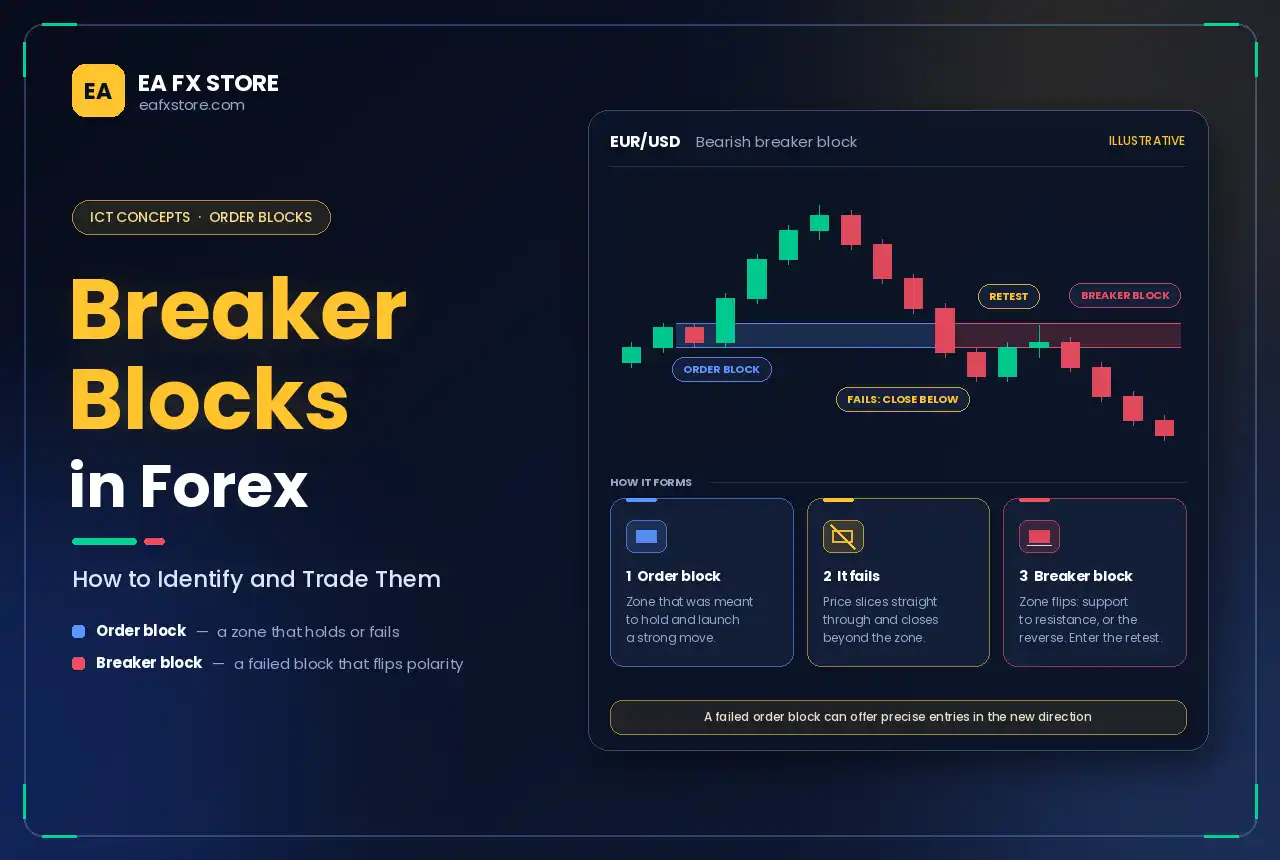
Order blocks are areas where institutions have placed large buy or sell orders.
- Bullish order block: Last bearish candle before an upward move.
- Bearish order block: Last bullish candle before a downward move.
These zones often act as strong support or resistance levels.
🎯 Liquidity
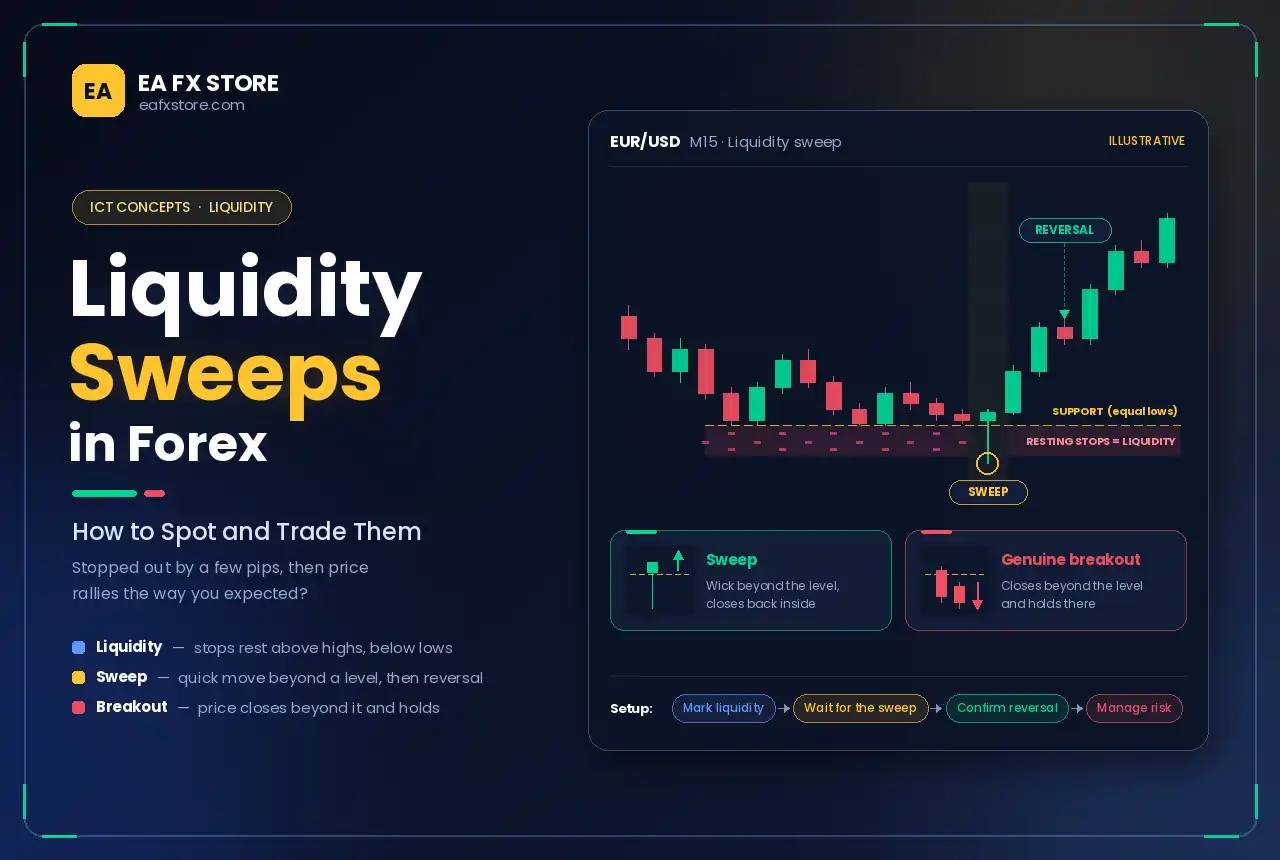
Liquidity is a central concept in SMC. It refers to areas where stop-loss orders are clustered.
Common liquidity zones include:
- Equal highs and lows.
- Trendline areas.
- Previous swing highs/lows.
Smart money often targets these zones to fill their orders.
🎯 Fair Value Gaps (FVG)
A Fair Value Gap (FVG) is an imbalance in price where the market moves too quickly, leaving a gap between candles.
- Indicates inefficiency in price.
- Price often returns to fill the gap.
FVGs are commonly used as entry points.
SMC vs Traditional Trading
Below is a comparison between Smart Money Concepts and traditional retail trading methods:
| Feature | Smart Money Concepts (SMC) | Traditional Trading |
|---|---|---|
| Approach | Price action & liquidity | Indicators & signals |
| Focus | Institutional behavior | Retail patterns |
| Entry Timing | High precision | Often delayed |
| Risk Management | Structure-based | Indicator-based |
| Market Understanding | Deep (cause of movement) | Surface-level (reaction) |
SMC provides a more advanced framework for understanding how and why the market moves.
How to Trade Using SMC
Applying SMC requires patience, discipline and practice. Here’s a simplified step-by-step process:
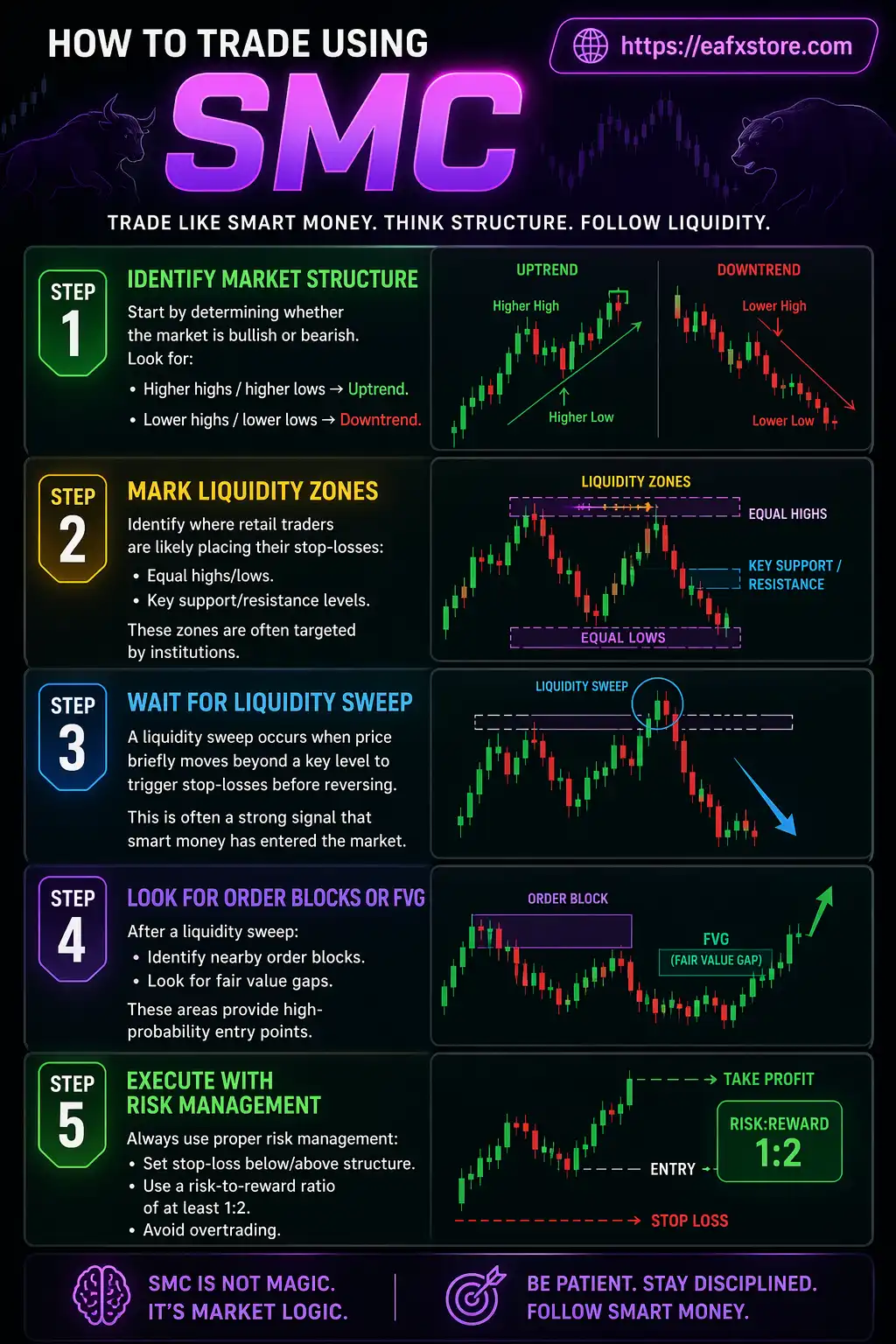
🎯 Step 1: Identify Market Structure
Start by determining whether the market is bullish or bearish. Look for:
- Higher highs / higher lows → Uptrend.
- Lower highs / lower lows → Downtrend.
🎯 Step 2: Mark Liquidity Zones
Identify where retail traders are likely placing their stop-losses:
- Equal highs/lows.
- Key support/resistance levels.
These zones are often targeted by institutions.
🎯 Step 3: Wait for Liquidity Sweep
A liquidity sweep occurs when price briefly moves beyond a key level to trigger stop-losses before reversing.
This is often a strong signal that smart money has entered the market.
🎯 Step 4: Look for Order Blocks or FVG
After a liquidity sweep:
- Identify nearby order blocks.
- Look for fair value gaps.
These areas provide high-probability entry points.
🎯 Step 5: Execute with Risk Management
Always use proper risk management:
- Set stop-loss below/above structure.
- Use a risk-to-reward ratio of at least 1:2.
- Avoid overtrading.
Common Mistakes in SMC Trading
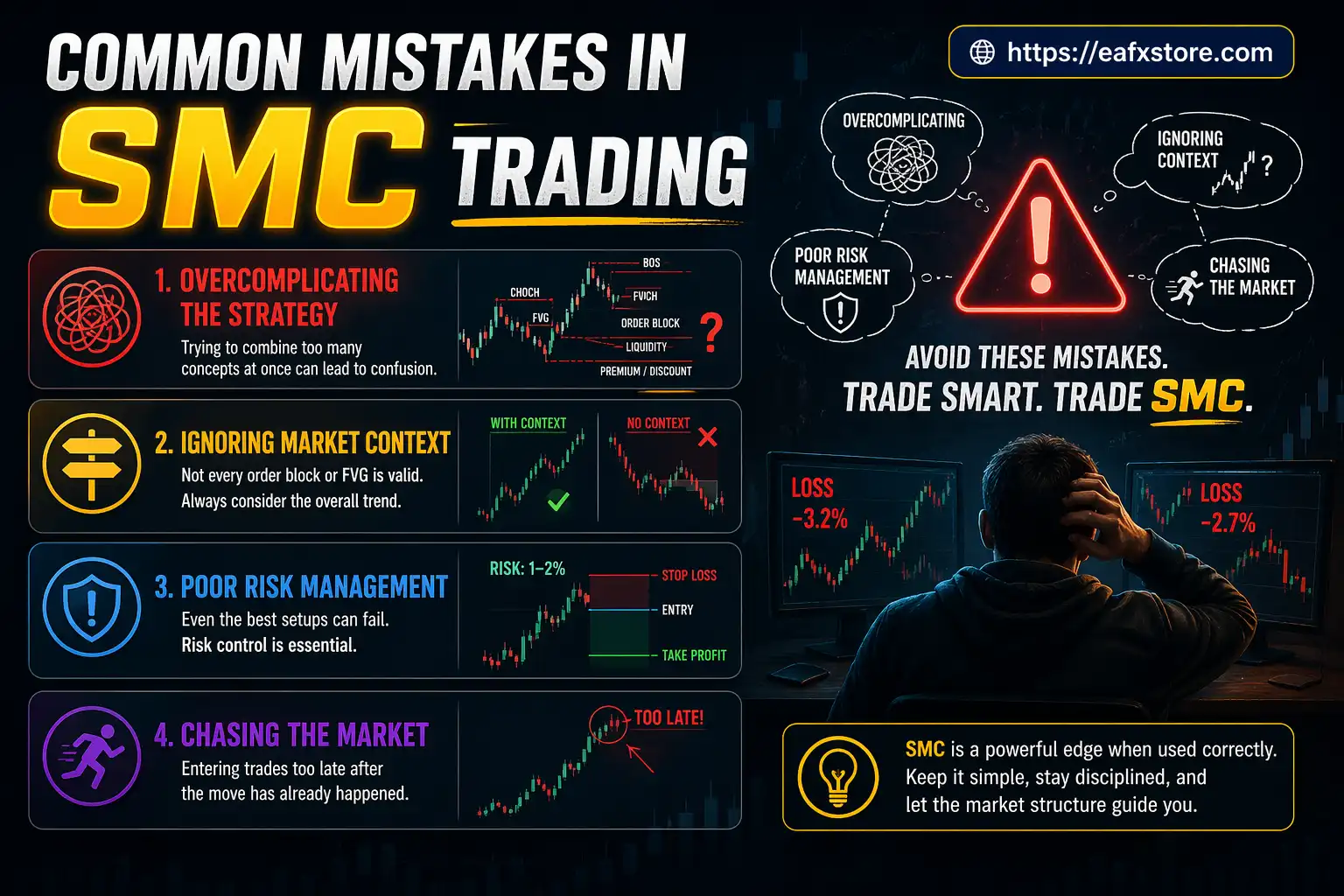
Even though SMC is powerful, many traders misuse it. Here are common pitfalls:
- Overcomplicating the Strategy: Trying to combine too many concepts at once can lead to confusion.
- Ignoring Market Context: Not every order block or FVG is valid. Always consider the overall trend.
- Poor Risk Management: Even the best setups can fail. Risk control is essential.
- Chasing the Market: Entering trades too late after the move has already happened.
Advantages of Smart Money Concepts
SMC offers several benefits that make it attractive for serious traders:
- High accuracy setups when applied correctly.
- Better understanding of market behavior.
- Reduced reliance on indicators.
- Improved risk-to-reward opportunities.
Disadvantages of SMC
Despite its advantages, SMC is not perfect:
- Requires significant learning and screen time.
- Can be subjective if not properly understood.
- Not beginner-friendly compared to basic indicators.
Is SMC Suitable for Beginners?
SMC can be challenging for beginners, but it is not impossible to learn. If you’re new to trading:
- Start with basic price action.
- Learn market structure first.
- Practice on demo accounts.
Once you’re comfortable, you can gradually incorporate advanced SMC concepts.
Final Thoughts
Smart Money Concepts provide a powerful framework for understanding how the Forex market truly operates. By focusing on liquidity, market structure, and institutional behavior, traders can gain a significant edge over traditional indicator-based approaches.
However, success with SMC requires patience, discipline, and continuous learning. It’s not a shortcut to quick profits—but for those willing to invest the time, it can be a game-changing strategy.
FAQs
❓ What is the main idea behind SMC?
It focuses on following institutional traders rather than retail indicators.
❓ Is SMC better than indicators?
It offers deeper market insight, but requires more skill and experience.
❓ Can SMC be used in other markets?
Yes, it works in stocks, crypto, and indices as well.