


In the world of Forex trading, many beginners struggle to understand why the market moves the way it does. Traditional indicators often lag behind price, leaving traders confused and late to opportunities. This is where Smart Money Concepts (SMC) comes in—a trading approach that focuses on understanding how institutional players (banks, hedge funds, and large financial entities) move the market.
This guide will walk you through the fundamentals of SMC in a simple, beginner-friendly way, helping you build a solid foundation for your Forex trading journey.
What Are Smart Money Concepts (SMC)?
Smart Money Concepts revolve around the idea that large institutions control market direction. These players have enough capital to influence price movements, unlike retail traders.
Instead of relying on indicators, SMC focuses on:
- Market structure.
- Liquidity.
- Order flow.
- Institutional behavior.
The goal is simple: trade in alignment with smart money rather than against it.
Why SMC Matters in Forex Trading
Most retail traders lose money because they:
- Enter trades too late.
- Follow misleading indicators.
- Ignore liquidity zones.
SMC helps you:
- Understand why price moves.
- Identify high-probability trade setups.
- Avoid common retail traps.

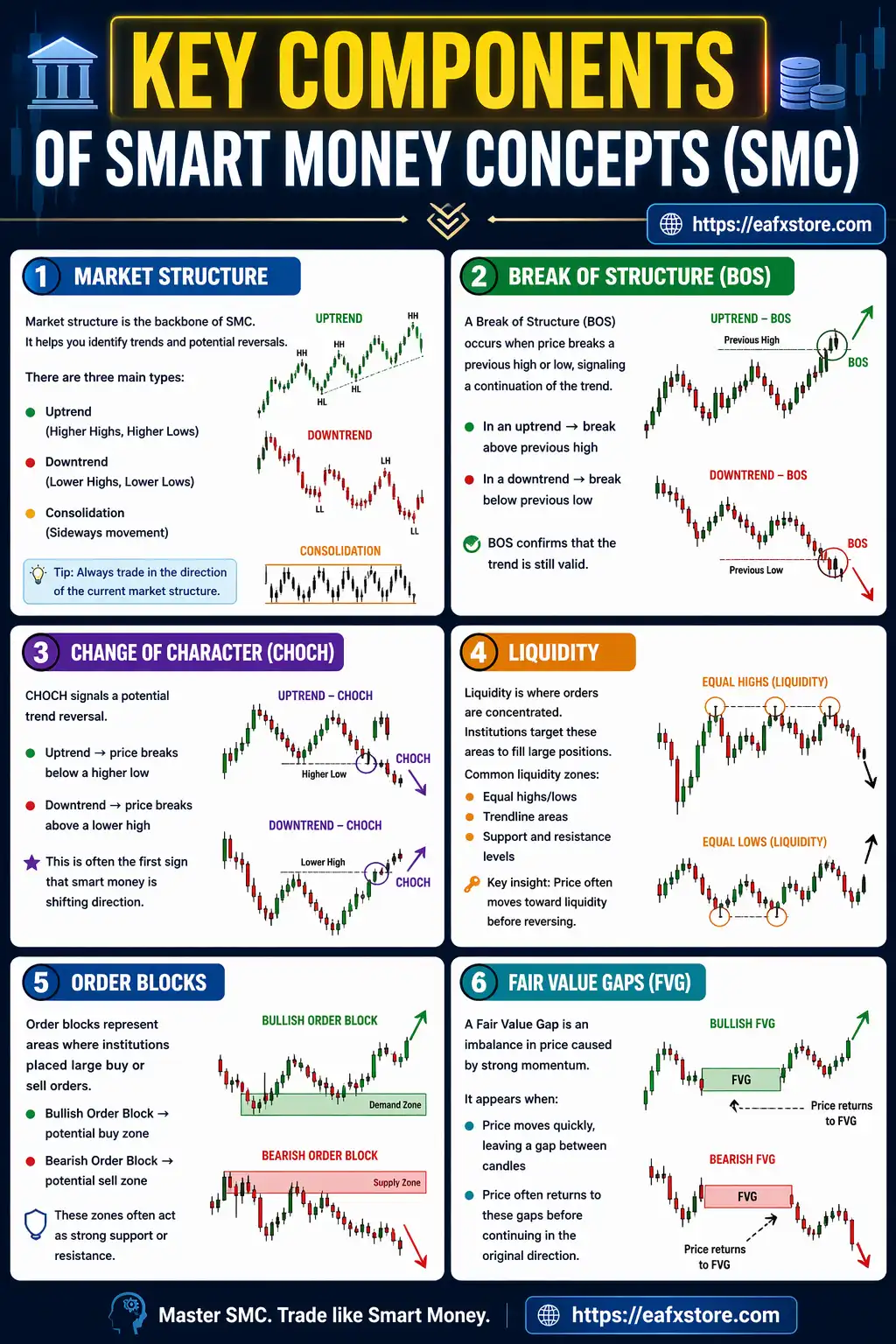
Key Components of Smart Money Concepts (SMC)
🎯 Market Structure
Market structure is the backbone of SMC. It helps you identify trends and potential reversals.
There are three main types:
- Uptrend (Higher Highs, Higher Lows).
- Downtrend (Lower Highs, Lower Lows).
- Consolidation (Sideways movement).
Tip: Always trade in the direction of the current market structure.
🎯 Break of Structure (BOS)
A Break of Structure (BOS) occurs when price breaks a previous high or low, signaling a continuation of the trend.
- In an uptrend → break above previous high.
- In a downtrend → break below previous low.
BOS confirms that the trend is still valid.
🎯 Change of Character (CHOCH)
Change of Character (CHOCH) signals a potential trend reversal.
- Uptrend → price breaks below a higher low.
- Downtrend → price breaks above a lower high.
This is often the first sign that smart money is shifting direction.
🎯 Liquidity
Liquidity is where orders are concentrated. Institutions target these areas to fill large positions.
Common liquidity zones:
- Equal highs/lows.
- Trendline areas.
- Support and resistance levels.
Key insight: Price often moves toward liquidity before reversing.
🎯 Order Blocks
Order blocks represent areas where institutions placed large buy or sell orders.
- Bullish Order Block → potential buy zone.
- Bearish Order Block → potential sell zone.
These zones often act as strong support or resistance.
🎯 Fair Value Gaps (FVG)
A Fair Value Gap (FVG) is an imbalance in price caused by strong momentum.
It appears when:
- Price moves quickly, leaving a gap between candles.
Price often returns to these gaps before continuing in the original direction.
Simple SMC Trading Strategy for Beginners
Here’s a step-by-step strategy you can follow:
🎯 Step 1: Identify Market Structure
Determine whether the market is trending up, down, or sideways.
🎯 Step 2: Wait for Liquidity Sweep
Look for price taking out equal highs or lows. This indicates institutions are grabbing liquidity.
🎯 Step 3: Confirm CHOCH or BOS
- CHOCH → possible reversal.
- BOS → trend continuation.
🎯 Step 4: Mark Order Block or FVG
Identify the zone where price is likely to return.
🎯 Step 5: Enter Trade
Enter when price revisits the zone with confirmation (candlestick pattern, rejection, etc.).
🎯 Step 6: Set Stop Loss & Take Profit
- Stop Loss (SL) → below/above order block.
- Take Profit (TP) → next liquidity zone.

Example of an SMC Trade Setup
| Step | Action | Description |
|---|---|---|
| 1 | Identify Trend | Uptrend confirmed |
| 2 | Liquidity Sweep | Price takes previous highs |
| 3 | CHOCH | Market shifts downward |
| 4 | Order Block | Mark bearish zone |
| 5 | Entry | Sell at order block |
| 6 | TP/SL | TP at liquidity, SL above block |
Common Mistakes Beginners Make
Even with SMC, beginners often fall into traps:
- Ignoring Market Structure: Trading against the trend reduces your probability of success.
- Entering Too Early: Wait for confirmation—don’t guess the market.
- Poor Risk Management: Never risk more than 1–2% per trade.
- Overcomplicating the Strategy: SMC is powerful but should remain simple.
Tips to Master SMC Faster
- Practice on demo accounts.
- Focus on one or two currency pairs.
- Use higher timeframes for clarity.
- Keep a trading journal.
- Review past trades regularly.
Consistency matters more than complexity.
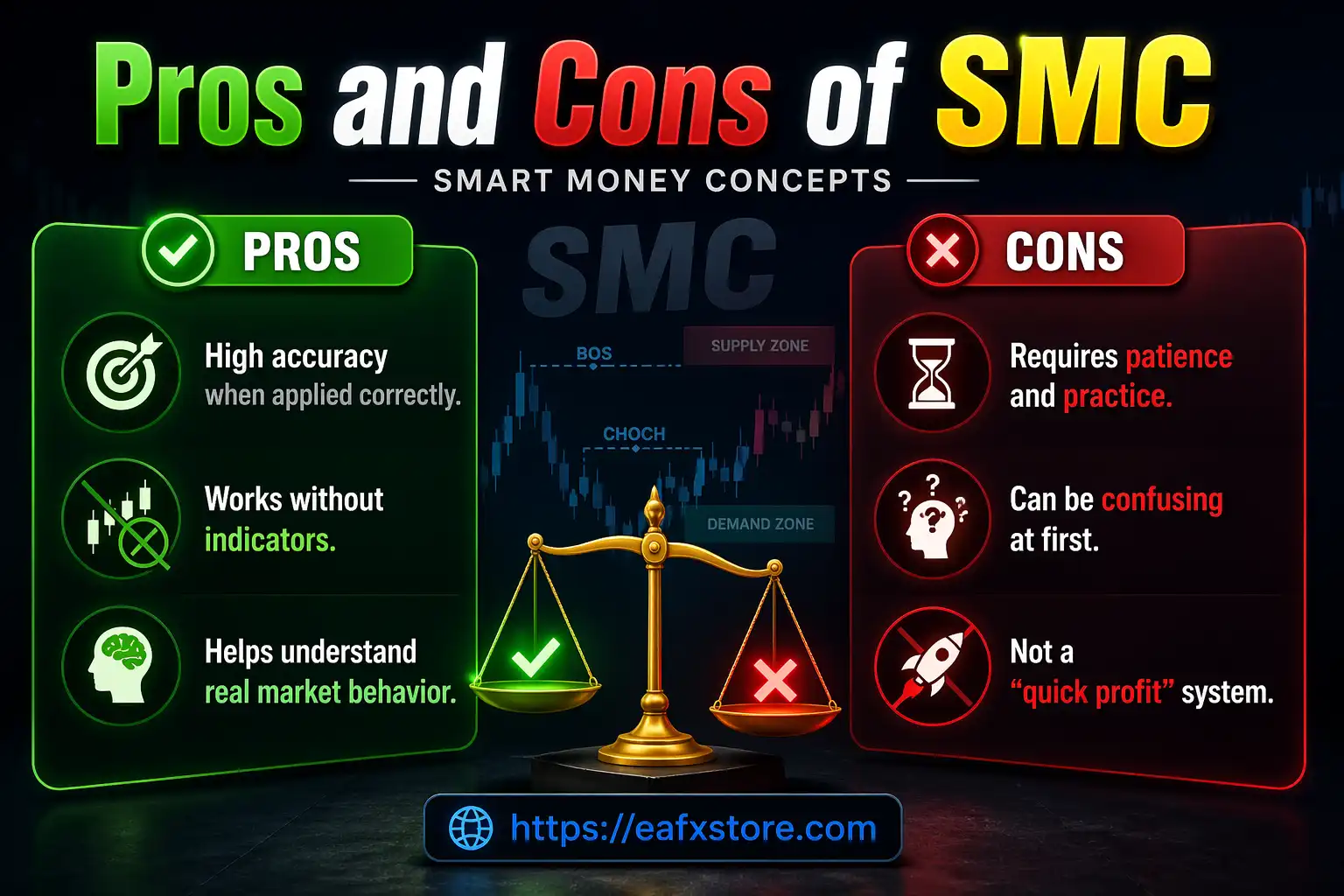
Pros and Cons of Smart Money Concepts
🎯 Pros
- High accuracy when applied correctly.
- Works without indicators.
- Helps understand real market behavior.
🎯 Cons
- Requires patience and practice.
- Can be confusing at first.
- Not a “quick profit” system.
Is SMC Suitable for Beginners?
Yes—but only if you approach it with the right mindset.
SMC is not about:
- Getting rich quickly.
- Taking random trades.
It’s about:
- Understanding price behavior.
- Thinking like institutional traders.
- Building long-term consistency.
Conclusion
Smart Money Concepts (SMC) offer a powerful way to understand and trade the Forex market by focusing on what truly moves price—institutional activity.
By mastering key elements like:
- Market structure.
- Liquidity.
- Order blocks.
- Break of structure.
You can significantly improve your trading accuracy and decision-making.