
What is Break of Structure (BOS) in Forex?
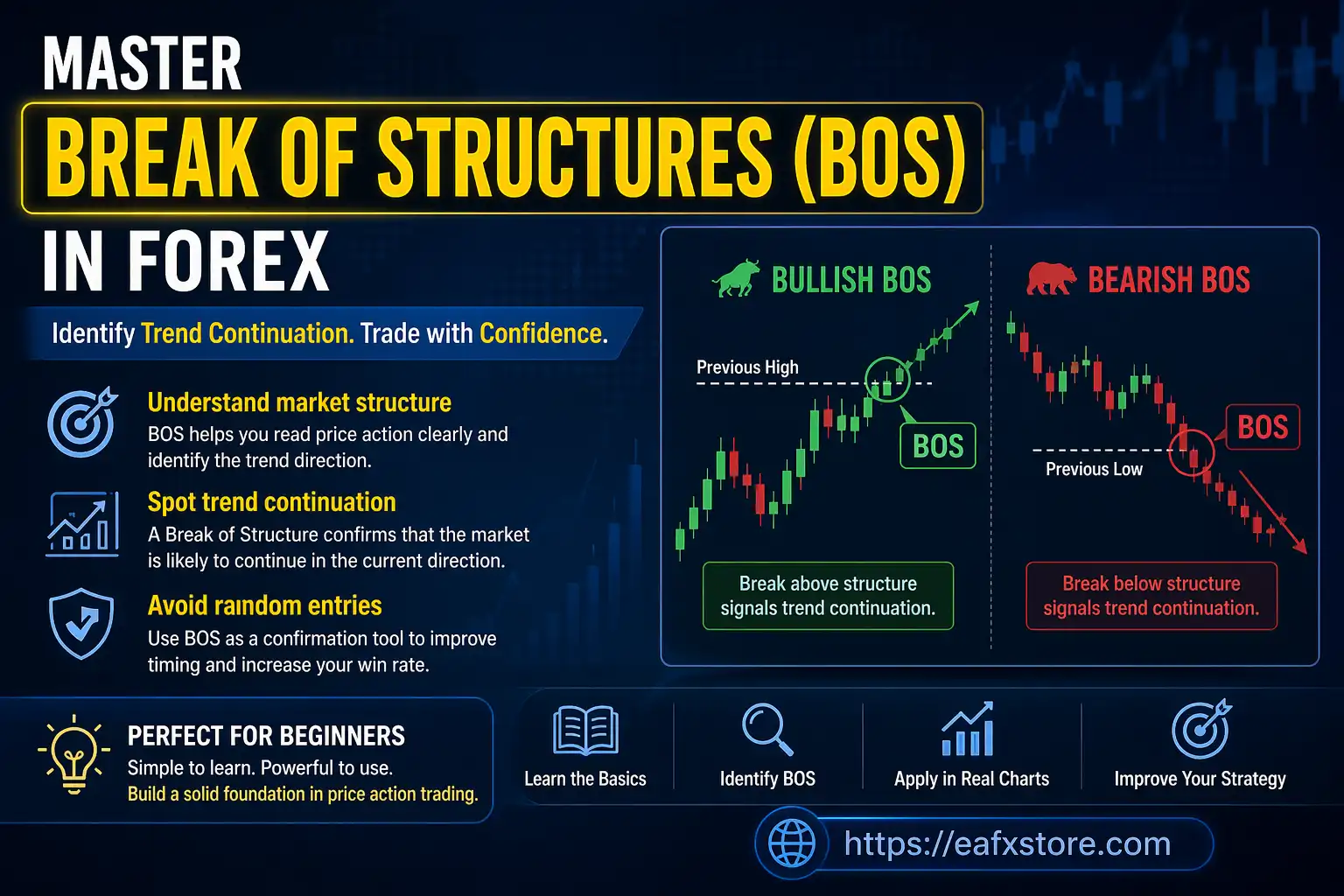
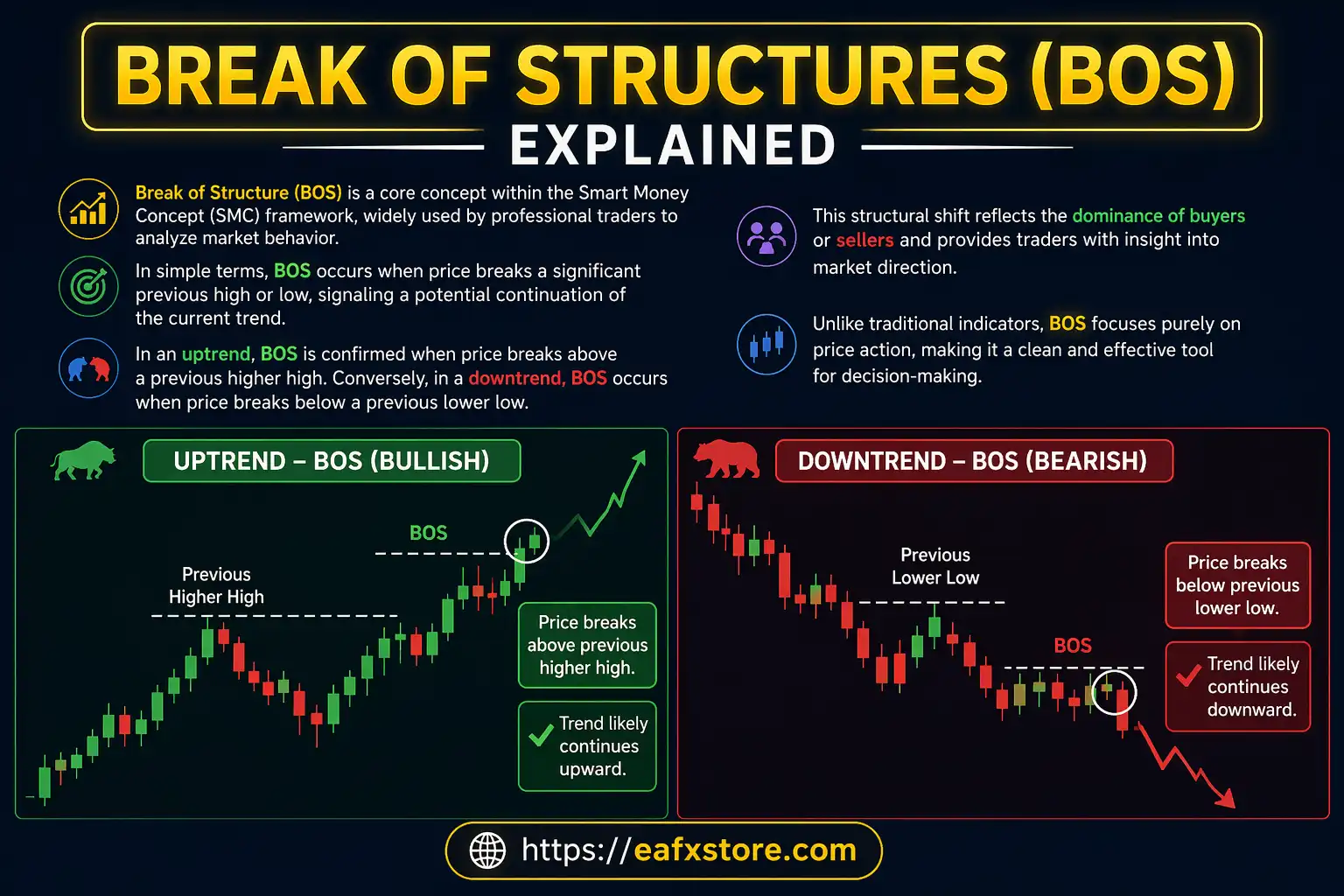
Break of Structure (BOS) is a core concept within the Smart Money Concept (SMC) framework, widely used by professional traders to analyze market behavior. In simple terms, BOS occurs when price breaks a significant previous high or low, signaling a potential continuation of the current trend.
In an uptrend, BOS is confirmed when price breaks above a previous higher high. Conversely, in a downtrend, BOS occurs when price breaks below a previous lower low. This structural shift reflects the dominance of buyers or sellers and provides traders with insight into market direction. Unlike traditional indicators, BOS focuses purely on price action, making it a clean and effective tool for decision-making.
Why BOS Matters in Smart Money Concept (SMC)
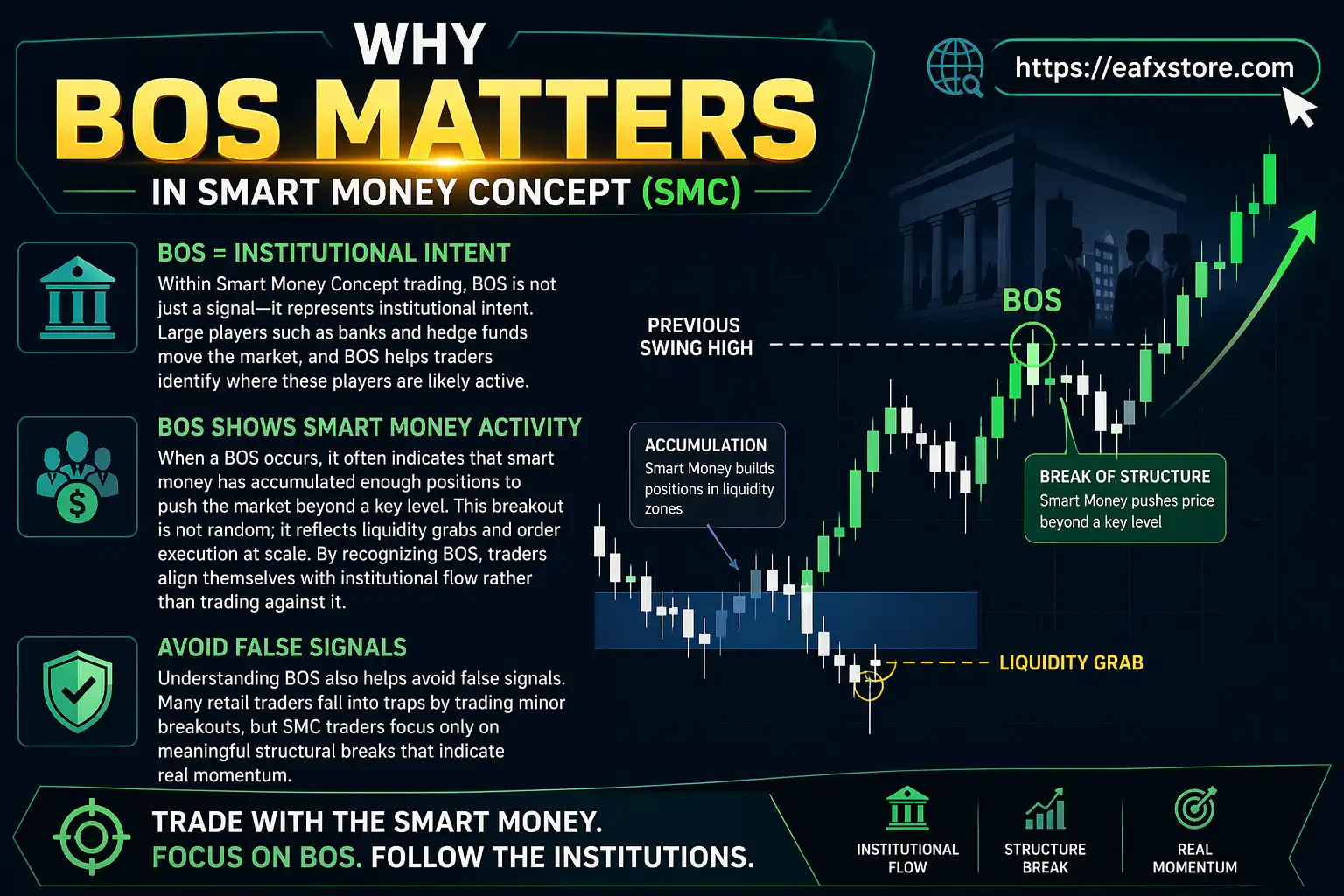
Within Smart Money Concept (SMC) trading, BOS is not just a signal—it represents institutional intent. Large players such as banks and hedge funds move the market, and BOS helps traders identify where these players are likely active.
When a BOS occurs, it often indicates that smart money has accumulated enough positions to push the market beyond a key level. This breakout is not random, it reflects liquidity grabs and order execution at scale. By recognizing BOS, traders align themselves with institutional flow rather than trading against it.
Understanding BOS also helps avoid false signals. Many retail traders fall into traps by trading minor breakouts, but SMC traders focus only on meaningful structural breaks that indicate real momentum.
Types of Break of Structure
There are two primary types of BOS in Forex trading, each providing different insights into market conditions:
| Type of BOS | Description | Market Implication |
|---|---|---|
| Bullish BOS | Price breaks above a previous high | Indicates continuation of an uptrend |
| Bearish BOS | Price breaks below a previous low | Indicates continuation of a downtrend |
Bullish BOS typically forms after a pullback in an uptrend, confirming that buyers are still in control. On the other hand, bearish BOS confirms that sellers maintain dominance in a downtrend.
It’s important to distinguish BOS from a Change of Character (CHOCH). While BOS confirms trend continuation, CHOCH signals a potential trend reversal. Mixing these concepts can lead to poor trade decisions.
How to Identify a Valid BOS
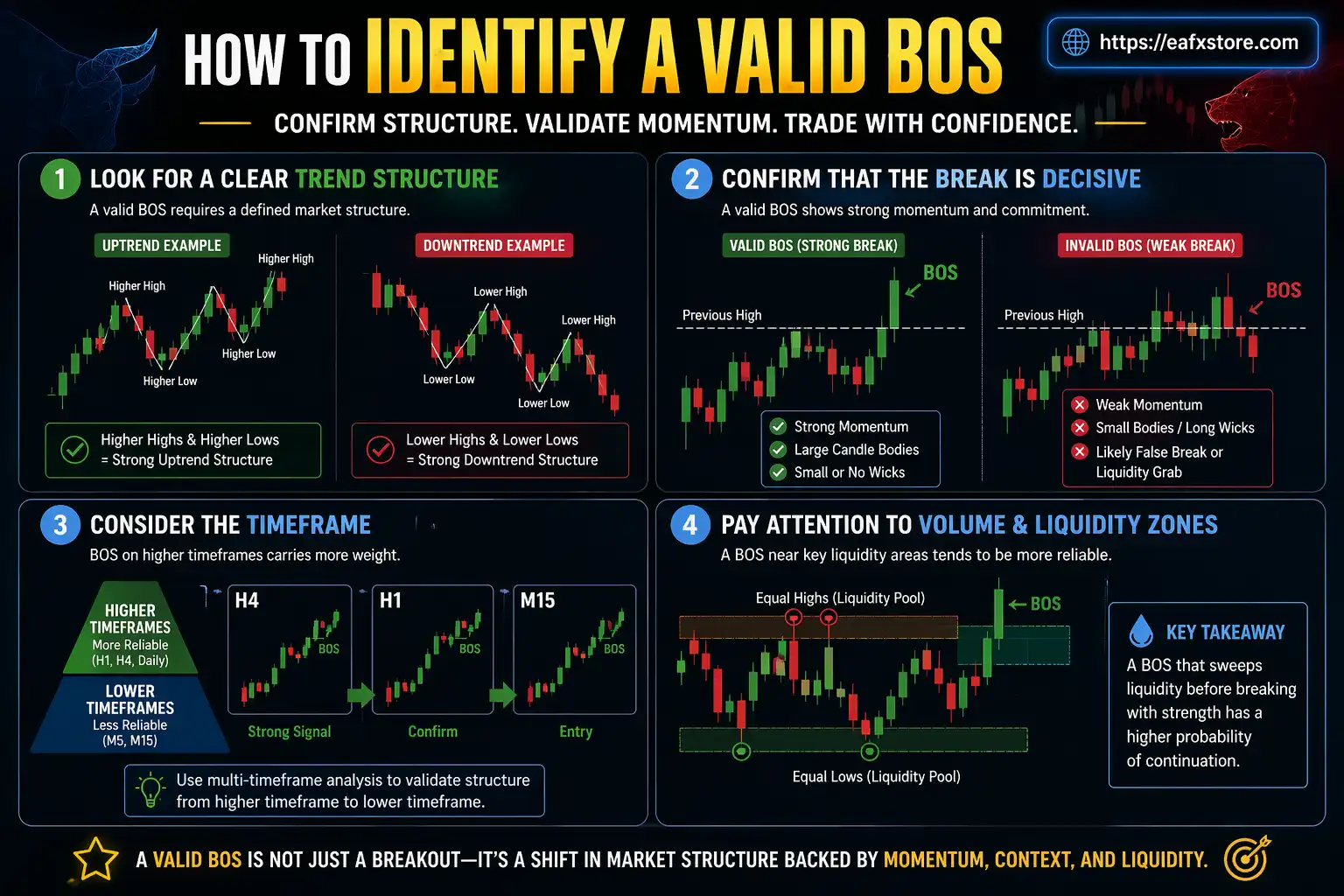
Identifying a valid BOS requires more than just spotting a breakout. Traders must evaluate the context and strength of the move.
First, look for a clear trend structure—higher highs and higher lows for an uptrend, or lower highs and lower lows for a downtrend. Without a defined structure, BOS loses its significance.
Second, confirm that the break is decisive. A valid BOS usually involves strong momentum, large candlestick bodies and minimal wicks. Weak or indecisive breaks often indicate false moves or liquidity grabs.
Third, consider the timeframe. BOS on higher timeframes (H1, H4, Daily) carries more weight than those on lower timeframes like M5 or M15. Professional traders often use multi-timeframe analysis to validate structure.
Finally, pay attention to volume and liquidity zones. A BOS that occurs near key liquidity areas—such as equal highs or lows—tends to be more reliable.
BOS vs Traditional Breakouts
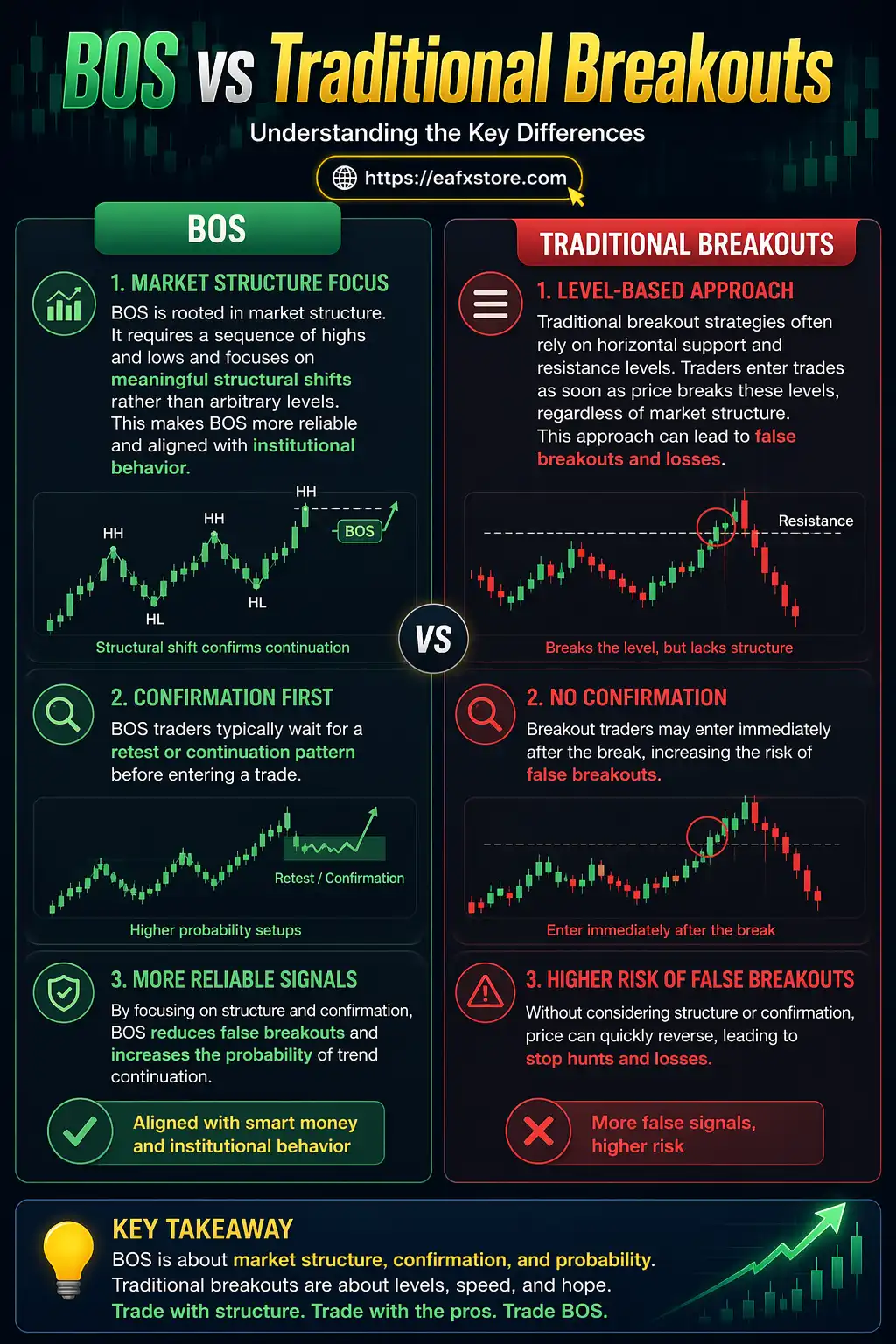
At first glance, BOS may seem similar to traditional breakout trading, but there are key differences.
Traditional breakout strategies often rely on horizontal support and resistance levels. Traders enter trades as soon as price breaks these levels, regardless of market structure. This approach can lead to false breakouts and losses.
In contrast, BOS is rooted in market structure. It requires a sequence of highs and lows and focuses on meaningful structural shifts rather than arbitrary levels. This makes BOS more reliable and aligned with institutional behavior.
Another difference lies in confirmation. BOS traders typically wait for a retest or continuation pattern before entering a trade, while breakout traders may enter immediately after the break.
How to Trade Using BOS
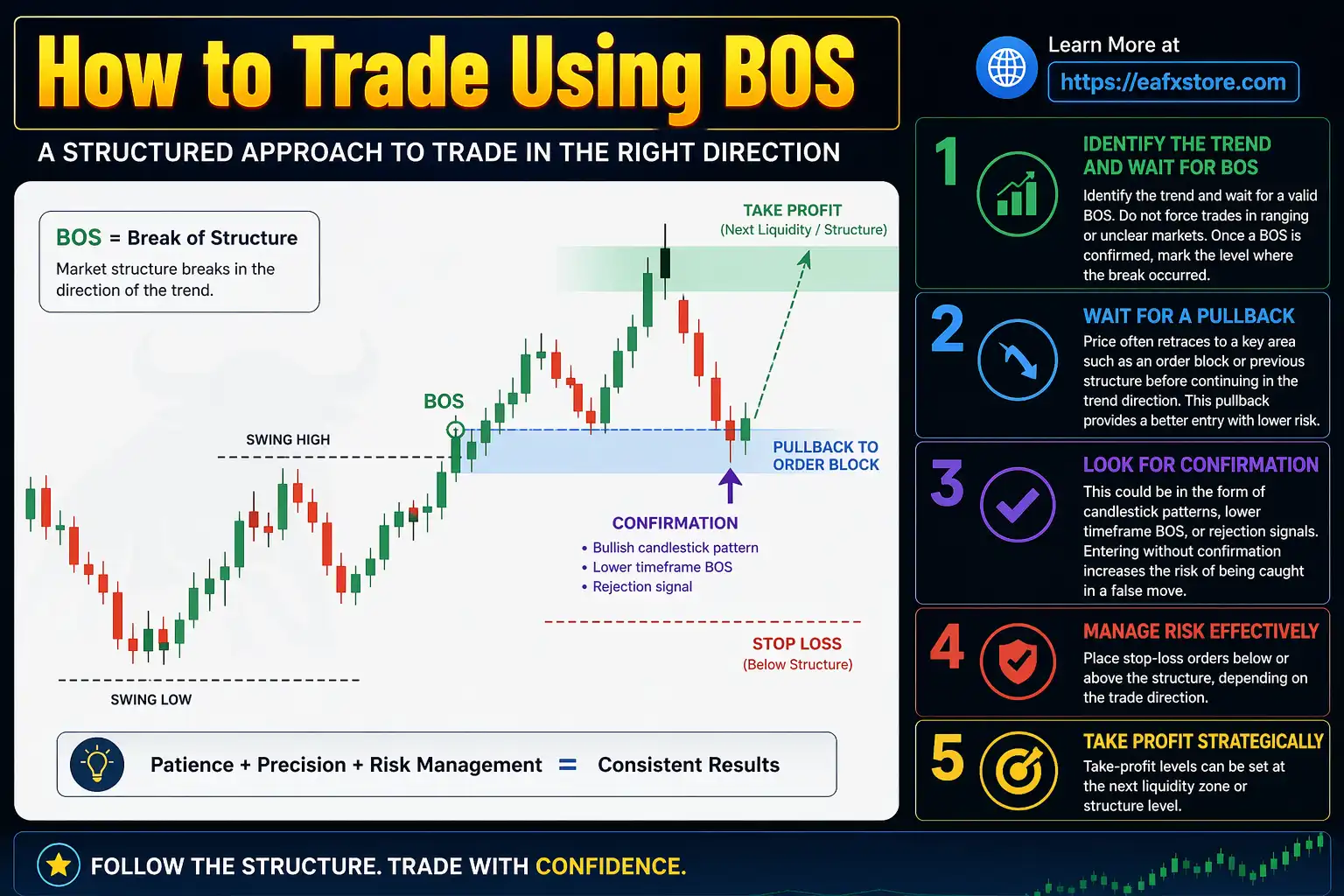
Trading with BOS involves a structured approach that combines patience and precision.
First, identify the trend and wait for a valid BOS. Do not force trades in ranging or unclear markets. Once a BOS is confirmed, mark the level where the break occurred.
Next, wait for a pullback. Price often retraces to a key area such as an order block or previous structure before continuing in the trend direction. This pullback provides a better entry with lower risk.
Then, look for confirmation. This could be in the form of candlestick patterns, lower timeframe BOS, or rejection signals. Entering without confirmation increases the risk of being caught in a false move.
Finally, manage risk effectively. Place stop-loss orders below or above the structure, depending on the trade direction. Take-profit levels can be set at the next liquidity zone or structure level.
Common Mistakes When Using BOS
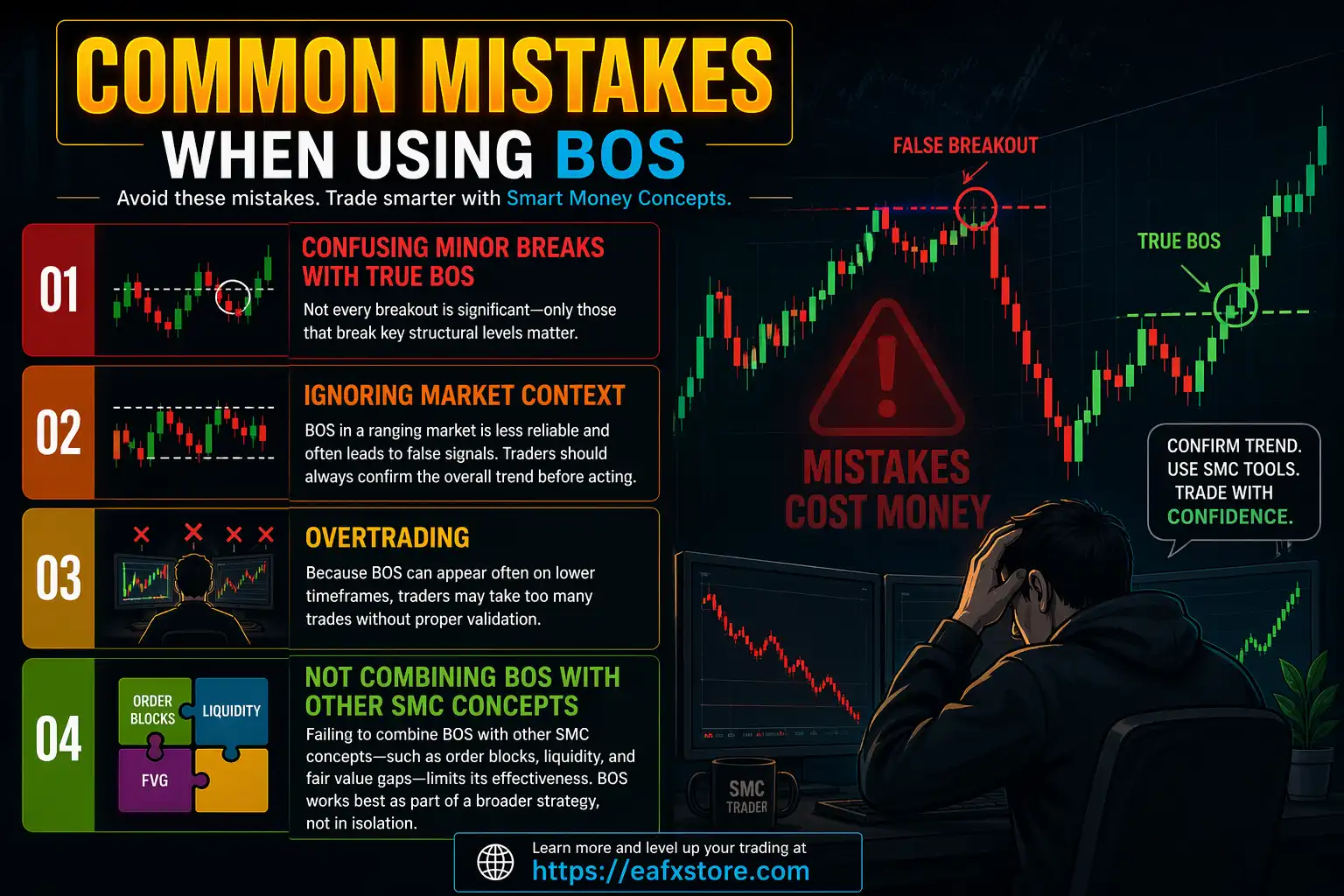
Many traders misunderstand BOS, leading to avoidable losses.
One common mistake is confusing minor breaks with true BOS. Not every breakout is significant—only those that break key structural levels matter.
Another mistake is ignoring market context. BOS in a ranging market is less reliable and often leads to false signals. Traders should always confirm the overall trend before acting.
Overtrading is also a frequent issue. Because BOS can appear often on lower timeframes, traders may take too many trades without proper validation.
Lastly, failing to combine BOS with other SMC concepts—such as order blocks, liquidity and fair value gaps—limits its effectiveness. BOS works best as part of a broader strategy, not in isolation.
BOS in Different Market Conditions
BOS behaves differently depending on market conditions.
In trending markets, BOS is highly reliable and frequently confirms continuation. Traders can use it to ride trends and maximize profits.
In ranging markets, BOS is less effective. Price may break structure temporarily but quickly reverse, creating false signals. In such cases, it’s better to wait for a clear breakout from the range before applying BOS strategies.
During high-impact news events, BOS can occur rapidly with strong momentum. While this can create opportunities, it also increases risk due to volatility. Traders should be cautious and avoid entering trades without confirmation.
Final Thoughts on BOS Trading
Break of Structure is a powerful tool for understanding market direction and aligning with smart money. By focusing on price action and structural shifts, traders gain a clearer view of market intent.
However, BOS is not a standalone solution. It requires discipline, context, and integration with other trading concepts. When used correctly, it can significantly improve trading accuracy and consistency.
For traders looking to move beyond basic indicators, mastering BOS within the Smart Money Concept framework is a valuable step toward more professional and informed trading decisions.