
Understanding market structure is one of the most important skills in Forex trading. Among the many concepts traders use, Break of Structure (BOS) stands out as a simple yet powerful tool to identify trend continuation and potential trading opportunities.
If you’re a beginner, BOS can help you read price action more clearly and avoid random entries. This guide will walk you through everything you need to know—from the basics to practical application—so you can start using BOS confidently in your trading strategy.
What is Break of Structure (BOS)?
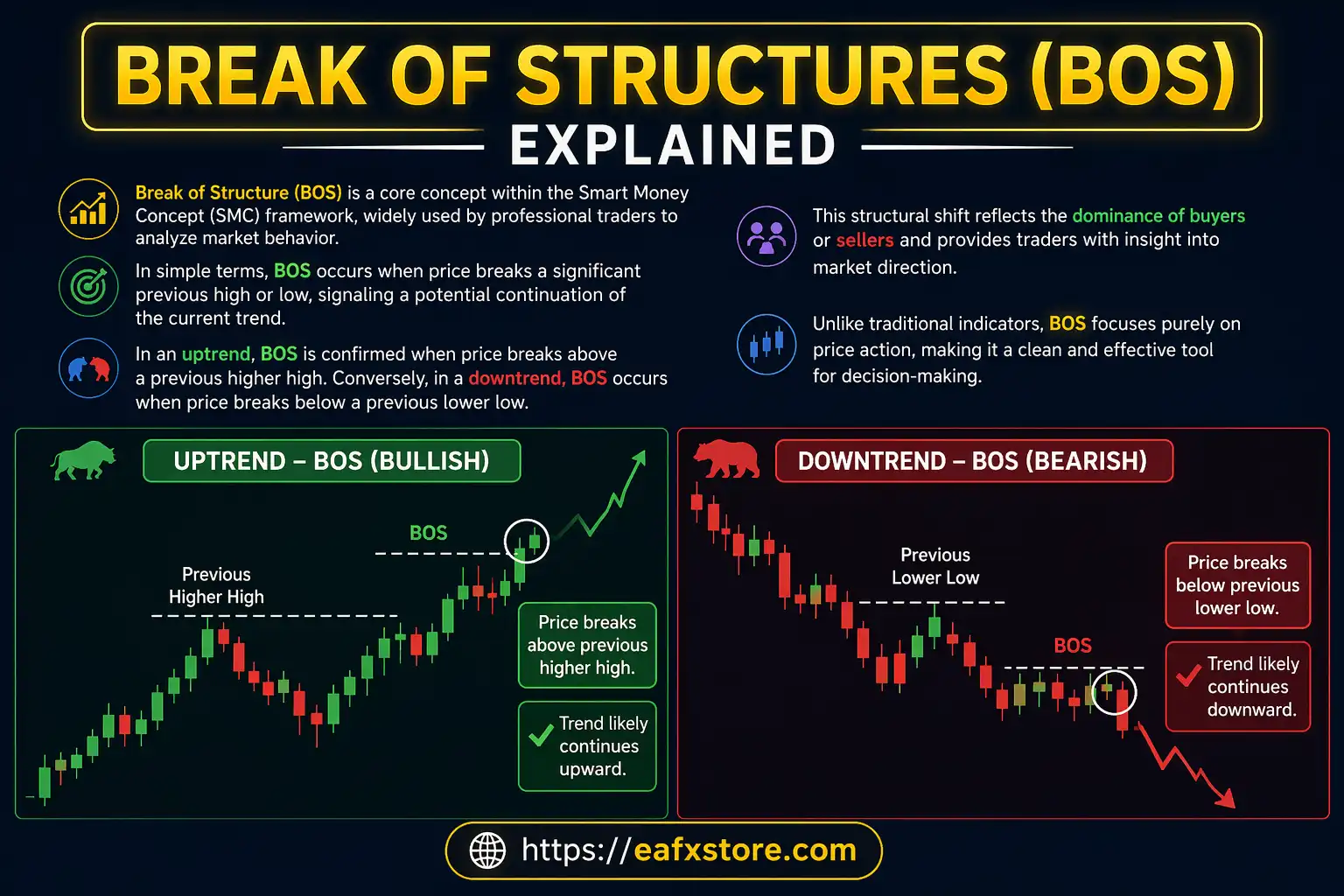
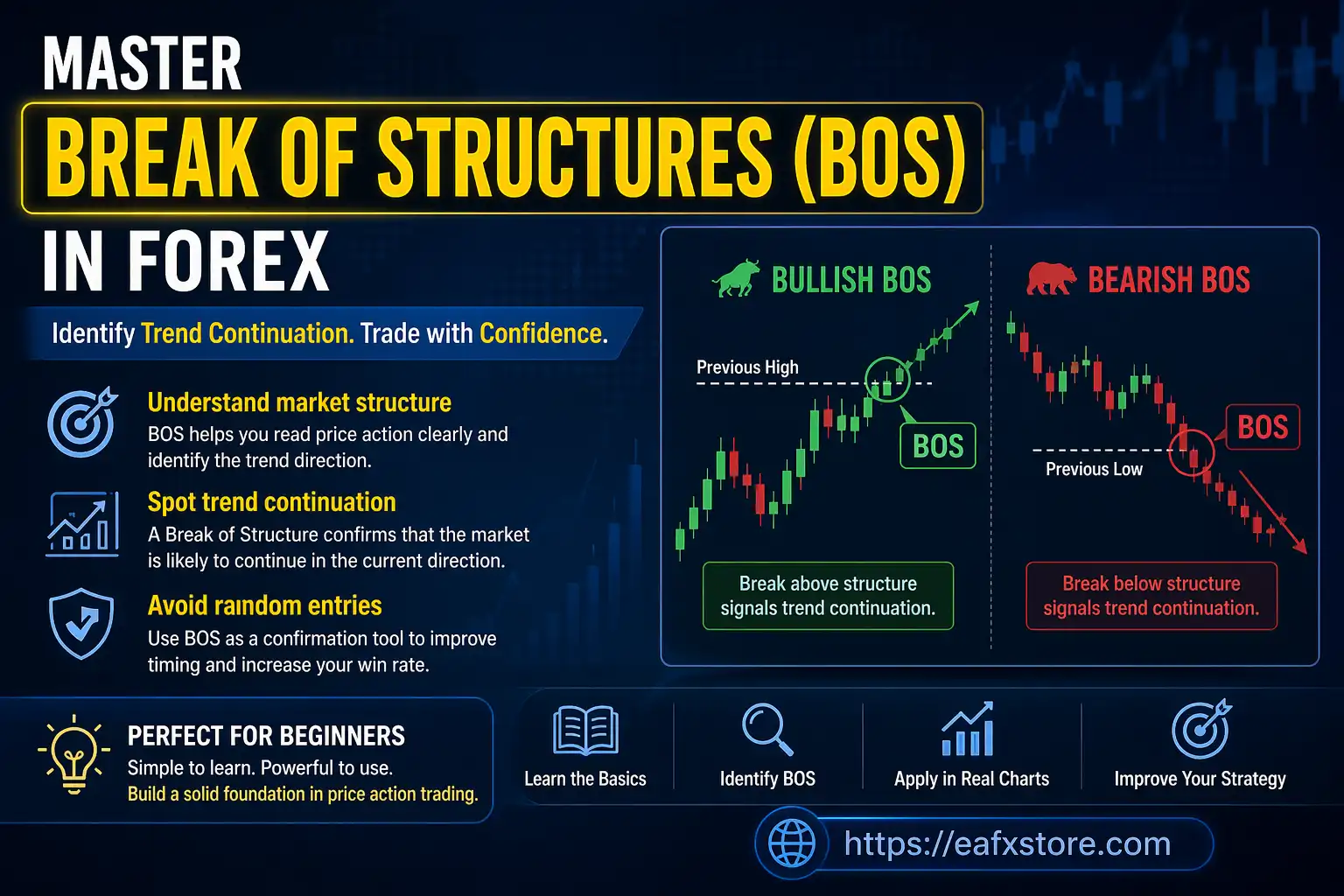
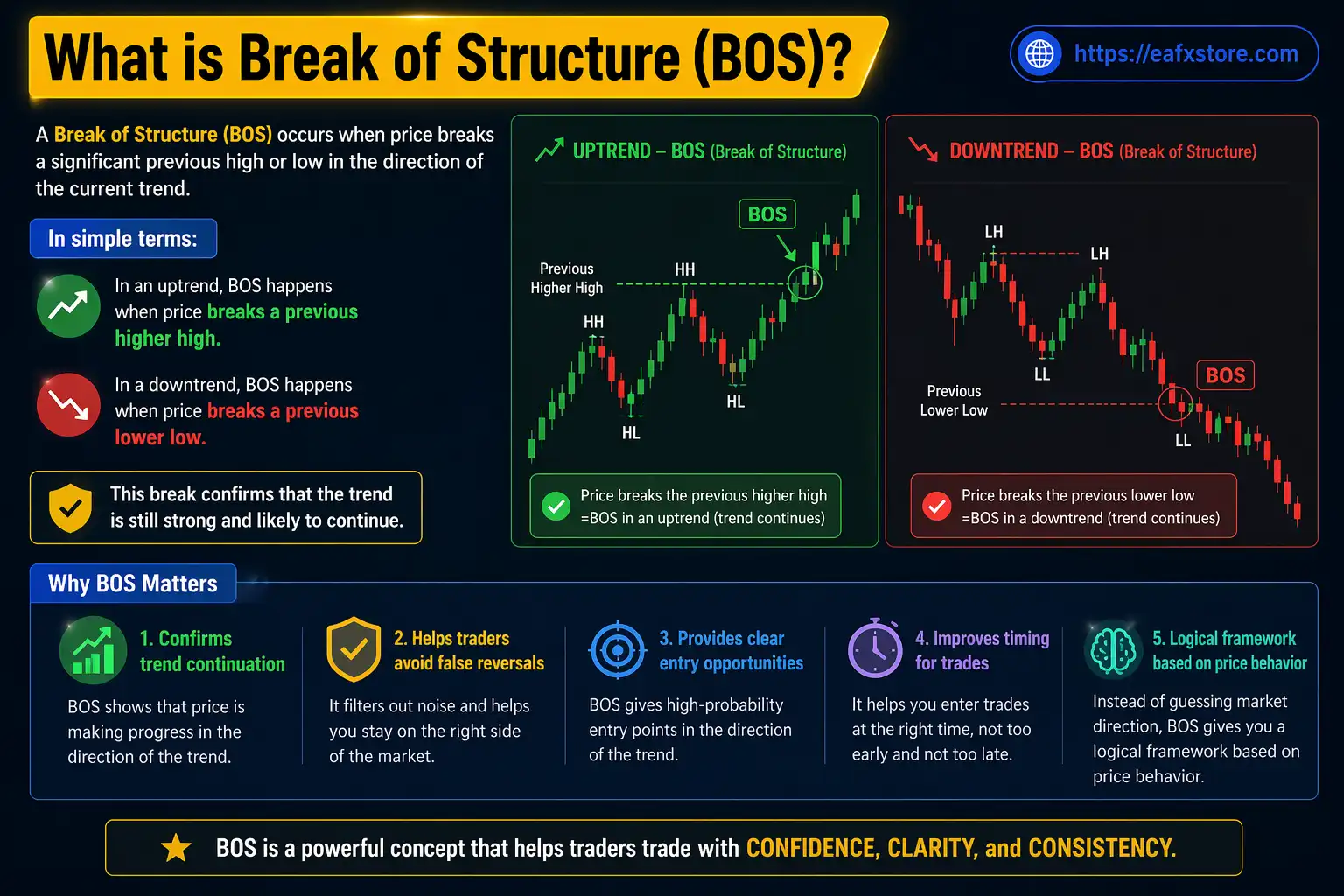
A Break of Structure (BOS) occurs when price breaks a significant previous high or low in the direction of the current trend.
In simple terms:
- In an uptrend, BOS happens when price breaks a previous higher high.
- In a downtrend, BOS happens when price breaks a previous lower low.
This break confirms that the trend is still strong and likely to continue.
Why BOS Matters
BOS is important because it:
- Confirms trend continuation.
- Helps traders avoid false reversals.
- Provides clear entry opportunities.
- Improves timing for trades.
Instead of guessing market direction, BOS gives you a logical framework based on price behavior.
Understanding Market Structure
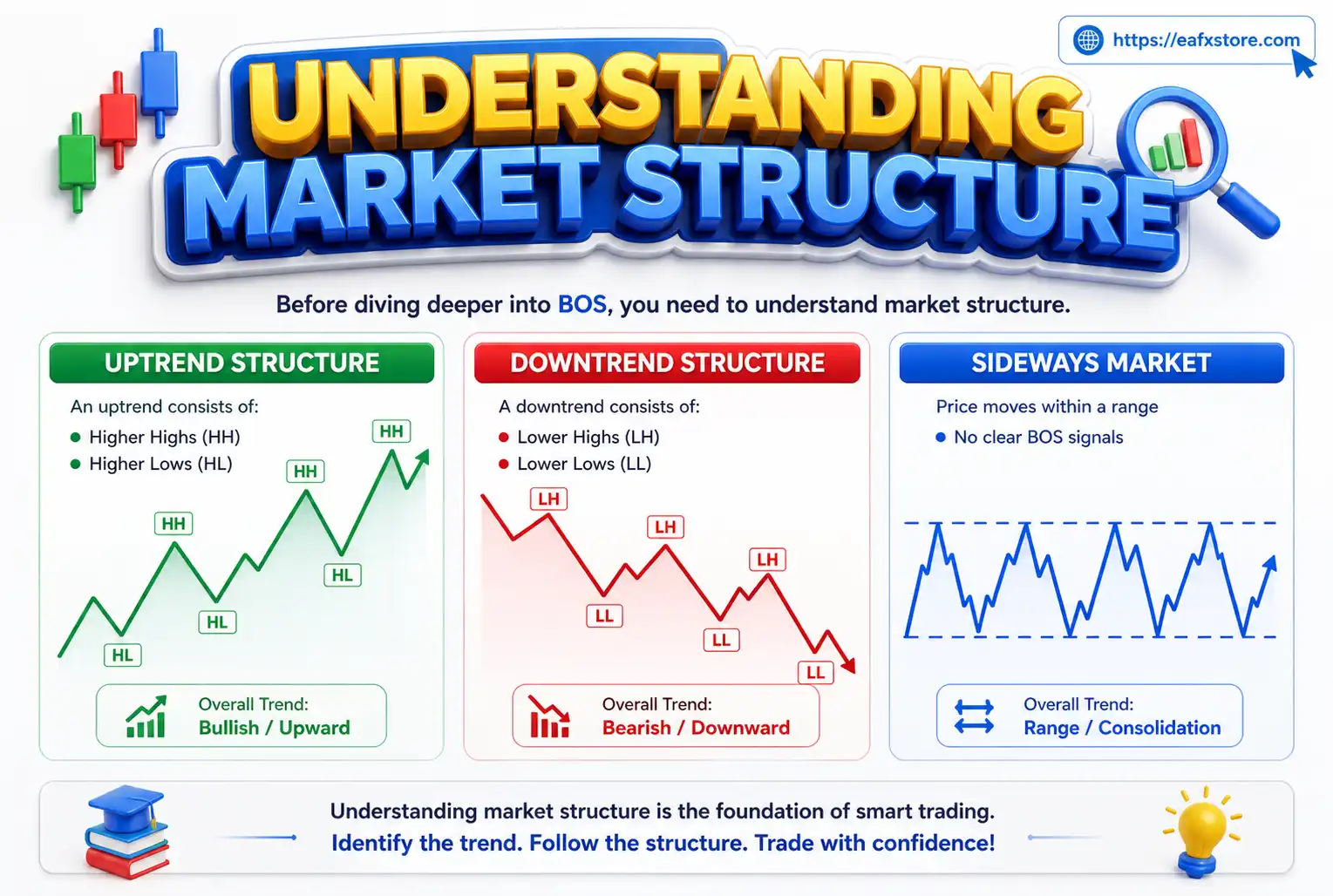
Before diving deeper into BOS, you need to understand market structure.
Uptrend Structure
An uptrend consists of:
- Higher Highs (HH)
- Higher Lows (HL)
Downtrend Structure
A downtrend consists of:
- Lower Highs (LH)
- Lower Lows (LL)
Sideways Market
- Price moves within a range
- No clear BOS signals
BOS vs Change of Character (ChoCH)
Many beginners confuse BOS with another concept called Change of Character (ChoCH).
Here’s a simple comparison:
| Concept | Meaning | Market Implication |
|---|---|---|
| BOS | Break in direction of trend | Trend continuation |
| ChoCH | Break against current trend | Possible reversal |
👉 Example:
- Uptrend + break above previous high → BOS
- Uptrend + break below previous low → ChoCH
Understanding this difference is critical to avoid entering trades too early.
Types of Break of Structure
Bullish BOS
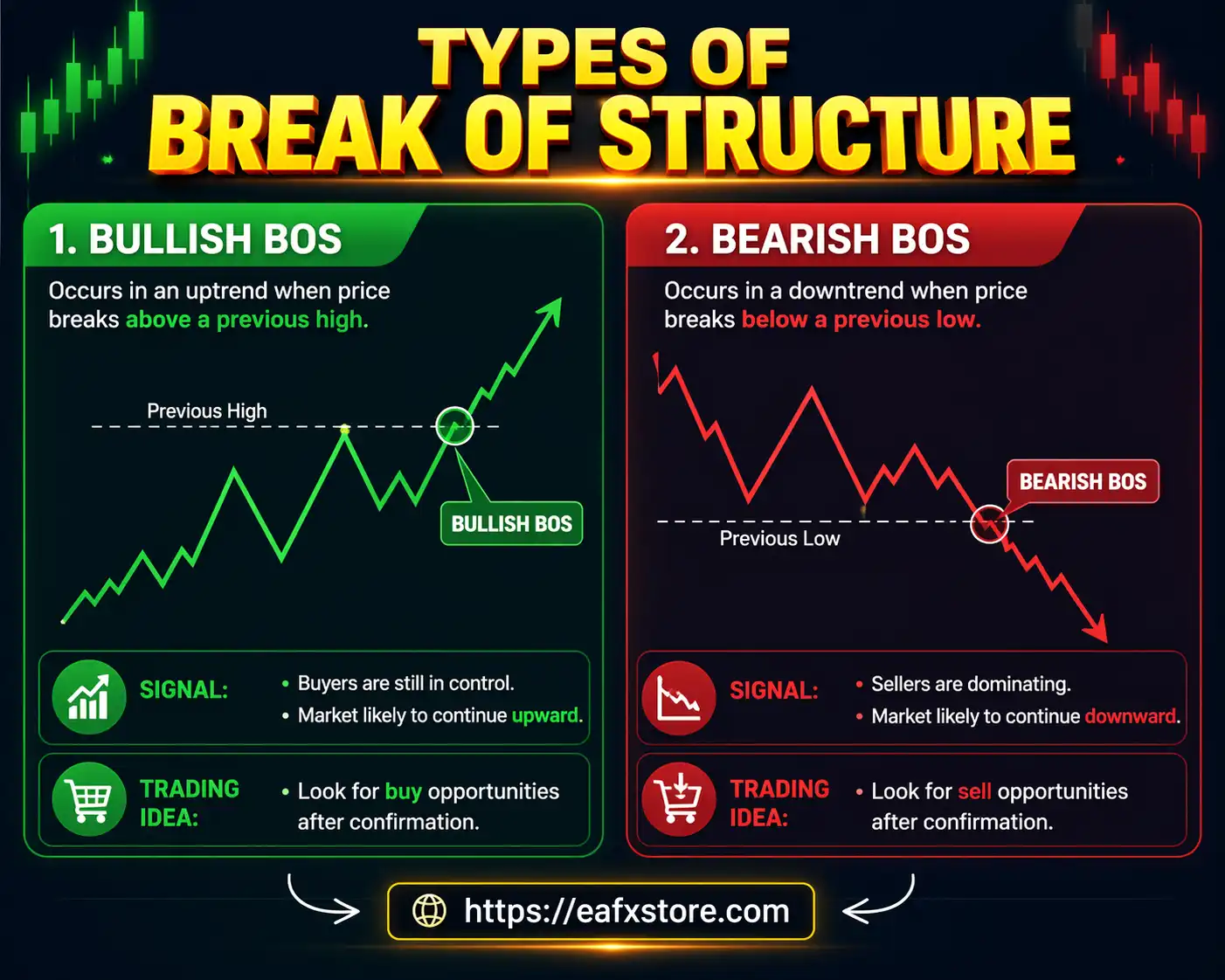
Occurs in an uptrend when price breaks above a previous high.
Signal:
- Buyers are still in control.
- Market likely to continue upward.
Trading idea:
- Look for buy opportunities after confirmation.
Bearish BOS
Occurs in a downtrend when price breaks below a previous low.
Signal:
- Sellers are dominating.
- Market likely to continue downward.
Trading idea:
- Look for sell opportunities after confirmation.
How to Identify a Valid BOS
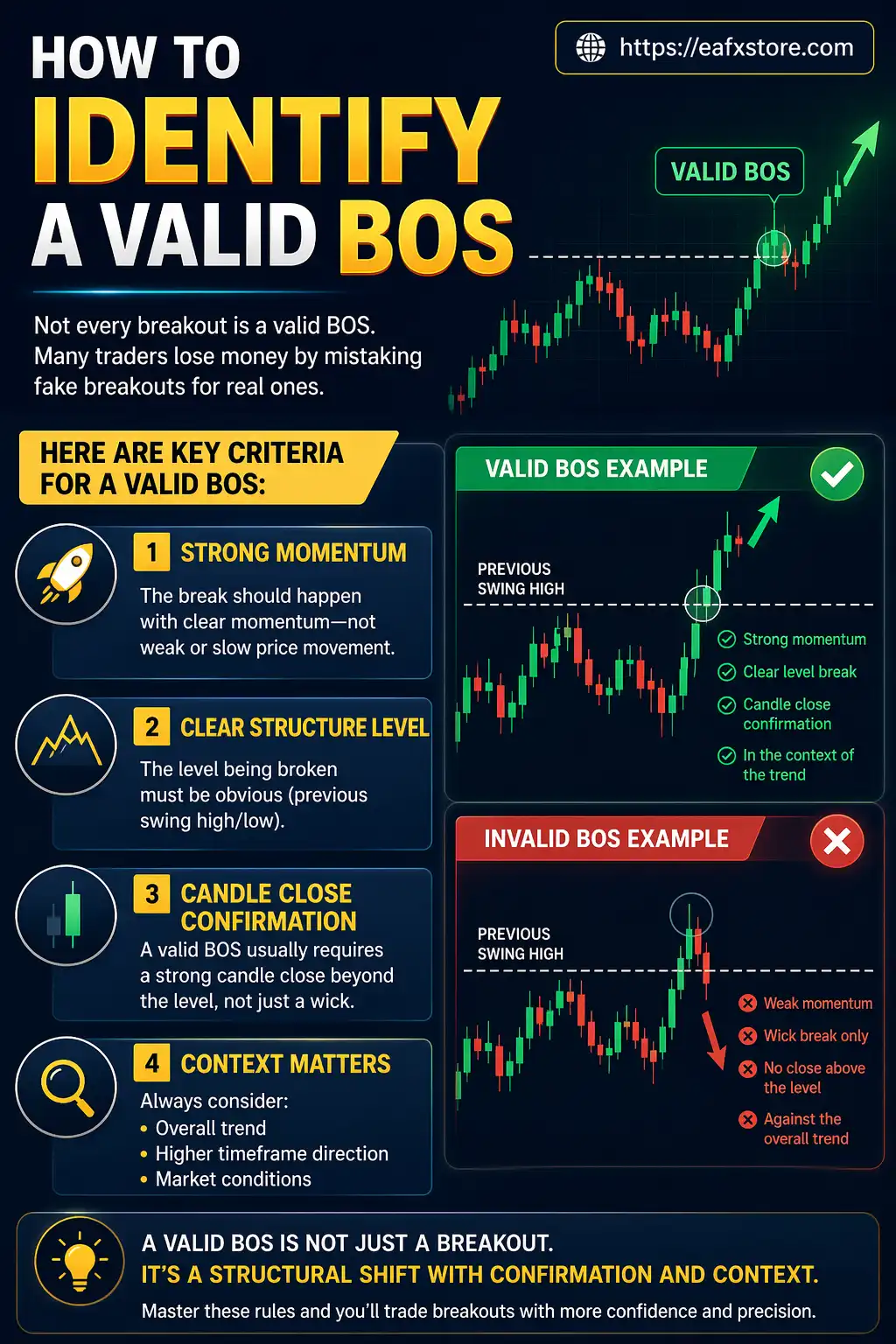
Not every breakout is a valid BOS. Many traders lose money by mistaking fake breakouts for real ones.
Here are key criteria for a valid BOS:
Strong Momentum
The break should happen with clear momentum—not weak or slow price movement.
Clear Structure Level
The level being broken must be obvious (previous swing high/low).
Candle Close Confirmation
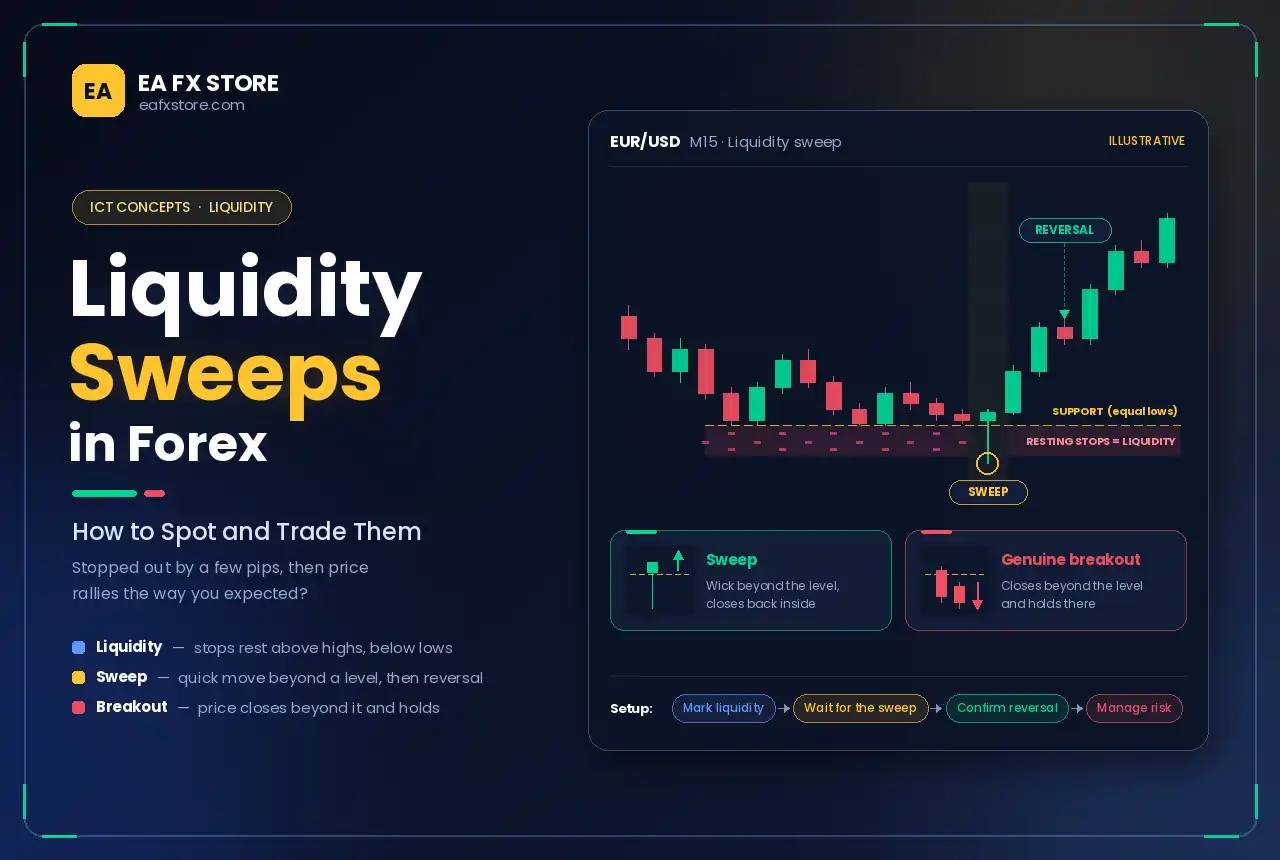
A valid BOS usually requires a strong candle close beyond the level, not just a wick.
Context Matters
Always consider:
- Overall trend.
- Higher timeframe direction.
- Market conditions.
Step-by-Step: How to Trade BOS
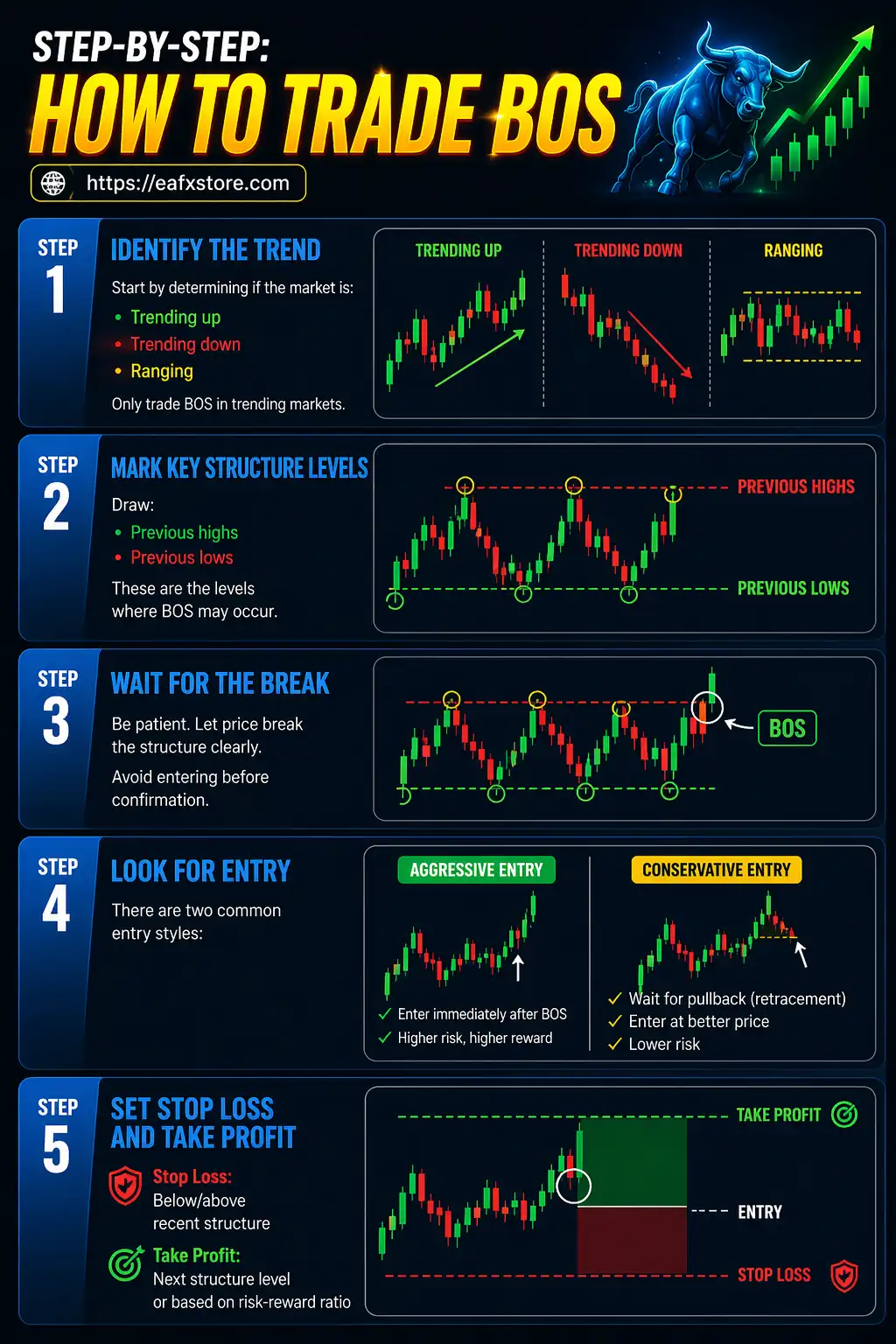
Step 1: Identify the Trend
Start by determining if the market is:
- Trending up
- Trending down
- Ranging
Only trade BOS in trending markets.
Step 2: Mark Key Structure Levels
Draw:
- Previous highs
- Previous lows
These are the levels where BOS may occur.
Step 3: Wait for the Break
Be patient. Let price break the structure clearly.
Avoid entering before confirmation.
Step 4: Look for Entry
There are two common entry styles:
Aggressive Entry
- Enter immediately after BOS
- Higher risk, higher reward
Conservative Entry
- Wait for pullback (retracement)
- Enter at better price
- Lower risk
Step 5: Set Stop Loss and Take Profit
- Stop Loss: Below/above recent structure
- Take Profit: Next structure level or based on risk-reward ratio
Common Mistakes Beginners Make
- Trading Every Break: Not all breaks are BOS. Many are fakeouts.
- Ignoring Higher Timeframes: A BOS on a small timeframe may go against the larger trend.
- Entering Too Early: Jumping in before confirmation leads to losses.
- No Risk Management: Even valid BOS setups can fail. Always manage risk.
BOS Strategy Example
Here’s a simple strategy you can follow:
- Identify an uptrend on the 1H chart.
- Wait for price to break previous high (BOS).
- Wait for pullback.
- Enter buy at support.
- Place stop loss below recent low.
- Target next resistance.
Example Table
| Step | Action |
|---|---|
| 1 | Confirm uptrend |
| 2 | Mark previous high |
| 3 | Wait for BOS |
| 4 | Wait for pullback |
| 5 | Enter trade |
| 6 | Manage risk |
BOS + Confluence (Advanced Tip)
BOS becomes much more powerful when combined with other tools:
Example: If BOS happens at a strong support zone → higher probability trade.
When NOT to Use BOS
Avoid using BOS in:
- Choppy markets
- Low volatility conditions
- News events (high unpredictability)
BOS works best in clear trending markets.
Final Thoughts
Break of Structure (BOS) is one of the simplest yet most effective concepts in Forex trading. It helps you understand market direction, confirm trends and find high-probability trading opportunities.
However, BOS is not a magic tool. It works best when combined with patience, proper risk management and a solid understanding of market structure.
If you’re just starting out, focus on:
- Practicing chart reading.
- Identifying clean structures.
- Avoiding overtrading.
Master BOS, and you’ll build a strong foundation for more advanced trading strategies.
FAQs
❓ Is BOS good for beginners?
Yes. BOS is one of the easiest price action concepts to learn and apply.
❓ Which timeframe is best for BOS?
It works on all timeframes, but beginners should start with H1 or H4 for clearer signals.
❓ Can BOS fail?
Yes. No strategy is 100% accurate. Always use stop loss and risk management.