

Momentum oscillators are among the most popular technical analysis tools used in forex trading. They help traders identify the strength, speed and potential reversal of price movements. Whether you are a beginner or an experienced trader, understanding momentum indicators can improve your entry and exit decisions.
In this guide, you will learn what momentum oscillators are, how they work, the most effective types and how to use them in a practical Forex trading strategy.
What Are Momentum Oscillators?
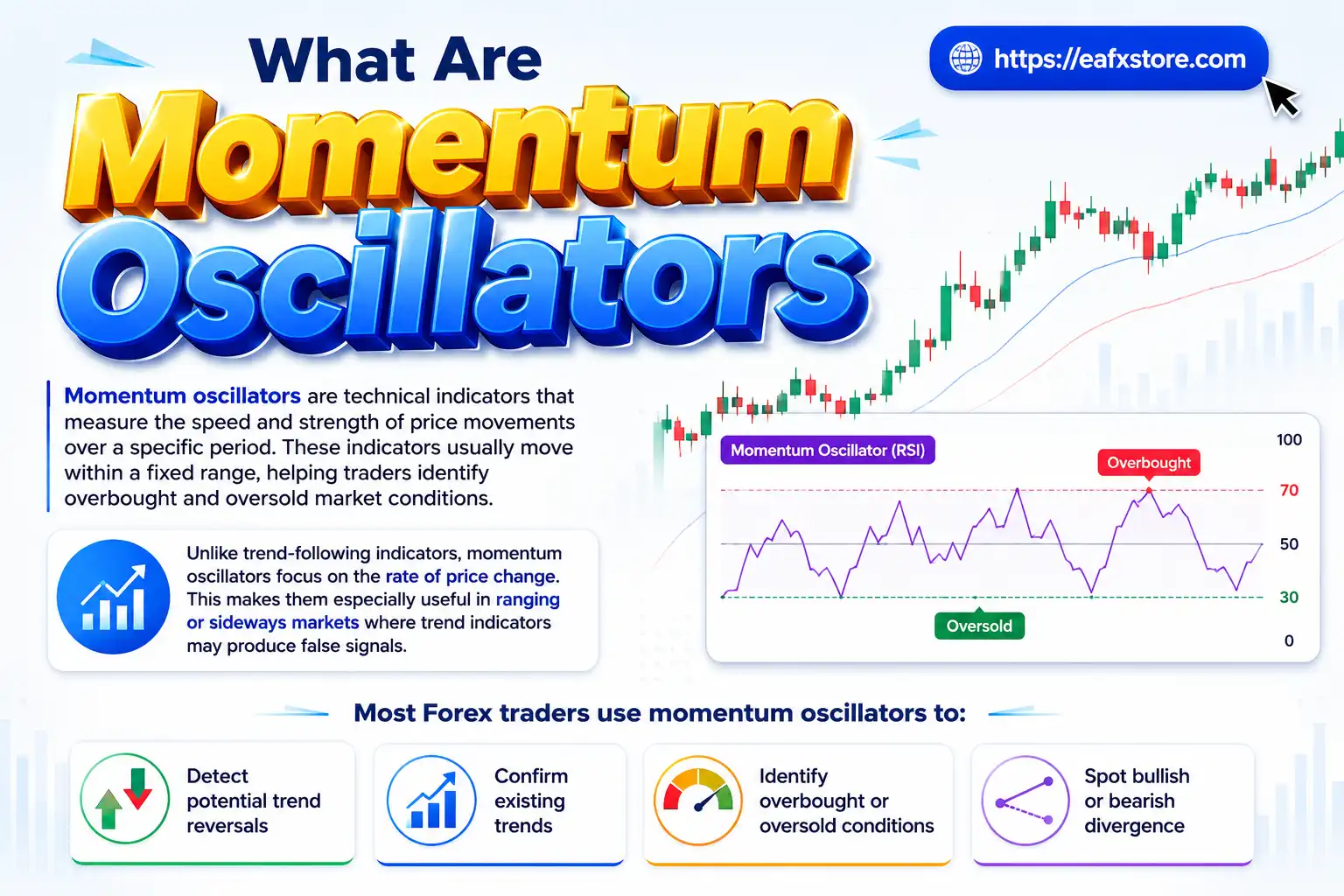
Momentum oscillators are technical indicators that measure the speed and strength of price movements over a specific period. These indicators usually move within a fixed range, helping traders identify overbought and oversold market conditions.
Unlike trend-following indicators, momentum oscillators focus on the rate of price change. This makes them especially useful in ranging or sideways markets where trend indicators may produce false signals.
Most Forex traders use momentum oscillators to:
- Detect potential trend reversals.
- Confirm existing trends.
- Identify overbought or oversold conditions.
- Spot bullish or bearish divergence.
Why Momentum Oscillators Matter in Forex Trading
The Forex market is highly volatile and price movements can change quickly. Momentum oscillators help traders react faster to changing market conditions.
Here are some key benefits of using momentum indicators in Forex:
| Benefit | Explanation |
|---|---|
| Early Reversal Signals | Helps identify potential turning points before price reverses |
| Better Entry Timing | Improves trade entries by confirming momentum strength |
| Overbought/Oversold Detection | Shows when the market may be stretched too far |
| Divergence Identification | Reveals weakening trends before reversals occur |
| Works Across Timeframes | Can be used for scalping, day trading, and swing trading |
These indicators are most effective when combined with support/resistance levels and trend analysis.
Relative Strength Index (RSI)
The Relative Strength Index (RSI) is one of the most widely used momentum oscillators in Forex trading. Developed by J. Welles Wilder, RSI measures the speed and magnitude of recent price changes.
RSI moves between 0 and 100:
- Above 70 = Overbought market
- Below 30 = Oversold market
How Traders Use RSI:
Forex traders often use RSI to identify potential reversals. For example, if RSI rises above 70, the market may be due for a pullback. If RSI falls below 30, buyers may soon enter the market.
RSI divergence is another popular strategy. When price makes a new high but RSI fails to do the same, it may indicate weakening bullish momentum.
Moving Average Convergence Divergence (MACD)
MACD is a trend-following momentum oscillator that helps traders identify changes in trend direction and momentum strength.
The MACD indicator consists of:
- MACD Line
- Signal Line
- Histogram
How Traders Use MACD:
A bullish signal occurs when the MACD line crosses above the signal line. A bearish signal appears when the MACD line crosses below the signal line.
MACD works particularly well in trending markets because it combines momentum analysis with moving averages.
Many Forex traders also watch for MACD divergence to identify weakening trends and possible reversals.
Stochastic Oscillator
The Stochastic Oscillator compares the closing price of a currency pair to its recent price range. It is highly effective for identifying overbought and oversold conditions.
The indicator ranges from 0 to 100:
- Above 80 = Overbought
- Below 20 = Oversold
How Traders Use the Stochastic Oscillator:
Traders typically look for crossover signals between the %K and %D lines. A bullish crossover below 20 may signal a buying opportunity, while a bearish crossover above 80 may indicate selling pressure.
The Stochastic Oscillator is especially useful in ranging markets where prices repeatedly move between support and resistance levels.
Best Momentum Oscillator Strategy for Forex
No single momentum oscillator is perfect. Successful traders often combine multiple indicators to improve accuracy.
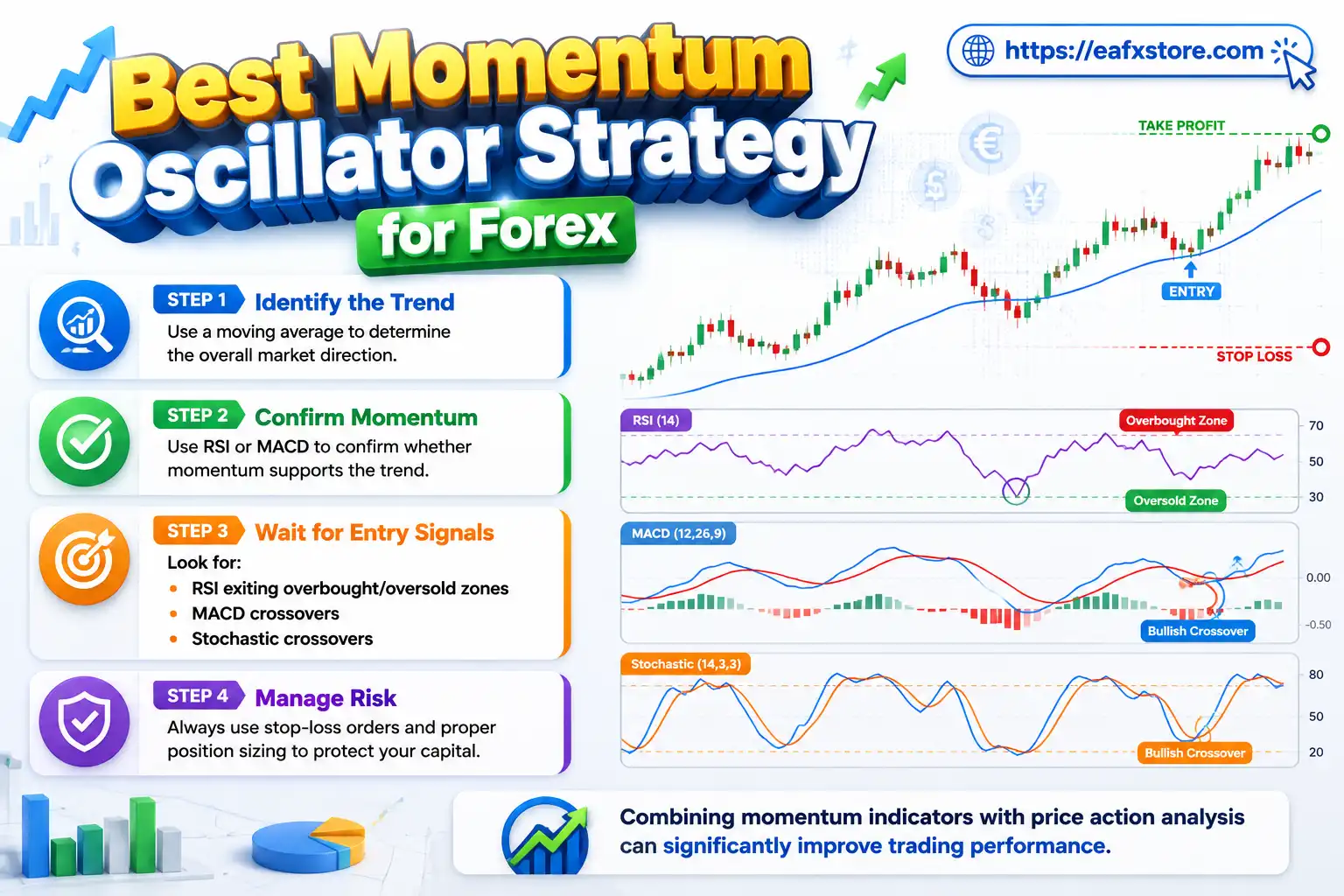
Here is a simple Forex momentum strategy:
🎯 Step 1: Identify the Trend
Use a moving average to determine the overall market direction.
🎯 Step 2: Confirm Momentum
Use RSI or MACD to confirm whether momentum supports the trend.
🎯 Step 3: Wait for Entry Signals
Look for:
- RSI exiting overbought/oversold zones
- MACD crossovers
- Stochastic crossovers
🎯 Step 4: Manage Risk
Always use stop-loss orders and proper position sizing to protect your capital.
Combining momentum indicators with price action analysis can significantly improve trading performance.
Common Mistakes Traders Make
Many beginners misuse momentum oscillators because they rely on them without considering market context.
Here are some common mistakes to avoid:
| Mistake | Why It Happens |
|---|---|
| Trading Every Signal | Not all oscillator signals are reliable |
| Ignoring the Trend | Counter-trend trades are riskier |
| Using Too Many Indicators | Creates confusion and conflicting signals |
| Forgetting Risk Management | Even strong signals can fail |
| Overtrading | Emotional decisions lead to poor results |
Successful Forex trading requires discipline, patience, and proper strategy testing.
Conclusion
Momentum oscillators are powerful tools that help Forex traders measure market strength and identify potential reversals. Indicators like RSI, MACD, and Stochastic Oscillator can improve trade timing and provide valuable confirmation signals.
However, no indicator works perfectly on its own. The best approach is to combine momentum oscillators with trend analysis, support and resistance levels and proper risk management.
By understanding how these indicators work and practicing them consistently, traders can make smarter and more confident Forex trading decisions.
FAQs
❓ What is the best momentum oscillator for Forex trading?
The RSI and MACD are considered two of the best momentum oscillators because they are reliable, easy to use, and suitable for different market conditions.
❓ Are momentum oscillators accurate?
Momentum oscillators can be highly effective when combined with other technical analysis tools, but they should not be used alone.
❓ Can beginners use momentum indicators?
Yes. Indicators like RSI and Stochastic are beginner-friendly and easy to understand.
❓ Do momentum oscillators work in trending markets?
Yes, especially MACD. However, some oscillators perform better in ranging markets than in strong trends.
❓ Which timeframe is best for momentum trading in Forex?
Momentum oscillators work on all timeframes, but many Forex traders prefer the 1-hour, 4-hour, and daily charts for more reliable signals.