
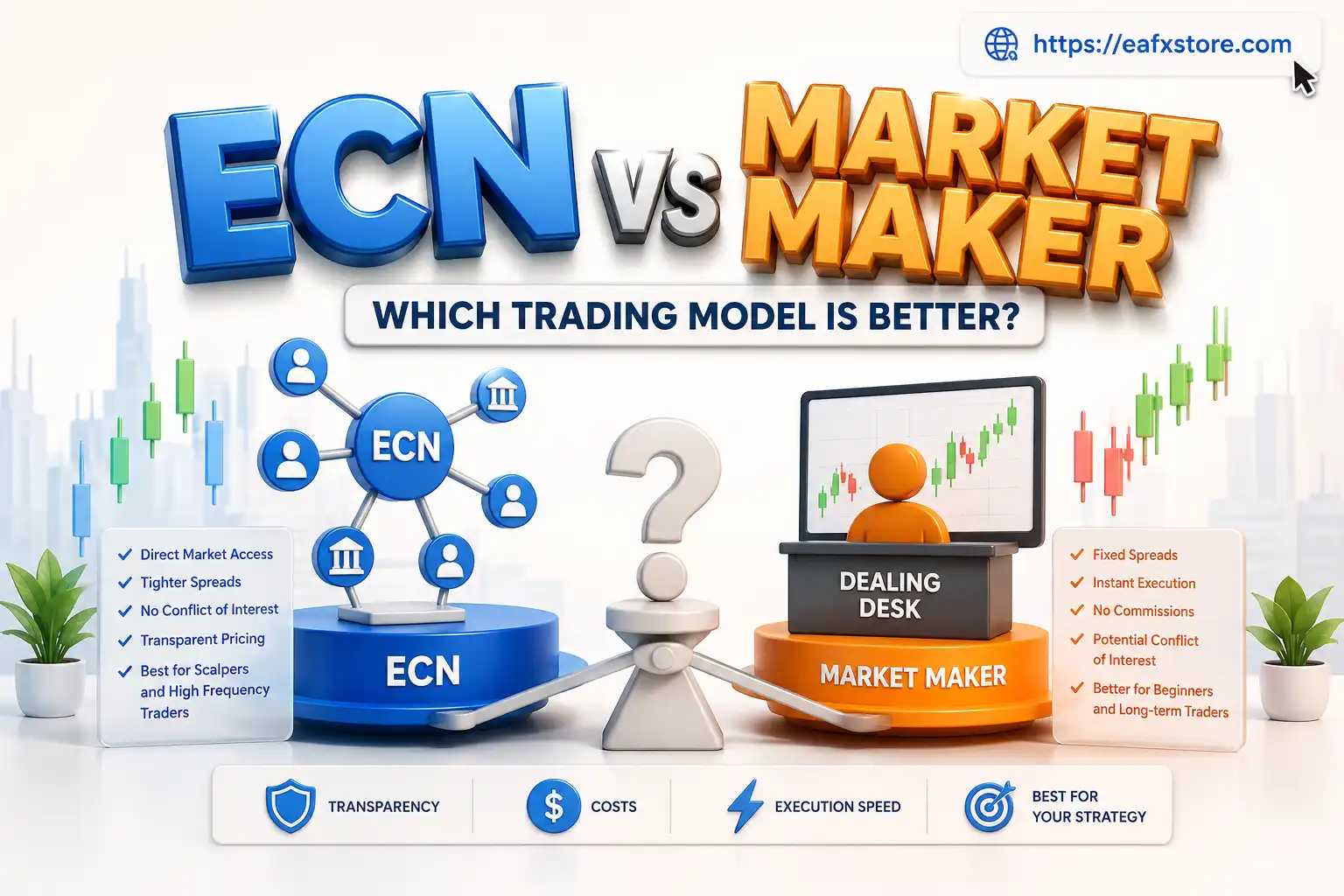
Choosing the right broker is one of the most critical decisions a trader can make. In the Forex and CFD world, the debate often boils down to two primary execution models: ECN (Electronic Communications Network) and Market Makers (Dealing Desk). While both provide access to the financial markets, they operate with fundamentally different mechanics, fee structures, and conflict-of-interest profiles.
In this comprehensive guide, we will break down how each model works, their pros and cons and help you decide which one aligns with your specific trading strategy.
What is an ECN Broker?
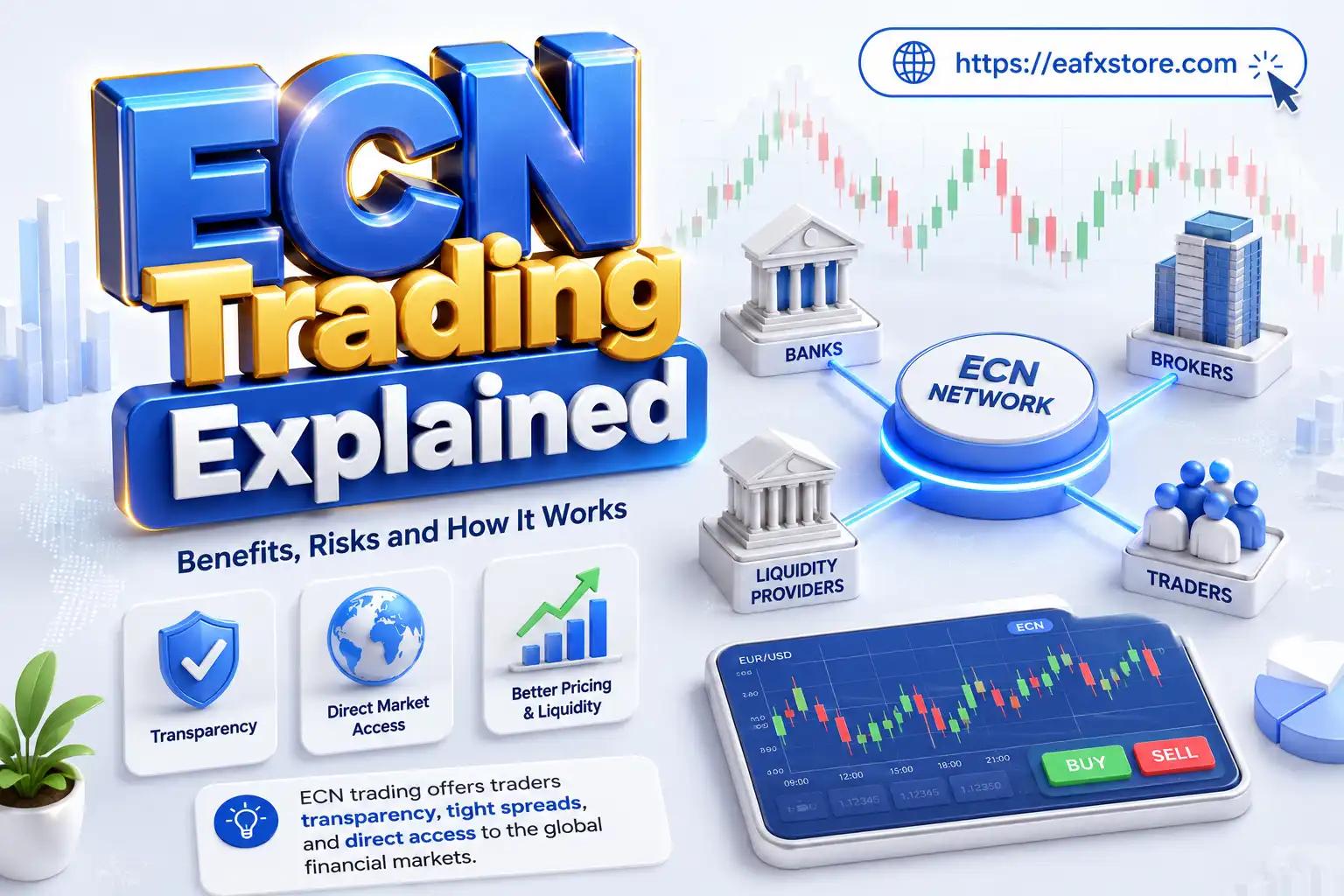
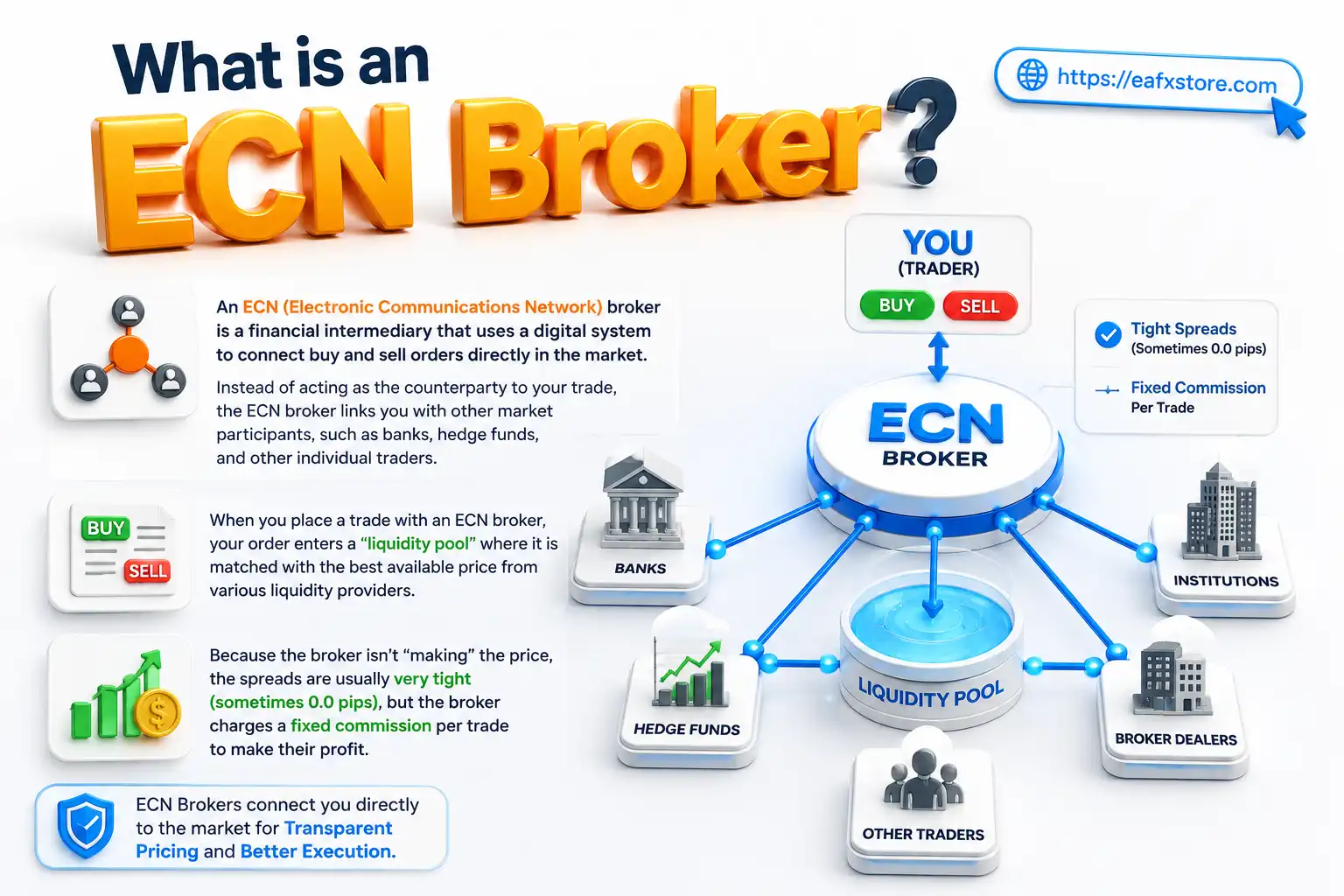
An ECN (Electronic Communications Network) broker is a financial intermediary that uses a digital system to connect buy and sell orders directly in the market. Instead of acting as the counterparty to your trade, the ECN broker links you with other market participants, such as banks, hedge funds and other individual traders.
When you place a trade with an ECN broker, your order enters a “liquidity pool” where it is matched with the best available price from various liquidity providers. Because the broker isn’t “making” the price, the spreads are usually very tight (sometimes 0.0 pips), but the broker charges a fixed commission per trade to make their profit.
What is a Market Maker (Dealing Desk)?
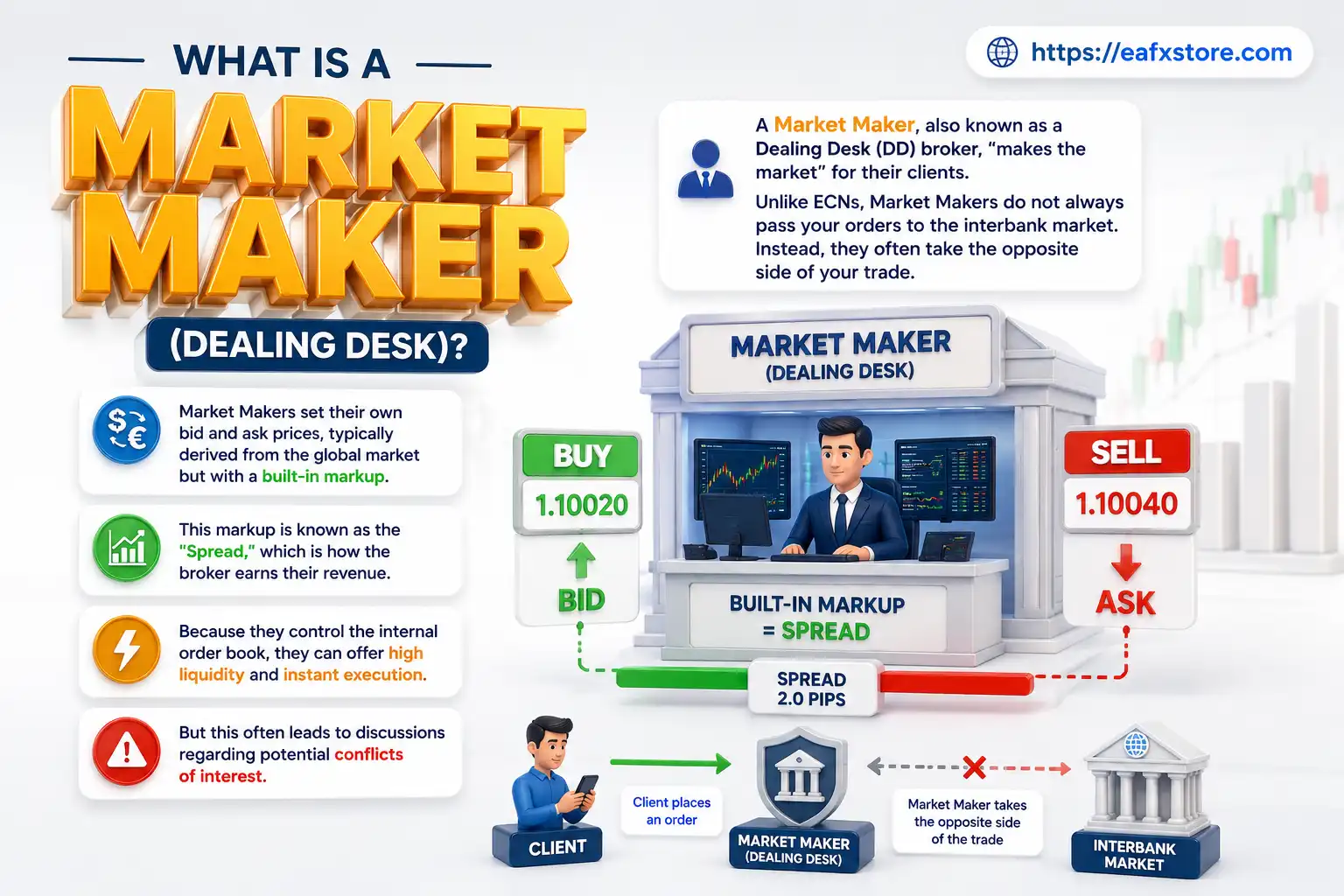
A Market Maker, also known as a Dealing Desk (DD) broker, “makes the market” for their clients. Unlike ECNs, Market Makers do not always pass your orders to the interbank market. Instead, they often take the opposite side of your trade.
Market Makers set their own bid and ask prices, typically derived from the global market but with a built-in markup. This markup is known as the “Spread,” which is how the broker earns their revenue. Because they control the internal order book, they can offer high liquidity and instant execution, but this often leads to discussions regarding potential conflicts of interest.
Key Differences Between ECN and Market Makers
Understanding the technical nuances between these two models is essential for managing your trading costs and execution speed. While both allow you to trade EUR/USD or Gold, the “under the hood” mechanics differ significantly in terms of transparency and price discovery.
The following table summarizes the primary distinctions:
Comparison Table: ECN vs Market Maker
| Feature | ECN Broker | Market Maker |
| Execution Method | Direct Market Access (No Dealing Desk) | Internal Matching (Dealing Desk) |
| Spreads | Variable (Very tight, starting at 0.0) | Fixed or Variable (Wider due to markup) |
| Fees | Commission per lot + Raw Spread | No commission (Profit is in the spread) |
| Conflict of Interest | None (Broker wants you to trade more) | Potential (Broker profits if you lose) |
| Price Quotes | From multiple liquidity providers | Set by the broker |
| Slippage | Possible during high volatility | Rare (Re-quotes are more common) |
The Pros and Cons of ECN Trading
ECN trading is often heralded as the “purest” form of trading. It is favored by professionals who prioritize transparency and raw market data. However, it is not without its hurdles, particularly for those with smaller account balances.
Pros:
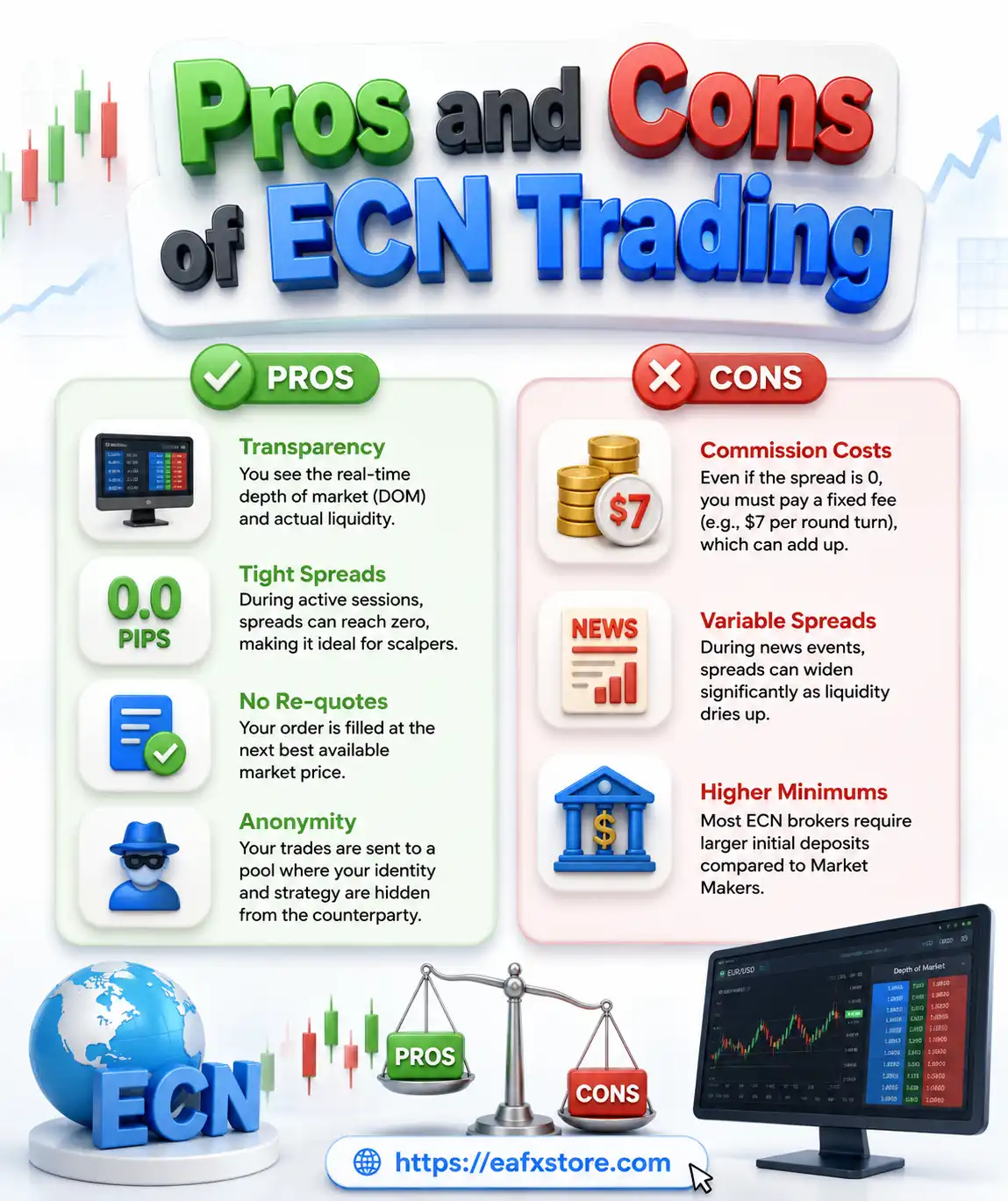
- Transparency: You see the real-time depth of market (DOM) and actual liquidity.
- Tight Spreads: During active sessions, spreads can reach zero, making it ideal for scalpers.
- No Re-quotes: Your order is filled at the next best available market price.
- Anonymity: Your trades are sent to a pool where your identity and strategy are hidden from the counterparty.
Cons:
- Commission Costs: Even if the spread is 0, you must pay a fixed fee (e.g., $7 per round turn), which can add up.
- Variable Spreads: During news events, spreads can widen significantly as liquidity dries up.
- Higher Minimums: Most ECN brokers require larger initial deposits compared to Market Makers.
The Pros and Cons of Market Maker Trading
Market Makers are often the entry point for most retail traders. They provide a “smoothed out” experience that removes some of the harsh volatility of the raw market. While often criticized for the “broker vs. trader” dynamic, they offer distinct advantages for beginners.
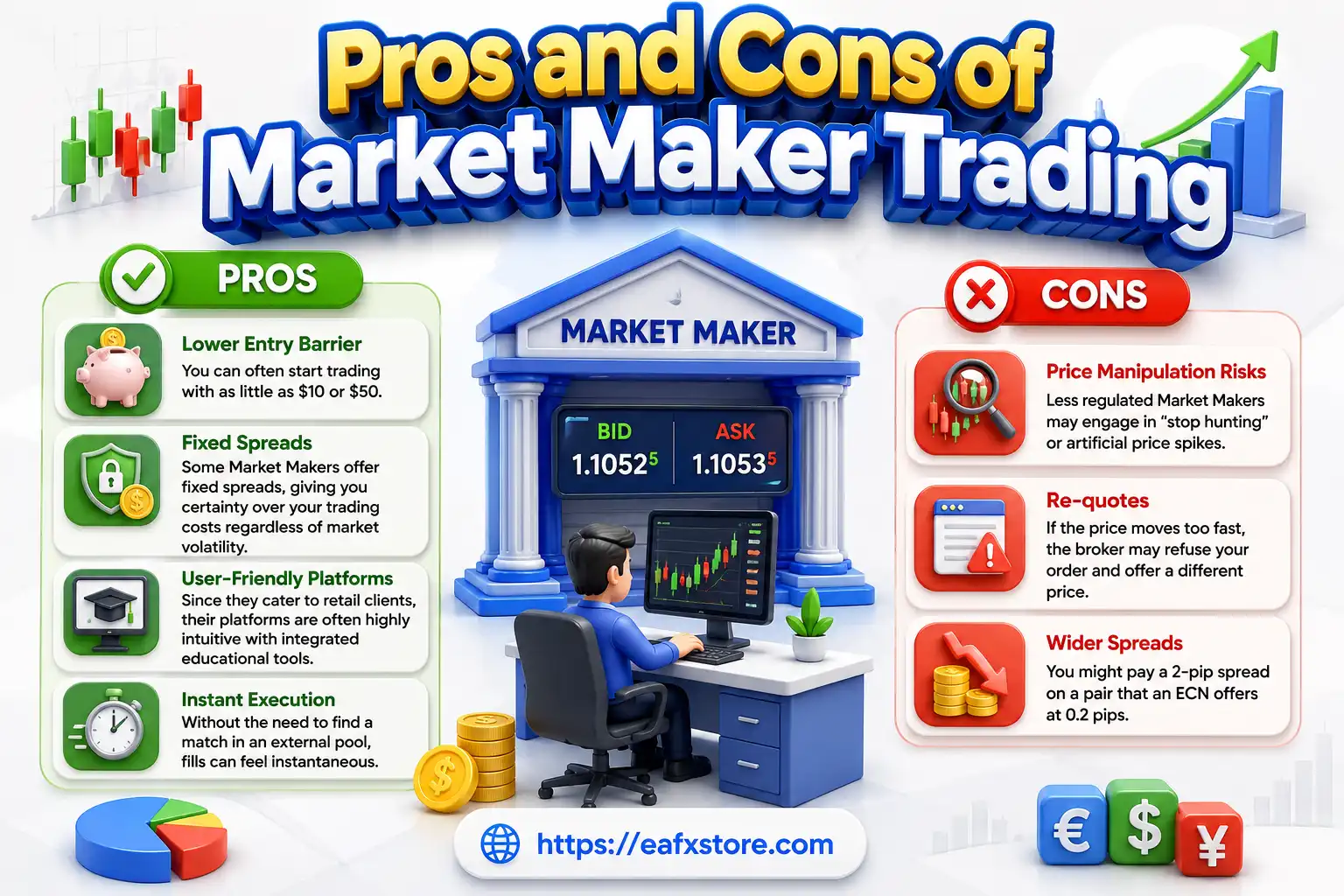
Pros:
- Lower Entry Barrier: You can often start trading with as little as $10 or $50.
- Fixed Spreads: Some Market Makers offer fixed spreads, giving you certainty over your trading costs regardless of market volatility.
- User-Friendly Platforms: Since they cater to retail clients, their platforms are often highly intuitive with integrated educational tools.
- Instant Execution: Without the need to find a match in an external pool, fills can feel instantaneous.
Cons:
- Price Manipulation Risks: Less regulated Market Makers may engage in “stop hunting” or artificial price spikes.
- Re-quotes: If the price moves too fast, the broker may refuse your order and offer a different price.
- Wider Spreads: You might pay a 2-pip spread on a pair that an ECN offers at 0.2 pips.
Transparency and Conflict of Interest
One of the most debated topics in Forex is whether a broker wants you to succeed. In the ECN model, the broker’s interests are perfectly aligned with yours; they earn money via commissions, so they want you to trade frequently and stay profitable for years.
In contrast, the Market Maker model creates a “Zero-Sum” environment. Because they take the other side of your trade, your loss is technically their gain. While reputable, regulated Market Makers use automated “hedging” to mitigate this risk (offsetting their exposure with larger banks), the inherent structure still leaves room for skepticism regarding trade interventions.
Which Model is Better for Your Strategy?
There is no “one size fits all” answer. The “better” model depends entirely on your trading style, frequency, and capital. A swing trader holding positions for weeks has different needs than a high-frequency scalper.
Choose an ECN Broker if:
- You are a Scalper or Day Trader where tight spreads are vital.
- You trade large volumes where commissions are more cost-effective than wide spreads.
- You use Expert Advisors (EAs) that require fast, direct execution.
- You value market transparency above all else.
Choose a Market Maker if:
- You are a Beginner with a small starting capital.
- You prefer Fixed Spreads to simplify your risk management.
- You trade less frequently (Swing Trading) and aren’t bothered by an extra pip of spread.
- You value additional features like comprehensive news feeds and social trading platforms.
Conclusion: Making the Right Choice
In the battle of ECN vs. Market Maker, the winner is the one that protects your capital while minimizing your overhead. ECNs offer the professional edge of raw pricing and neutrality, while Market Makers provide accessibility and stability for those just starting out.
Before committing, always check the broker’s regulation (e.g., FCA, ASIC, or SEC) regardless of their model. A regulated Market Maker is always safer than an unregulated ECN. Test both models using a demo account to see which execution feel suits your psychology best.
FAQs
❓ Do ECN brokers have a Dealing Desk?
No, ECN brokers are “No Dealing Desk” (NDD) brokers. They use an automated system to match your orders with external liquidity providers rather than handling them manually or internally.
❓ Is slippage worse on ECN or Market Maker?
Slippage is more common on ECNs because you are dealing with the real market; if there is no liquidity at your price, you get the next one. Market Makers use re-quotes to prevent slippage, which can be equally frustrating as it prevents your trade from opening at all.
❓ Why do ECN brokers charge commission?
Since ECN brokers pass the “raw” market spread to you without adding a markup, the commission is their only way to generate revenue for providing the technology and connection to the liquidity pool.
❓ Can a Market Maker be a “good” broker?
Absolutely. Many top-tier, highly regulated brokers are Market Makers. They provide deep liquidity and stable environments that are often more reliable for retail traders than the “wild” raw spreads of an ECN during news events.
❓ Which is better for scalping?
ECN is generally considered superior for scalping. Scalpers target small price movements (3-5 pips), so having a 0.0 or 0.1 pip spread is essential for profitability, even after accounting for the commission.