
Have you ever watched a currency pair drift sideways for hours, then suddenly jump 30 pips in a few minutes before stalling again? Volume Profile often explains this behaviour. The price zone the market raced through was probably a Low Volume Node (LVN), an area where very little trading took place in the past. Understanding LVNs helps you anticipate fast moves, place smarter stops and find precise entries.
What is a Low Volume Node (LVN)?
A Low Volume Node is a price zone within a Volume Profile where volume is much lower than at the surrounding prices. On the profile histogram it looks like a valley or a gap between two peaks.
LVNs usually sit between High Volume Nodes (HVNs). If an HVN represents a zone the market accepted, an LVN represents a zone the market rejected or passed through quickly. On Forex CFD charts, LVNs are built from tick volume, so they mark areas of low activity rather than exact traded size.
Why Volume is Low at an LVN
Low volume forms at a price for one of two reasons:
- Fast movement. A news release, a large order or a breakout pushed price through the zone so quickly that few trades happened there.
- Rejection. Price visited the zone briefly, participants found it unattractive, and the market moved away.
Either way, the market has not established value at that price. There is little “memory” there, and few traders have positions to defend.
How Price Behaves Around LVNs
Price tends to move quickly through LVNs. With few resting orders and little interest, there is not much to slow price down. When the market re-enters an LVN, it often crosses it fast and heads to the next HVN.
LVNs often act as turning points. Because the market previously rejected these prices, the edge of an LVN can act as support or resistance. Price may touch the LVN and bounce sharply back towards the HVN it came from.
These two behaviours sound contradictory, but they share one idea: price does not like to stay inside an LVN. It either bounces off or travels through.
How to Trade Low Volume Nodes
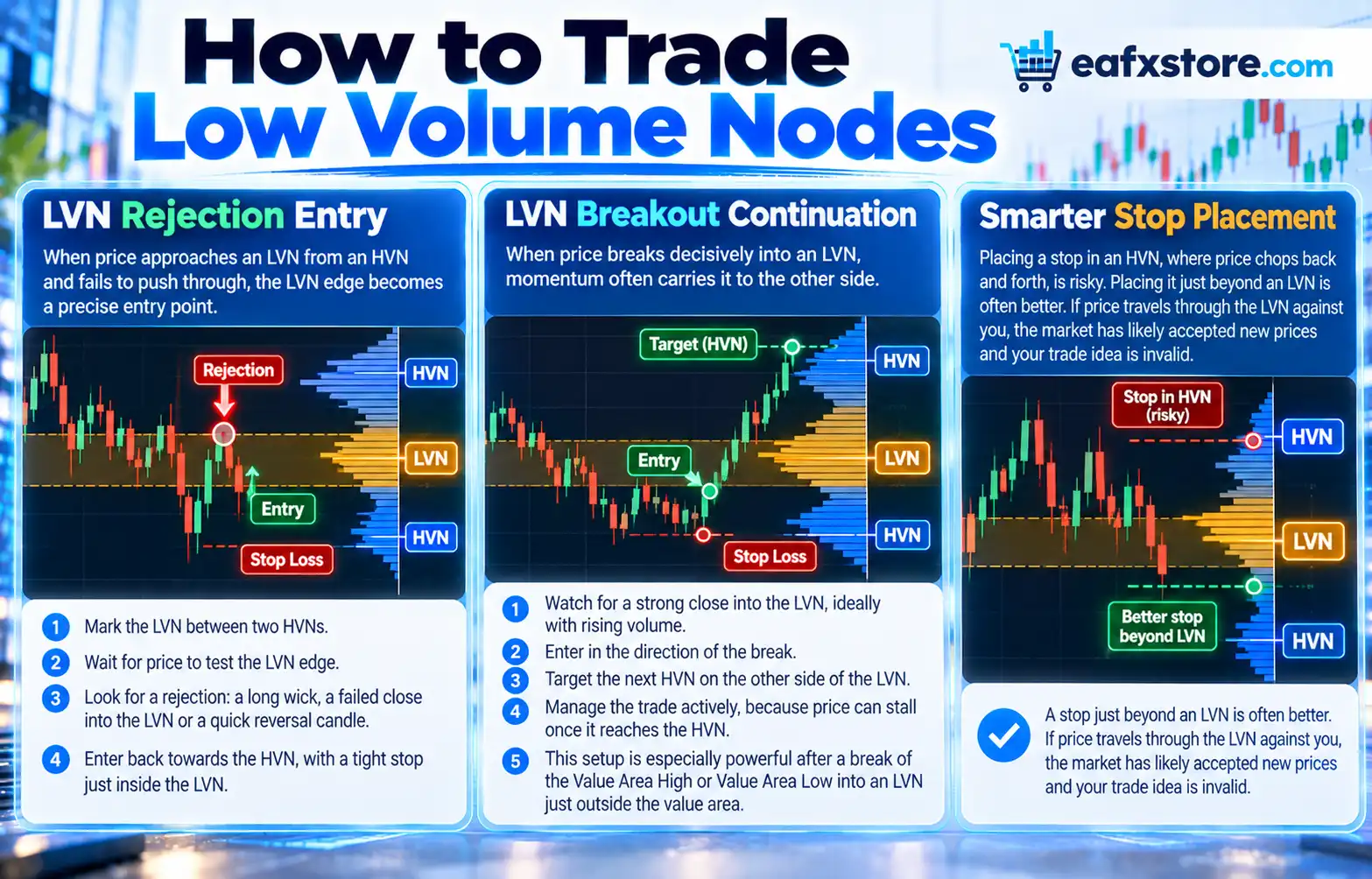
LVN rejection entry
When price approaches an LVN from an HVN and fails to push through, the LVN edge becomes a precise entry point.
- Mark the LVN between two HVNs.
- Wait for price to test the LVN edge.
- Look for a rejection: a long wick, a failed close into the LVN or a quick reversal candle.
- Enter back towards the HVN, with a tight stop just inside the LVN.
The tight stop is the advantage. If price is truly rejecting the LVN, it should not stay there.
LVN breakout continuation
When price breaks decisively into an LVN, momentum often carries it to the other side.
- Watch for a strong close into the LVN, ideally with rising volume.
- Enter in the direction of the break.
- Target the next HVN on the other side of the LVN.
- Manage the trade actively, because price can stall once it reaches the HVN.
This setup is especially powerful after a break of the Value Area High or Value Area Low into an LVN just outside the value area.
Smarter stop placement
Placing a stop in an HVN, where price chops back and forth, is risky. Placing it just beyond an LVN is often better. If price travels through the LVN against you, the market has likely accepted new prices and your trade idea is invalid.
LVNs and Market Structure
LVNs also help you read the bigger picture. A profile with a clear LVN splitting two HVNs shows the market moved from one balance area to another. If the upper HVN is newer, the market migrated higher, a bullish sign. If the lower HVN is newer, value moved lower, a bearish sign.
When you see price return to an old LVN after weeks, expect volatility. The zone may be filled quickly, or it may produce a sharp reversal.
Tips for Using LVNs in Forex
- Use weekly or composite profiles to find the most meaningful LVNs.
- Combine LVNs with session timing; fast moves through LVNs are more likely during active London and New York hours.
- Confirm reactions with OHLC candle closes, not intrabar spikes.
- Stay consistent with one broker’s data, as LVN positions can shift slightly between tick feeds.
Frequently Asked Questions
What is an LVN in Volume Profile?
An LVN, or Low Volume Node, is a price zone with much lower volume than the surrounding prices.
Why does price move fast through LVNs?
Few orders and little interest exist there, so there is nothing to slow price down.
Is an LVN support or resistance?
Its edges can act as support or resistance, because the market previously rejected those prices.
Where should I place stops with LVNs?
Many traders place stops just beyond an LVN rather than inside an HVN, where normal chop can trigger them.
Conclusion
Low Volume Nodes are the fast lanes of the market. They show where price is likely to accelerate or reject, giving you precise entries and logical stop placements. Combined with High Volume Nodes and the Point of Control, LVNs complete your map of how price moves between areas of value.
Risk warning: Trading Forex and CFDs on margin carries a high level of risk and may not be suitable for all investors. This article is for educational purposes only and is not investment advice.