
“I’m bullish on the dollar.” “EUR/USD looks bullish.” You will hear the word bullish constantly in trading, but what does it actually mean, and how do you know when a currency pair has truly turned bullish? This guide explains the meaning of bullish in Forex, the signs that confirm a bullish market, and practical ways to trade it.
What Does Bullish Mean?
Bullish describes an expectation that price will rise. A bullish trader expects a market to move higher and looks for buying opportunities. A bullish market, or bull market, is one where prices are rising or are expected to rise.
The term is popularly linked to the way a bull attacks: it thrusts its horns upward. Its opposite, bearish, comes from a bear swiping its paws downward.
What Bullish Means for a Currency Pair
In Forex, every quote involves two currencies, so being bullish on a pair has a specific meaning. If you are bullish on EUR/USD, you expect the euro (the base currency) to strengthen against the US dollar (the quote currency). You would buy, or go long, EUR/USD.
This also means that being bullish on EUR/USD is effectively being bearish on the US dollar against the euro. Always be clear which currency you expect to strengthen.
Signs of a Bullish Market
Price action
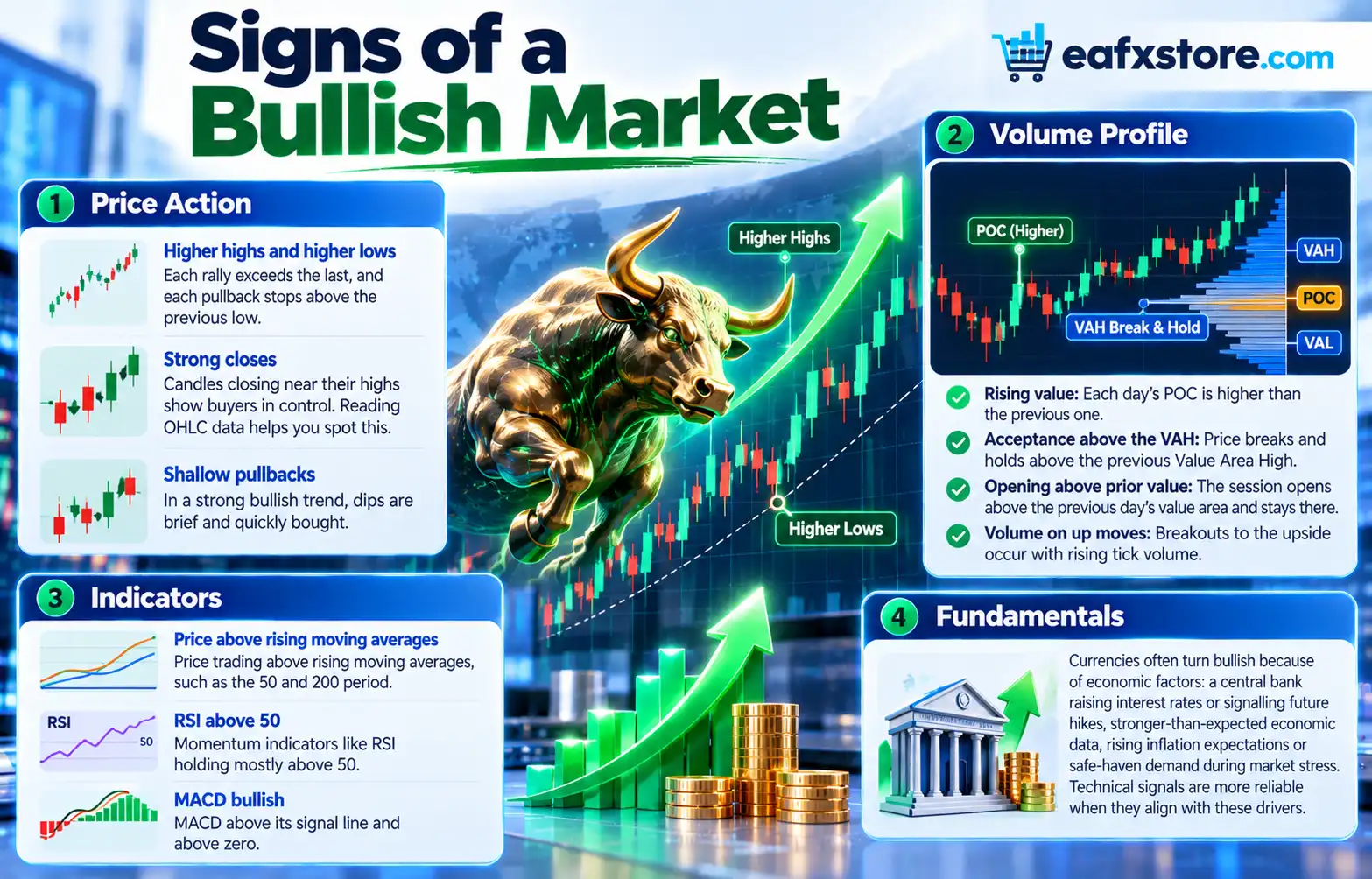
- Higher highs and higher lows. The most basic definition of an uptrend: each rally exceeds the last, and each pullback stops above the previous low.
- Strong closes. Candles closing near their highs show buyers in control. Reading OHLC data helps you spot this.
- Shallow pullbacks. In a strong bullish trend, dips are brief and quickly bought.
Volume Profile
- Rising value. Each day’s Point of Control (POC) is higher than the previous one, showing that the market accepts higher prices.
- Acceptance above the VAH. Price breaks and holds above the previous Value Area High.
- Opening above prior value. The session opens above the previous day’s value area and stays there.
- Volume on up moves. Breakouts to the upside occur with rising tick volume.
Indicators
- Price trading above rising Moving Averages, such as the 50 and 200 period.
- Momentum indicators like RSI holding mostly above 50.
- MACD above its signal line and above zero.
Fundamentals
Currencies often turn bullish because of economic factors: a central bank raising interest rates or signalling future hikes, stronger-than-expected economic data, rising inflation expectations or safe-haven demand during market stress. Technical signals are more reliable when they align with these drivers.
Common Bullish Candlestick Patterns
- Bullish engulfing: a large bullish candle completely engulfs the previous bearish candle.
- Hammer: a small body with a long lower wick, showing buyers rejected lower prices.
- Morning star: a three-candle reversal pattern at the end of a decline.
- Bullish pin bar at support: a long lower wick at a key level such as the Value Area Low.
Patterns are most reliable at important levels and in the direction of the higher-timeframe trend.
How to Trade a Bullish Market
Buy the pullback
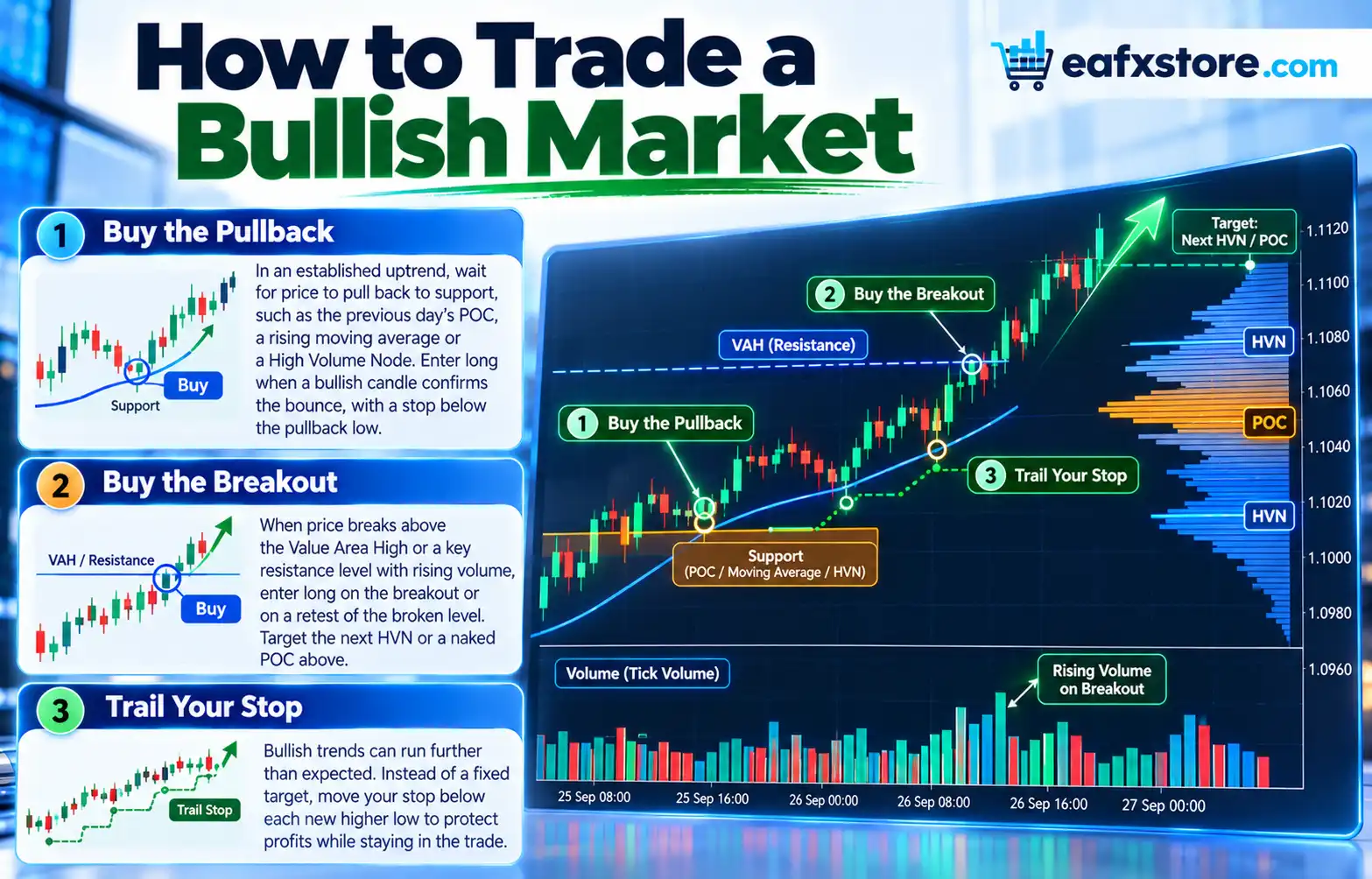
In an established uptrend, wait for price to pull back to support, such as the previous day’s POC, a rising moving average or a High Volume Node. Enter long when a bullish candle confirms the bounce, with a stop below the pullback low.
Buy the breakout
When price breaks above the Value Area High or a key resistance level with rising volume, enter long on the breakout or on a retest of the broken level. Target the next HVN or a naked POC above.
Trail your stop
Bullish trends can run further than expected. Instead of a fixed target, move your stop below each new higher low to protect profits while staying in the trade.
Mistakes to Avoid
- Calling a trend bullish too early. One green candle does not make an uptrend. Wait for structure.
- Chasing extended moves. Buying after a long rally without a pullback gives you a poor risk-to-reward ratio.
- Ignoring the higher timeframe. A bullish hourly chart inside a bearish daily trend often fails.
- Forgetting the other currency. A pair can rise because the quote currency is weakening, not because the base currency is strong.
Frequently Asked Questions
What does bullish mean in Forex?
It means expecting a currency pair to rise, which usually leads traders to buy or go long.
What is the opposite of bullish?
The opposite is bearish, an expectation that prices will fall. When there is no clear direction, the market is neutral.
How can I confirm a bullish trend?
Look for higher highs and higher lows, rising value on Volume Profile, and price above key moving averages.
Is a bullish market always safe to buy?
No. Even in a bullish market, prices pull back and trends end. Always use risk management.
Conclusion
Being bullish simply means expecting prices to rise, but trading a bullish market well requires confirmation. Combine price structure, Volume Profile signals such as a rising POC and acceptance above the VAH, and supportive fundamentals. Then buy at logical levels, manage your risk and let the trend work for you.
Risk warning: Trading Forex and CFDs on margin carries a high level of risk and may not be suitable for all investors. This article is for educational purposes only and is not investment advice.