
Many new traders only think about buying low and selling high. In Forex, falling prices offer just as many opportunities as rising ones, and markets often fall faster than they rise. To take advantage, you need to understand what bearish means, how to recognise a bearish market, and how to trade it with discipline.
What Does Bearish Mean?
Bearish describes an expectation that prices will fall. A bearish trader expects a market to decline and looks for selling opportunities. A bearish market, or bear market, is one where prices are falling or are expected to fall.
The word is commonly explained by the way a bear attacks, swiping its paws downward. Its opposite is bullish, and a market with no clear direction is Neutral.
Being Bearish on a Currency Pair
If you are bearish on GBP/USD, you expect the British pound to weaken against the US dollar. You would sell, or go short, GBP/USD. In other words, you are betting on the quote currency (USD) to strengthen against the base currency (GBP).
How short selling works in Forex
Unlike stocks, where short selling requires borrowing shares, selling a currency pair is as simple as buying one. When you trade Forex CFDs, you click Sell, and you profit if the price falls. If you sell EUR/USD at 1.1000 and buy back at 1.0950, you gain 50 pips, minus costs.
Bullish vs Bearish at a Glance
| Bullish | Bearish | |
| Expectation | Price rises | Price falls |
| Typical action | Buy / go long | Sell / go short |
| Trend structure | Higher highs, higher lows | Lower highs, lower lows |
| Volume Profile | Value migrating higher | Value migrating lower |
| Key level to watch | Acceptance above the VAH | Acceptance below the VAL |
How to Spot a Bearish Market
Price structure
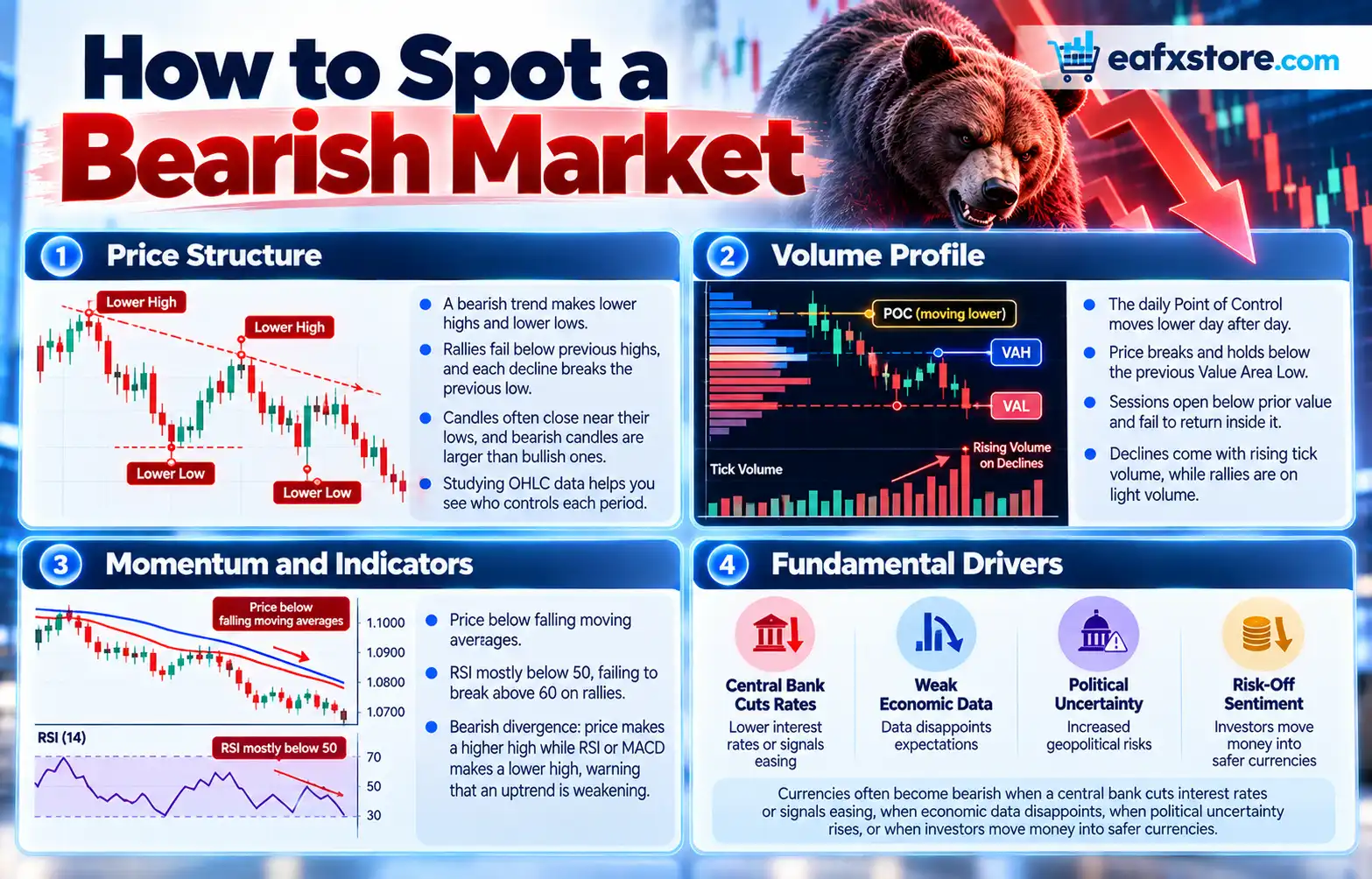
A bearish trend makes lower highs and lower lows. Rallies fail below previous highs, and each decline breaks the previous low. Candles often close near their lows, and bearish candles are larger than bullish ones. Studying OHLC data helps you see who controls each period.
Volume Profile
- The daily Point of Control moves lower day after day.
- Price breaks and holds below the previous Value Area Low.
- Sessions open below prior value and fail to return inside it.
- Declines come with rising tick volume, while rallies are on light volume.
Momentum and indicators
- Price below falling Moving Averages.
- RSI mostly below 50, failing to break above 60 on rallies.
- Bearish divergence: price makes a higher high while RSI or MACD makes a lower high, warning that an uptrend is weakening.
Fundamental drivers
Currencies often become bearish when a central bank cuts interest rates or signals easing, when economic data disappoints, when political uncertainty rises, or when investors move money into safer currencies.
Bearish Candlestick Patterns
- Bearish engulfing: a large bearish candle engulfs the previous bullish candle.
- Shooting star: a small body with a long upper wick at resistance.
- Evening star: a three-candle reversal at the top of a rally.
- Rejection at the VAH: a long upper wick at the Value Area High.
Trade Setups for Bearish Markets
Sell the rally
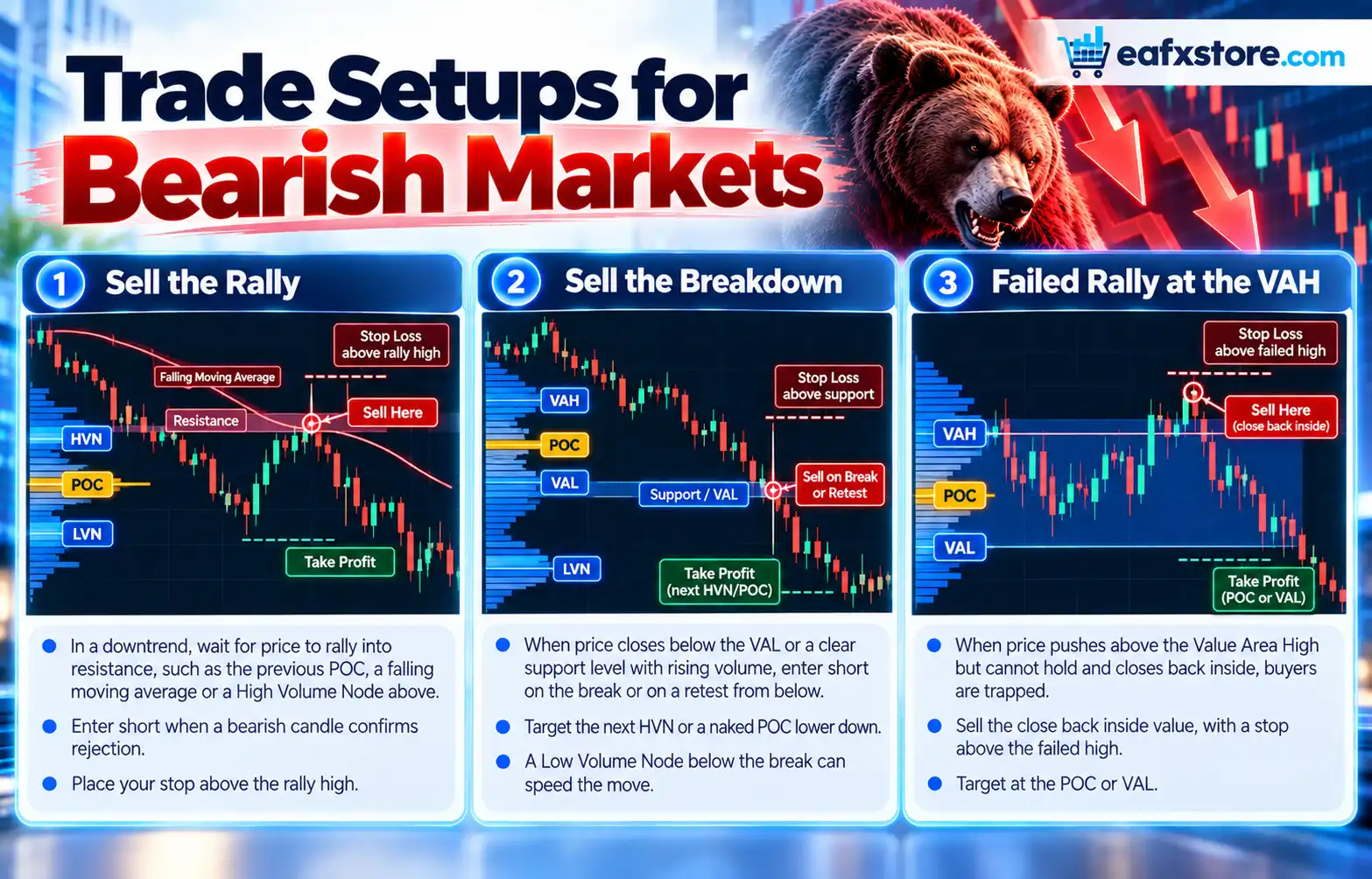
In a downtrend, wait for price to rally into resistance, such as the previous POC, a falling moving average or a High Volume Node above. Enter short when a bearish candle confirms rejection. Place your stop above the rally high.
Sell the breakdown
When price closes below the VAL or a clear support level with rising volume, enter short on the break or on a retest from below. Target the next HVN or a naked POC lower down. A Low Volume Node below the break can speed the move.
Failed rally at the VAH
When price pushes above the Value Area High but cannot hold and closes back inside, buyers are trapped. Sell the close back inside value, with a stop above the failed high and a target at the POC or VAL.
Avoiding Bear Traps
Not every drop is a new bearish trend. A bear trap occurs when price briefly breaks support, draws in sellers, and then reverses sharply higher. To avoid them:
- Wait for a candle close below support, not just a wick.
- Check whether the higher-timeframe trend supports a decline.
- Watch whether price is accepted below the level or quickly returns.
- Be cautious of breakdowns just before major news, which can reverse violently.
Frequently Asked Questions
What does bearish mean in Forex?
It means expecting a currency pair to fall, which usually leads traders to sell or go short.
Can you make money when a currency falls?
Yes. In Forex you can sell a pair as easily as you buy it, profiting when the price declines.
What is bearish divergence?
It occurs when price makes a higher high but a momentum indicator makes a lower high, signalling weakening buying pressure.
What is a bear trap?
A false breakdown below support that quickly reverses higher and traps sellers.
Conclusion
A bearish market is not something to fear; it is an opportunity for traders who know how to sell. Confirm the downtrend with lower highs and lower lows, falling value on Volume Profile and supporting fundamentals. Then sell rallies and breakdowns at logical levels, avoid bear traps and always manage your risk.
Risk warning: Trading Forex and CFDs on margin carries a high level of risk and may not be suitable for all investors. This article is for educational purposes only and is not investment advice.