
If there is one line that institutional traders watch on an intraday chart, it is the VWAP. Banks, funds and execution desks use it to judge whether they bought or sold at a fair price. Because so many large participants pay attention to it, VWAP often acts as a magnet, a support or resistance level, and a quick way to tell who is in control of the session.
This guide explains what VWAP is, how it is calculated, how to use VWAP bands and Anchored VWAP, and what Forex traders need to know before relying on it.
What is VWAP?
VWAP stands for Volume Weighted Average Price. It is the average price of an instrument over a period, weighted by the volume traded at each price. Unlike a simple moving average, which treats every bar equally, VWAP gives more weight to bars where more trading took place.
The result is a single line that represents the average price paid by market participants since the start of the calculation, usually the start of the trading day. Price above VWAP means buyers, on average, are paying more than the session’s fair value; price below VWAP means sellers are in control.
How VWAP Is Calculated
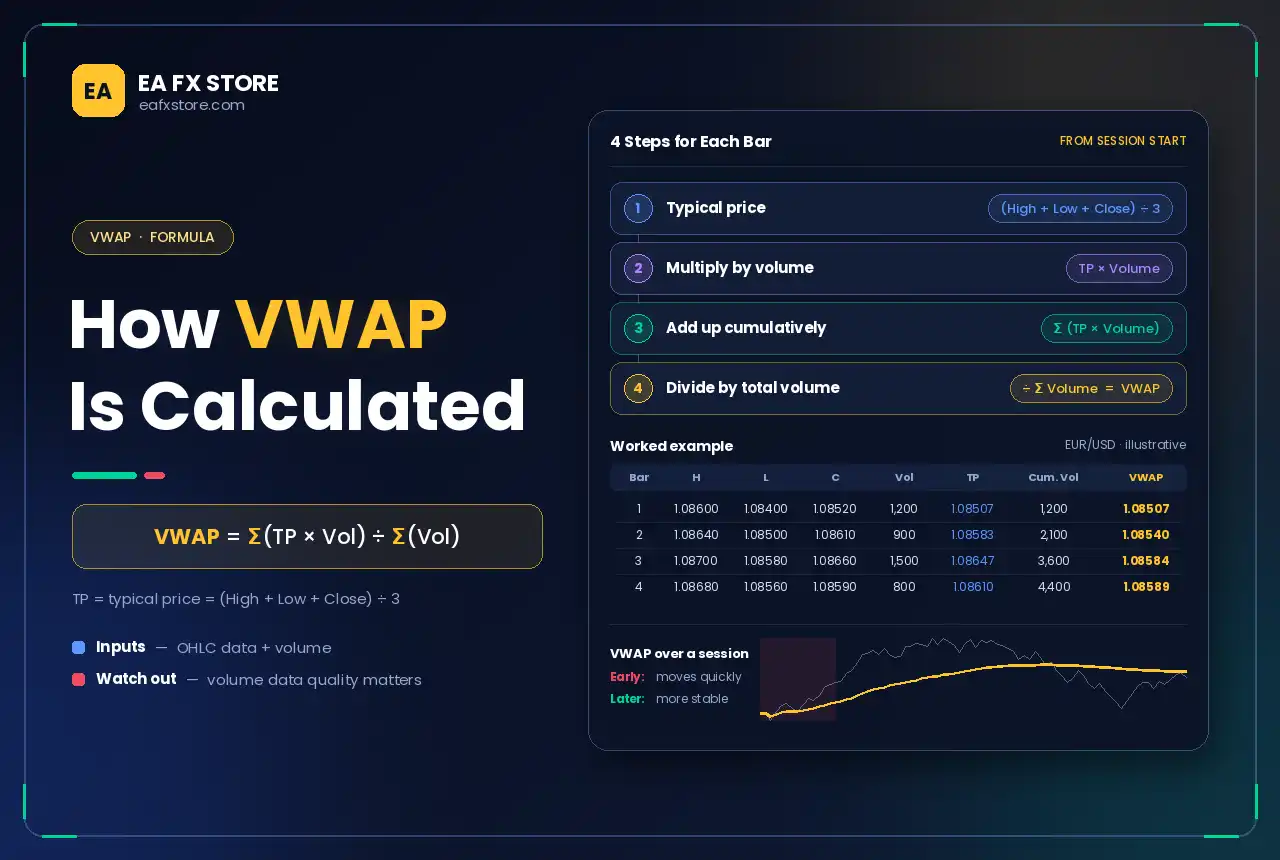
VWAP is calculated in four steps for each bar:
- Find the typical price: (High + Low + Close) ÷ 3.
- Multiply the typical price by the bar’s volume.
- Add up these values cumulatively from the start of the session.
- Divide by the cumulative volume since the start of the session.
In short: VWAP = Σ(typical price × volume) ÷ Σ(volume).
Because both totals keep growing through the day, VWAP becomes more stable as the session goes on. Early in the session it moves quickly; later, it takes a lot of volume to shift it. The calculation relies on OHLC data and volume, which is why the quality of your volume data matters.
VWAP in Forex: The Volume Question
On stock and futures charts, VWAP uses real volume from the exchange. In spot Forex and CFDs, there is no central exchange, so platforms calculate VWAP with tick volume instead.
This has two consequences:
- Forex VWAP is an approximation. Tick volume tracks activity reasonably well, but it does not measure trade size.
- VWAP can differ slightly between brokers, because each broker’s tick feed is different.
The session start also matters. Forex trades nearly 24 hours a day, so VWAP usually resets at your broker’s daily open, often 5:00 PM New York time. Some traders prefer to anchor VWAP to the London or New York open instead. For exchange-grade VWAP, you can use currency futures, such as the CME Euro FX contract (6E).
How to Read VWAP
- Price above VWAP: the session is bullish. Buyers are in control, and pullbacks to VWAP can be buying opportunities.
- Price below VWAP: the session is bearish. Rallies to VWAP can be selling opportunities.
- Price crossing VWAP repeatedly: the market is neutral and balanced, so trend strategies are less reliable.
- VWAP slope: a rising VWAP confirms upward value migration; a flat VWAP suggests a range.
VWAP Bands
Many platforms add standard deviation bands above and below VWAP, typically at 1, 2 and 3 standard deviations. They work in a similar way to Bollinger Bands, but they are anchored to the volume-weighted price.
- Inside the first band: price is trading close to fair value.
- At the second band: price is stretched, and mean-reversion trades become more attractive in a range.
- Beyond the third band: price is extremely extended, often during news releases or strong trends.
In trending sessions, price may “ride” the first or second band for hours. In ranging sessions, it tends to rotate between the bands and VWAP.
Anchored VWAP
Anchored VWAP (AVWAP) starts the calculation from a point you choose rather than the start of the day. Common anchor points include:
- A major swing high or low.
- The start of the week or month.
- A high-impact news release, such as a central bank decision.
- A breakout bar or a gap.
Anchored VWAP shows the average price paid by everyone who traded since that event. If price is above an AVWAP anchored at a major low, buyers since that low are still in profit on average, which supports the uptrend. A break below it suggests those buyers are now under pressure.
VWAP Trading Strategies
VWAP pullback in a trend
When price is clearly above VWAP and VWAP is rising, wait for a pullback to the VWAP line. Look for a bullish rejection candle or a lower-timeframe Market Structure Shift before buying. Place the stop below the pullback low and target the session high or the upper band. Reverse the logic for short trades.
VWAP mean reversion
In a balanced session, sell when price reaches the second upper band with signs of rejection, and target a return to VWAP. Buy at the second lower band with the same logic. This works best when VWAP is flat and no major news is due.
VWAP reclaim or loss
When price breaks below VWAP and then quickly reclaims it with strength, the move can trap sellers and fuel a rally. The opposite, a failure to reclaim VWAP from below, confirms bearish control.
Combining VWAP With Volume Profile
VWAP and Volume Profile both describe fair value, but in different ways. VWAP is a single average price that moves through time; Volume Profile shows how volume is distributed across price levels.
- When VWAP sits close to the Point of Control, the session is well balanced around one clear fair price.
- When price is above both VWAP and the Value Area High, value is migrating higher, supporting long trades.
- When price is below both VWAP and the Value Area Low, sellers are firmly in control.
VWAP also fits well with session timing. Many traders focus on VWAP reactions during the London and New York Kill Zones, when volume and volatility are highest.
Limitations of VWAP
- Intraday focus. Standard VWAP resets each session, so it is less useful for swing trading unless you use Anchored VWAP.
- Lagging late in the day. As cumulative volume grows, VWAP reacts slowly to new moves.
- Tick volume in Forex. Results are approximate and broker dependent.
- Not a signal on its own. VWAP tells you where fair value is, not when to enter.
Frequently Asked Questions
What does VWAP stand for?
VWAP stands for Volume Weighted Average Price, the average price weighted by volume over a period.
Does VWAP work in Forex?
Yes, but Forex VWAP uses tick volume rather than real volume, so treat it as an approximation and stay consistent with one broker’s data.
What is the difference between VWAP and a moving average?
A moving average weights each bar equally or by time; VWAP weights each bar by its volume and usually resets at the start of each session.
What is Anchored VWAP?
It is VWAP calculated from a chosen starting point, such as a swing low or a news event, instead of the start of the day.
Conclusion
VWAP gives you a quick, objective view of fair value during the trading session and of who is in control. Use it to define your bias, find pullback entries, and judge when price is stretched. In Forex, remember that VWAP is built on tick volume and depends on your session settings. Combine it with Volume Profile, market structure and session timing, and it becomes one of the most practical lines on your chart.
Risk warning: Trading Forex and CFDs on margin carries a high level of risk and may not be suitable for all investors. This article is for educational purposes only and is not investment advice.