
Markets do not trend all the time. In fact, currency pairs often spend long stretches moving sideways, with neither buyers nor sellers taking control. These periods are called neutral markets. Traders who try to force trend strategies onto a neutral market usually get chopped up; traders who recognise it can either profit from the range or protect their capital by stepping aside.
This guide explains what a neutral market is, how to identify it, and how to trade it.
What Does Neutral Mean in Trading?
Neutral describes a market with no clear directional bias. Price is neither bullish (trending up) nor bearish (trending down). It moves sideways within a range, often called a ranging, sideways or consolidating market.
Neutral can also describe a trader’s view. A trader with a neutral bias has no strong opinion on direction and waits for evidence before committing, or uses strategies that do not depend on direction.
Why Markets Become Neutral
- Balance between buyers and sellers. Both sides agree on a fair price, so neither pushes it far.
- Waiting for news. Before central bank decisions or major data releases, many participants reduce activity and wait.
- Quiet sessions. Major pairs like EUR/USD and GBP/USD often move sideways during the Asian session.
- After a big move. Markets frequently pause and consolidate after a strong trend, building a base before the next move.
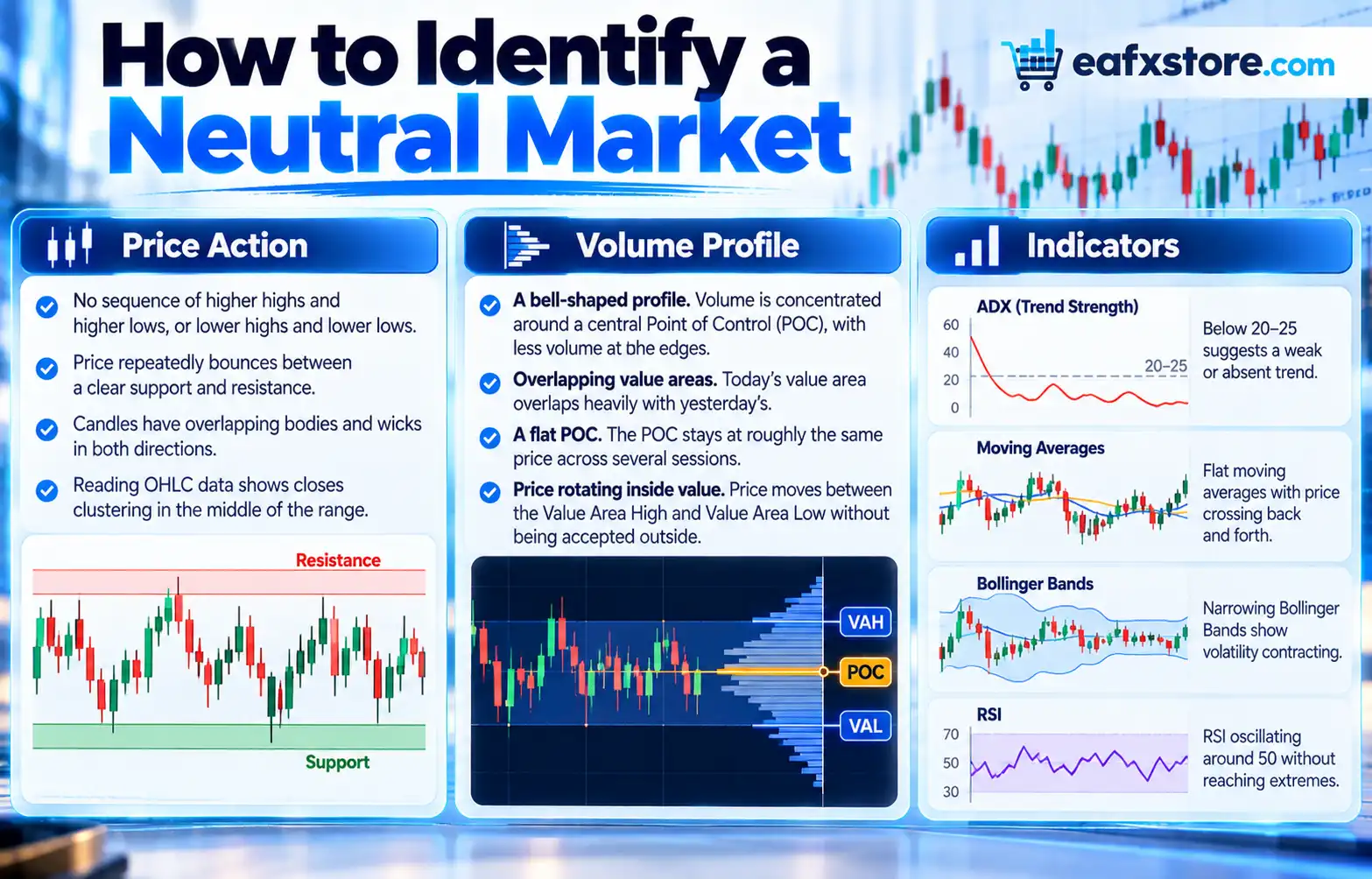
How to Identify a Neutral Market
Price action
- No sequence of higher highs and higher lows, or lower highs and lower lows.
- Price repeatedly bounces between a clear support and resistance.
- Candles have overlapping bodies and wicks in both directions. Reading OHLC data shows closes clustering in the middle of the range.
Volume Profile
Volume Profile is one of the best tools for spotting a neutral market:
- A bell-shaped profile. Volume is concentrated around a central Point of Control (POC), with less volume at the edges. This is the classic shape of a balanced market.
- Overlapping value areas. Today’s value area overlaps heavily with yesterday’s.
- A flat POC. The POC stays at roughly the same price across several sessions instead of migrating up or down.
- Price rotating inside value. Price moves between the Value Area High and Value Area Low without being accepted outside.
Indicators
- ADX below about 20 to 25 suggests a weak or absent trend.
- Flat moving averages with price crossing back and forth.
- Narrowing Bollinger Bands show volatility contracting.
- RSI oscillating around 50 without reaching extremes.
Strategies for Neutral Markets
Range trading between VAH and VAL
This is the most natural approach.
- Mark the previous session’s VAH, POC and VAL.
- Sell near the VAH when price shows rejection, targeting the POC.
- Buy near the VAL when price shows rejection, targeting the POC.
- Place stops just outside the value area.
- Take profit quickly, because ranges offer limited room.
Trading the POC rotation
In a neutral market, price often returns to the POC repeatedly. Short-term traders can fade moves away from the POC and target a return to it, keeping positions small and stops tight.
Preparing for the breakout
Neutral periods do not last forever. Contraction usually leads to expansion. Mark the range boundaries and wait for price to break and be accepted outside the value area, ideally with rising tick volume. A Low Volume Node just outside the range can make the breakout move quickly.
Staying out
Sometimes the best trade is no trade. If the range is narrow, spreads eat most of the potential profit, or major news is due, standing aside protects your account and your focus.
Risks of Trading Neutral Markets
- False breakouts are common. Price pokes outside the range, then snaps back.
- Small profit potential means costs matter more.
- Sudden transitions from neutral to trending can catch range traders on the wrong side, especially around news.
Always use stops, and reduce position size when the range is narrow.
Frequently Asked Questions
What is a neutral market in Forex?
It is a market with no clear trend, where price moves sideways within a range.
How do I know if the market is neutral?
Look for sideways price action, a flat POC, overlapping value areas and a low ADX reading.
What is the best strategy for a neutral market?
Range trading between the Value Area High and Value Area Low is popular, but staying out is also a valid choice.
What comes after a neutral market?
Usually a breakout. Periods of low volatility tend to be followed by expansion in one direction.
Conclusion
A neutral market is not a dead market; it is a market in balance. By recognising the signs, including a bell-shaped Volume Profile, a flat POC and price rotating inside the value area, you can switch from trend strategies to range strategies or step aside until the next breakout. Understanding when the market is neutral is just as important as knowing when it is bullish or bearish.
Risk warning: Trading Forex and CFDs on margin carries a high level of risk and may not be suitable for all investors. This article is for educational purposes only and is not investment advice.