
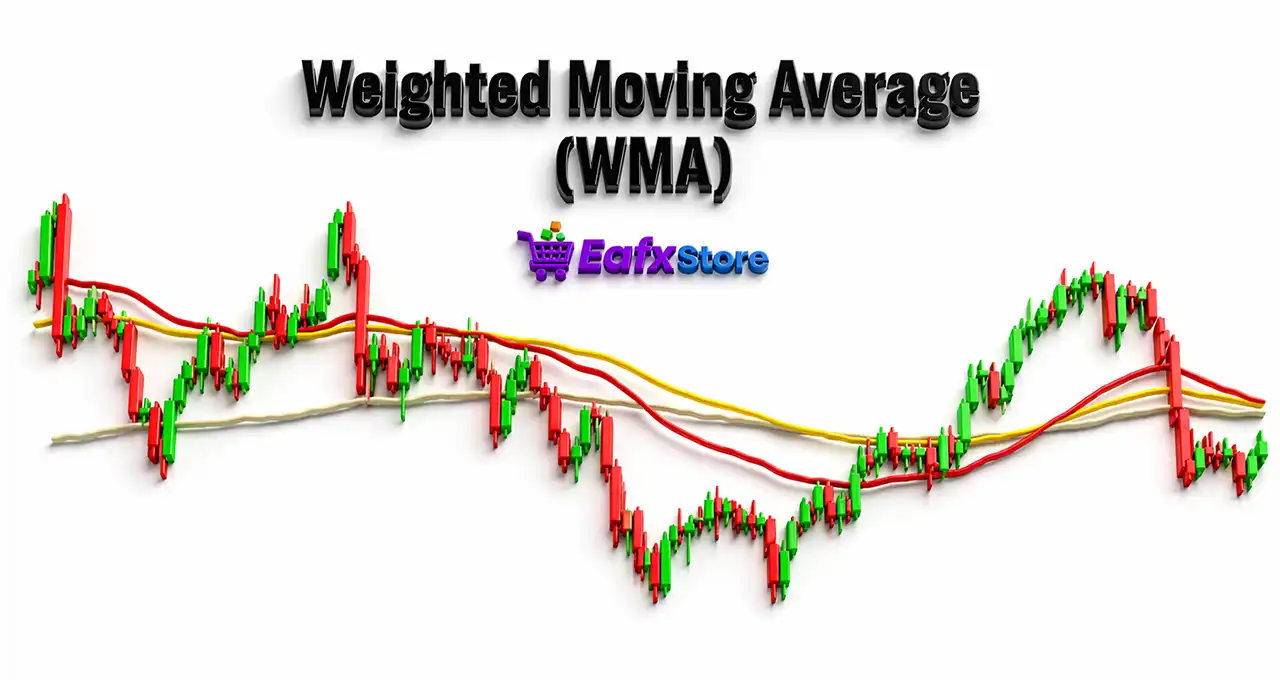
What is Weighted Moving Average (WMA)?
The Weighted Moving Average (WMA) is a type of Moving Average (MA) that places more emphasis (weight) on recent prices while giving less importance to older data points. This makes it more sensitive to current market conditions compared to simpler averages.
In Forex trading, where price movements can change rapidly, this responsiveness is extremely valuable.
Key Characteristics of WMA:
- Prioritizes recent Price Action.
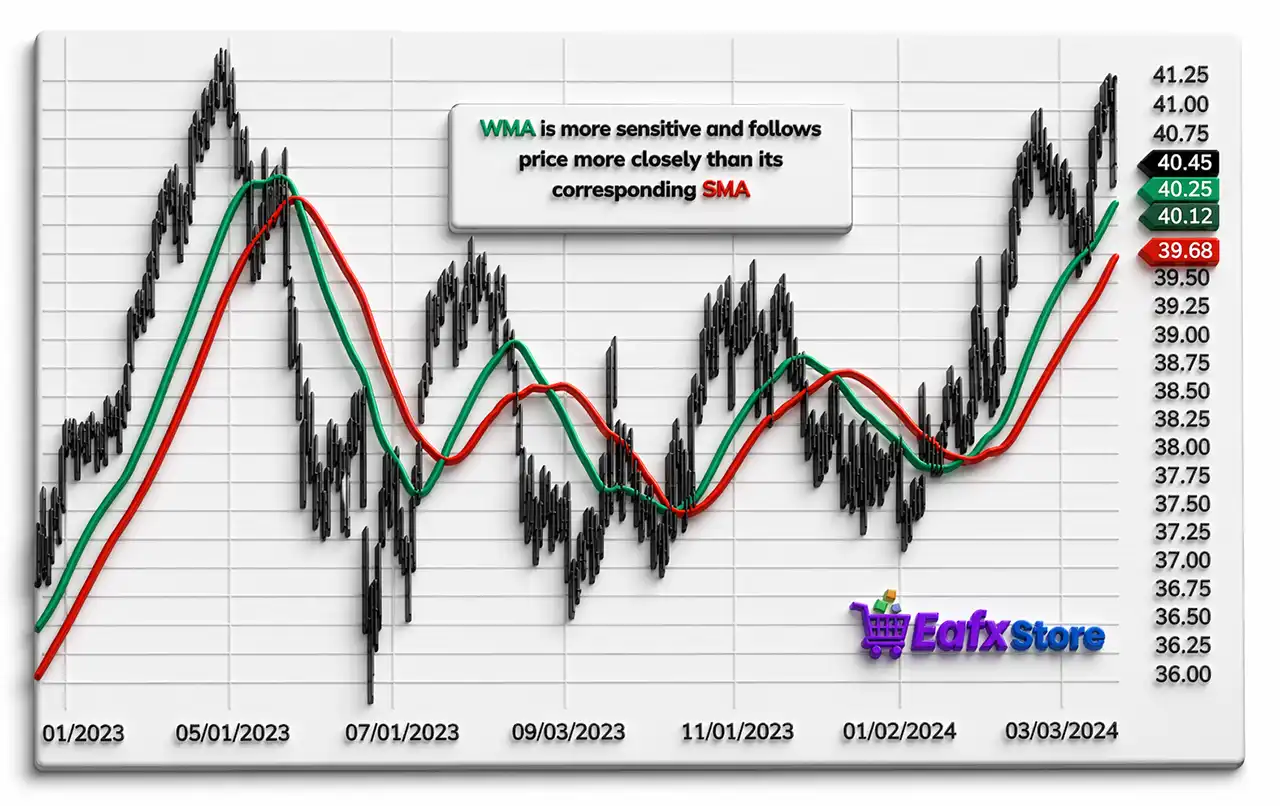
- Reacts faster than Simple Moving Average (SMA).
- Smoother than raw price data but more dynamic than Exponential Moving Average (EMA) in some cases.
- Helps identify short-term trends effectively.
How Does WMA Work?
The calculation of WMA involves multiplying each price by a weighting factor. The most recent data point gets the highest weight, and weights decrease progressively for older data.
Basic Formula:
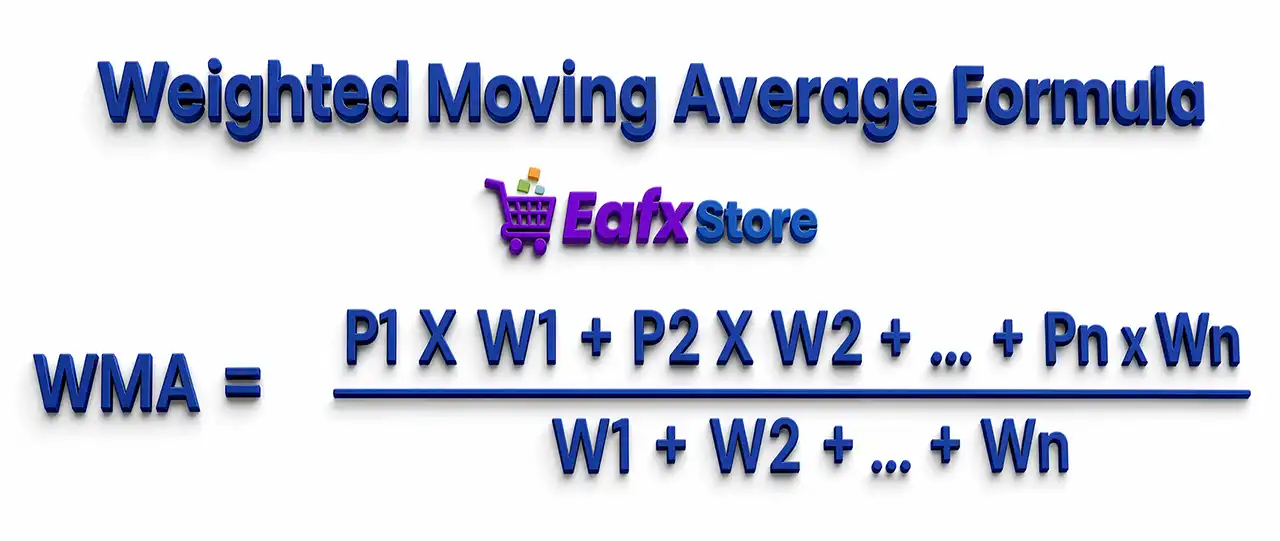
WMA = (Price₁ × Weight₁ + Price₂ × Weight₂ + … + Priceₙ × Weightₙ) / Sum of Weights
For example, in a 5-period WMA:
- Most recent price × 5
- Previous price × 4
- And so on…
This structure ensures that recent price movements have a stronger influence on the indicator.
Why Use WMA in Forex Trading?
Forex markets are highly volatile and influenced by real-time events. Using a lagging indicator like SMA may cause delayed entries or exits. WMA helps solve this problem.
Advantages of WMA:
- Faster signals: Captures trend changes quickly
- Better responsiveness: Ideal for short-term traders and scalpers
- Reduced lag: Compared to SMA
- Improved accuracy: Reflects current market sentiment
However, increased sensitivity can also lead to false signals, especially in ranging markets.
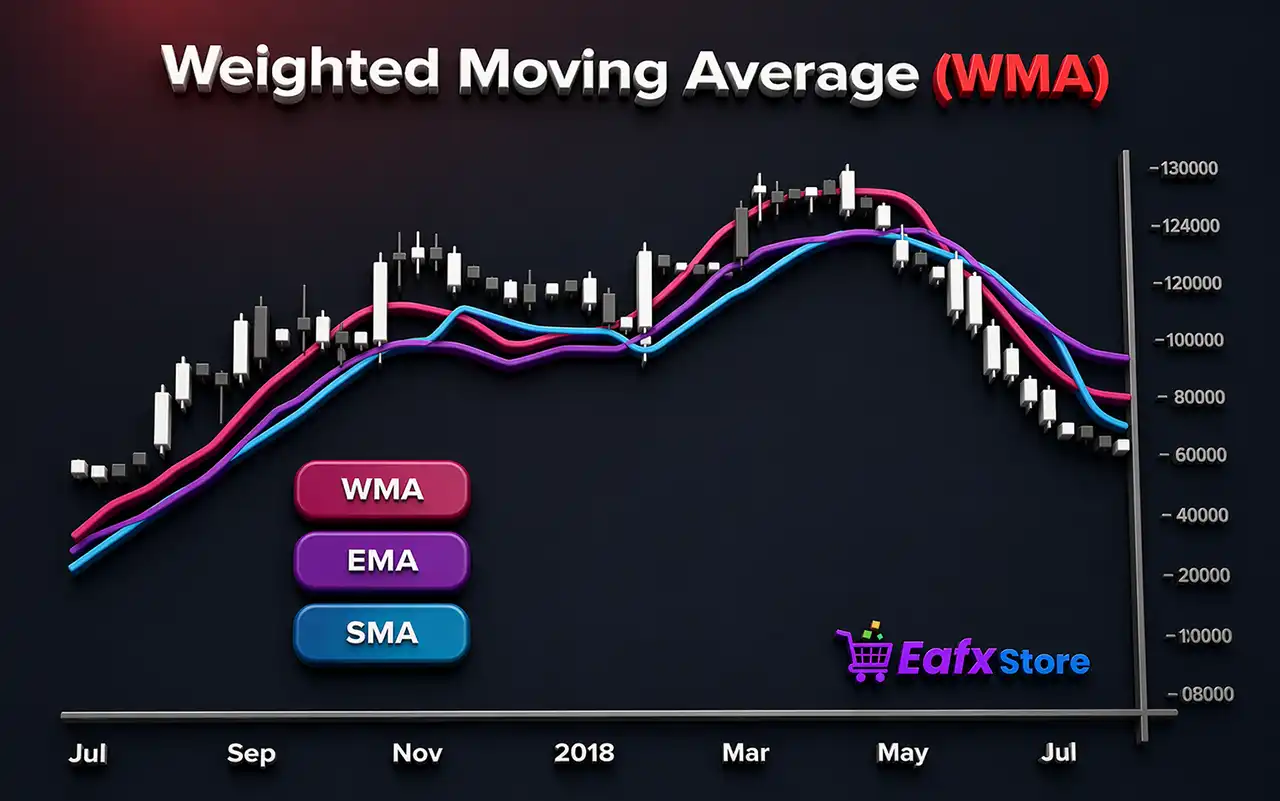
WMA vs SMA vs EMA
Understanding the differences between moving averages is essential for choosing the right tool.
1. Simple Moving Average (SMA)
- Equal weight to all data points
- Smooth but slow
- Best for long-term trend analysis
2. Exponential Moving Average (EMA)
- More weight to recent prices
- Faster than SMA
- Widely used in trend-following strategies
3. Weighted Moving Average (WMA)
- Linear weighting system
- Even more emphasis on recent data
- Faster reaction than SMA and sometimes EMA
Key Takeaway:
WMA is ideal when you need a balance between responsiveness and structure, especially in fast-moving Forex markets.
How to Use WMA in Forex Trading
1. Trend Identification
The simplest way to use WMA is to identify trends:
- Price above WMA → Uptrend
- Price below WMA → Downtrend
A rising WMA indicates bullish momentum, while a falling WMA signals bearish pressure.
2. WMA Crossover Strategy
This is one of the most popular Forex strategies.
Setup:
- Use two WMAs: a short-term (e.g., 10-period) and a long-term (e.g., 50-period)
Signals:
- Buy Signal: Short WMA crosses above long WMA
- Sell Signal: Short WMA crosses below long WMA
This strategy works best in trending markets.
3. Dynamic Support and Resistance
WMA can act as a dynamic support or resistance level:
- In an uptrend, price often bounces off the WMA
- In a downtrend, WMA acts as resistance
This helps traders identify entry points with better timing.
4. Combining WMA with Other Indicators
To reduce false signals, combine WMA with other technical indicators:
- RSI (Relative Strength Index): Confirm overbought/oversold conditions
- MACD (Moving Average Convergence Divergence): Validate trend strength
- Bollinger Bands: Identify volatility
This multi-indicator approach improves accuracy.
Best WMA Settings for Forex
There is no one-size-fits-all setting, but here are common configurations:
Short-Term Trading (Scalping/Day Trading):
- 5-period WMA
- 10-period WMA
Swing Trading:
- 20-period WMA
- 50-period WMA
Long-Term Trading:
- 100-period WMA
- 200-period WMA
Choosing the right setting depends on your trading style and timeframe.
Advantages of WMA
- Reacts quickly to price changes
- Helps identify early trend reversals
- More precise for short-term strategies
- Flexible across different timeframes
Limitations of WMA
Despite its benefits, WMA is not perfect:
- More noise: Can produce false signals in sideways markets
- Complex calculation: Harder to compute manually
- Over-sensitivity: May lead to overtrading
To overcome these issues, always use risk management and combine WMA with other tools.
Practical Example of WMA Strategy
Imagine you are trading EUR/USD on a 15-minute chart:
- Apply 10-period and 50-period WMA
- Wait for crossover
- Confirm with RSI above 50
- Enter trade
- Set stop-loss below recent support
This structured approach reduces emotional trading and improves consistency.
Tips for Using WMA Effectively
- Avoid using WMA alone—combine it with confirmation indicators
- Backtest your strategy before live trading
- Adjust WMA periods based on market conditions
- Use higher timeframes to confirm trends
- Always apply proper risk management
Common Mistakes to Avoid
- Over-relying on WMA signals
- Ignoring market context (news/events)
- Using too many indicators
- Not adapting settings to timeframe
Forex trading requires flexibility, and no single indicator should be used in isolation.
Is WMA Suitable for Beginners?
Yes, but with caution.
WMA is slightly more advanced than SMA, but once you understand how weighting works, it becomes a powerful addition to your toolkit. Beginners should start with simple strategies like trend identification and gradually move to crossover systems.
Conclusion
The Weighted Moving Average (WMA) is a highly effective technical indicator for Forex traders who want faster and more responsive insights into market trends. By emphasizing recent price action, WMA allows traders to react more quickly to changing market conditions.
However, its sensitivity can also be a double-edged sword. To maximize its effectiveness, traders should combine WMA with other indicators, apply proper risk management and adapt strategies to market conditions.
Whether you’re a scalper, day trader, or swing trader, mastering WMA can significantly enhance your trading performance.
FAQ: Weighted Moving Average (WMA)
1. Is WMA better than EMA?
Not necessarily. WMA is more structured in weighting, while EMA uses exponential smoothing. The choice depends on your strategy.
2. What timeframe works best with WMA?
WMA works well on all timeframes but is especially effective for short-term trading.
3. Can WMA predict market reversals?
It can signal potential reversals, but confirmation from other indicators is essential.
4. Is WMA good for beginners?
Yes, if used with simple strategies and proper risk management.