
Introduction
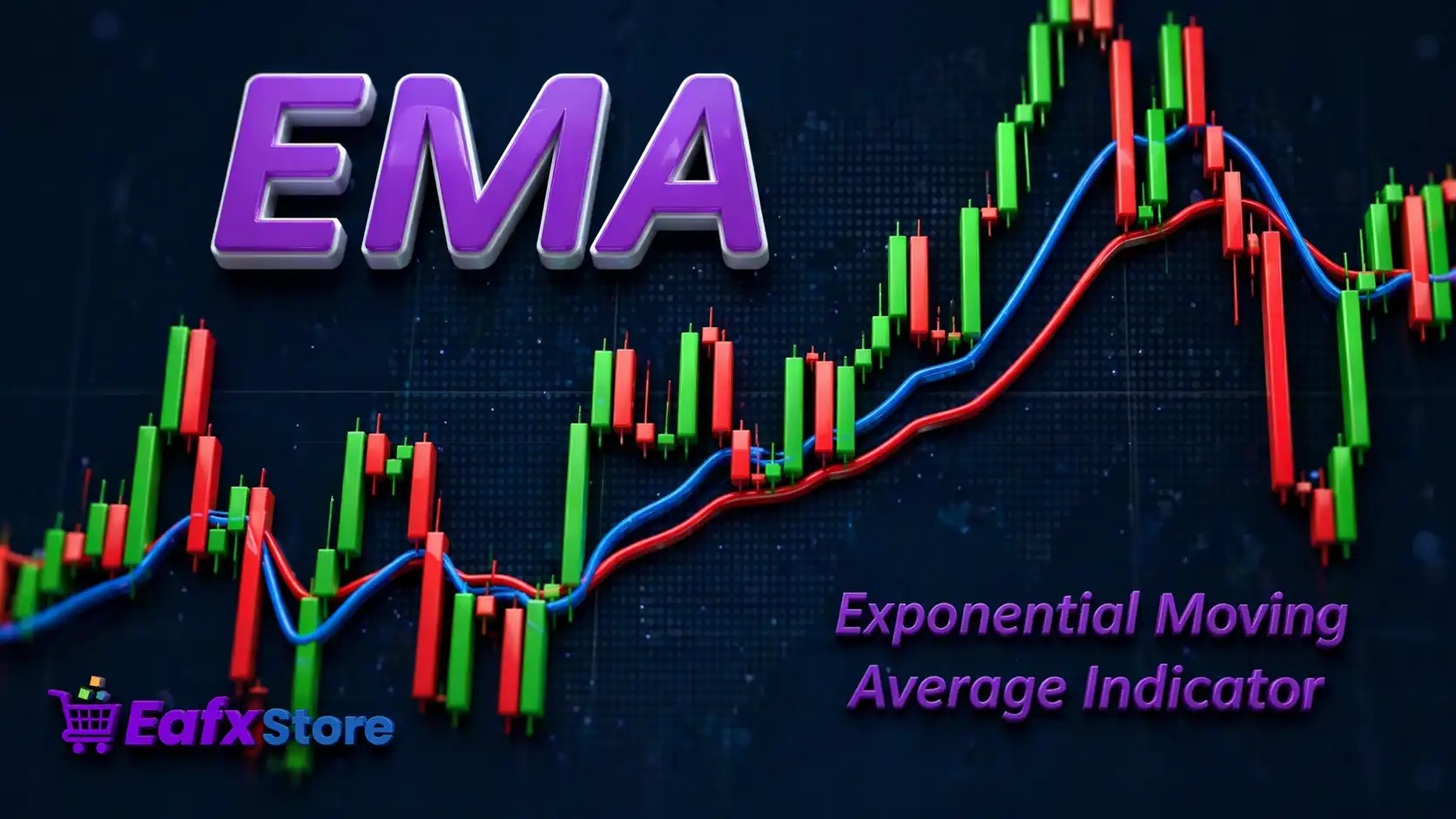
In the fast-paced world of Forex trading, timing is everything. Traders rely heavily on technical indicators to make informed decisions, and one of the most widely used tools is the Exponential Moving Average (EMA). Unlike simple indicators that lag behind price action, the EMA is designed to respond quickly to market changes, making it particularly valuable in volatile currency markets.
This comprehensive guide will walk you through everything you need to know about EMA—from its definition and calculation to practical trading strategies. Whether you are a beginner or an experienced trader, mastering EMA can significantly enhance your trading performance.
What is Exponential Moving Average (EMA)?
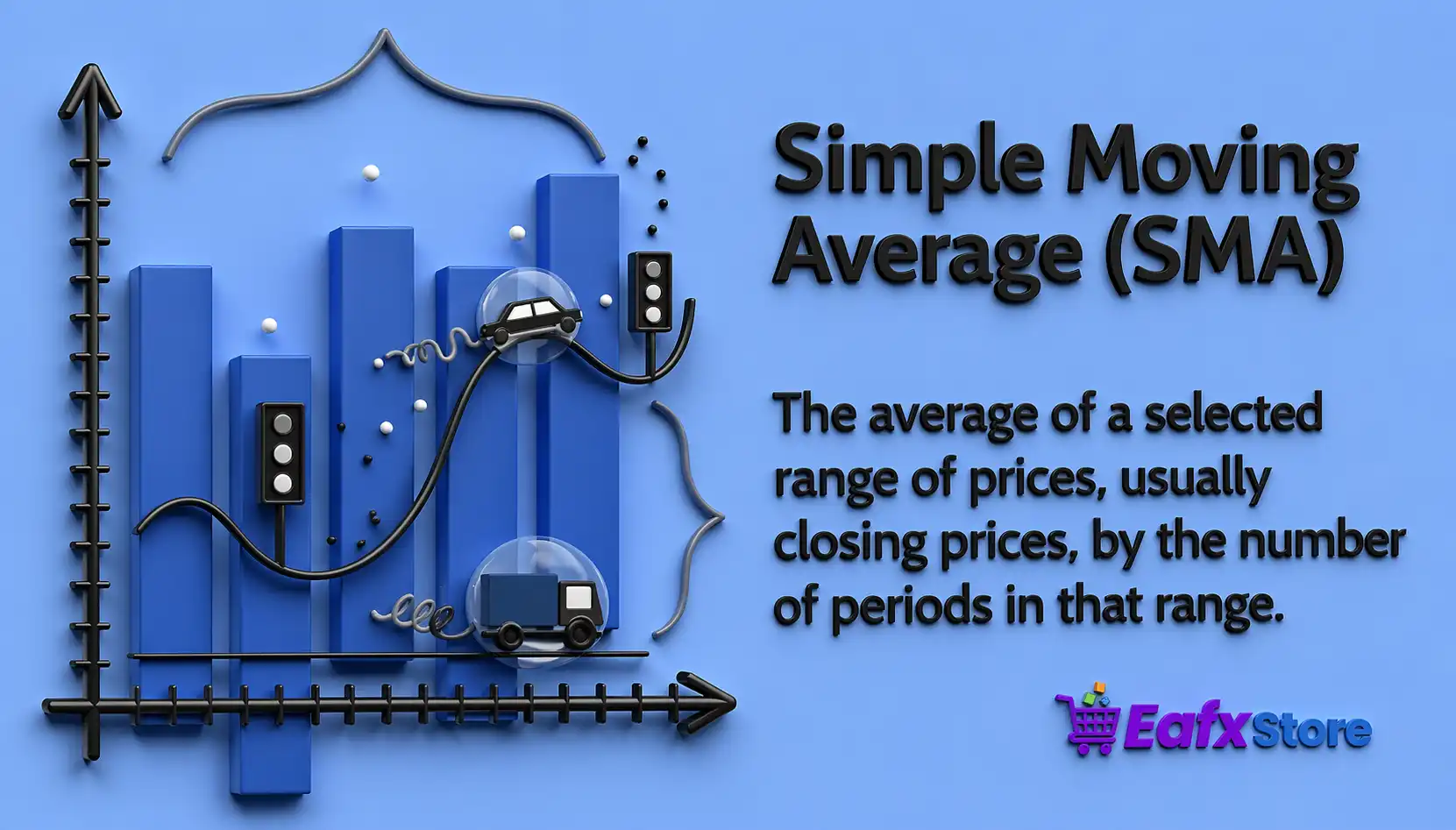
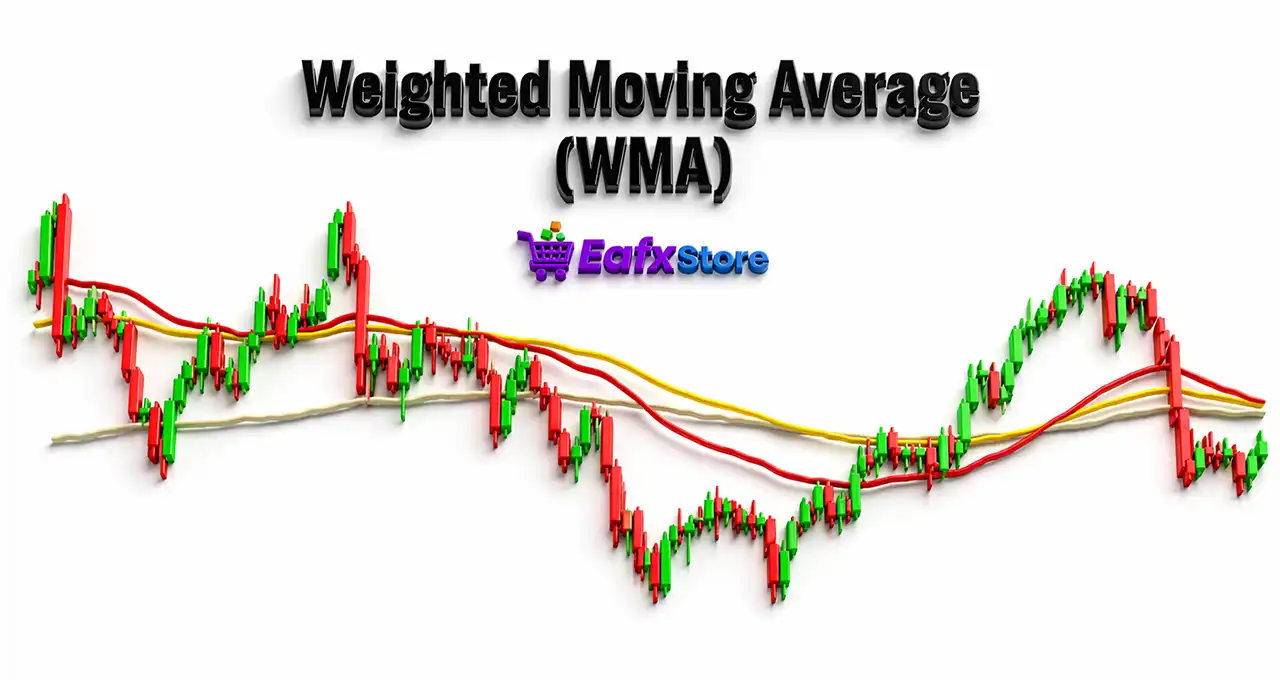
The Exponential Moving Average (EMA) is a type of moving average that places greater weight on recent price data. This makes it more responsive to current market conditions compared to the Simple Moving Average (SMA).
Key Characteristics of EMA:
- Prioritizes recent price movements.
- Reacts faster to price changes than SMA.
- Helps identify trends and reversals.
- Commonly used in short-term and intraday trading.
In Forex trading, where price movements can shift rapidly, the EMA provides a more accurate reflection of current market sentiment.
How EMA Works
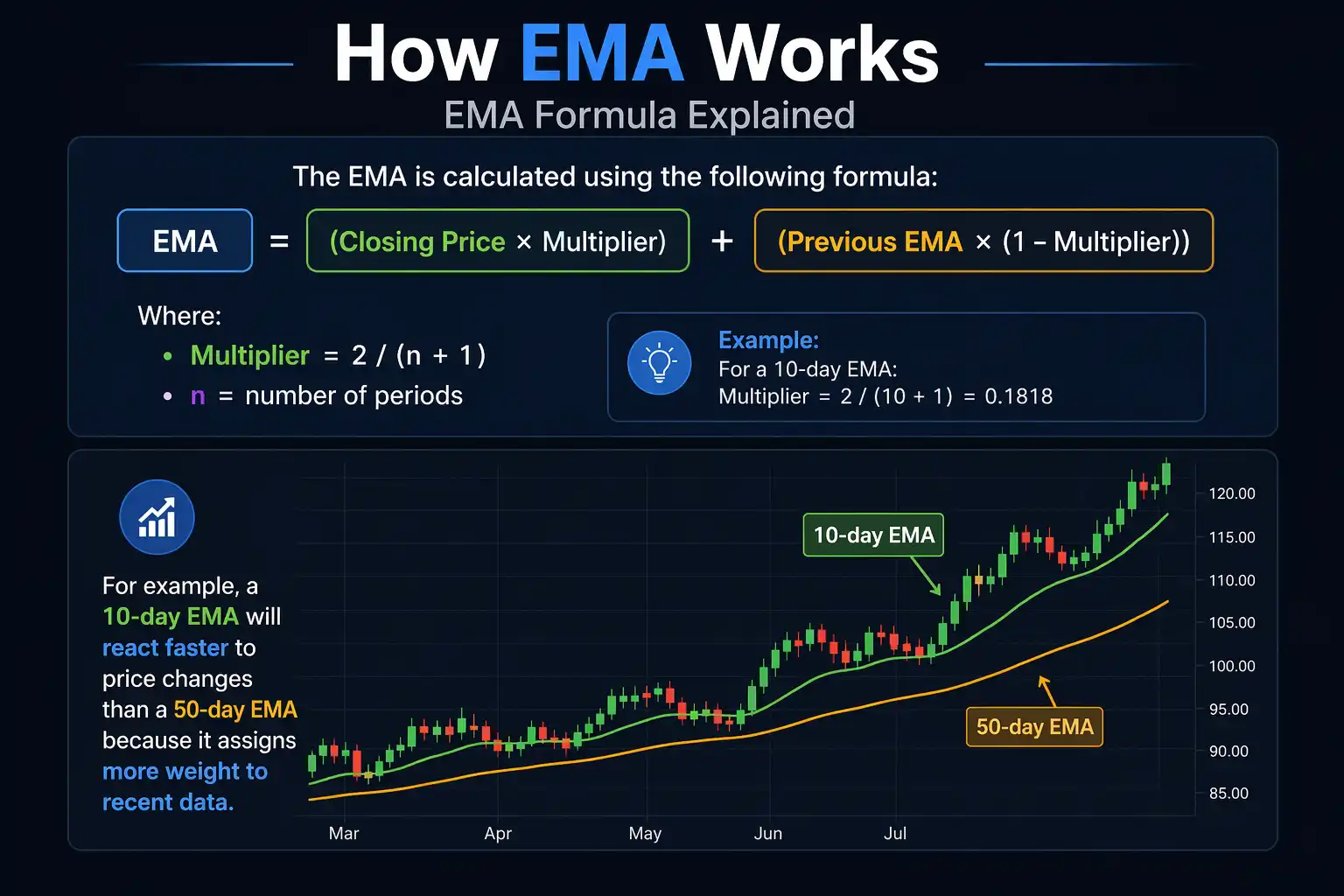
EMA Formula Explained:
The EMA is calculated using the following formula:
Where:
- Multiplier = 2 / (n + 1)
- n = number of periods
For example, a 10-day EMA will react faster to price changes than a 50-day EMA because it assigns more weight to recent data.
Why Forex Traders Prefer EMA
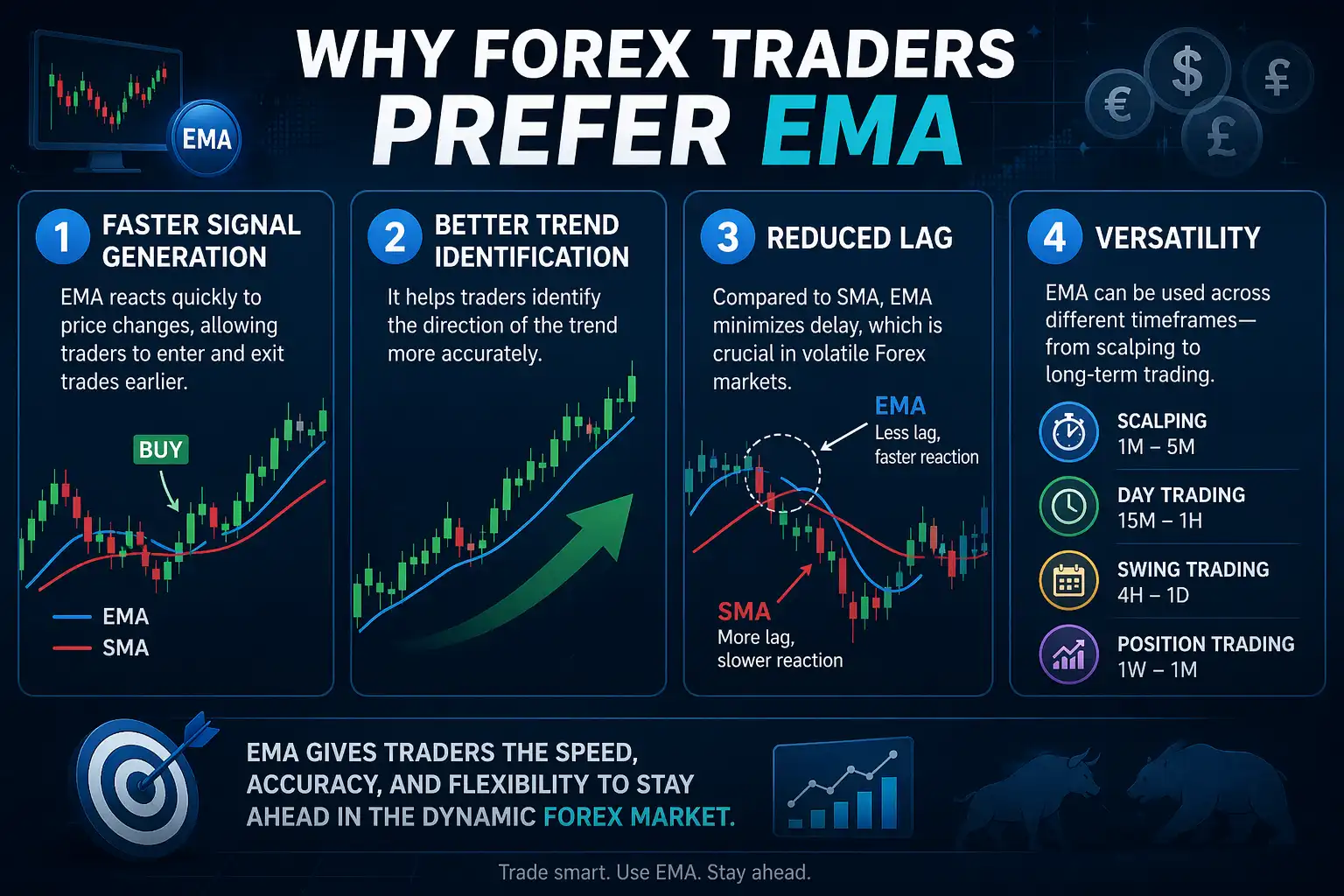
1. Faster Signal Generation
EMA reacts quickly to price changes, allowing traders to enter and exit trades earlier.
2. Better Trend Identification
It helps traders identify the direction of the trend more accurately.
3. Reduced Lag
Compared to SMA, EMA minimizes delay, which is crucial in volatile Forex markets.
4. Versatility
EMA can be used across different timeframes—from scalping to long-term trading.
EMA vs SMA: Key Differences
| Feature | EMA | SMA |
|---|---|---|
| Sensitivity | High | Low |
| Reaction Speed | Fast | Slow |
| Weight Distribution | More weight to recent prices | Equal weight to all prices |
| Best Use Case | Short-term trading | Long-term trend analysis |
While SMA is useful for smoothing data, EMA is better suited for traders who need timely signals.
Popular EMA Settings in Forex
Different EMA periods serve different trading purposes:
- 9 EMA & 12 EMA → Short-term trading (scalping, day trading)
- 20 EMA → Medium-term trend tracking
- 50 EMA → Strong trend confirmation
- 100 EMA & 200 EMA → Long-term trend analysis
Combining multiple EMAs can provide deeper insights into market structure.
EMA Trading Strategies
1. EMA Crossover Strategy
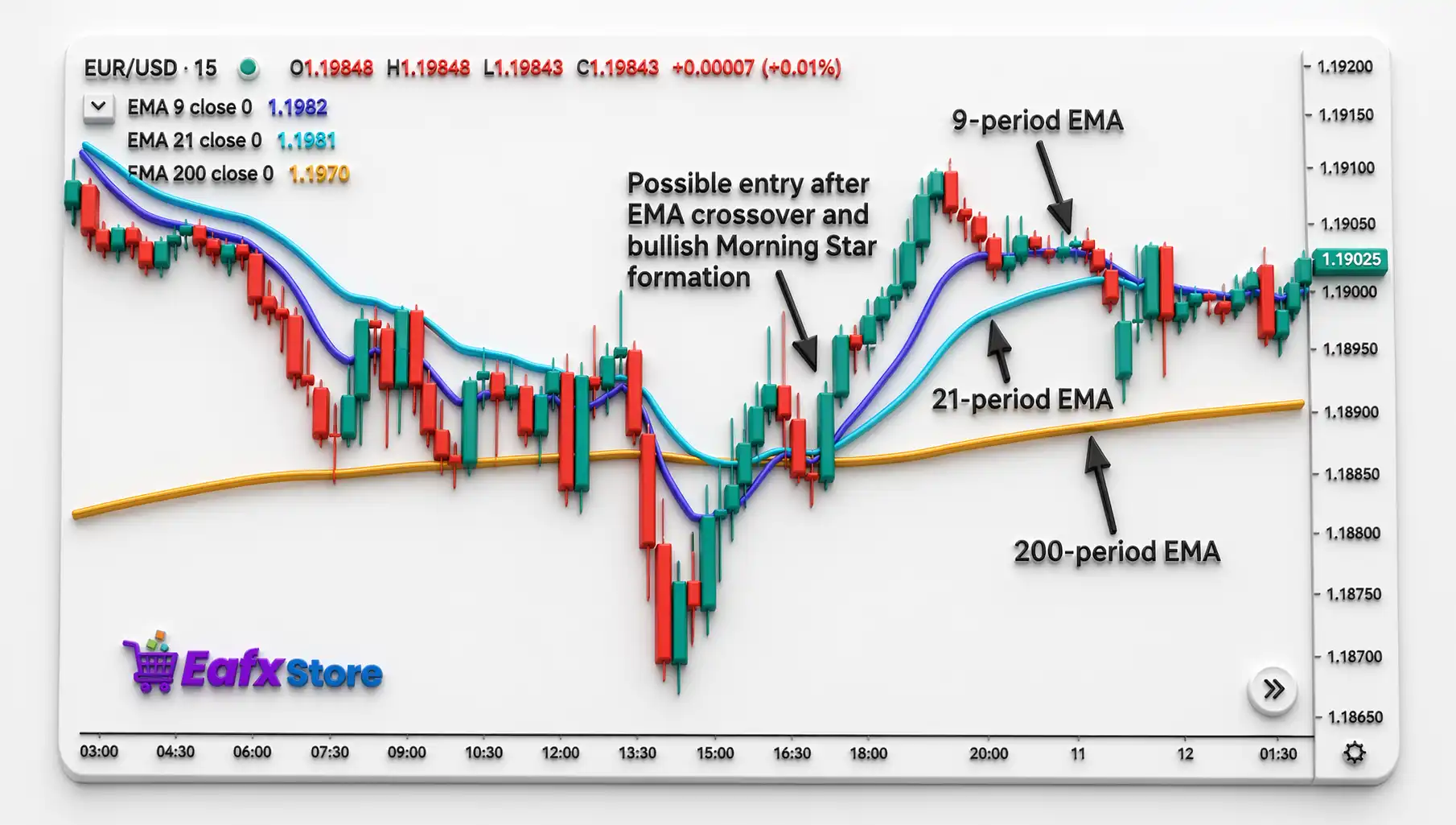
This is one of the most popular EMA strategies.
How it works:
- A short-term EMA (e.g., 9 EMA) crosses above a long-term EMA (e.g., 21 EMA) → Buy signal
- A short-term EMA crosses below a long-term EMA → Sell signal
Why it works:
It captures momentum shifts and trend reversals early.
2. EMA Trend Following Strategy
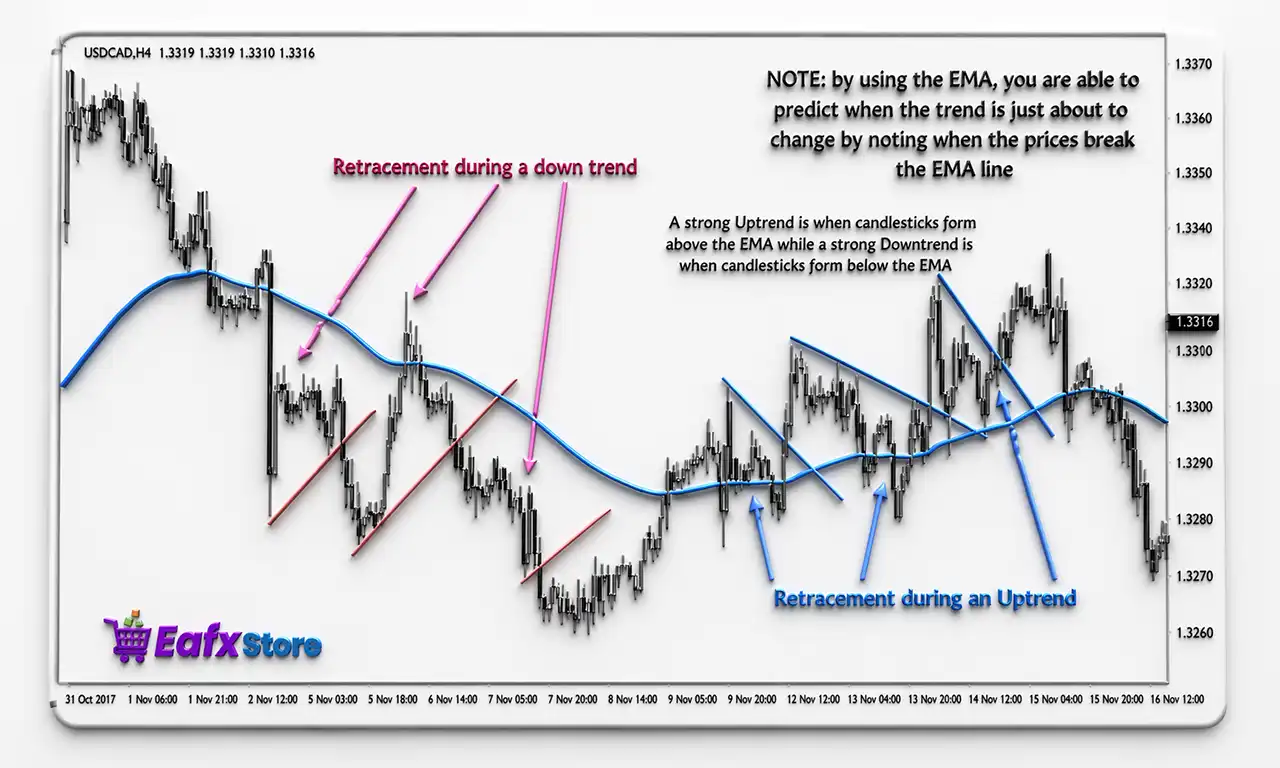
In this strategy, EMA acts as a dynamic support or resistance level.
Steps:
- Identify trend direction using a 50 EMA or 200 EMA.
- Wait for price to retrace to the EMA.
- Enter trade in the direction of the trend.
Example:
- In an uptrend, price pulls back to the EMA → Buy opportunity.
- In a downtrend, price retraces upward → Sell opportunity.
3. Multiple EMA Strategy
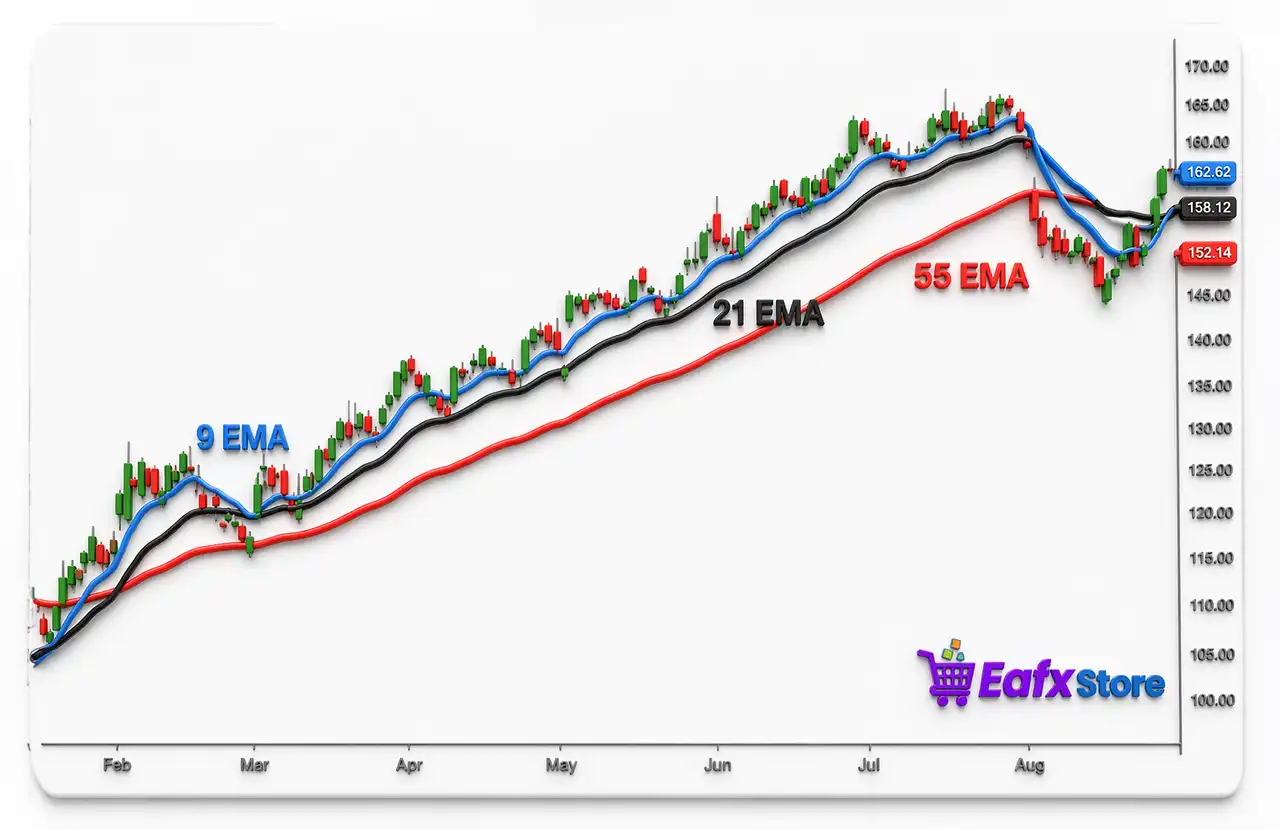
This involves using several EMAs together (e.g., 9, 21, 50).
Signal interpretation:
- EMAs aligned upward → Strong bullish trend
- EMAs aligned downward → Strong bearish trend
- EMAs crossing frequently → Sideways market
This strategy helps filter out false signals and improves accuracy.
Best Timeframes for EMA Trading
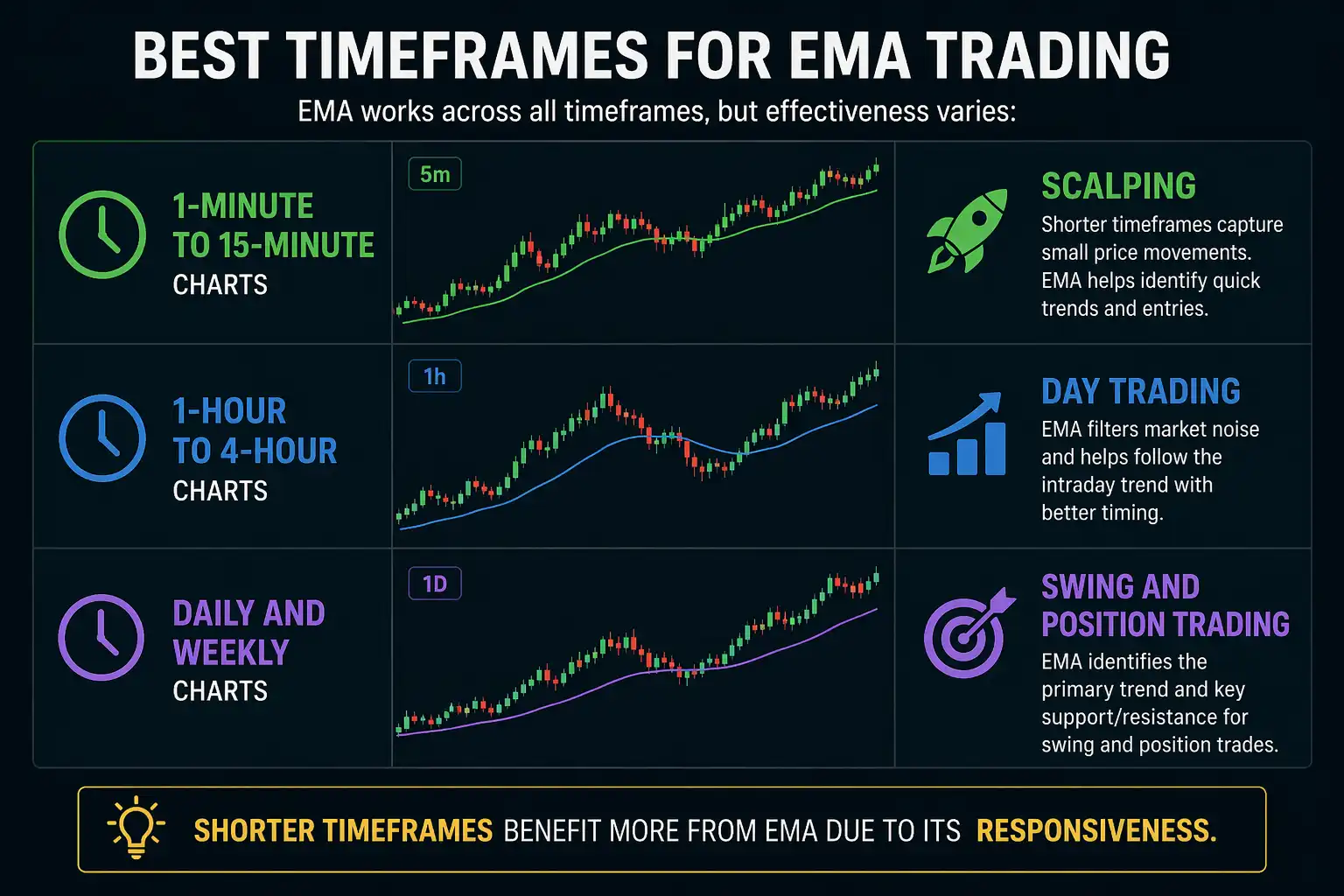
EMA works across all timeframes, but effectiveness varies:
- 1-minute to 15-minute charts → Scalping.
- 1-hour to 4-hour charts → Day trading.
- Daily and weekly charts → Swing and position trading.
Shorter timeframes benefit more from EMA due to its responsiveness.
Common Mistakes When Using EMA
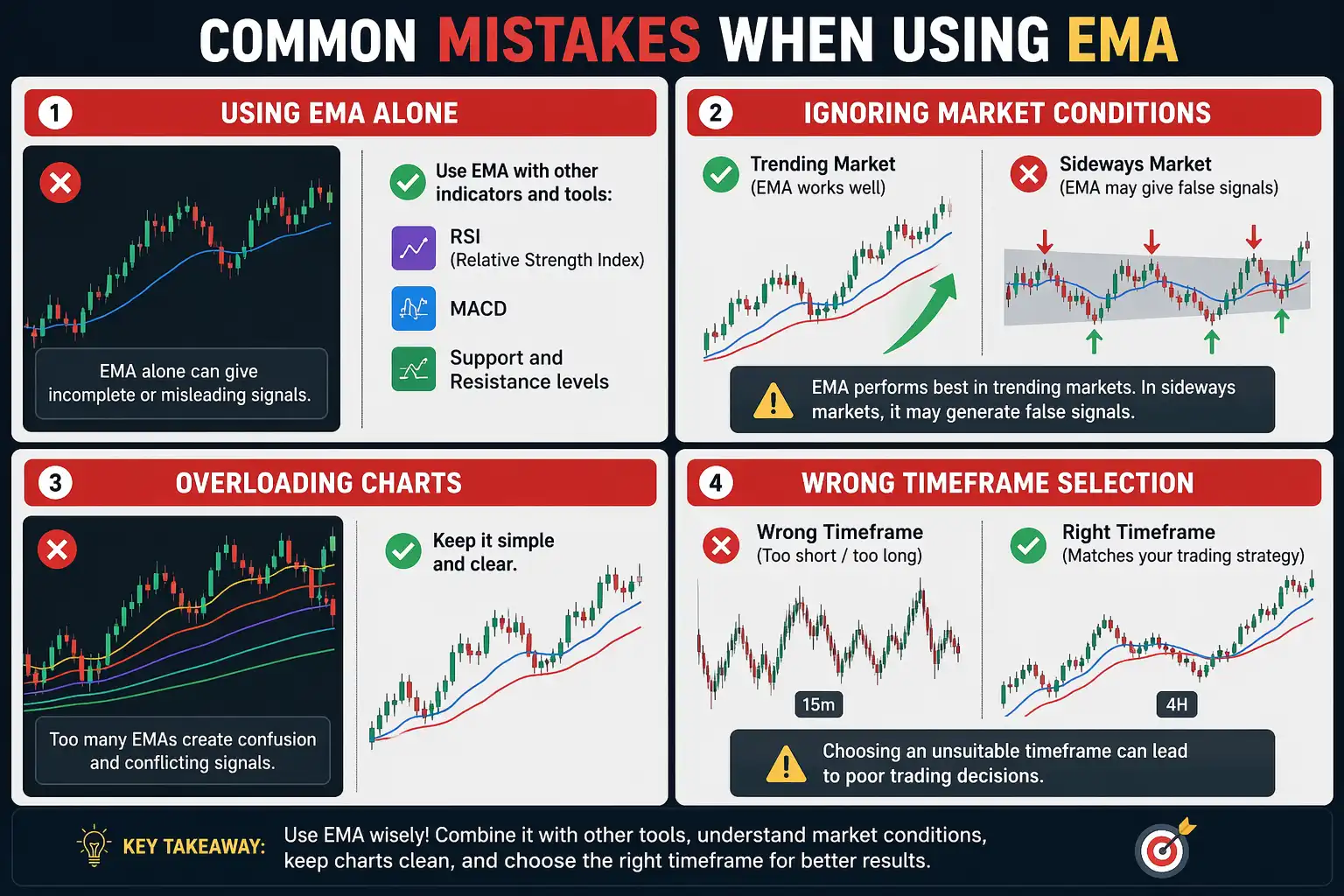
1. Using EMA Alone
EMA should not be used in isolation. Combine it with:
2. Ignoring Market Conditions
EMA performs best in trending markets. In sideways markets, it may generate false signals.
3. Overloading Charts
Using too many EMAs can create confusion and conflicting signals.
4. Wrong Timeframe Selection
Choosing an unsuitable timeframe can lead to poor trading decisions.
Tips for Using EMA Effectively
- Combine EMA with price action analysis.
- Use higher timeframes for trend confirmation.
- Backtest strategies before live trading.
- Adjust EMA periods based on your trading style.
- Always apply risk management.
EMA in Different Market Conditions
1. Trending Market
EMA works exceptionally well by helping traders ride the trend.
2. Sideways Market
EMA may produce false signals due to frequent crossovers.
3. Volatile Market
Short-period EMAs (like 9 or 12) are more effective in capturing quick movements.
Advanced EMA Techniques
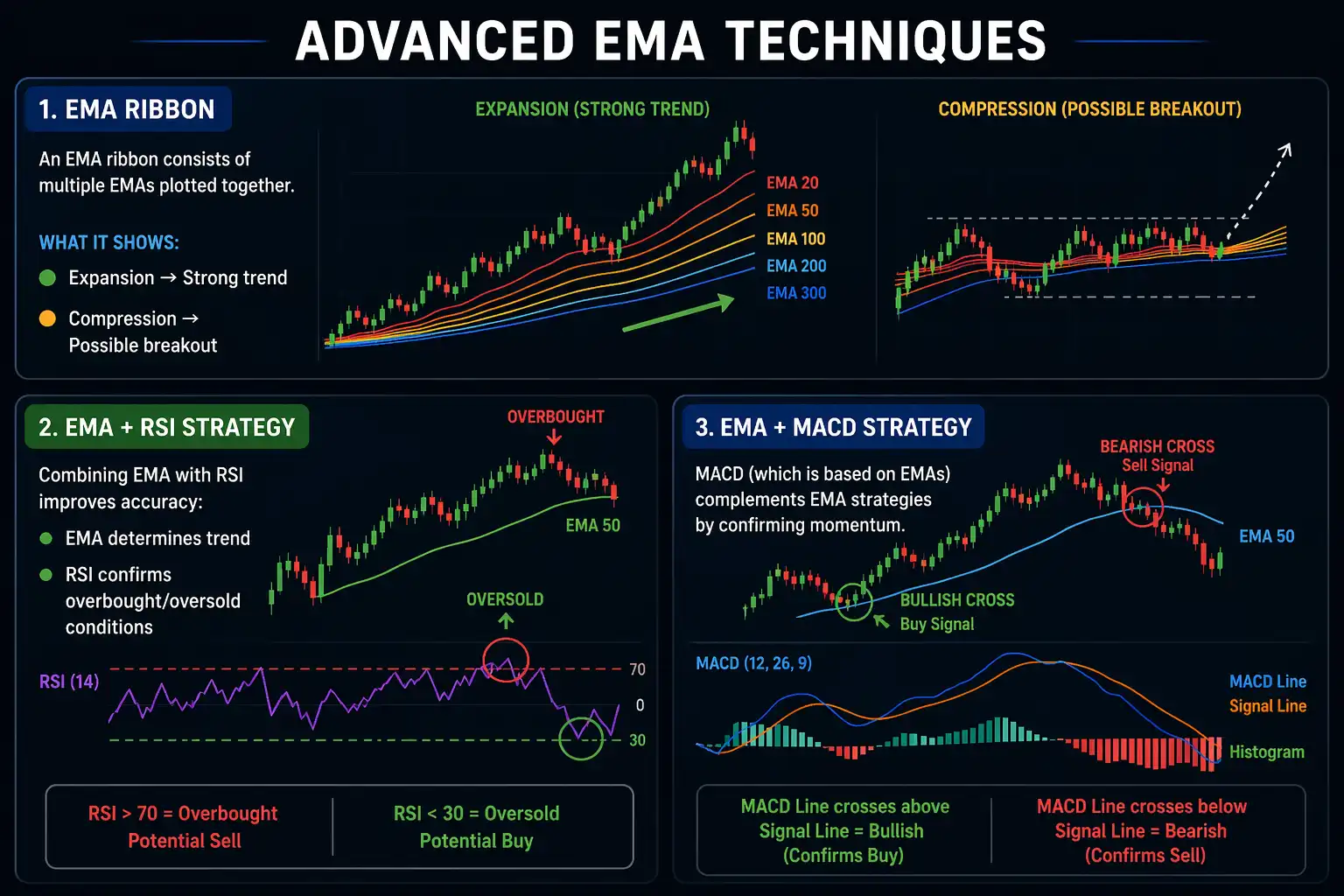
1. EMA Ribbon
An EMA ribbon consists of multiple EMAs plotted together.
What it shows:
- Expansion → Strong trend.
- Compression → Possible breakout.
2. EMA + RSI Strategy
Combining EMA with RSI improves accuracy:
- EMA determines trend.
- RSI confirms overbought/oversold conditions.
3. EMA + MACD Strategy
MACD (which is based on EMAs) complements EMA strategies by confirming momentum.
Advantages of EMA
- Quick response to price changes.
- Ideal for short-term trading.
- Helps identify entry and exit points.
- Widely used and trusted by traders.
Disadvantages of EMA
- Can generate false signals in sideways markets.
- More sensitive to price noise.
- Requires confirmation from other indicators.
Conclusion
The Exponential Moving Average (EMA) is an essential tool for Forex traders looking to gain an edge in the market. Its ability to react quickly to price changes makes it particularly useful for identifying trends, spotting reversals and executing timely trades.
However, like any indicator, EMA is not foolproof. The key to success lies in combining it with other technical tools, understanding market conditions, and applying sound risk management strategies.
By mastering EMA and integrating it into your trading system, you can significantly improve your decision-making and overall trading performance.