

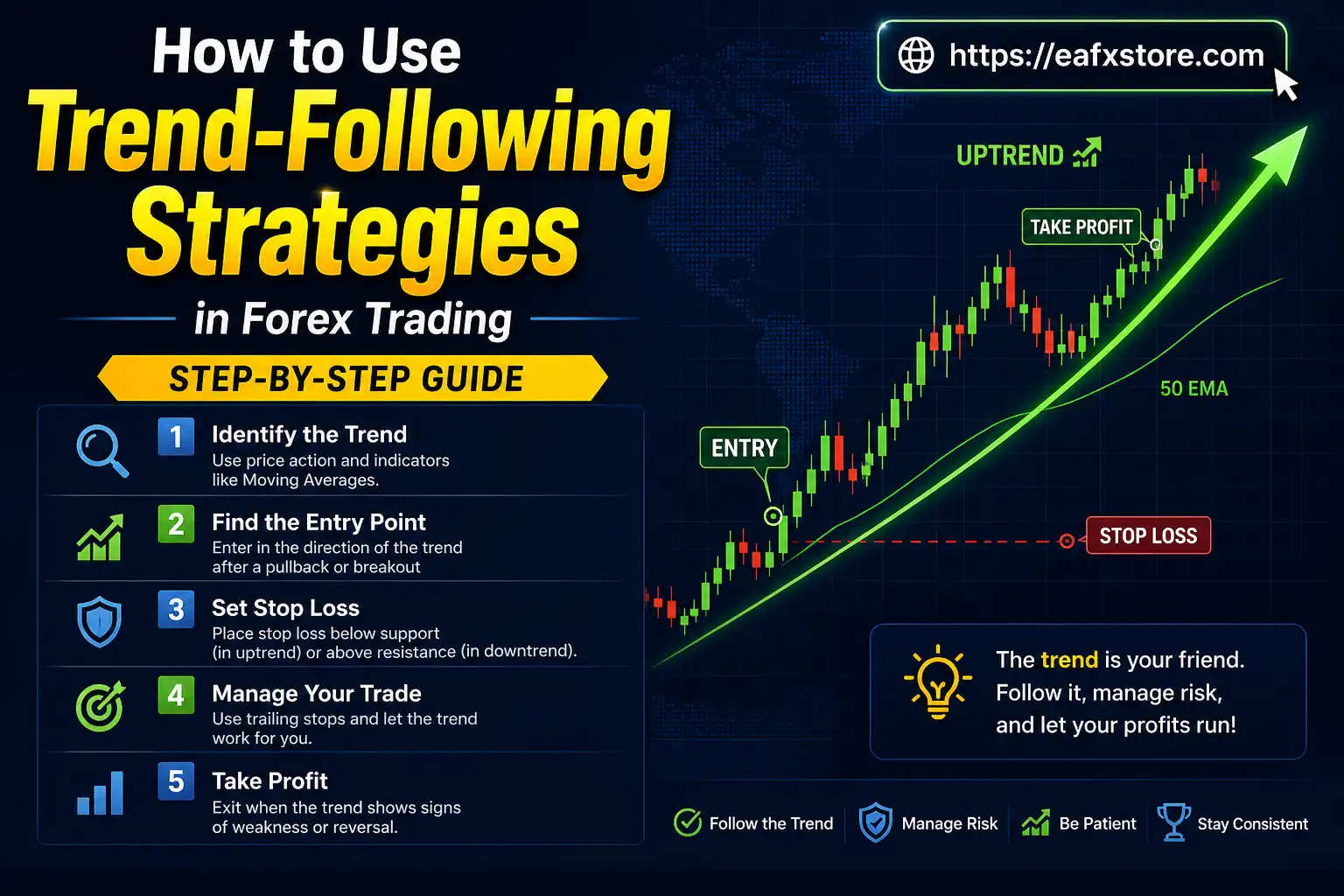
Trend-following is one of the most popular and beginner-friendly approaches in Forex trading. Instead of predicting market reversals, traders focus on identifying and riding existing trends for as long as they last. In this guide, you’ll learn how to use trend-following strategies step by step, along with practical tips to improve your trading performance.
What is Trend-Following in Forex?
Trend-following is a trading strategy that aims to capture profits by identifying the direction of the market and trading in alignment with it. The core idea is simple: “the trend is your friend.”
In Forex, trends can move upward (bullish), downward (bearish), or sideways (range-bound). Trend-following strategies focus primarily on bullish and bearish markets, where price moves consistently in one direction over time.
Traders using this method rely on technical indicators, price action, and market structure to confirm trends rather than trying to predict them in advance. This reduces guesswork and allows for more disciplined trading decisions.
Why Trend-Following Works
Trend-following works because financial markets often move in sustained directions due to economic factors, institutional trading, and market sentiment.
When a trend forms, it is usually driven by strong forces such as interest rate changes, economic data releases, or geopolitical events. These forces don’t disappear instantly, which creates opportunities for traders to ride the trend over time.
Additionally, trend-following reduces emotional trading. Instead of constantly guessing reversals, traders follow a clear rule: enter with the trend and exit when it weakens.
Types of Forex Trends
Understanding the types of trends is essential before applying any strategy.
| Trend Type | Description | Trading Approach |
|---|---|---|
| Uptrend | Higher highs and higher lows | Look for buying opportunities |
| Downtrend | Lower highs and lower lows | Look for selling opportunities |
| Sideways | Price moves within a range | Avoid or use range strategies |
Each trend type requires a different approach, but trend-following strategies are most effective in clear uptrends or downtrends.
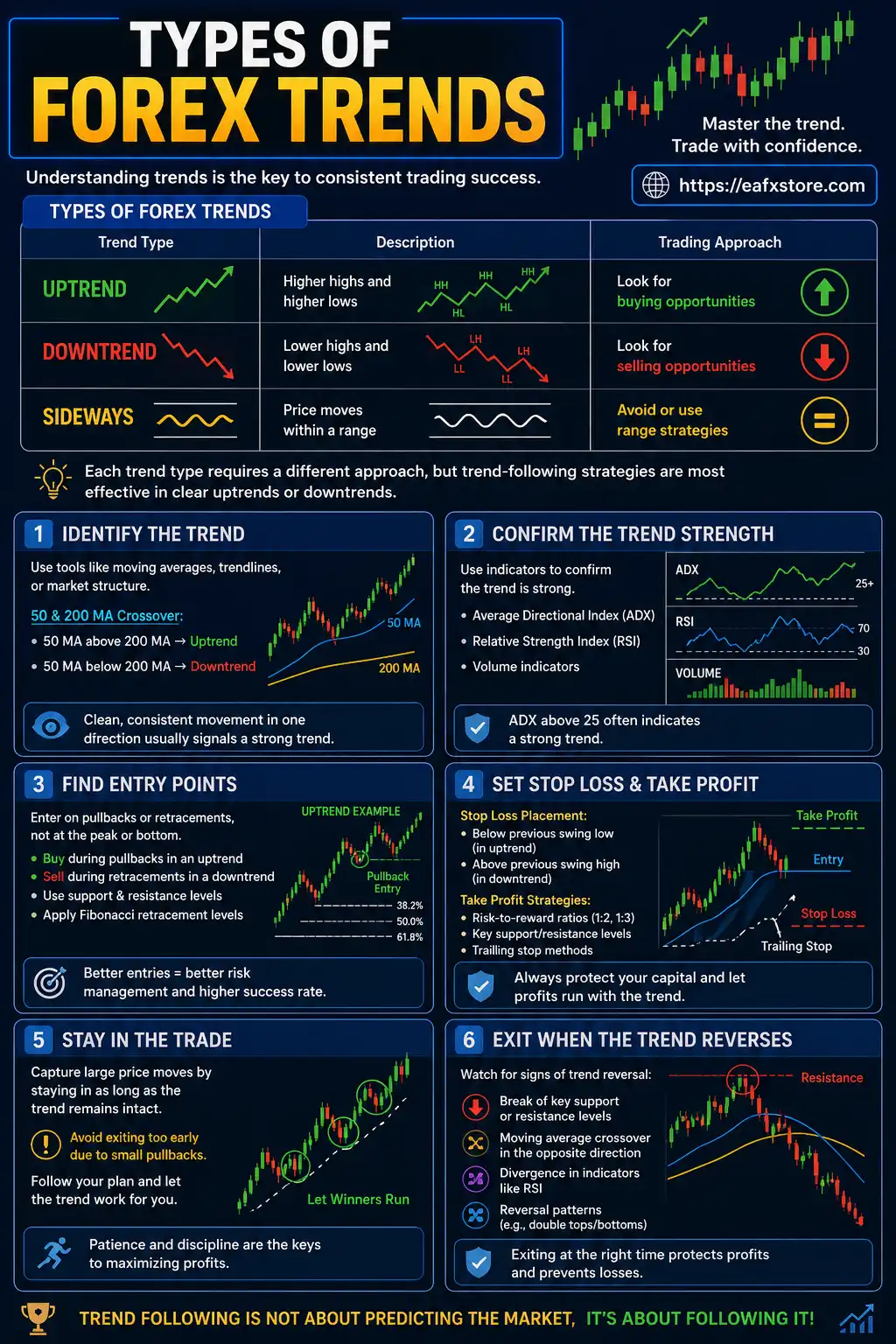
🎯 Step 1: Identify the Trend
The first step in any trend-following strategy is identifying the direction of the market.
Traders often use tools such as moving averages, trendlines, or market structure. For example, if the price is consistently above a moving average and forming higher highs, it indicates an uptrend.
A simple method is the 50-period and 200-period moving average crossover:
- If the 50 MA is above the 200 MA → Uptrend
- If the 50 MA is below the 200 MA → Downtrend
You can also visually inspect price action. Clean, consistent movement in one direction usually signals a strong trend.
🎯 Step 2: Confirm the Trend Strength
Not all trends are strong enough to trade. Weak trends can quickly reverse and lead to losses.
To confirm trend strength, traders use indicators such as:
- Average Directional Index (ADX)
- Relative Strength Index (RSI)
- Volume indicators
For example, an ADX value above 25 often indicates a strong trend. This confirmation step helps filter out false signals and improves trade quality.
🎯 Step 3: Find Entry Points
Once a trend is confirmed, the next step is finding optimal entry points.
Trend-following traders typically avoid entering at the peak or bottom. Instead, they wait for pullbacks or retracements within the trend.
Common entry techniques include:
- Buying during pullbacks in an uptrend
- Selling during retracements in a downtrend
- Using support and resistance levels
- Applying Fibonacci retracement levels
This approach allows traders to enter at better prices and reduces risk.
🎯 Step 4: Set Stop Loss and Take Profit
Risk management is crucial in Forex trading, especially when following trends.
A stop loss protects your capital if the market moves against your position. In trend-following, stop losses are often placed:
- Below the previous swing low (in an uptrend)
- Above the previous swing high (in a downtrend)
Take profit levels can be set using:
- Risk-to-reward ratios (e.g., 1:2 or 1:3)
- Key resistance/support levels
- Trailing stop methods
Trailing stops are particularly useful in trend-following because they allow profits to grow while protecting gains.
🎯 Step 5: Stay in the Trade
One of the biggest advantages of trend-following is the ability to capture large price movements. However, many traders exit too early.
To maximize profits, you should stay in the trade as long as the trend remains intact. Avoid closing positions prematurely due to small pullbacks.
Instead, follow your trading plan and rely on indicators or price structure to determine when the trend is weakening.
🎯 Step 6: Exit When the Trend Reverses
Every trend eventually ends. Knowing when to exit is just as important as knowing when to enter.
Signs of a trend reversal include:
- Break of key support or resistance levels.
- Moving average crossover in the opposite direction.
- Divergence in indicators like RSI.
- Formation of reversal patterns (e.g., double tops/bottoms).
Exiting at the right time helps protect profits and prevents losses from trend reversals.
Common Trend-Following Indicators
Here are some of the most widely used indicators in trend-following strategies:
| Indicator | Purpose | Best Use Case |
|---|---|---|
| Moving Averages | Identify trend direction | Beginners |
| MACD | Trend and momentum confirmation | Medium-term trades |
| ADX | Measure trend strength | Filtering trades |
| RSI | Detect overbought/oversold | Entry timing |
Each indicator has its strengths, and combining them can improve accuracy.
Advantages of Trend-Following Strategies
Trend-following offers several benefits for Forex traders:
- Simple and easy to understand.
- Works well in strong markets.
- Reduces emotional decision-making.
- Potential for large profits.
Because of its simplicity, it is often recommended for beginners who are just starting in Forex trading.

Common Mistakes to Avoid
While trend-following is effective, many traders make avoidable mistakes:
- Entering too late after the trend has already moved significantly.
- Ignoring risk management.
- Trading in sideways markets.
- Over-relying on indicators without understanding price action.
Avoiding these mistakes can significantly improve your results.
Tips for Successful Trend Trading
To improve your trend-following strategy, consider these tips:
- Always trade with the higher timeframe trend.
- Use multiple confirmations before entering a trade.
- Keep a trading journal to track performance.
- Practice on a demo account before trading live.
- Stay disciplined and follow your plan.
Consistency and discipline are key to long-term success in Forex trading.
Conclusion
Trend-following strategies provide a structured and effective way to trade the Forex market. By identifying trends, confirming their strength, and managing risk properly, traders can increase their chances of success.
The key is not to predict the market but to follow it. With practice, patience, and proper risk management, trend-following can become a powerful tool in your trading arsenal.