


Forex trading can feel overwhelming for beginners, especially with the constant price fluctuations and complex charts. However, one of the most accessible and effective approaches for new traders is trend-following. Instead of trying to predict market reversals, trend-following strategies focus on identifying and riding established market directions.
In this guide, you’ll learn the most practical trend-following strategies, how they work, and how to apply them effectively in your trading journey.
What Is Trend-Following in Forex?
Trend-following is a trading approach where traders identify the general direction of the market—uptrend, downtrend, or sideways—and make trades aligned with that direction. The core idea is simple: “The trend is your friend.”
In an uptrend, traders look for buying opportunities, while in a downtrend, they focus on selling. This method reduces the need for constant prediction and allows beginners to trade with the market rather than against it.

Why Trend-Following Works for Beginners
Trend-following strategies are particularly suitable for beginners because they rely on clear signals and structured rules rather than intuition. Instead of reacting emotionally to market noise, traders follow predefined indicators and patterns.
Another advantage is that trends often persist longer than expected. By entering early and staying disciplined, traders can capture significant price movements without overtrading.
Moving Average Strategy
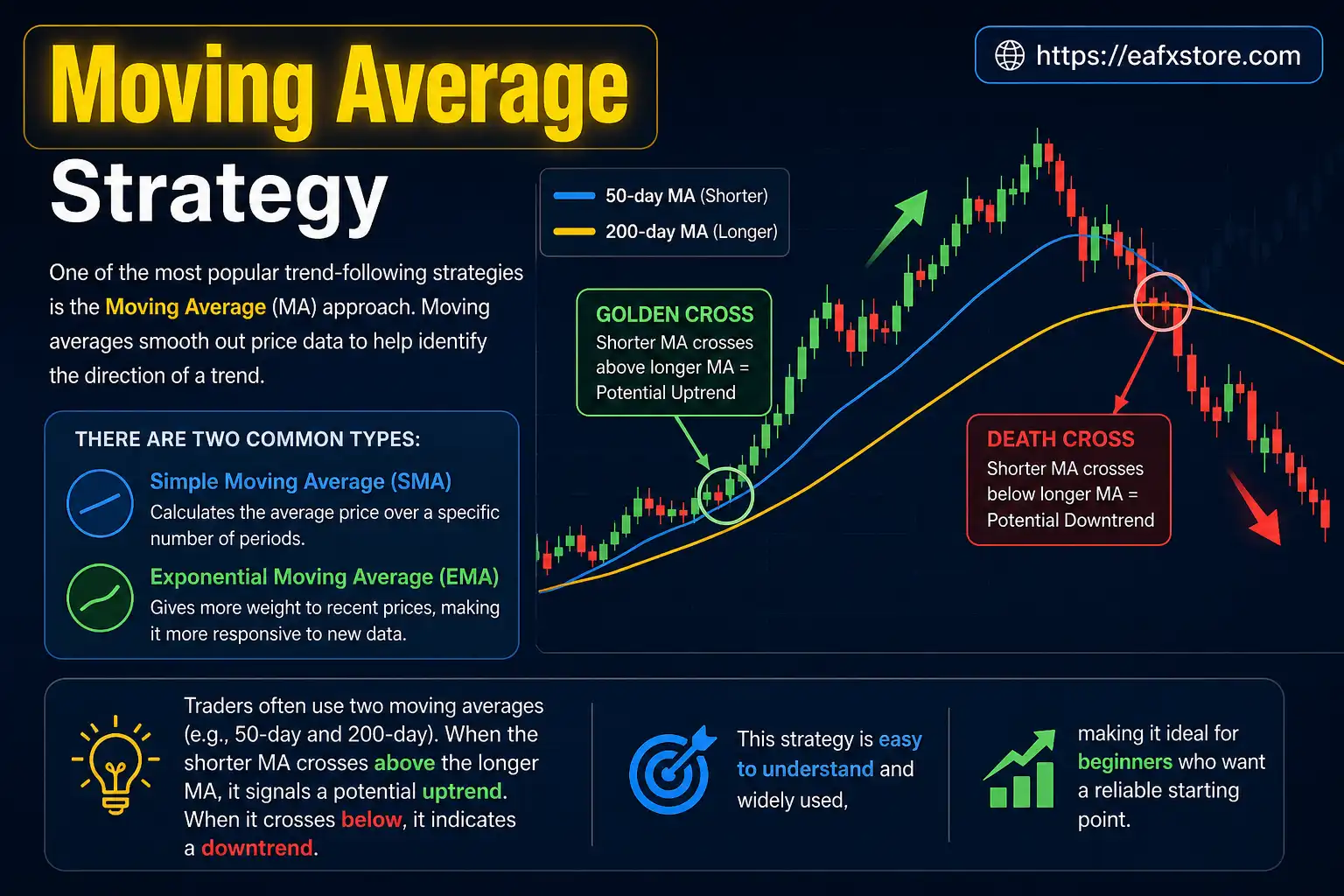
One of the most popular trend-following strategies is the Moving Average (MA) approach. Moving averages smooth out price data to help identify the direction of a trend.
There are two common types:
- Simple Moving Average (SMA)
- Exponential Moving Average (EMA)
Traders often use two moving averages (e.g., 50-day and 200-day). When the shorter MA crosses above the longer MA, it signals a potential uptrend. When it crosses below, it indicates a downtrend.
This strategy is easy to understand and widely used, making it ideal for beginners who want a reliable starting point.
Trendline Trading Strategy
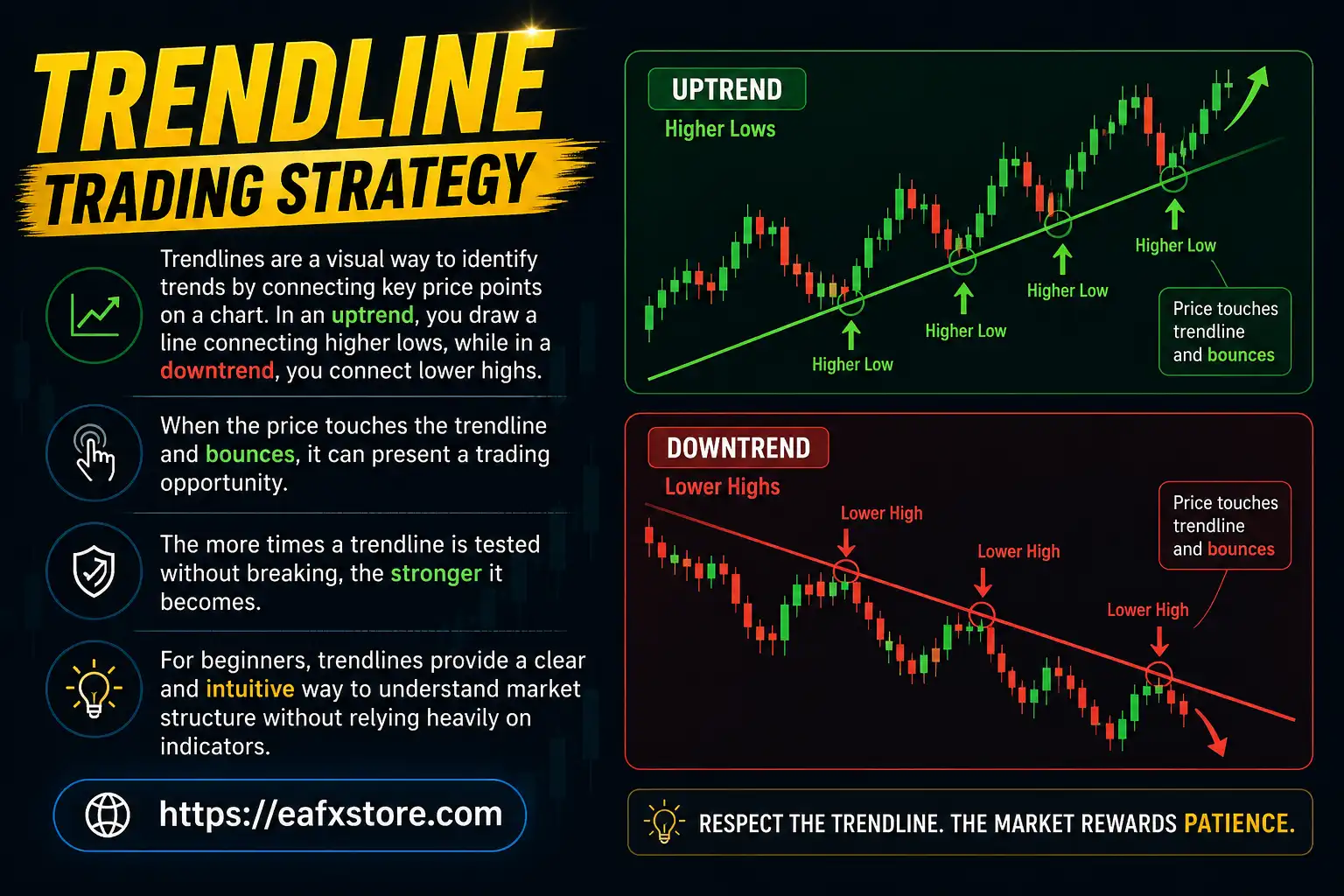
Trendlines are a visual way to identify trends by connecting key price points on a chart. In an uptrend, you draw a line connecting higher lows, while in a downtrend, you connect lower highs.
When the price touches the trendline and bounces, it can present a trading opportunity. The more times a trendline is tested without breaking, the stronger it becomes.
For beginners, trendlines provide a clear and intuitive way to understand market structure without relying heavily on indicators.
Breakout Strategy
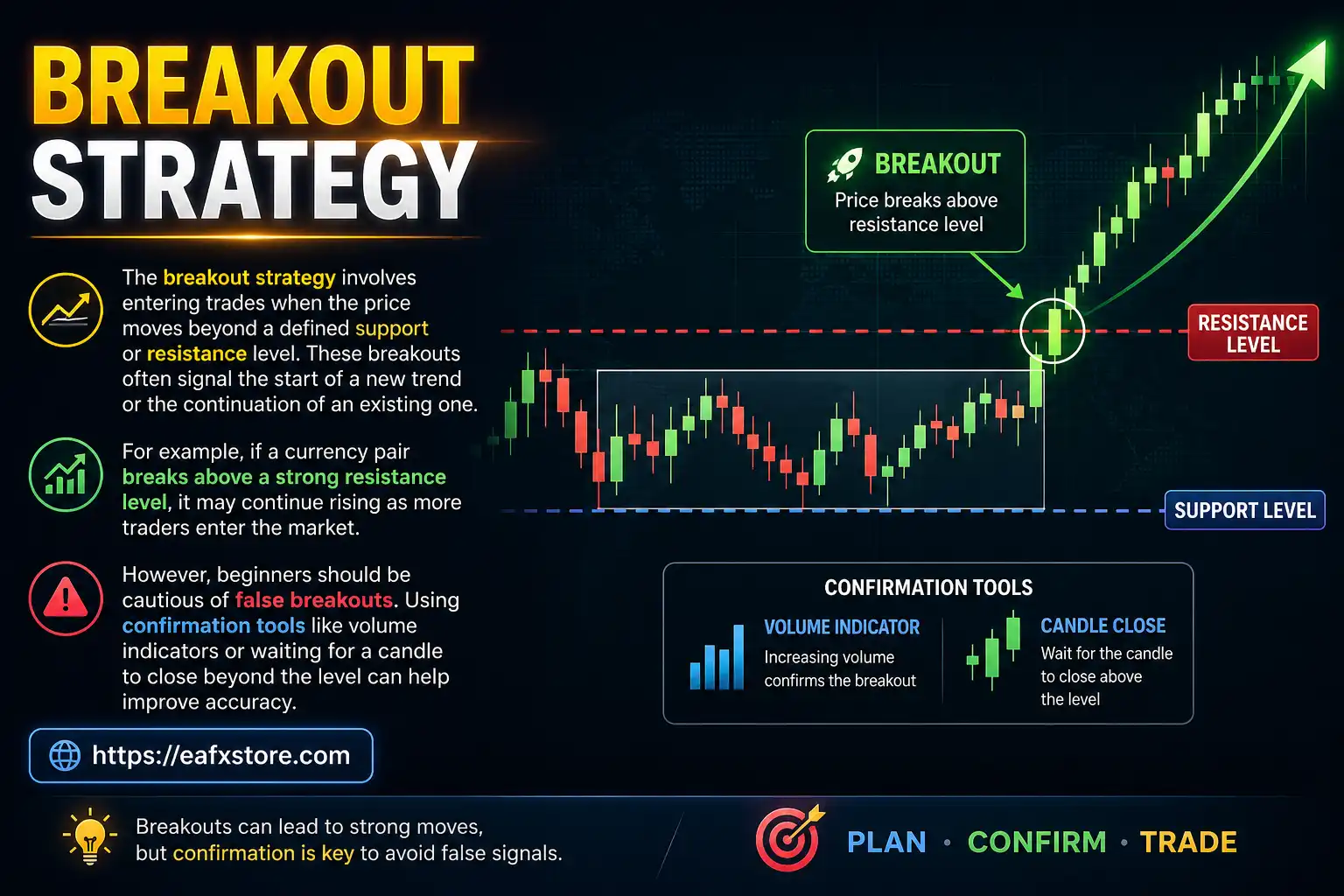
The breakout strategy involves entering trades when the price moves beyond a defined support or resistance level. These breakouts often signal the start of a new trend or the continuation of an existing one.
For example, if a currency pair breaks above a strong resistance level, it may continue rising as more traders enter the market.
However, beginners should be cautious of false breakouts. Using confirmation tools like volume indicators or waiting for a candle to close beyond the level can help improve accuracy.
MACD Trend Strategy
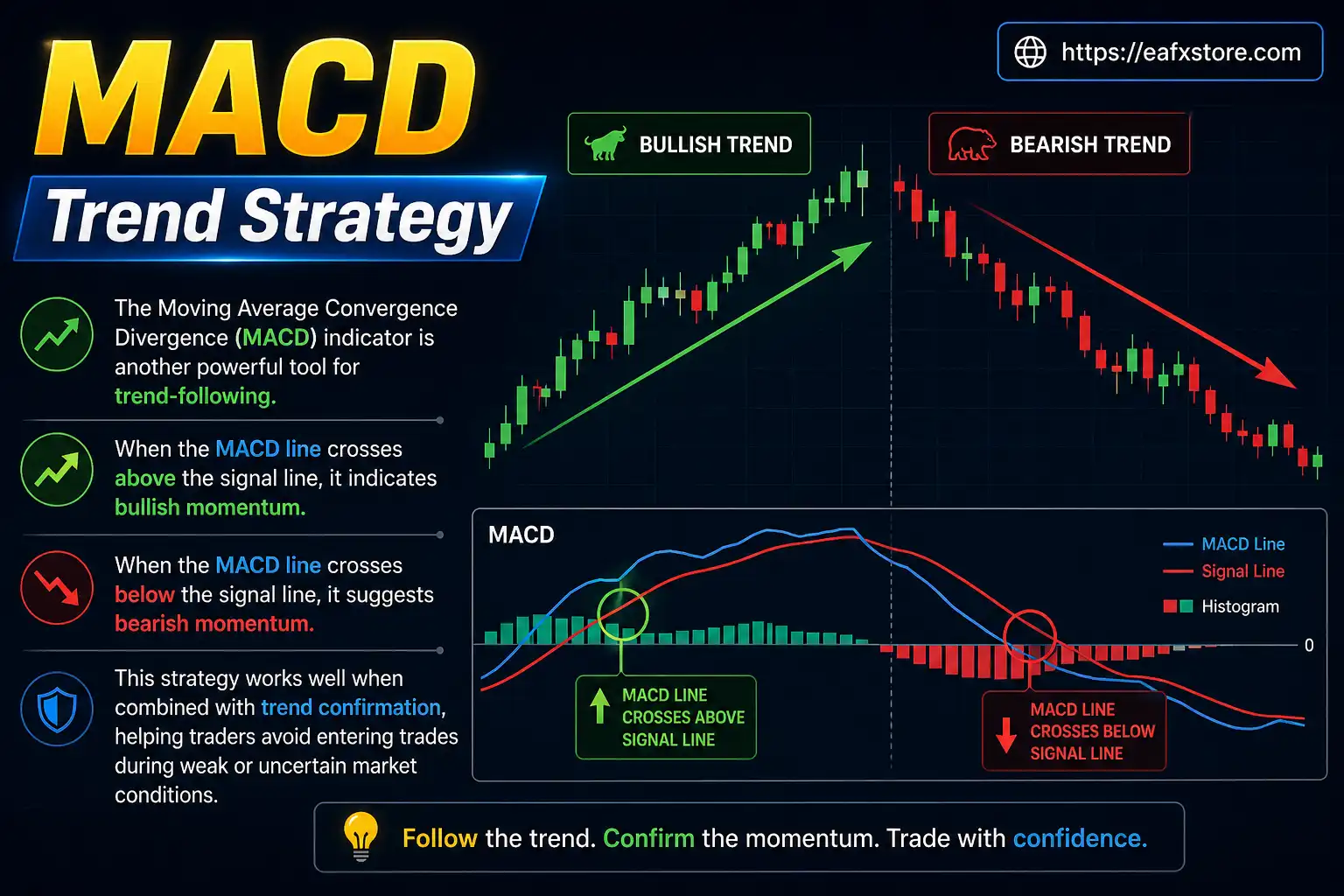
The Moving Average Convergence Divergence (MACD) indicator is another powerful tool for trend-following. It shows the relationship between two moving averages and helps identify momentum.
When the MACD line crosses above the signal line, it indicates bullish momentum. When it crosses below, it suggests bearish momentum.
This strategy works well when combined with trend confirmation, helping traders avoid entering trades during weak or uncertain market conditions.
RSI Trend Confirmation Strategy
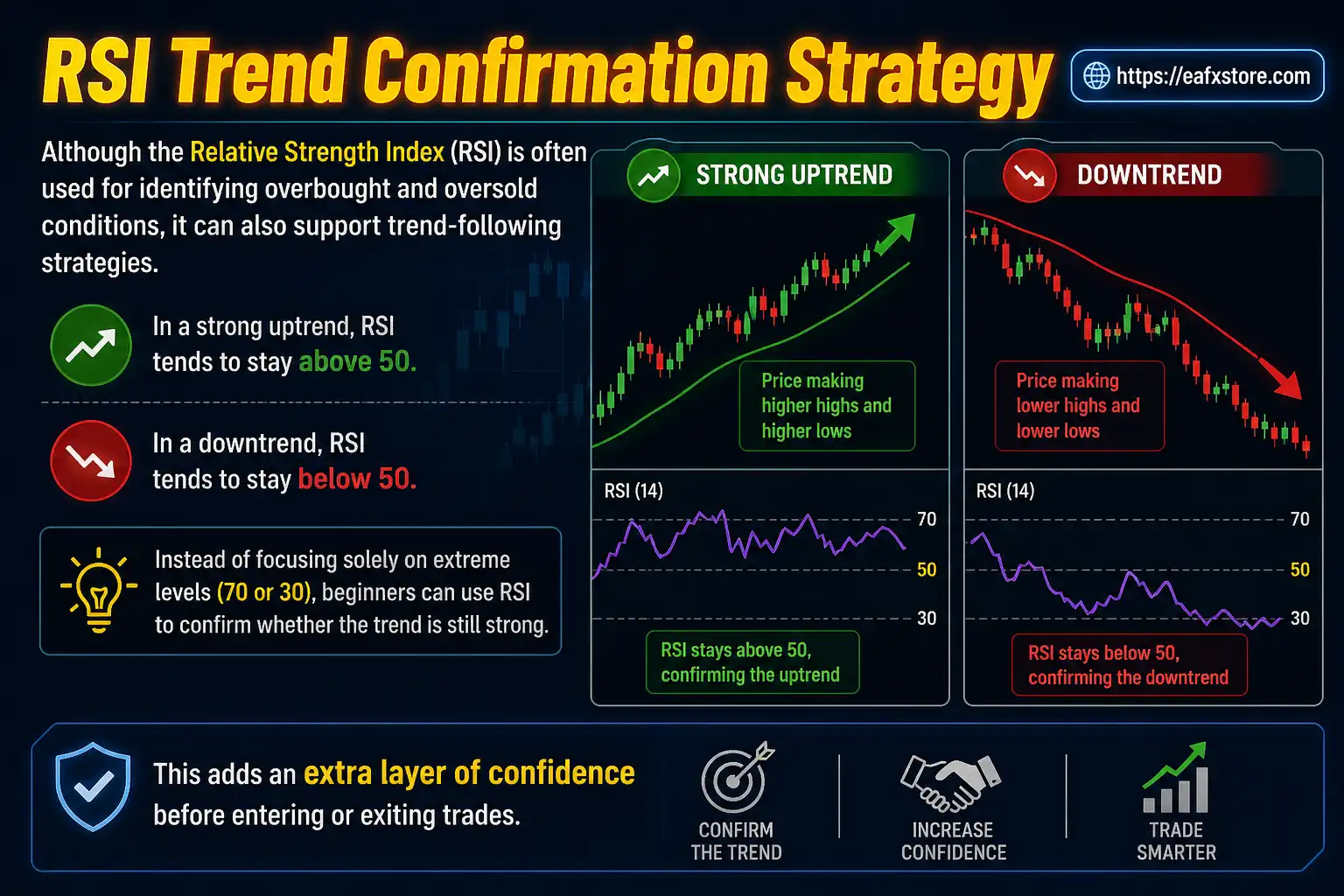
Although the Relative Strength Index (RSI) is often used for identifying overbought and oversold conditions, it can also support trend-following strategies.
In a strong uptrend, RSI tends to stay above 50, while in a downtrend, it remains below 50. Instead of focusing solely on extreme levels (70 or 30), beginners can use RSI to confirm whether the trend is still strong.
This adds an extra layer of confidence before entering or exiting trades.
Comparison of Trend-Following Strategies
Below is a simple comparison of the most common strategies for beginners:
| Strategy | Difficulty Level | Best For | Key Advantage |
|---|---|---|---|
| Moving Averages | Easy | Identifying trend direction | Simple and widely used |
| Trendlines | Easy | Visual traders | Clear price structure |
| Breakout Strategy | Medium | Volatile markets | Captures strong movements |
| MACD | Medium | Momentum trading | Combines trend + momentum |
| RSI Confirmation | Easy | Trend validation | Reduces false signals |
Risk Management in Trend Trading
Even the best strategy can fail without proper risk management. Beginners should never risk more than a small percentage of their trading capital on a single trade—typically 1–2%.
Using stop-loss orders is essential. In trend-following, stop-losses are often placed below support levels in an uptrend or above resistance in a downtrend.
Additionally, traders should avoid over-leveraging, as it can amplify losses just as quickly as profits.
Common Mistakes to Avoid
Many beginners struggle not because of poor strategies, but due to common mistakes:
- Chasing the trend too late: Entering after a big move increases risk.
- Ignoring confirmations: Relying on a single indicator can lead to false signals.
- Overtrading: Taking too many trades reduces overall profitability.
- Emotional decisions: Fear and greed often lead to poor timing.
By staying disciplined and following a structured approach, traders can significantly improve their results.
Tips to Improve Your Trend-Following Skills
To become more effective in trend trading, beginners should focus on continuous learning and practice. Using demo accounts allows traders to test strategies without financial risk.
Keeping a trading journal is also helpful. By recording trades and analyzing outcomes, traders can identify patterns and improve decision-making over time.
Finally, patience is key. Not every market condition is suitable for trend-following, so waiting for clear setups is often the best strategy.
Conclusion
Trend-following is one of the most beginner-friendly approaches in Forex trading. By focusing on the direction of the market rather than predicting reversals, traders can simplify their decision-making process and increase their chances of success.
Strategies like moving averages, trendlines, breakouts, MACD, and RSI provide a solid foundation for identifying and trading trends. When combined with proper risk management and discipline, these methods can help beginners build confidence and consistency in the Forex market.