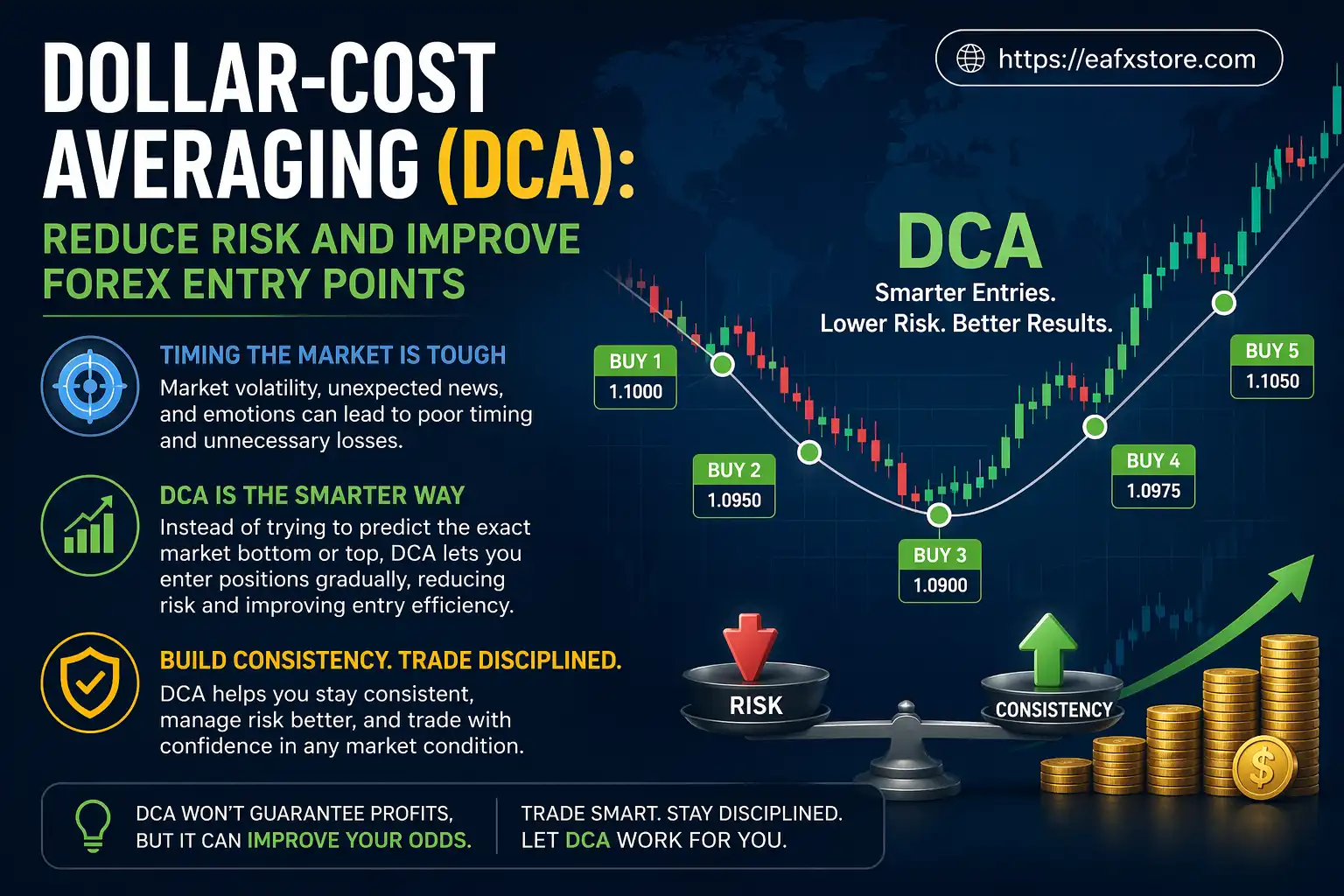
The foreign exchange (Forex) market is notorious for its volatility. For many traders, the pressure of “timing the market” perfectly—buying at the absolute bottom and selling at the peak—is a primary source of stress and, frequently, financial loss. Even the most seasoned professionals struggle to predict short-term price fluctuations with 100% accuracy. This is where […]
The foreign exchange (Forex) market is notorious for its volatility. For many traders, the pressure of “timing the market” perfectly—buying at the absolute bottom and selling at the peak—is a primary source of stress and, frequently, financial loss. Even the most seasoned professionals struggle to predict short-term price fluctuations with 100% accuracy.
This is where Dollar-Cost Averaging (DCA) comes into play. While traditionally associated with long-term stock investing, DCA is an incredibly powerful tool for Forex traders looking to stabilize their equity curves, reduce psychological pressure and improve their average entry price over time.
What is Dollar-Cost Averaging (DCA)?
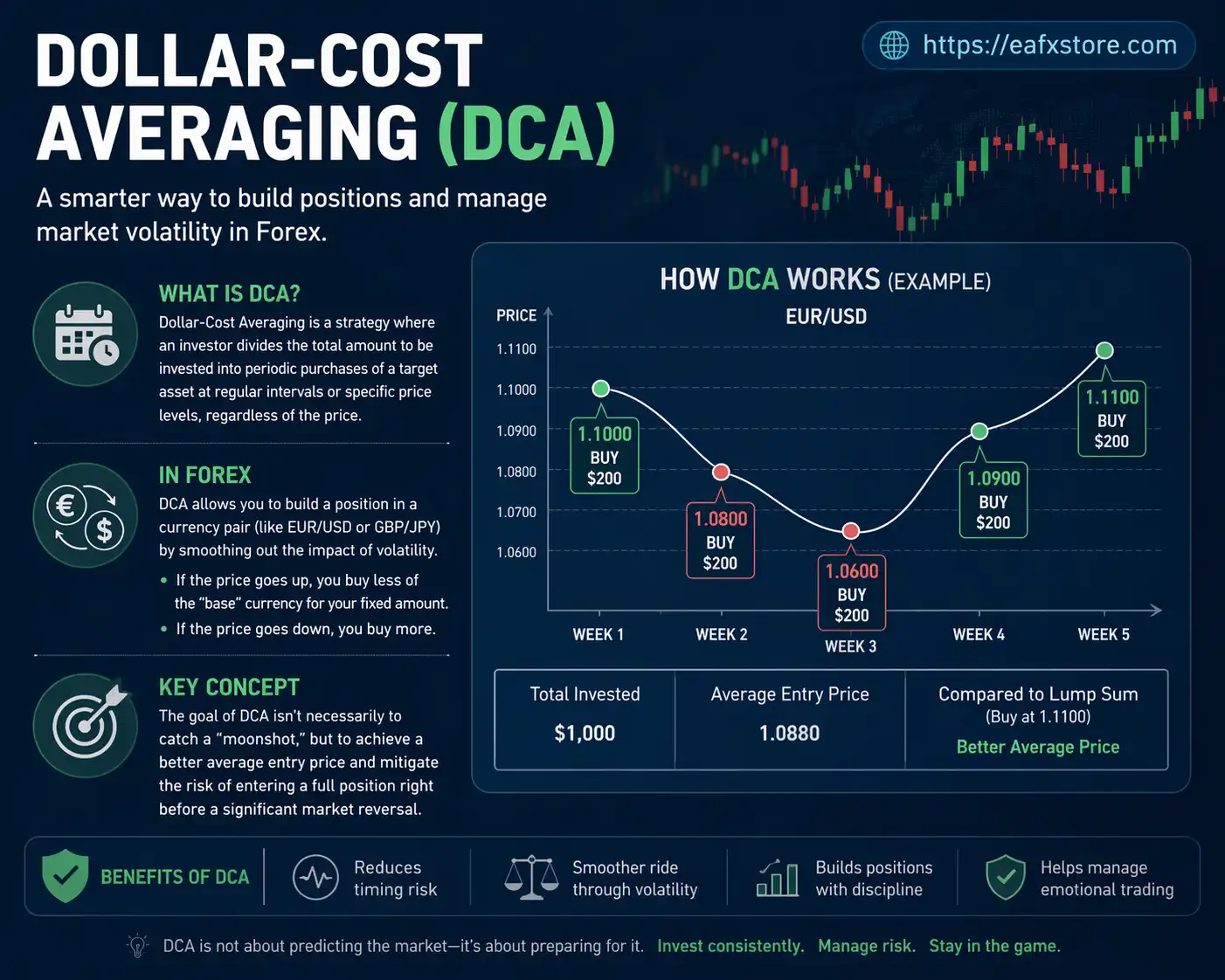
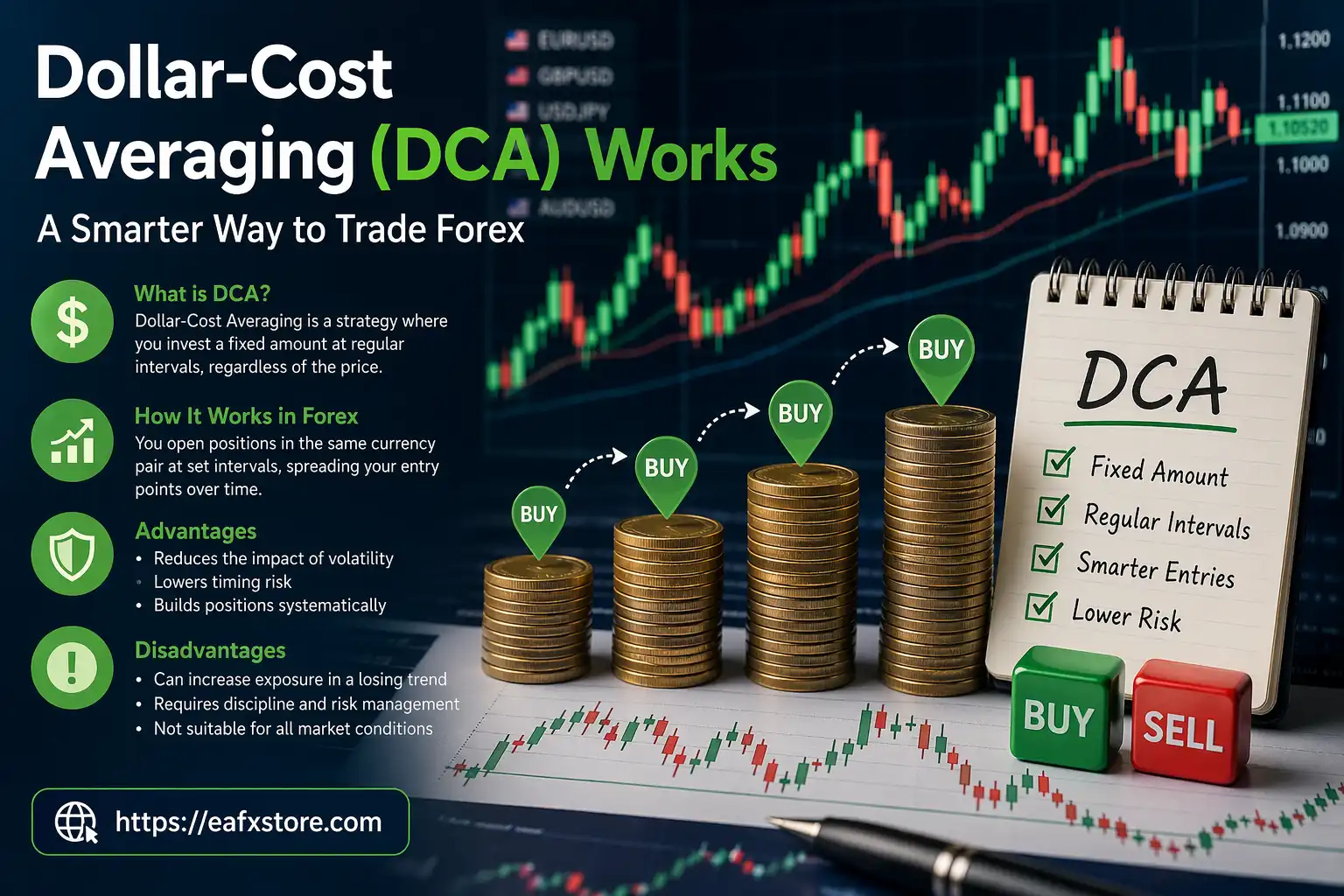
At its core, Dollar-Cost Averaging is a strategy where an investor divides the total amount to be invested into periodic purchases of a target asset. Instead of entering a trade with one large “lump sum” position, you enter smaller positions at regular intervals or specific price levels, regardless of the price.
In the context of Forex, DCA allows you to build a position in a currency pair (like EUR/USD or GBP/JPY) by smoothing out the impact of volatility. If the price goes up, you buy less of the “base” currency for your fixed amount; if the price goes down, you buy more.
Key Concept: The goal of DCA isn’t necessarily to catch a “moonshot,” but to achieve a better average entry price and mitigate the risk of entering a full position right before a significant market reversal.
DCA Strategies
Why Use DCA in the Forex Market?
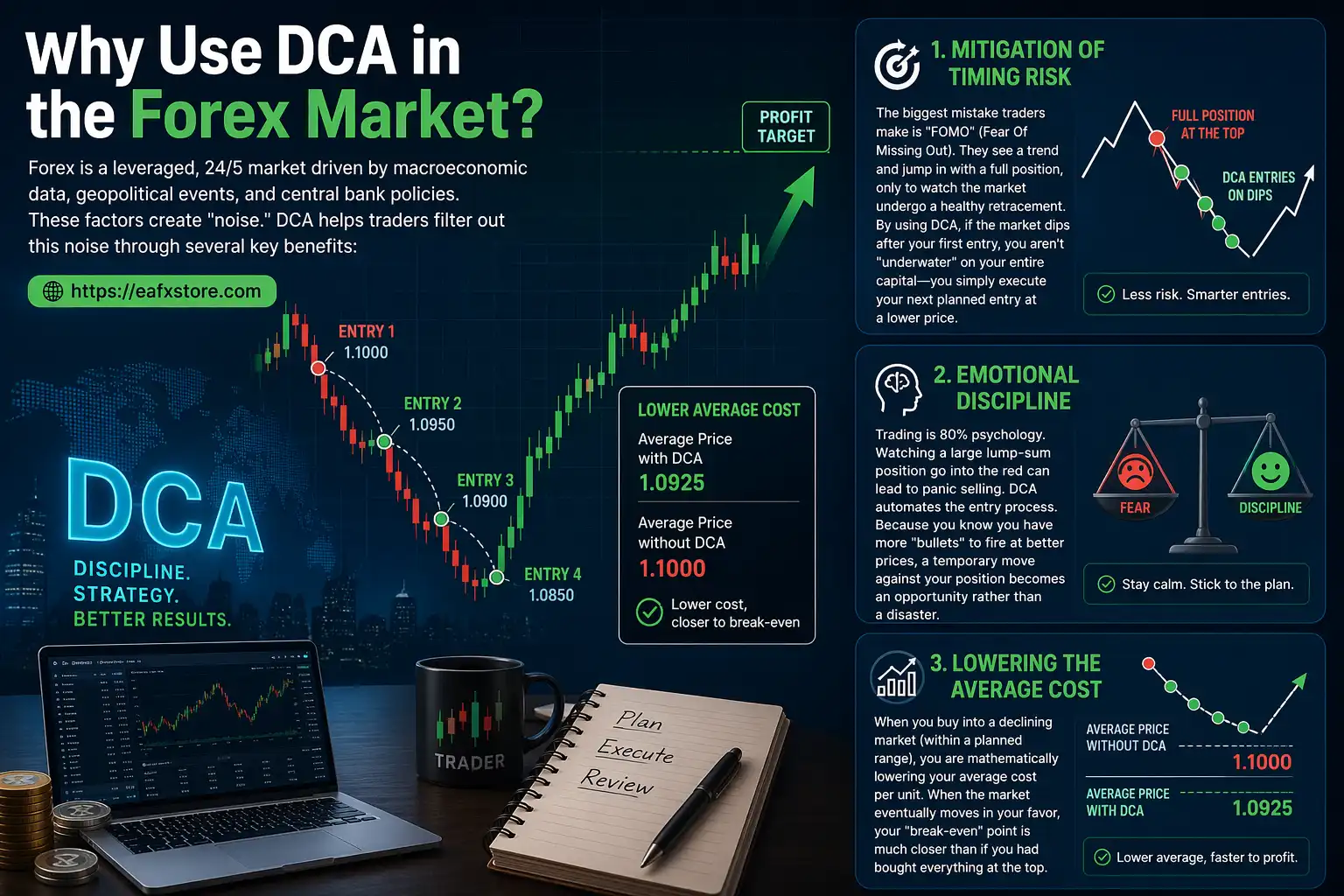
Forex is a leveraged, 24/5 market driven by macroeconomic data, geopolitical events, and central bank policies. These factors create “noise.” DCA helps traders filter out this noise through several key benefits:
Mitigation of Timing Risk
The biggest mistake traders make is “FOMO” (Fear Of Missing Out). They see a trend and jump in with a full position, only to watch the market undergo a healthy retracement. By using DCA, if the market dips after your first entry, you aren’t “underwater” on your entire capital—you simply execute your next planned entry at a lower price.
Emotional Discipline
Trading is 80% psychology. Watching a large lump-sum position go into the red can lead to panic selling. DCA automates the entry process. Because you know you have more “bullets” to fire at better prices, a temporary move against your position becomes an opportunity rather than a disaster.
Lowering the Average Cost
When you buy into a declining market (within a planned range), you are mathematically lowering your average cost per unit. When the market eventually moves in your favor, your “break-even” point is much closer than if you had bought everything at the top.
DCA in the Forex Market
How to Implement DCA Strategies in Forex
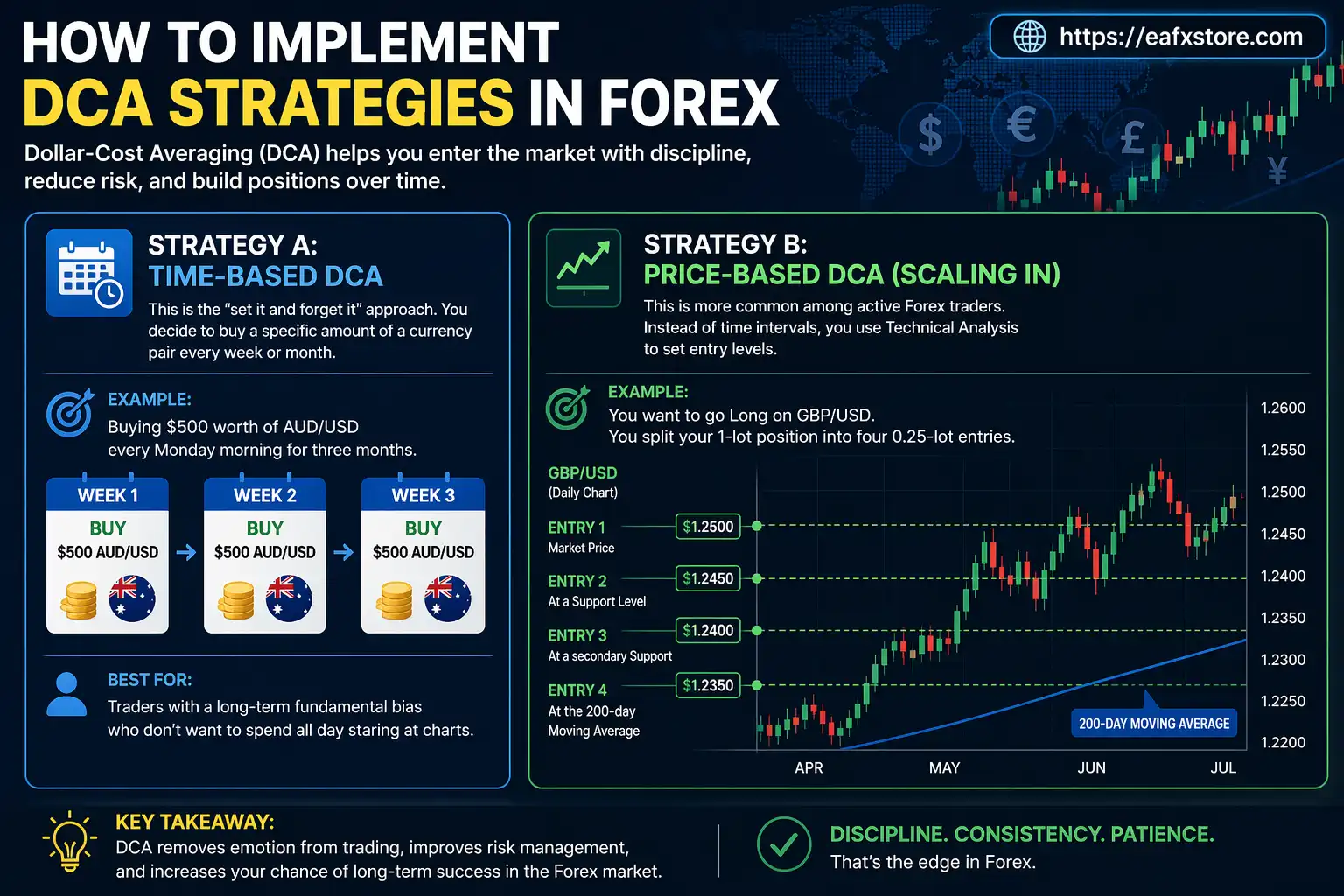
There are two primary ways to approach DCA in Forex: Time-Based DCA and Price-Based DCA (Scaling In).
Strategy A: Time-Based DCA
This is the “set it and forget it” approach. You decide to buy a specific amount of a currency pair every week or month.
Example: Buying $500 worth of AUD/USD every Monday morning for three months.
Best for: Traders with a long-term fundamental bias who don’t want to spend all day staring at charts.
Strategy B: Price-Based DCA (Scaling In)
This is more common among active Forex traders. Instead of time intervals, you use Technical Analysis to set entry levels.
Example: You want to go Long on GBP/USD. You split your 1-lot position into four 0.25-lot entries.
Entry 1: Market Price ($1.2500$)
Entry 2: At a Support Level ($1.2450$)
Entry 3: At a secondary Support ($1.2400$)
Entry 4: At the 200-day Moving Average ($1.2350$)
DCA Strategies in Forex
Mathematical Advantage: An Example
Let’s look at a hypothetical scenario where the USD/JPY is in a corrective phase, but your long-term outlook is bullish.
Scenario 1: Lump Sum Entry
You invest $10,000 at a price of 150.00.
Your average price: 150.00.
Scenario 2: DCA Entry (4 Tranches)
Buy $2,500 at 150.00
Buy $2,500 at 148.00
Buy $2,500 at 146.00
Buy $2,500 at 144.00
In Scenario 2, your total investment is still $10,000, but your average entry price is now 147.00. If the market recovers to 149.00, the Lump Sum trader is still at a loss, while the DCA trader is already in a significant profit.
The Risks of DCA: What to Avoid
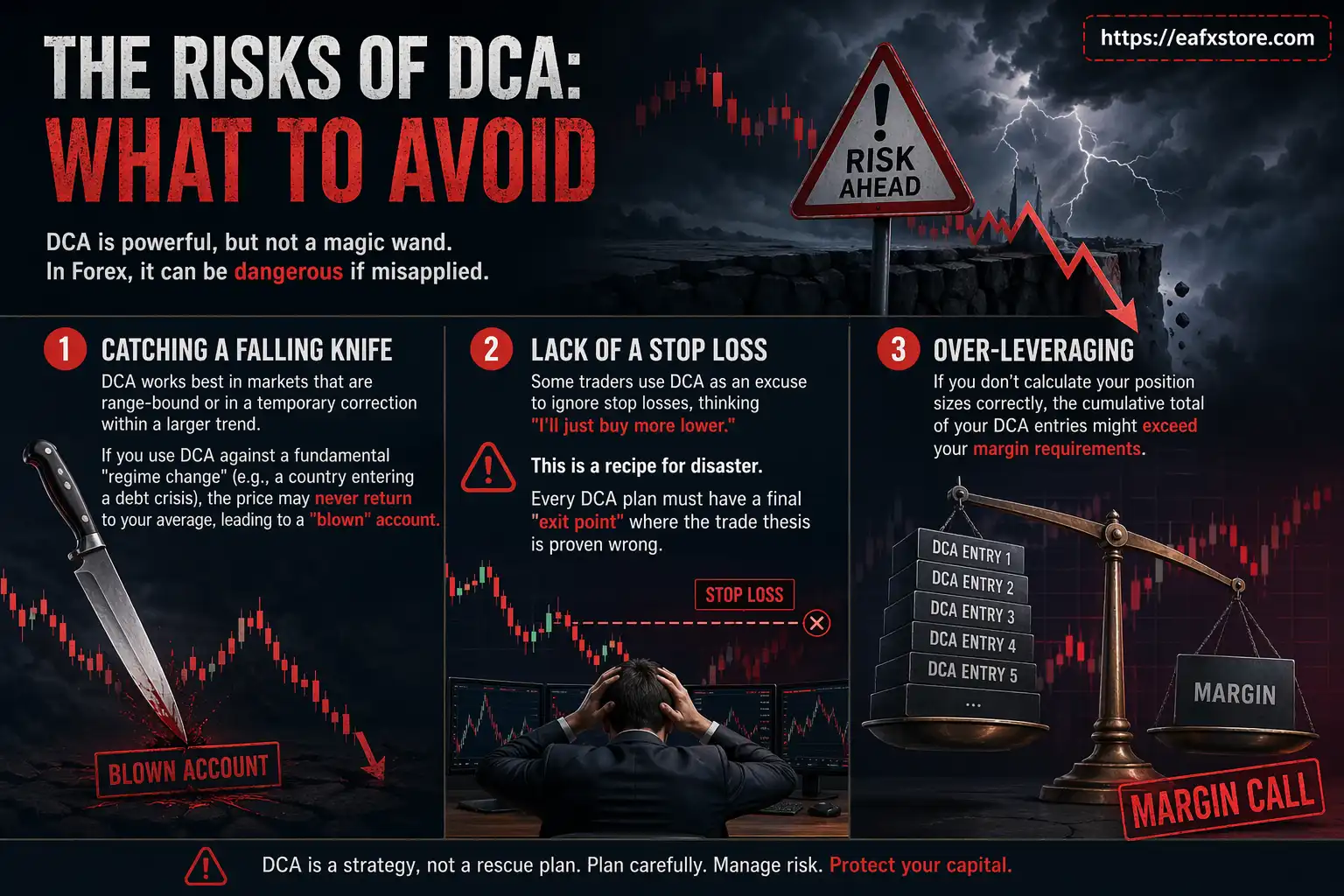
While DCA is powerful, it is not a magic wand. In Forex, it can be dangerous if misapplied.
Catching a Falling Knife: DCA works best in markets that are range-bound or in a temporary correction within a larger trend. If you use DCA against a fundamental “regime change” (e.g., a country entering a debt crisis), the price may never return to your average, leading to a “blown” account.
Lack of a Stop Loss (SL): Some traders use DCA as an excuse to ignore stop losses, thinking “I’ll just buy more lower.” This is a recipe for disaster. Every DCA plan must have a final “exit point” where the trade thesis is proven wrong.
Over-Leveraging: If you don’t calculate your position sizes correctly, the cumulative total of your DCA entries might exceed your margin requirements.
Risks of DCA
Step-by-Step Guide to Building your DCA Plan
Identify the Trend: Use Weekly or Daily charts to find the “Big Picture” direction.
Define the Zone: Use Fibonacci retracements or Support/Resistance to find a “Value Zone” where you expect the price to stabilize.
Divide Capital: Split your total intended risk into 3 to 5 installments.
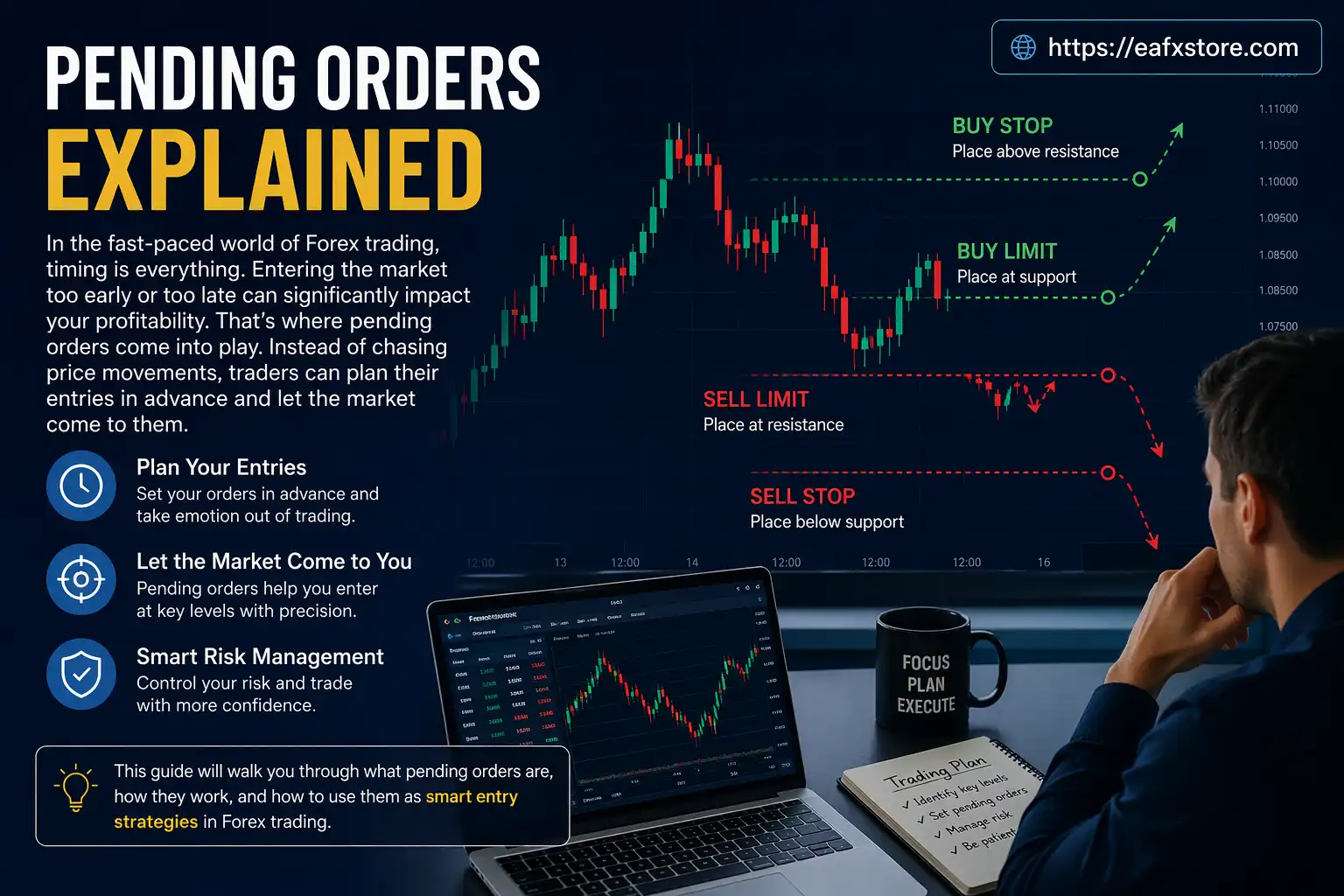
Execute Dispassionately: Place limit orders at your predefined levels.
Set the “Uncle Point”: Place a hard Stop Loss below the final support level where the bullish/bearish thesis is no longer valid.
Conclusion
Dollar-Cost Averaging (DCA) turns market volatility from a foe into a friend. By removing the need for “perfect” timing, it allows Forex traders to build positions with lower average costs and significantly less emotional stress.
Remember, the goal of trading isn’t to be “right” about a single candle; it’s to be profitable over a series of trades. DCA is the ultimate tool for achieving that consistency. Start small, plan your entries and let the math do the heavy lifting.
FAQ
Is DCA better than Lump Sum?
A: In volatile markets like Forex, DCA usually provides a better risk-adjusted return and better psychological stability, though Lump Sum can outperform in a very strong, immediate breakout.
Can I use DCA for Day Trading?
A: Yes, but on a smaller scale. You can scale into a position over several hours using M15 or H1 support levels rather than days or weeks.
What happens if the market never hits my second or third DCA levels?
A: You simply trade with a smaller position. It is better to make a smaller profit on a winning trade than to force a large position at a bad price.