

Forex trading is often associated with fast-paced decisions, high volatility and the constant pressure to time the market correctly. For many traders—especially beginners—this can be overwhelming. That’s where Dollar-Cost Averaging (DCA) comes in. Originally popular in long-term investing, DCA has found its place in forex trading as a strategy to manage risk and smooth out market entry.
In this article, you’ll learn what Dollar-Cost Averaging is, how it works in forex trading, its advantages and disadvantages, and how to apply it effectively.
What Is Dollar-Cost Averaging (DCA)?
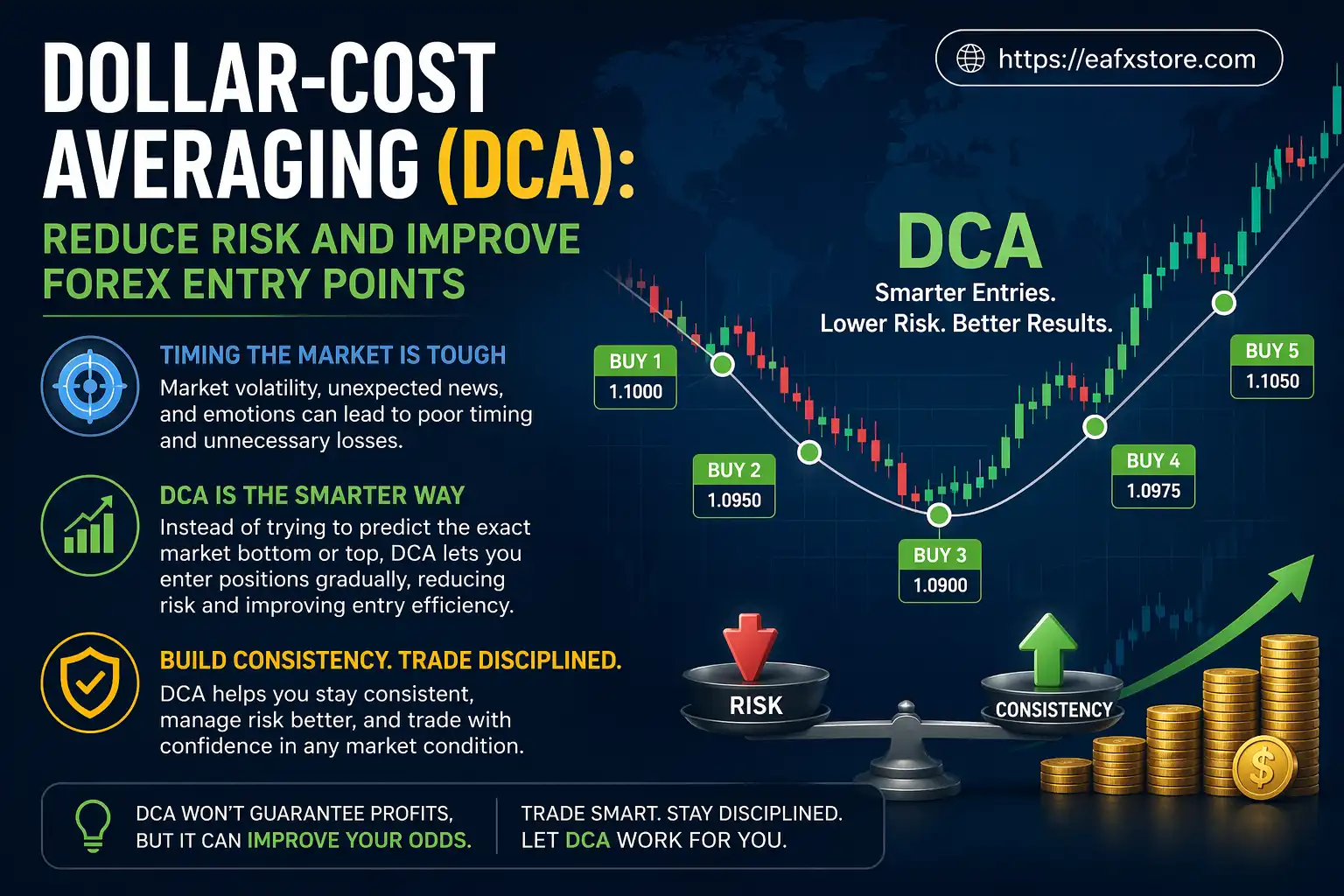
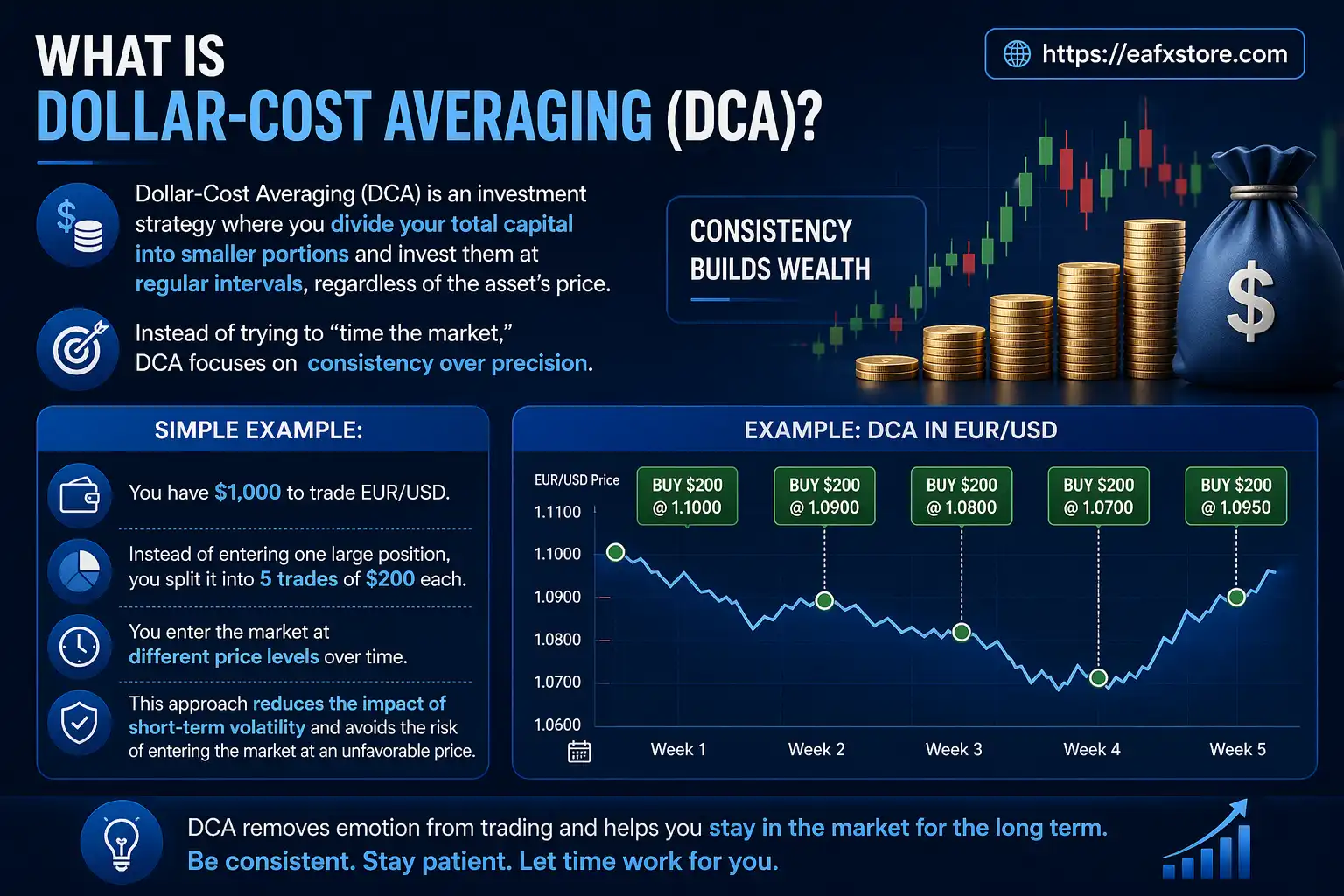
Dollar-Cost Averaging (DCA) is an investment strategy where you divide your total capital into smaller portions and invest them at regular intervals, regardless of the asset’s price.
Instead of trying to “time the market,” DCA focuses on consistency over precision.
Simple Example:
- You have $1,000 to trade EUR/USD.
- Instead of entering one large position, you split it into 5 trades of $200 each.
- You enter the market at different price levels over time.
This approach reduces the impact of short-term volatility and avoids the risk of entering the market at an unfavorable price.
How DCA Works in Forex Trading
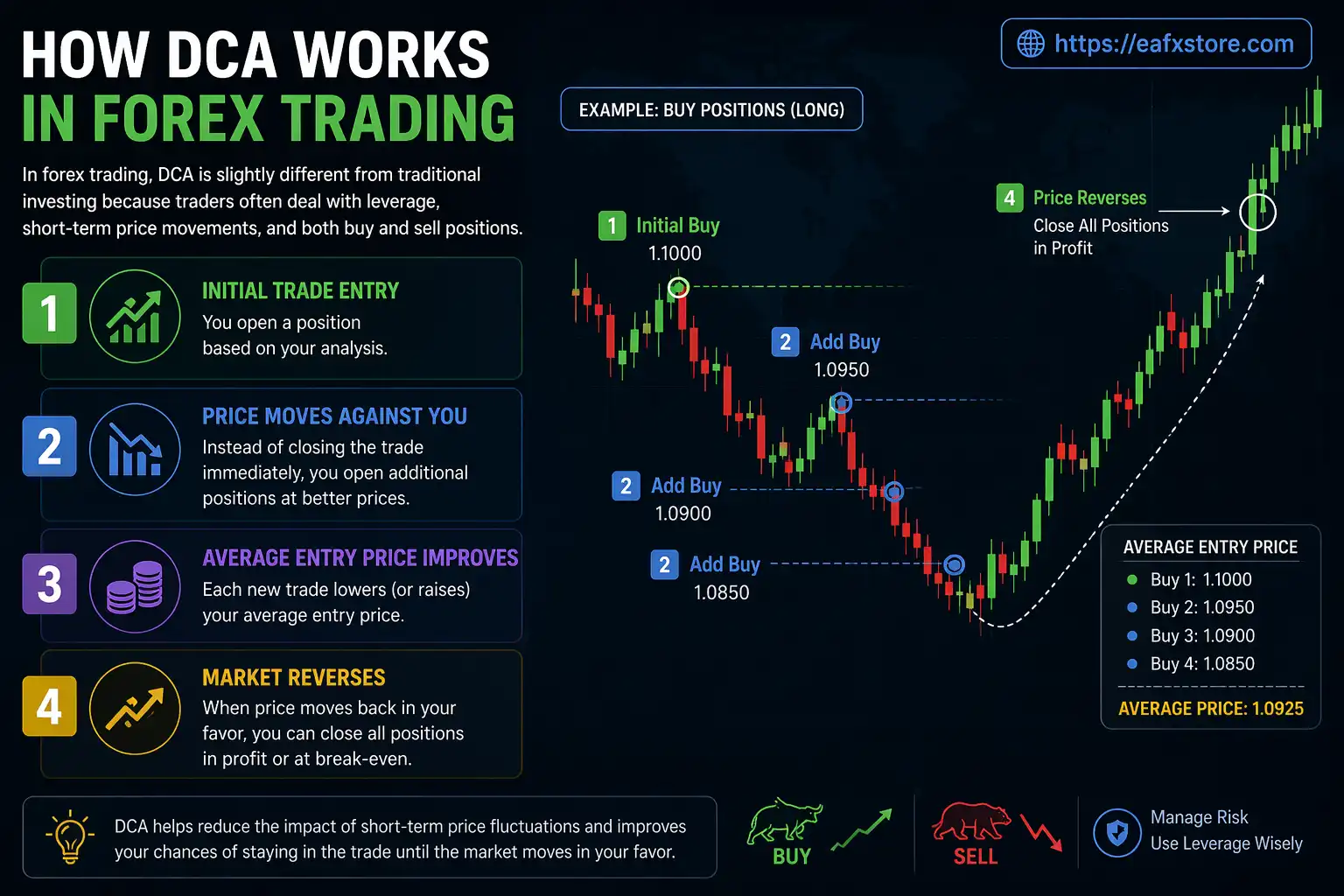
In forex trading, DCA is slightly different from traditional investing because traders often deal with leverage, short-term price movements, and both buy and sell positions.
Core Mechanism:
- Initial Trade Entry: You open a position based on your analysis.
- Price Moves Against You: Instead of closing the trade immediately, you open additional positions at better prices.
- Average Entry Price Improves: Each new trade lowers (or raises) your average entry price.
- Market Reverses: When price moves back in your favor, you can close all positions in profit or at break-even.
Example of DCA in Forex
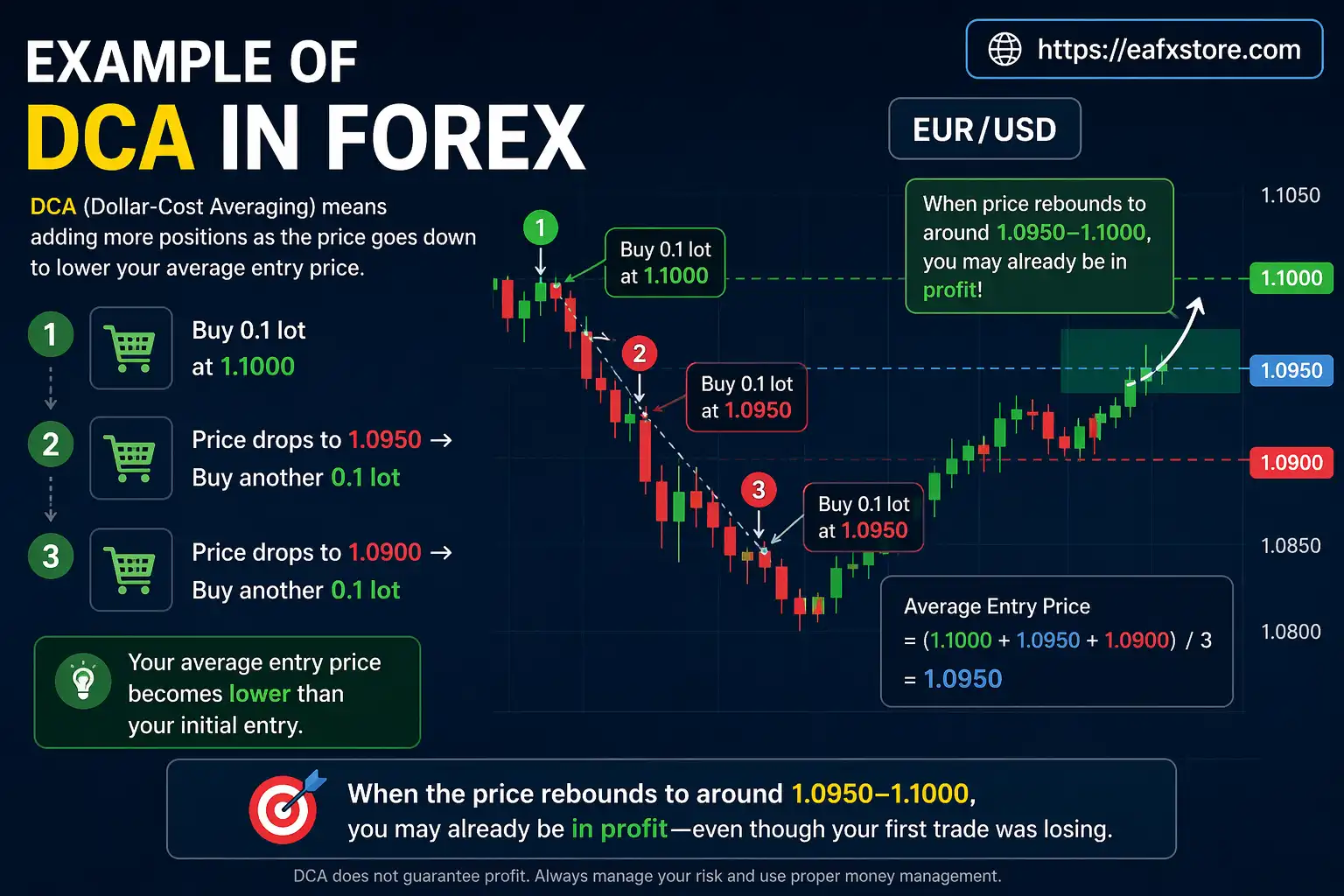
Let’s say you believe EUR/USD will go up:
- Buy 0.1 lot at 1.1000
- Price drops to 1.0950 → Buy another 0.1 lot
- Price drops to 1.0900 → Buy another 0.1 lot
Your average entry price becomes lower than your initial entry.
When the price rebounds to around 1.0950–1.1000, you may already be in profit—even though your first trade was losing.
Why Traders Use DCA in Forex
- Reduces Timing Pressure: Trying to enter at the “perfect” price is nearly impossible. DCA removes that burden by spreading entries over time.
- Smooths Volatility Impact: Forex markets are highly volatile. DCA helps absorb price fluctuations by averaging positions.
- Improves Entry Price: When used correctly, DCA can significantly improve your overall entry level.
- Psychological Benefits: It reduces emotional stress because you’re not relying on a single entry point.
Advantages of Dollar-Cost Averaging in Forex
- Risk Distribution: Instead of risking your entire capital at once, you spread it across multiple trades.
- Flexibility: You can adjust your position size and entry points based on market conditions.
- Better Recovery Potential: Even if the market moves against you initially, DCA allows you to recover faster when price reverses.
- Suitable for Trending Markets: DCA works well when markets experience temporary pullbacks within a broader trend.

Disadvantages of DCA in Forex
DCA is not a magic solution. In fact, if used incorrectly, it can be risky.
- Can Increase Losses: If the market continues moving against your position without reversal, losses can compound quickly.
- Requires Strong Risk Management: Without proper planning, DCA can lead to overexposure and margin calls.
- Not Ideal for Strong Trends Against You: If you’re trading against a strong trend, DCA can amplify losses instead of reducing them.
- Capital Intensive: You need enough capital to sustain multiple entries.
DCA vs. Martingale Strategy
Many traders confuse DCA with the Martingale strategy, but they are not the same.
| Feature | DCA | Martingale |
|---|---|---|
| Position Size | Usually equal or planned | Doubles each trade |
| Risk Level | Moderate | Very high |
| Goal | Improve average price | Recover losses quickly |
| Sustainability | More sustainable | Risky long-term |
👉 Key takeaway: DCA is controlled averaging, while Martingale is aggressive risk escalation.
When Should You Use DCA in Forex?
DCA works best under specific market conditions:
- In Ranging Markets: When price moves within a range, DCA can help capture reversals.
- In Pullbacks Within Trends: Entering during retracements in a trend is ideal for DCA.
- When You Have a Long-Term Bias: If your analysis supports a strong directional bias, DCA can help build a position gradually.
When You Should Avoid DCA
- During Strong Breakouts: If the market is breaking out aggressively, DCA can lead to continuous losses.
- Without a Stop-Loss Plan: Never use DCA blindly. Always define your maximum risk.
- In Highly Uncertain Conditions: Major news events or unpredictable markets can make DCA dangerous.
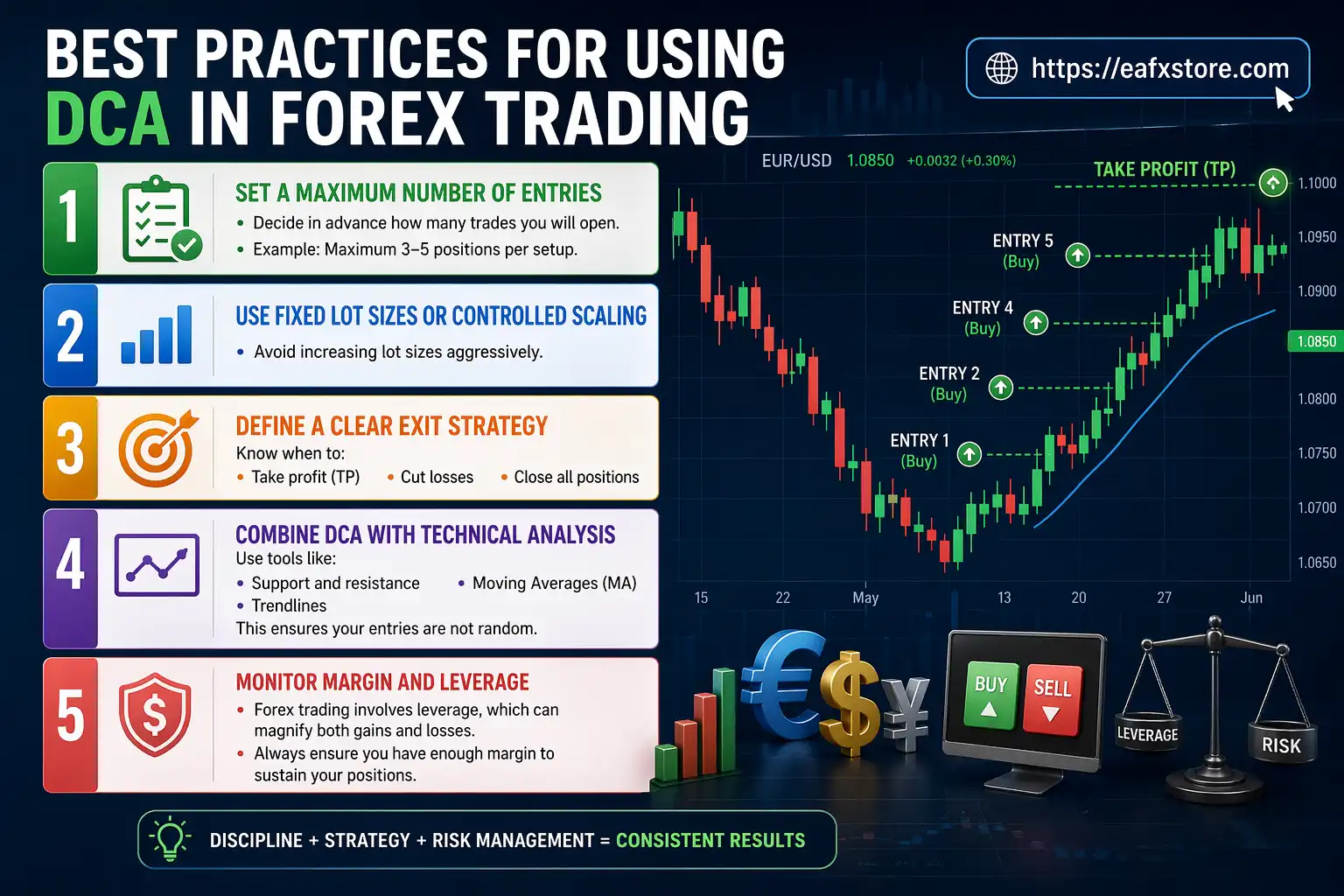
Best Practices for Using DCA in Forex Trading
1. Set a Maximum Number of Entries
Decide in advance how many trades you will open.
Example: Maximum 3–5 positions per setup.
2. Use Fixed Lot Sizes or Controlled Scaling
Avoid increasing lot sizes aggressively.
3. Define a Clear Exit Strategy
Know when to:
- Take Profit (TP)
- Cut losses
- Close all positions
4. Combine DCA with Technical Analysis
Use tools like:
- Support and Resistance
- Trendlines
- Moving Averages (MA)
This ensures your entries are not random.
5. Monitor Margin and Leverage
Forex trading involves leverage, which can magnify both gains and losses.
Always ensure you have enough margin to sustain your positions.
DCA Strategy Example (Step-by-Step)
Let’s walk through a structured DCA approach:
- Identify an uptrend in GBP/USD
- Wait for a pullback to support
- Enter first trade (0.1 lot)
- If price drops further, enter second trade at next support
- Enter third trade if needed
- Set a collective take-profit above average entry
- Exit all trades together
This structured approach prevents emotional decision-making.
Is DCA Suitable for Beginners?
Yes—but with caution.
DCA can be beginner-friendly because:
- It reduces the need for perfect timing
- It simplifies entry decisions
However, beginners must:
- Use small lot sizes
- Avoid overtrading
- Practice on demo accounts first
Common Mistakes When Using DCA
- Averaging Without a Plan: Entering trades randomly defeats the purpose of DCA.
- Ignoring Market Trends: DCA works best with the trend, not against it.
- Overleveraging: Using too much leverage can wipe out your account quickly.
- Holding Losing Trades Too Long: Always define a maximum loss threshold.
Final Thoughts
Dollar-Cost Averaging (DCA) is a powerful strategy in forex trading when used correctly. It helps traders manage volatility, reduce emotional pressure and improve entry prices. However, it is not risk-free.
The key to success with DCA lies in:
- Proper risk management.
- Strategic planning.
- Understanding market conditions.
If applied with discipline, DCA can become a valuable tool in your forex trading toolkit—helping you navigate the market with greater confidence and control.
FAQs
1. Is DCA safe in forex trading?
DCA can reduce risk but is not completely safe. Without proper risk management, it can lead to significant losses.
2. How many positions should I open in DCA?
Typically, 3–5 entries are considered safe, depending on your capital and strategy.
3. Can DCA guarantee profit?
No strategy guarantees profit. DCA improves probability but does not eliminate risk.
4. Is DCA better than single-entry trading?
It depends on your trading style. DCA is better for managing volatility, while single-entry trading requires precise timing.