
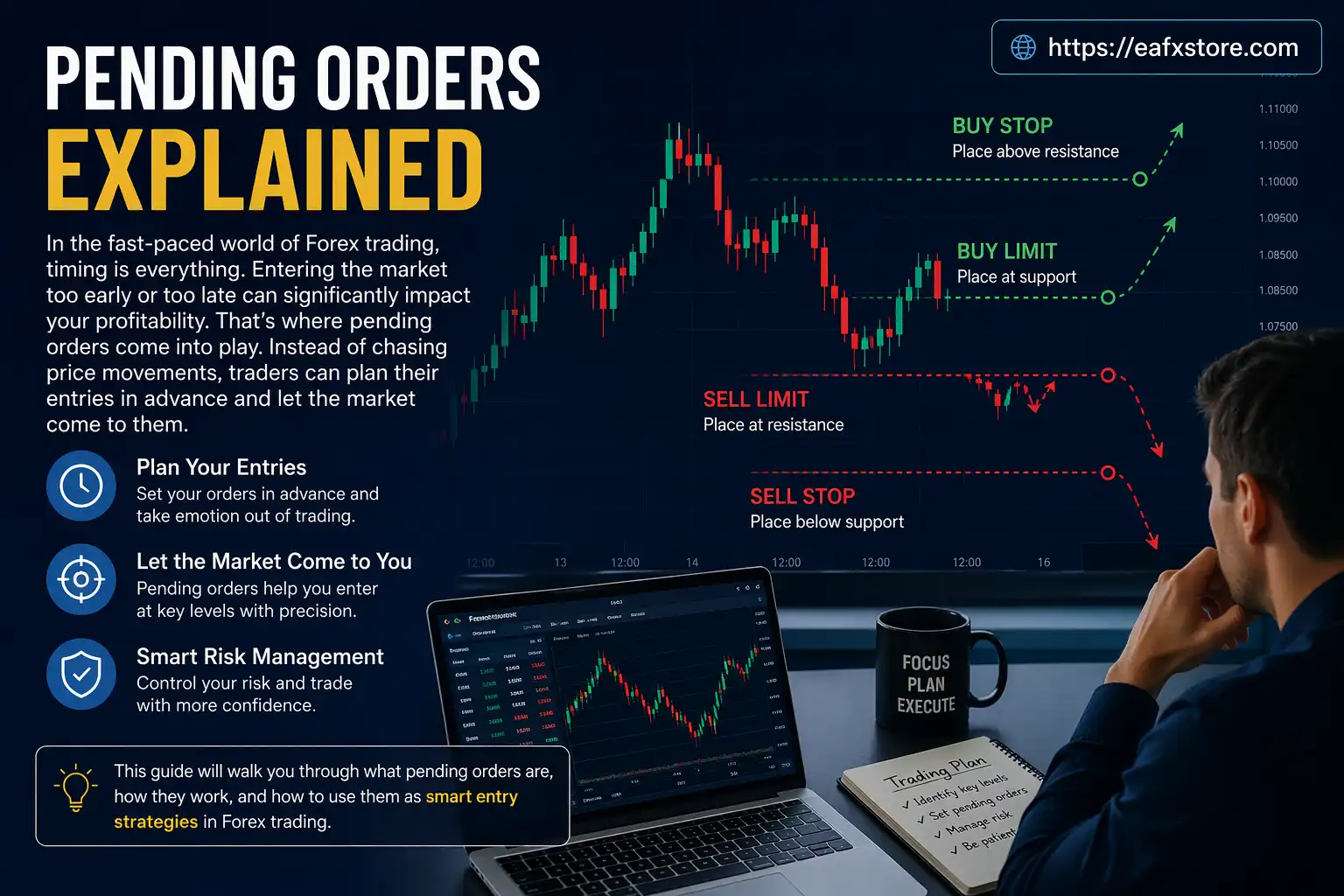
In the fast-paced world of Forex trading, timing is everything. Entering the market too early or too late can significantly impact your profitability. That’s where pending orders come into play. Instead of chasing price movements, traders can plan their entries in advance and let the market come to them.
This guide will walk you through what pending orders are, how they work and how to use them as smart entry strategies in Forex trading.
What Are Pending Orders in Forex?
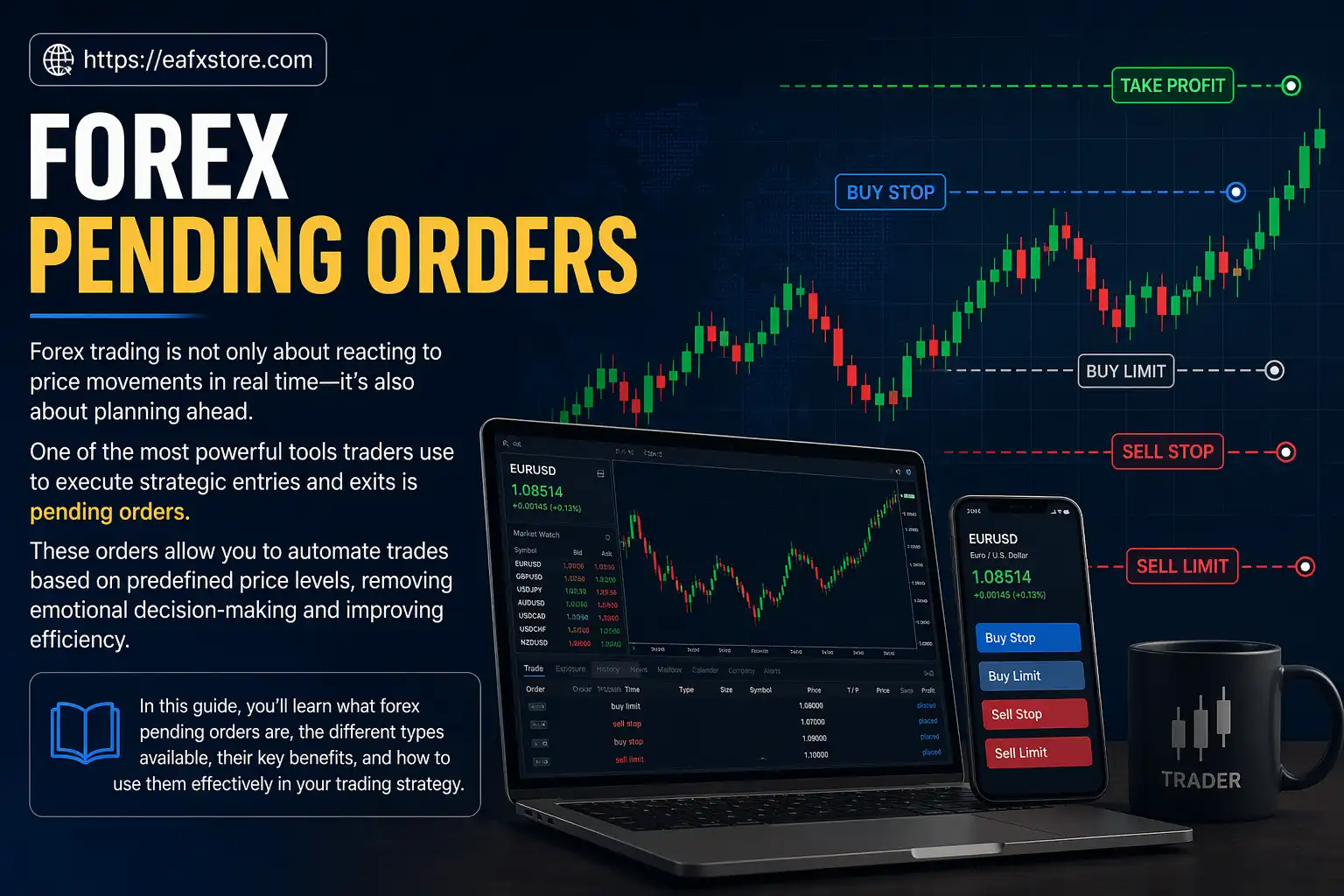
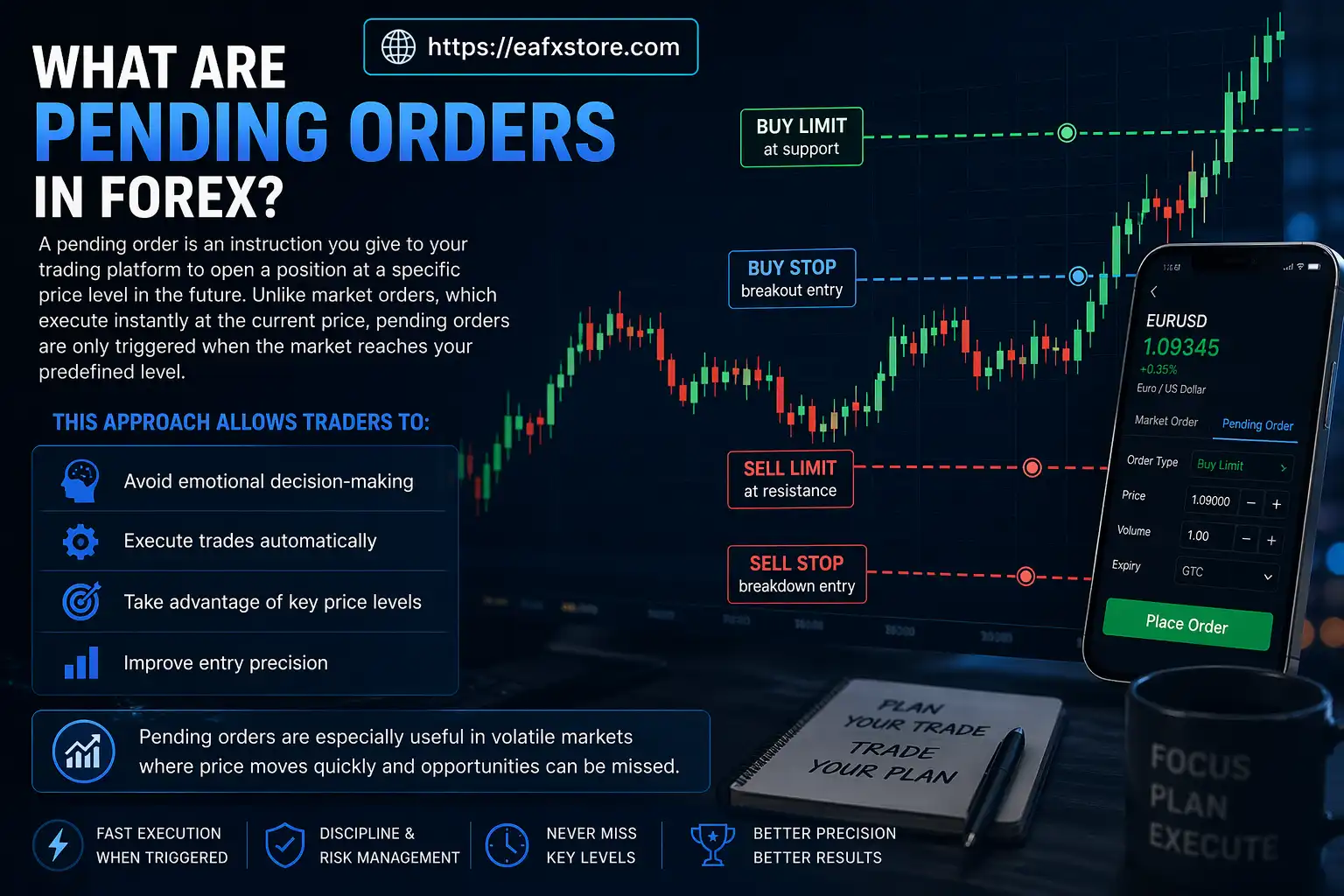
A pending order is an instruction you give to your trading platform to open a position at a specific price level in the future. Unlike Market Orders, which execute instantly at the current price, pending orders are only triggered when the market reaches your predefined level.
This approach allows traders to:
- Avoid emotional decision-making.
- Execute trades automatically.
- Take advantage of key price levels.
- Improve entry precision.
Pending orders are especially useful in volatile markets where price moves quickly and opportunities can be missed.
Types of Pending Orders
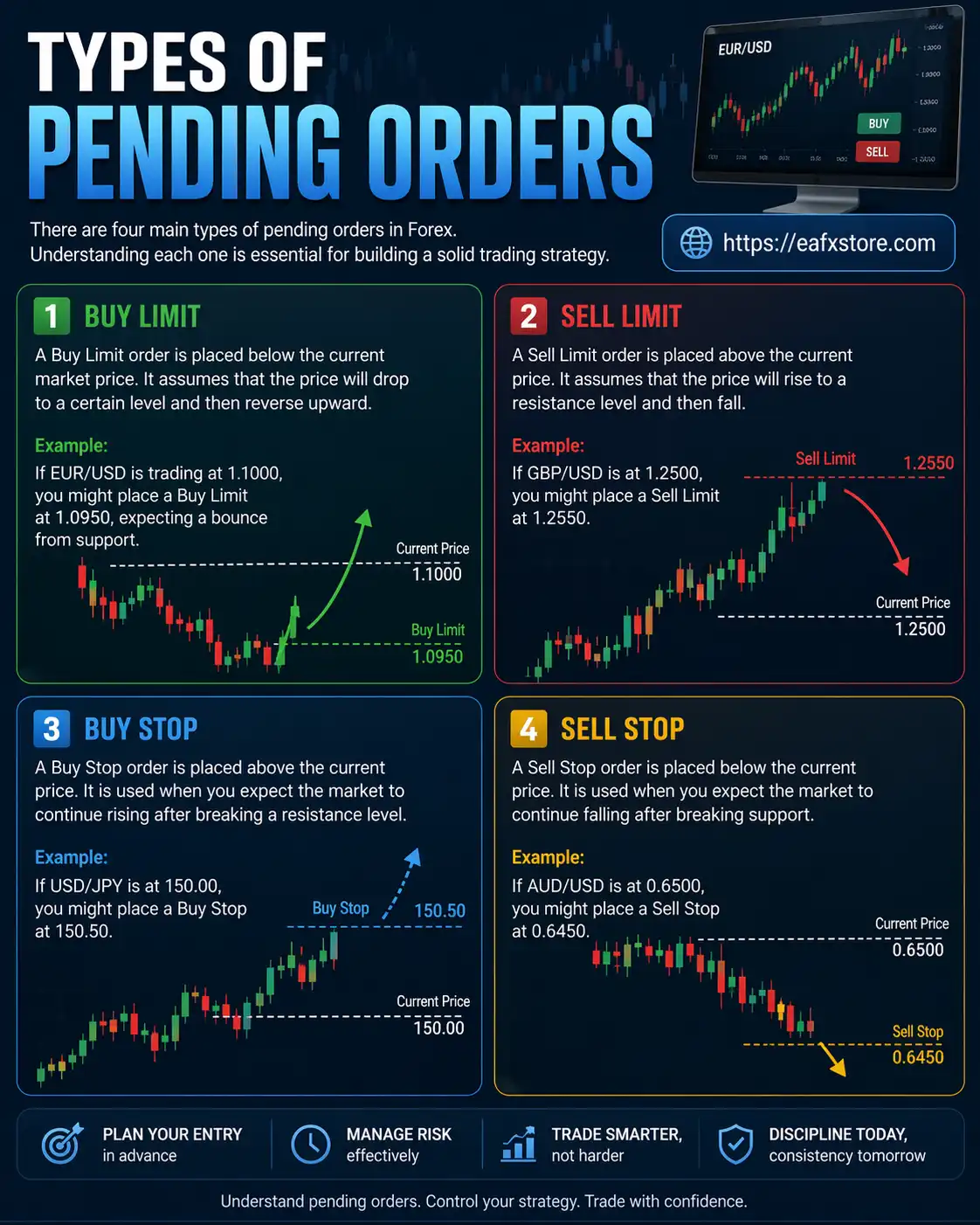
There are four main types of pending orders in Forex. Understanding each one is essential for building a solid trading strategy.
1. Buy Limit
A Buy Limit order is placed below the current market price. It assumes that the price will drop to a certain level and then reverse upward.
➡️ Example: If EUR/USD is trading at 1.1000, you might place a Buy Limit at 1.0950, expecting a bounce from support.
2. Sell Limit
A Sell Limit order is placed above the current price. It assumes that the price will rise to a resistance level and then fall.
➡️ Example: If GBP/USD is at 1.2500, you might place a Sell Limit at 1.2550.
3. Buy Stop
A Buy Stop order is placed above the current price. It is used when you expect the market to continue rising after breaking a resistance level.
➡️ Example: If USD/JPY is at 150.00, you might place a Buy Stop at 150.50.
4. Sell Stop
A Sell Stop order is placed below the current price. It is used when you expect the market to continue falling after breaking support.
➡️ Example: If AUD/USD is at 0.6500, you might place a Sell Stop at 0.6450.
Why Use Pending Orders?
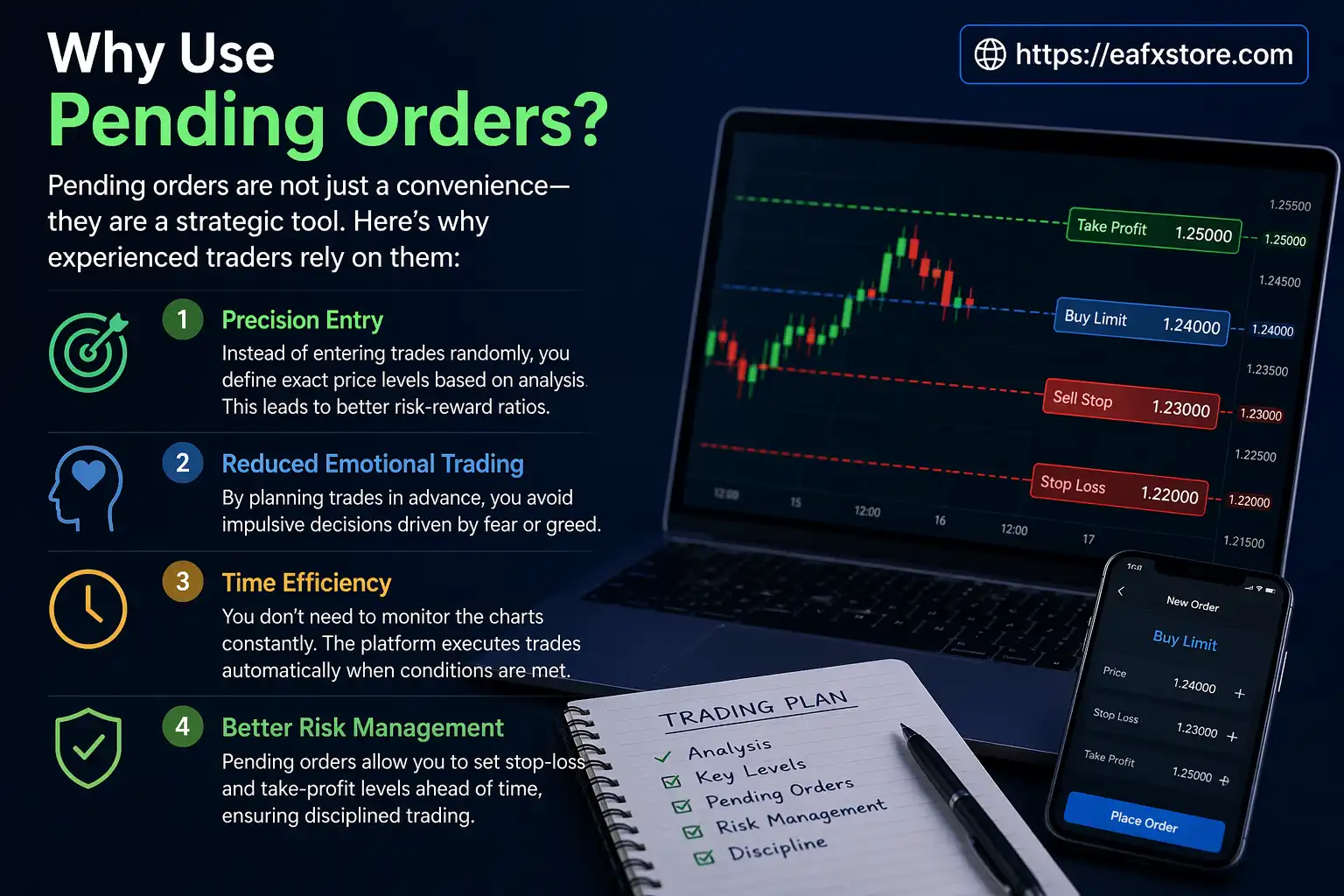
Pending orders are not just a convenience—they are a strategic tool. Here’s why experienced traders rely on them:
- Precision Entry: Instead of entering trades randomly, you define exact price levels based on analysis. This leads to better risk-reward ratios.
- Reduced Emotional Trading: By planning trades in advance, you avoid impulsive decisions driven by fear or greed.
- Time Efficiency: You don’t need to monitor the charts constantly. The platform executes trades automatically when conditions are met.
- Better Risk Management: Pending orders allow you to set stop-loss and take-profit levels ahead of time, ensuring disciplined trading.
Smart Entry Strategies Using Pending Orders
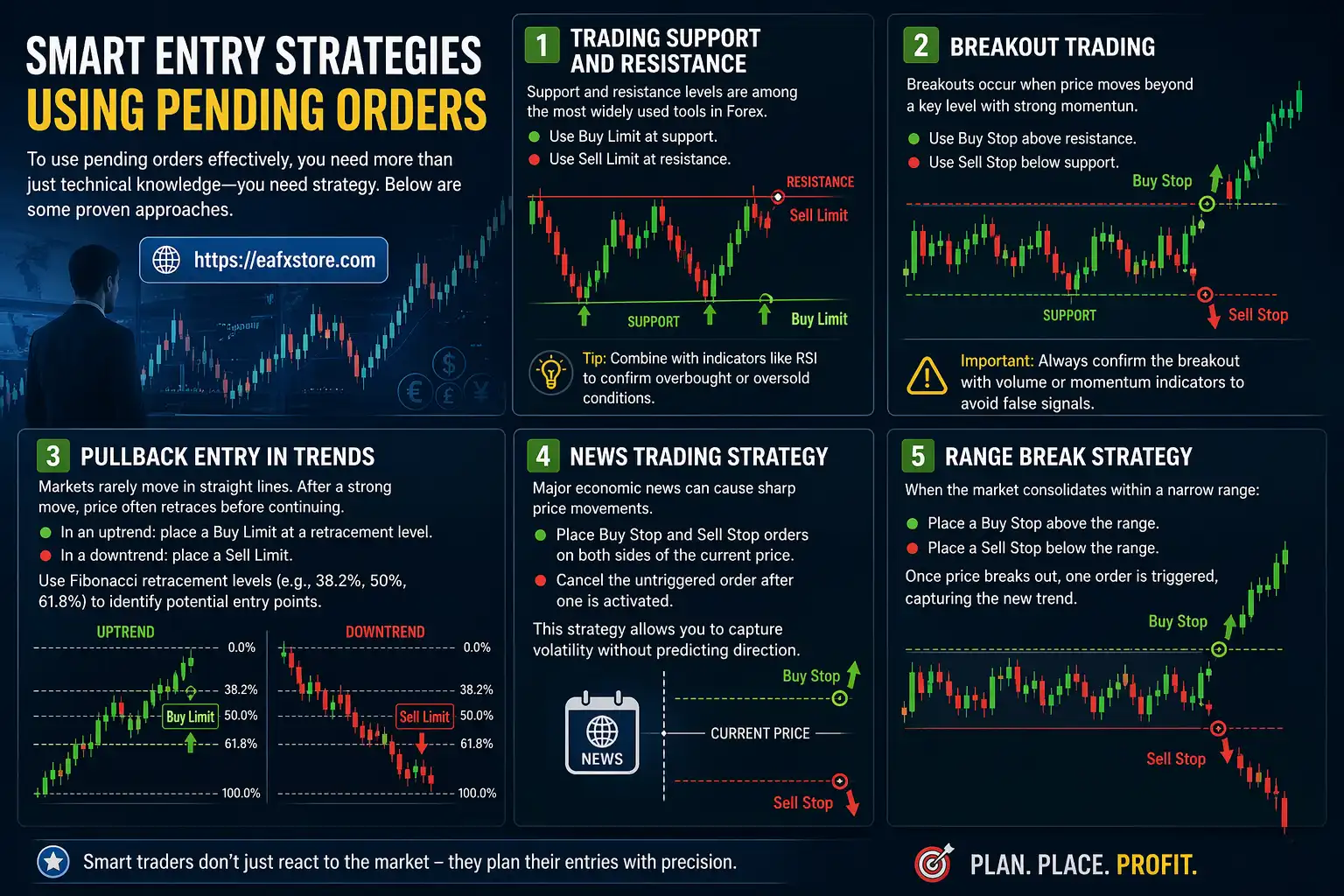
To use pending orders effectively, you need more than just technical knowledge—you need strategy. Below are some proven approaches.
1. Trading Support and Resistance
Support and resistance levels are among the most widely used tools in Forex.
- Use Buy Limit at support.
- Use Sell Limit at resistance.
This strategy works best in ranging markets where price moves between defined levels.
Tip: Combine with indicators like RSI to confirm overbought or oversold conditions.
2. Breakout Trading
Breakouts occur when price moves beyond a key level with strong momentum.
- Use Buy Stop above resistance.
- Use Sell Stop below support.
This strategy is ideal during high-impact news events or strong trends.
Important: Always confirm the breakout with volume or momentum indicators to avoid false signals.
3. Pullback Entry in Trends
Markets rarely move in straight lines. After a strong move, price often retraces before continuing.
- In an uptrend: place a Buy Limit at a retracement level.
- In a downtrend: place a Sell Limit.
Use Fibonacci retracement levels (e.g., 38.2%, 50%, 61.8%) to identify potential entry points.
4. News Trading Strategy
Major economic news can cause sharp price movements.
- Place Buy Stop and Sell Stop orders on both sides of the current price.
- Cancel the untriggered order after one is activated.
This strategy allows you to capture volatility without predicting direction.
5. Range Break Strategy
When the market consolidates within a narrow range:
- Place a Buy Stop above the range.
- Place a Sell Stop below the range.
Once price breaks out, one order is triggered, capturing the new trend.
Common Mistakes to Avoid
Even though pending orders are powerful, misuse can lead to losses. Here are some pitfalls to watch out for:
- Placing Orders Too Close to Price: If your entry is too close, you may get triggered by market noise rather than a meaningful move.
- Ignoring Market Conditions: Not all strategies work in all conditions. For example, limit orders perform better in ranging markets, while stop orders are better for trending markets.
- No Stop-Loss Placement: Every pending order should include a Stop Loss (SL). Without it, a single trade can wipe out your account.
- Overusing Pending Orders: Placing too many orders can lead to overtrading and confusion. Focus on high-quality setups.
- Forgetting to Cancel Orders: If market conditions change, your pending orders may no longer be valid. Always review and adjust them.
Best Practices for Using Pending Orders
To maximize effectiveness, follow these best practices:
- Always base entries on technical or fundamental analysis.
- Use risk management rules (e.g., risk 1–2% per trade).
- Combine with indicators like moving averages or MACD.
- Backtest your strategy before applying it live.
- Keep a trading journal to track performance.
Pending Orders vs Market Orders
| Feature | Pending Orders | Market Orders |
|---|---|---|
| Execution | Future price level | Immediate |
| Control | High | Low |
| Emotion | Minimal | High |
| Precision | High | Depends on timing |
Pending orders offer greater control and are better suited for disciplined traders.
When Should You Use Pending Orders?
Pending orders are ideal when:
- You have identified key price levels.
- You cannot monitor the market constantly.
- You want to automate your trading strategy.
- You aim to reduce emotional decisions.
They are less suitable when:
- Markets are highly unpredictable.
- Spreads are extremely wide.
- Liquidity is low.
Final Thoughts
Pending orders are a cornerstone of professional Forex trading. They allow you to plan your trades with precision, reduce emotional interference and execute strategies more effectively.
However, they are not a shortcut to success. Like any trading tool, they require practice, discipline and proper risk management. The key is to align your pending order strategy with market conditions and your overall trading plan.