
In Forex, when you trade can matter as much as what you trade. The market is open almost 24 hours a day, but it does not move evenly. Some hours are quiet and choppy, while others bring sharp, directional moves. The Kill Zones, a concept taught by the ICT (Inner Circle Trader) methodology, are specific time windows when the most important price moves are most likely to happen.
This guide explains what Kill Zones are, the standard Kill Zone times, what typically happens in each one, and how to build a trading routine around them.
What Are Kill Zones?
Kill Zones are periods of the trading day when liquidity and volatility tend to be highest, usually around the opening of major financial centres. During these windows, banks, funds and large traders are most active, so price is more likely to make meaningful moves, sweep liquidity and set the high or low of the day.
The idea behind Kill Zones is simple: instead of watching charts all day, focus your attention on the few hours when opportunities are most likely to appear, and avoid trading in slow, unpredictable periods.
The Standard ICT Kill Zone Times
ICT defines Kill Zones in New York local time. The table below shows the most commonly used windows, with approximate UTC equivalents. New York moves between Eastern Daylight Time (EDT, UTC-4) in the northern summer and Eastern Standard Time (EST, UTC-5) in winter.
| Kill Zone | New York time | UTC (summer, EDT) | UTC (winter, EST) |
| Asian Kill Zone | 8:00 PM – 10:00 PM | 00:00 – 02:00 | 01:00 – 03:00 |
| London Open Kill Zone | 2:00 AM – 5:00 AM | 06:00 – 09:00 | 07:00 – 10:00 |
| New York Open Kill Zone | 7:00 AM – 10:00 AM | 11:00 – 14:00 | 12:00 – 15:00 |
| London Close Kill Zone | 10:00 AM – 12:00 PM | 14:00 – 16:00 | 15:00 – 17:00 |
Different educators and indicators use slightly different windows, so check the settings of any Kill Zone indicator you use. Also note that the United States and Europe change their clocks on different dates, so for a few weeks each spring and autumn the gap between London and New York shifts by one hour.
What Happens in Each Kill Zone
Asian Kill Zone
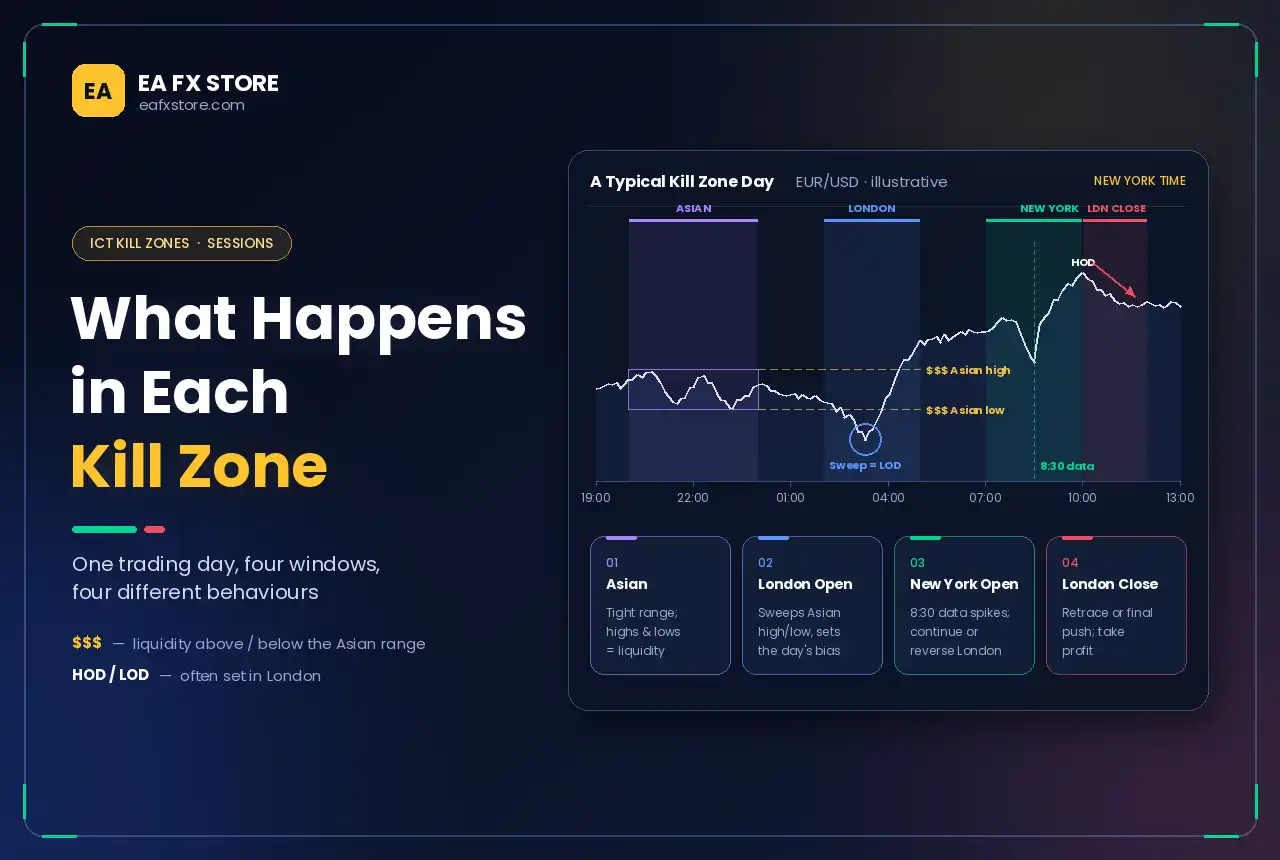
The Asian session is usually quieter for major pairs such as EUR/USD and GBP/USD. Price often forms a relatively tight range. That range matters: its high and low become liquidity pools, with stop orders resting above and below. Pairs involving the Japanese yen, Australian dollar and New Zealand dollar can be more active during this window.
London Open Kill Zone
The London open is often the most important window of the day for European currency pairs. A common pattern is a move that sweeps the Asian high or low, triggering stops, before price reverses and establishes the real direction of the day. Many ICT traders expect the high or low of the day to form here.
New York Open Kill Zone
The New York open brings a second wave of liquidity as US markets become active, and it overlaps with the London session, making it one of the busiest periods in Forex. Major US economic data, such as employment and inflation figures, is often released at 8:30 AM New York time, so volatility can spike suddenly. Price may continue the London move or reverse it.
London Close Kill Zone
As European traders close positions, price can retrace the day’s move or make a final push. This window is often used for taking profit or catching short reversals rather than for starting new trend trades.
How to Trade the Kill Zones
A simple ICT-style routine for a Kill Zone looks like this:
- Set your bias before the session using a higher timeframe. Decide whether the market is bullish, bearish or neutral.
- Mark key levels: the Asian session high and low, the previous day’s high and low, and Volume Profile levels such as the Value Area High, Value Area Low and Point of Control.
- Wait for the Kill Zone to open. Avoid forcing trades before it starts.
- Look for a liquidity sweep of a marked high or low against your bias.
- Wait for a Market Structure Shift (MSS) on a lower timeframe in your direction.
- Enter on the retracement into a fair value gap or order block.
- Place the stop beyond the sweep and target the opposite liquidity pool.
- Stop looking for new setups once the Kill Zone ends, unless your plan says otherwise.
Why Kill Zones Work
Kill Zones are not magic time windows. They work because they reflect how the Forex market is actually structured:
- More participants means more liquidity and larger moves.
- Session opens bring new orders, as traders in a new region react to overnight news and positioning.
- Economic data releases are concentrated in specific hours.
- Stop orders cluster around session highs and lows, creating predictable targets for price.
You can see this in the data. Tick volume on most major pairs rises sharply at the London and New York opens and falls during the late US and early Asian hours.
Kill Zones and Your Time Zone
For traders outside Europe and North America, Kill Zones can fall at inconvenient hours. The London Open Kill Zone, for example, lands in the afternoon for traders in Southeast Asia, while the New York Open falls in the evening. Convert the times to your own time zone, check your broker’s server time, and choose the Kill Zone that fits your schedule. Trading one Kill Zone well is better than trading all of them tired.
Common Mistakes
- Treating a Kill Zone as a signal. A time window tells you when to look, not what to do.
- Ignoring daylight saving changes, which shift the windows by an hour.
- Trading during high-impact news without a plan for sudden spikes and wider spreads.
- Overtrading because the market is moving fast.
- Ignoring the pair. Kill Zones matter most for pairs whose currencies are active in that session.
Frequently Asked Questions
What are Kill Zones in ICT trading?
They are time windows around major session opens when liquidity and volatility are highest, making significant price moves more likely.
What time is the London Kill Zone?
It is usually defined as 2:00 AM to 5:00 AM New York time, which is about 06:00–09:00 UTC in summer and 07:00–10:00 UTC in winter.
What time is the New York Kill Zone?
It is usually 7:00 AM to 10:00 AM New York time, about 11:00–14:00 UTC in summer and 12:00–15:00 UTC in winter.
Do I have to trade every Kill Zone?
No. Most traders focus on one or two Kill Zones that suit their schedule and the pairs they trade.
Conclusion
Kill Zones help you focus your time and energy on the hours when the Forex market is most likely to deliver clean, meaningful moves. Mark the Asian range, watch for liquidity sweeps at the London and New York opens, and combine them with market structure and Volume Profile levels. With a clear plan for each window, you will trade less, but with more purpose.
Risk warning: Trading Forex and CFDs on margin carries a high level of risk and may not be suitable for all investors. This article is for educational purposes only and is not investment advice.