
Few trading methods have spread through the Forex community as quickly as ICT. Search any trading forum or YouTube channel and you will find traders talking about liquidity sweeps, order blocks, fair value gaps and killzones. These ideas come from the Inner Circle Trader (ICT) methodology, and they have shaped a whole generation of price action traders.
This guide explains what ICT trading is, the core concepts behind it, how to combine them into a simple trade model, and how ICT fits alongside tools such as Volume Profile.
What is ICT Trading?
ICT stands for Inner Circle Trader, the online name of Michael J. Huddleston, a trader and educator who has shared his approach through free videos and mentorship programmes for many years. ICT trading is a price action method built on one central idea: large institutions move the market, and they leave footprints on the chart that retail traders can learn to read.
Many of the ideas taught by ICT are also known more broadly as Smart Money Concepts (SMC). The focus is not on indicators, but on where liquidity sits, how price moves to reach it, and where institutions are likely to enter.
Core ICT Concepts
Market structure
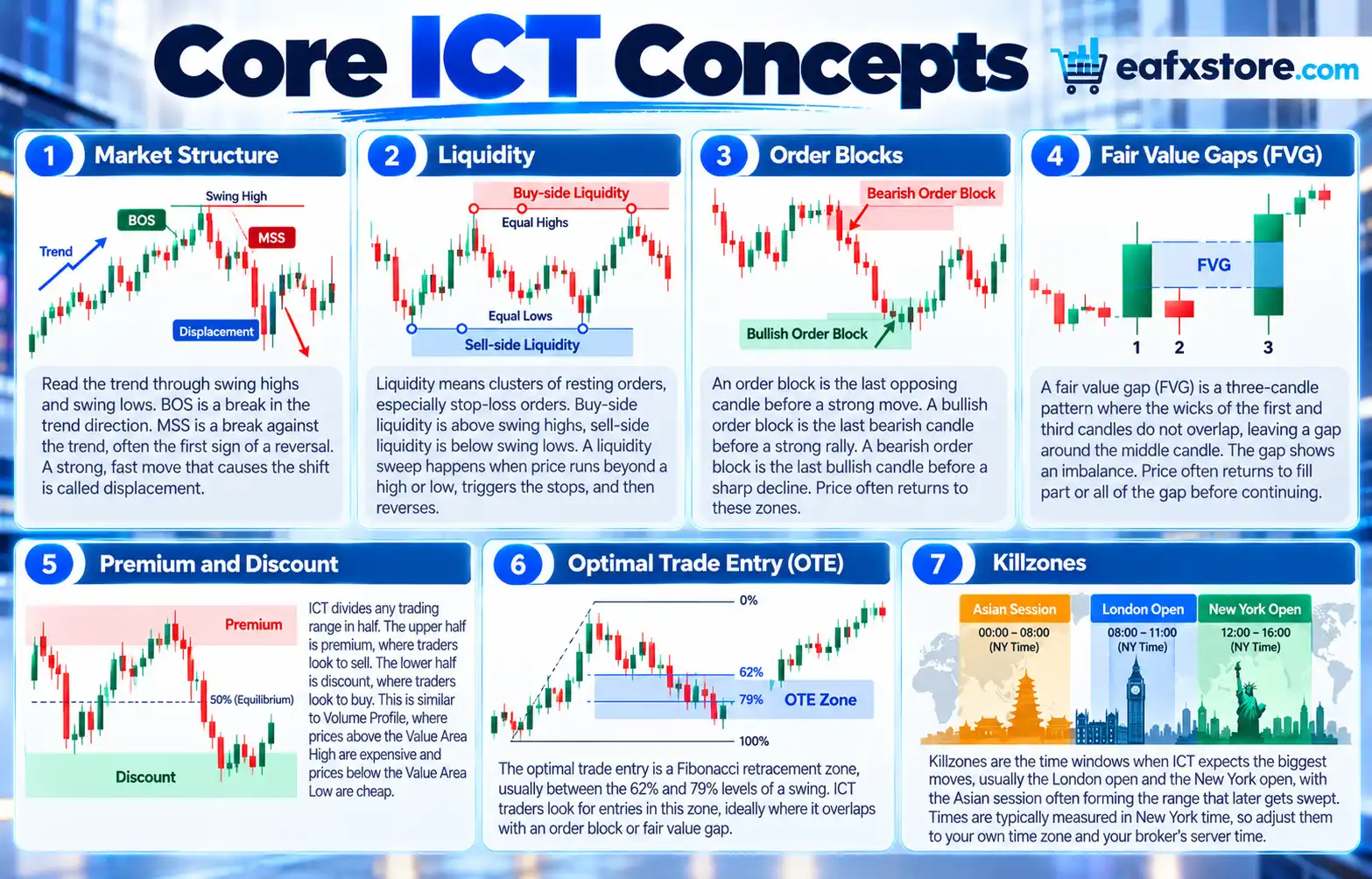
ICT traders start by reading the trend through swing highs and swing lows. A Break of structure (BOS) occurs when price breaks a swing point in the direction of the trend. A Market Structure Shift (MSS) occurs when price breaks a swing point against the trend, often the first sign of a reversal. A strong, fast move that causes the shift is called displacement.
Liquidity
In ICT, liquidity means clusters of resting orders, especially stop-loss orders. Buy-side liquidity sits above swing highs and equal highs, where short sellers place their stops. Sell-side liquidity sits below swing lows and equal lows, where buyers place theirs.
ICT teaches that price is often driven towards these pools. A liquidity sweep happens when price briefly runs beyond a high or low, triggers the stops, and then reverses. For many ICT traders, the sweep is the event that sets up the trade.
Order blocks
An order block is the last opposing candle before a strong move. A bullish order block is the last bearish candle before a strong rally; a bearish order block is the last bullish candle before a sharp decline. ICT traders expect price to return to these zones, where institutions may have left unfilled orders.
Fair value gaps
A Fair value gap (FVG) is a three-candle pattern where the wicks of the first and third candles do not overlap, leaving a gap around the middle candle. The gap shows an imbalance: price moved so fast that one side was barely filled. Price often returns to fill part or all of the gap before continuing. Reading OHLC data carefully makes FVGs easy to spot.
Premium and discount
ICT divides any trading range in half. The upper half is premium, where traders look to sell. The lower half is discount, where traders look to buy. This is similar in spirit to Volume Profile, where prices above the Value Area High are expensive and prices below the Value Area Low are cheap.
Optimal trade entry (OTE)
The optimal trade entry is a Fibonacci retracement zone, usually between the 62% and 79% levels of a swing. ICT traders look for entries in this zone, ideally where it overlaps with an order block or fair value gap.
Killzones
Killzones are the time windows when ICT expects the biggest moves, usually the London open and the New York open, with the Asian session often forming the range that later gets swept. Times are typically measured in New York time, so adjust them to your own time zone and your broker’s server time.
A Simple ICT Trade Model
Many ICT traders combine these concepts into a step-by-step model:
- Set the bias on a higher timeframe, such as the daily or four-hour chart. Is price making higher highs (bullish) or lower lows (bearish)?
- Mark liquidity: the Asian session high and low, the previous day’s high and low, and any equal highs or lows.
- Wait for a killzone, such as the London or New York open.
- Look for a liquidity sweep against your bias. In a bullish bias, wait for price to run below a recent low.
- Confirm a market structure shift with displacement back in your direction.
- Enter on the retracement into a fair value gap or order block, ideally within the OTE zone and in discount for longs (premium for shorts).
- Place the stop beyond the sweep’s high or low.
- Target the opposite liquidity pool, such as the high of the range for longs.
ICT and Volume Profile
ICT and Volume Profile come from different traditions, but they complement each other well. A fair value gap that lines up with a Low Volume Node shows the same idea from two angles: price moved quickly and left little trading behind. A liquidity sweep just beyond the Value Area High or Low, followed by a return inside value, looks very similar to a failed breakout in Market Profile terms. The Point of Control can also serve as a realistic target inside a range.
Keep in mind that Forex CFD charts use tick volume, not real volume, so treat all volume-based levels as zones rather than exact prices.
Strengths and Limitations of ICT
Strengths:
- Gives clear, rule-based reference points for entries, stops and targets.
- Encourages patience: waiting for a sweep and confirmation before entering.
- Works on any liquid market and timeframe.
Limitations:
- Concepts can be applied subjectively, so two traders may mark different order blocks on the same chart.
- Hindsight makes setups look obvious; in real time, many sweeps simply continue.
- ICT does not publish a verified trading record, so claims about its accuracy should be tested, not assumed.
- Beginners often mix too many concepts at once and overcomplicate their charts.
The best approach is to backtest one simple model on one or two currency pairs, record the results, and trade it on a demo account before risking real money.
Frequently Asked Questions
What does ICT stand for in trading?
ICT stands for Inner Circle Trader, the name used by trader and educator Michael J. Huddleston.
Is ICT the same as Smart Money Concepts?
They overlap heavily. SMC is a broader term that grew out of many ICT ideas, such as order blocks, liquidity and fair value gaps.
What is an ICT killzone?
A time window, usually around the London and New York opens, when ICT expects the most volatile and meaningful price moves.
Does ICT trading work in Forex?
Many Forex traders use ICT concepts, but results depend on the trader’s rules, discipline and risk management. Always backtest before trading live.
Conclusion
ICT trading teaches you to read the chart through the eyes of institutions: where liquidity rests, how price reaches it, and where imbalances are likely to be filled. Start with the basics of market structure, liquidity and fair value gaps, build one clear trade model, and combine it with Volume Profile levels for extra confirmation.
Risk warning: Trading Forex and CFDs on margin carries a high level of risk and may not be suitable for all investors. This article is for educational purposes only and is not investment advice.