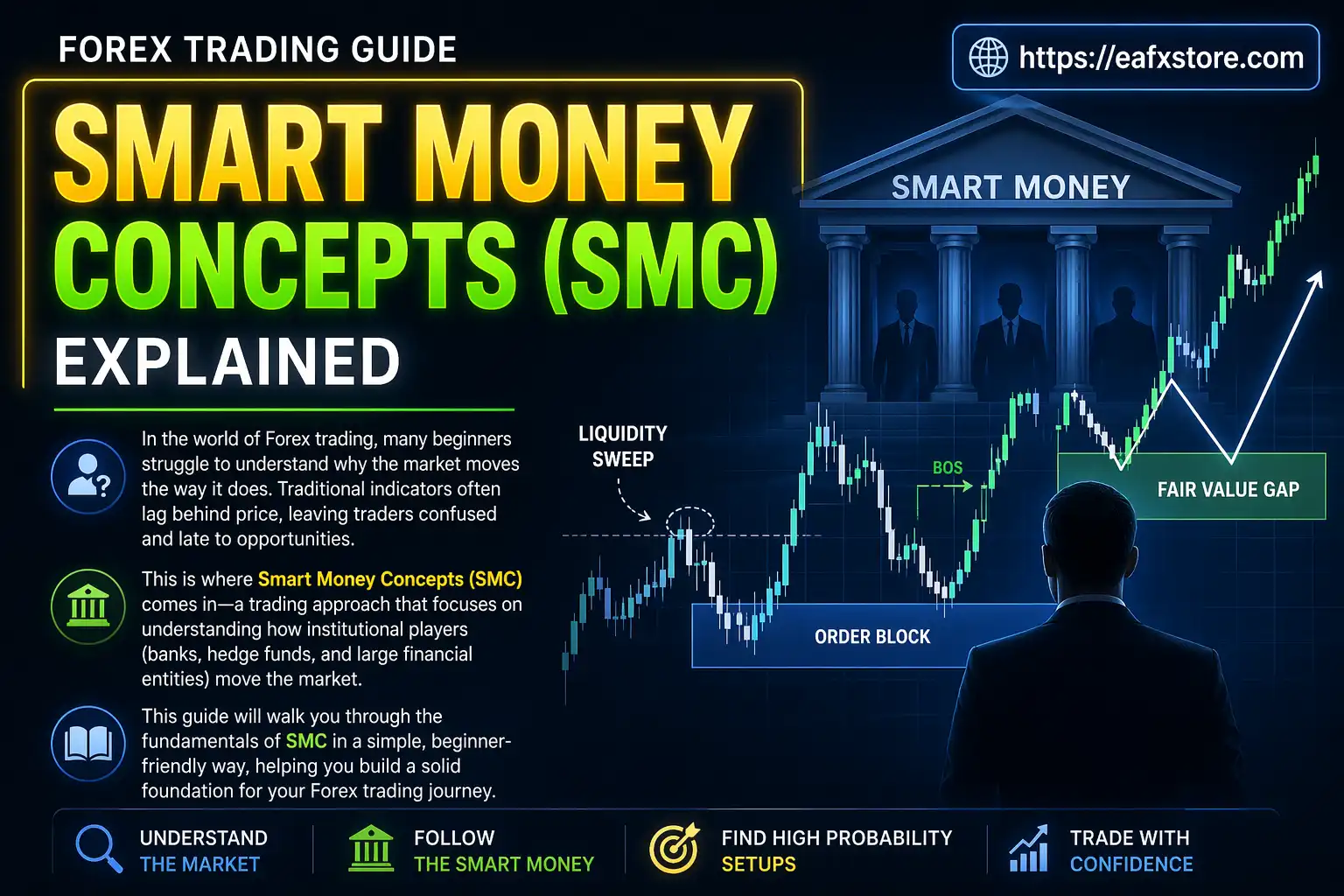

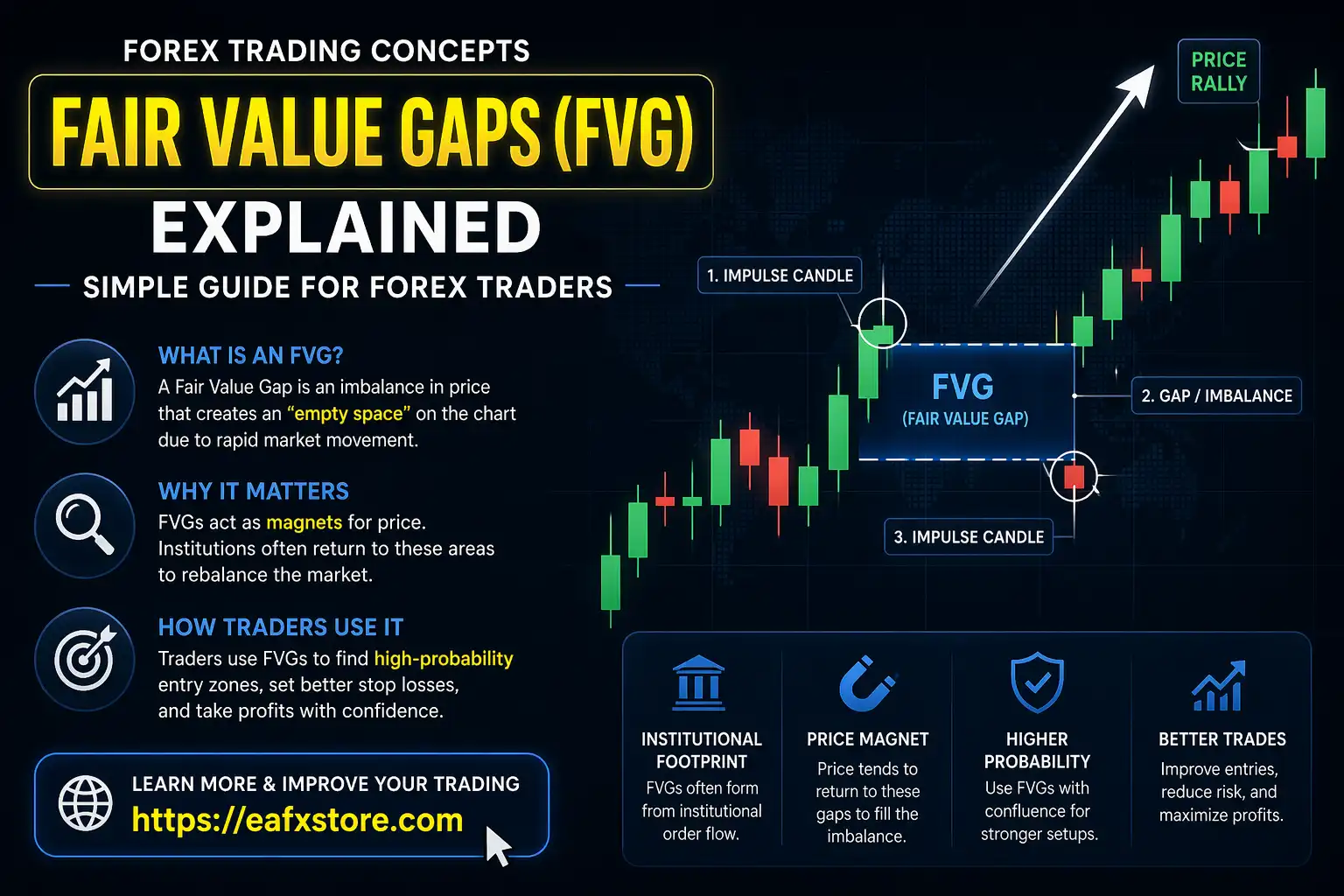
In the world of Forex trading, price doesn’t move randomly—it often follows patterns driven by liquidity, order flow, and institutional activity. One concept that has gained significant attention among modern traders is the Fair Value Gap (FVG).
If you’ve ever noticed price moving aggressively in one direction and leaving behind “empty space” on the chart, you’ve already seen an FVG in action. Understanding how these gaps form—and how to trade them—can give you a meaningful edge in the market.
This guide breaks down Fair Value Gaps in a simple, practical way so you can start applying them to your Forex strategy.
What Is a Fair Value Gap (FVG)?
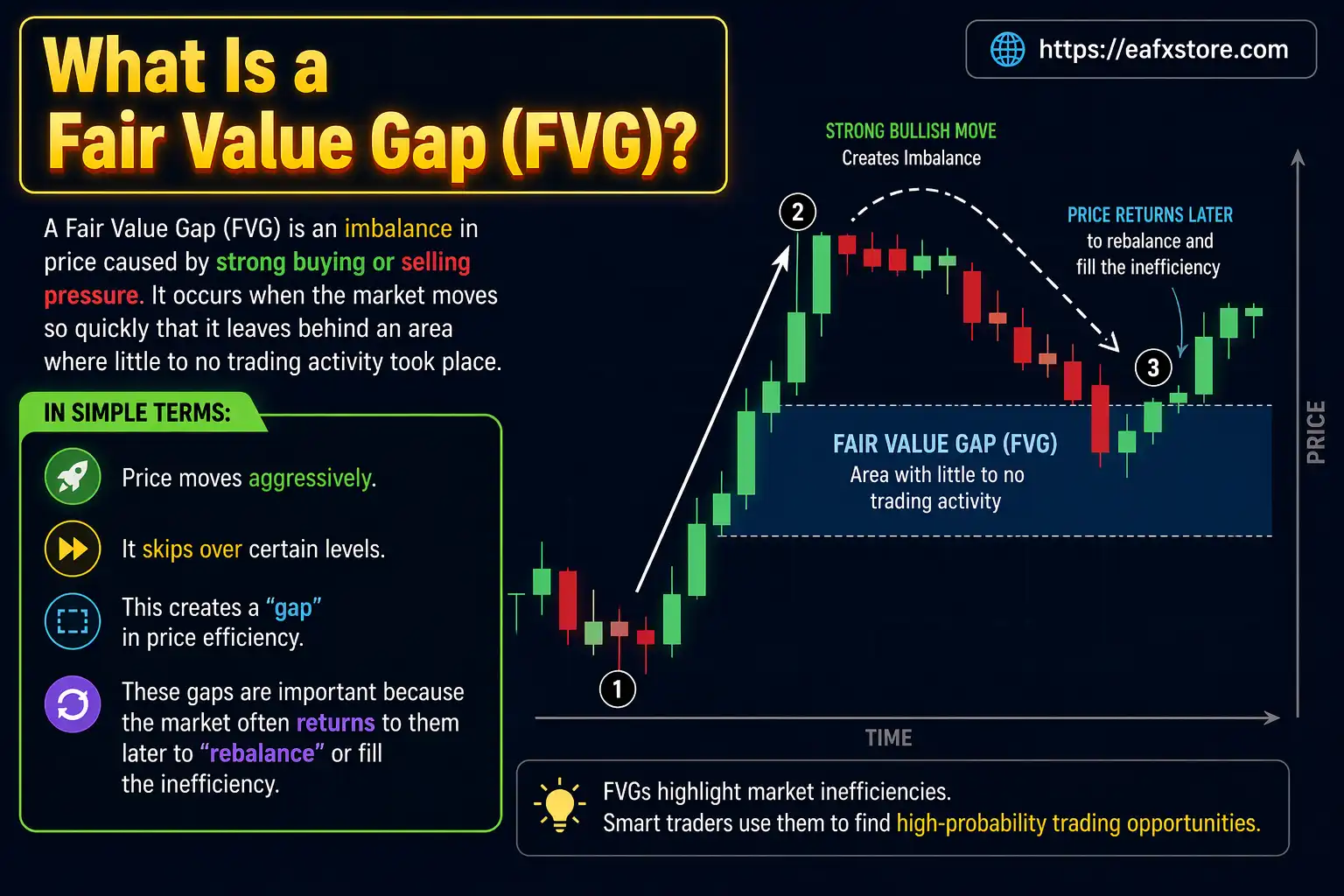
A Fair Value Gap (FVG) is an imbalance in price caused by strong buying or selling pressure. It occurs when the market moves so quickly that it leaves behind an area where little to no trading activity took place.
In simple terms:
- Price moves aggressively.
- It skips over certain levels.
- This creates a “gap” in price efficiency.
These gaps are important because the market often returns to them later to “rebalance” or fill the inefficiency.
How to Identify a Fair Value Gap
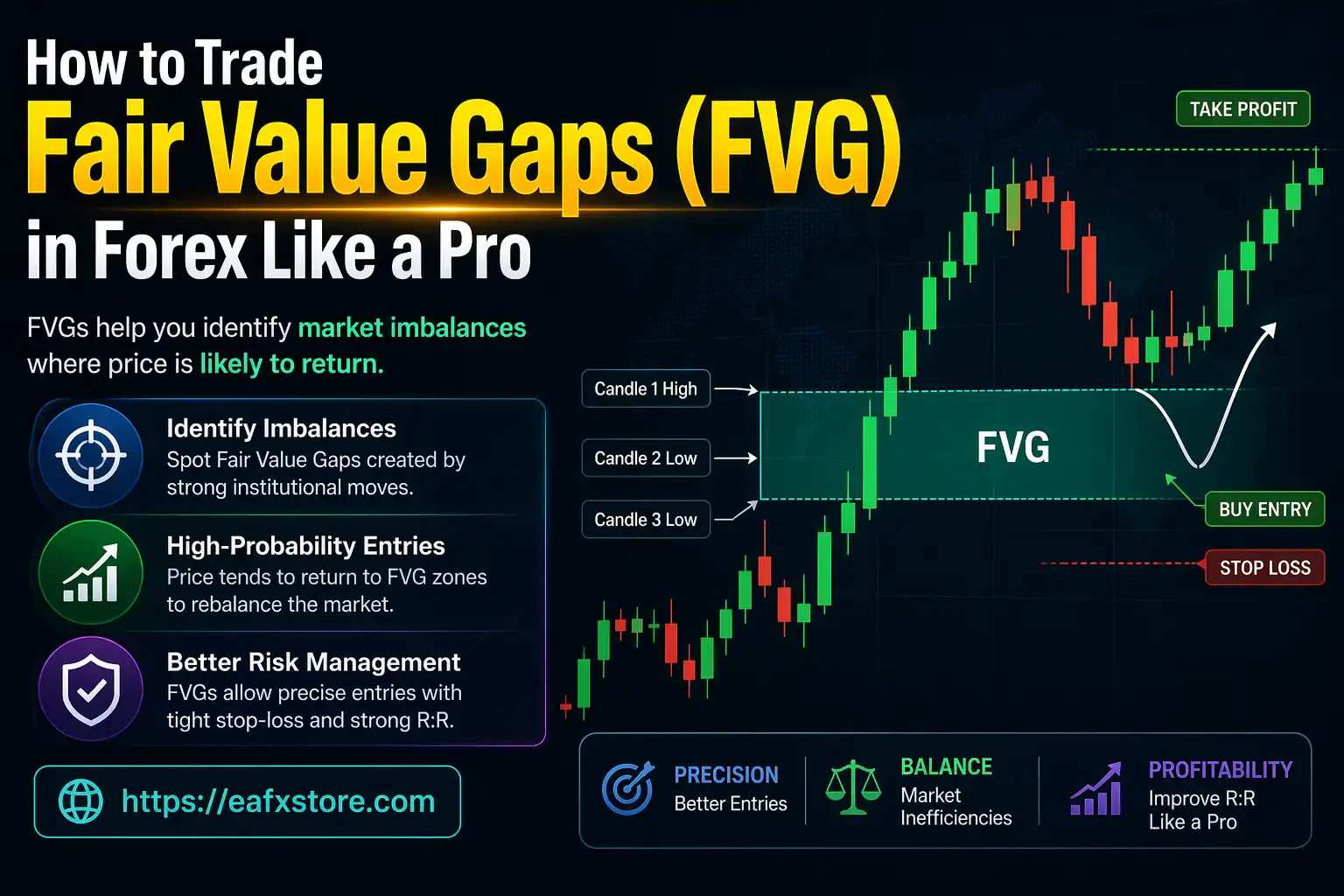
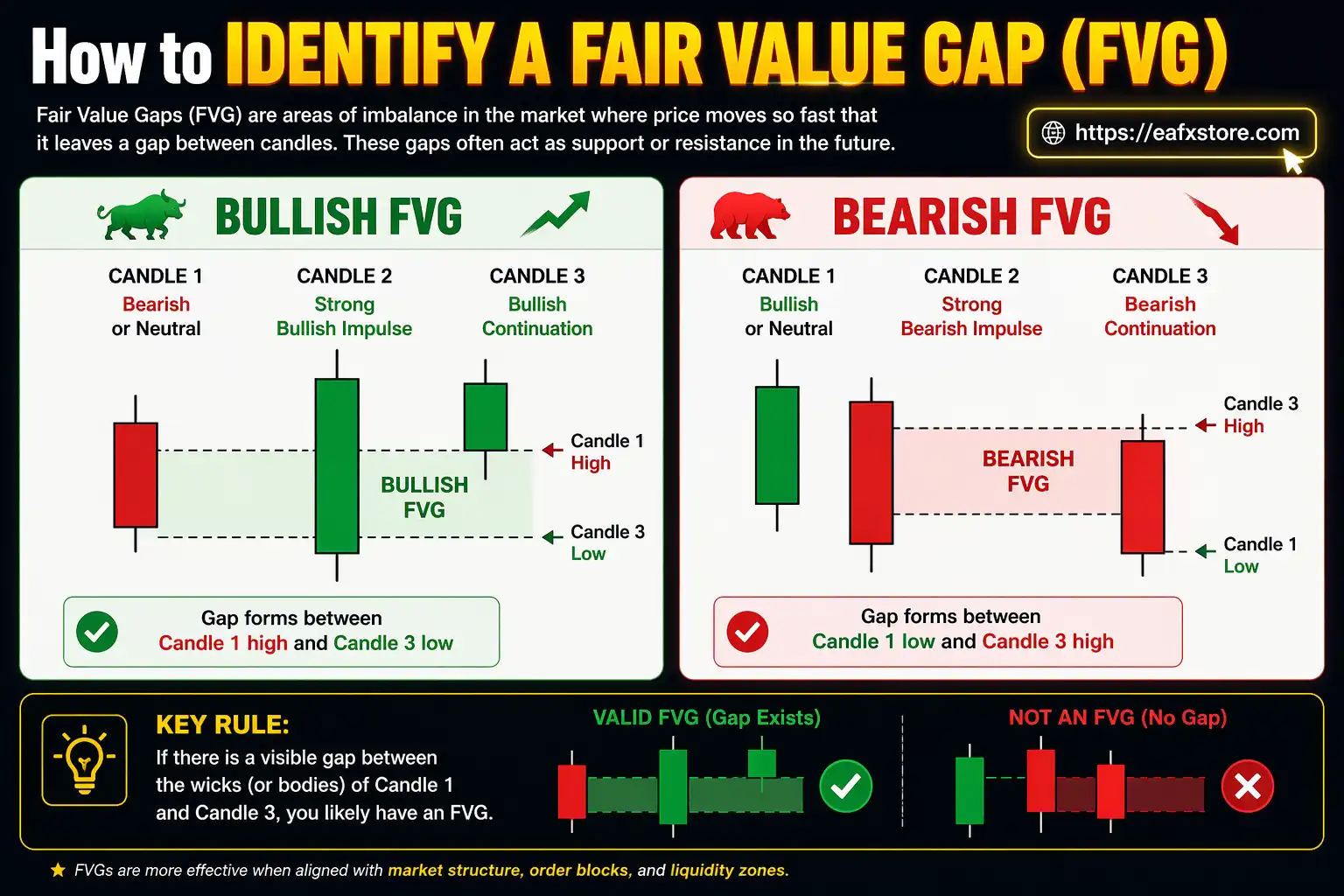
The most common way to spot an FVG is by using a three-candle structure:
🎯 Bullish FVG:
- Candle 1: bearish or neutral
- Candle 2: strong bullish impulse
- Candle 3: bullish continuation
- Gap forms between Candle 1 high and Candle 3 low
🎯 Bearish FVG:
- Candle 1: bullish or neutral
- Candle 2: strong bearish impulse
- Candle 3: bearish continuation
- Gap forms between Candle 1 low and Candle 3 high
🎯 Key Rule:
If there is a visible gap between the wicks (or bodies) of Candle 1 and Candle 3, you likely have an FVG.
Why Fair Value Gaps Matter
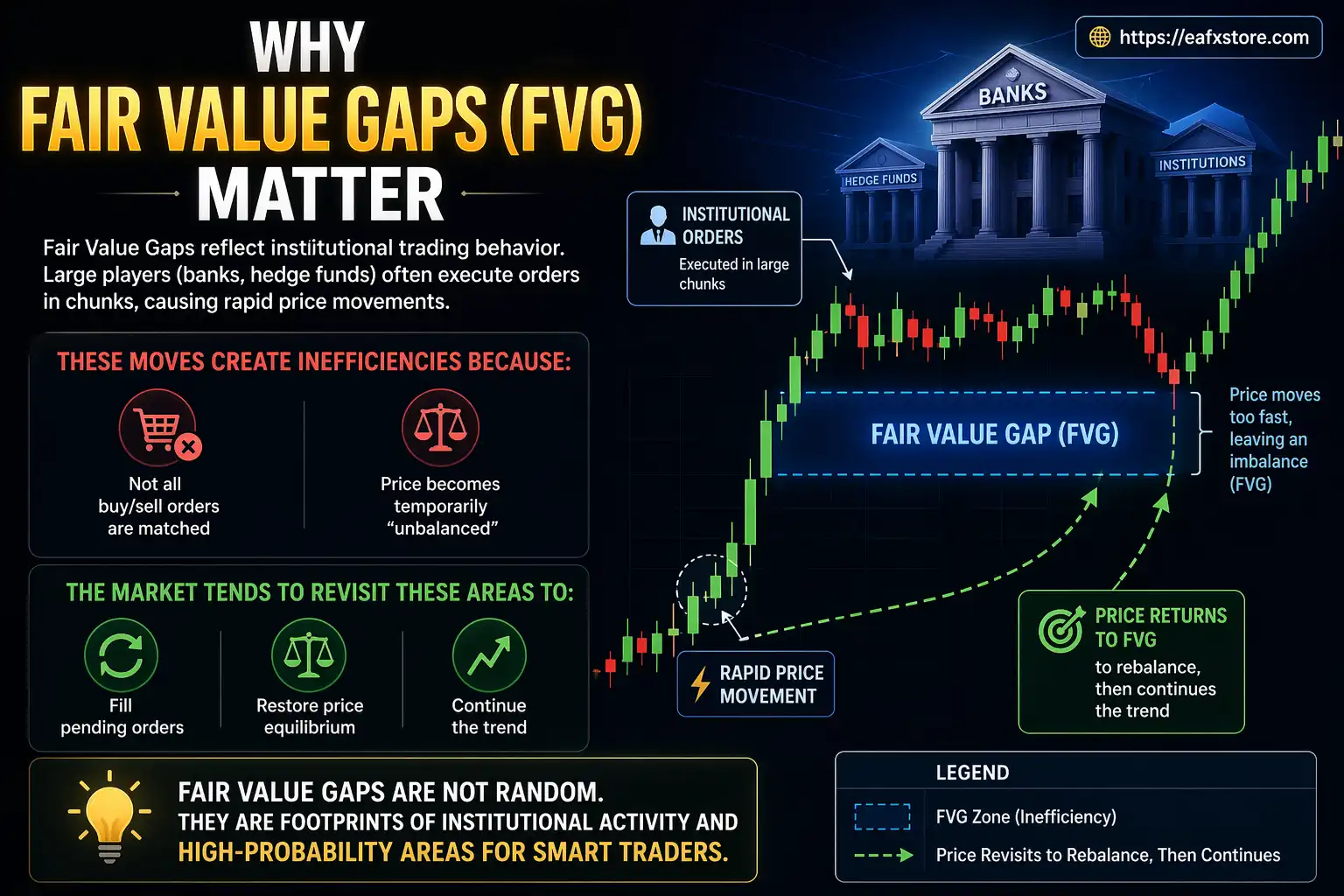
Fair Value Gaps reflect institutional trading behavior. Large players (banks, hedge funds) often execute orders in chunks, causing rapid price movements.
These moves create inefficiencies because:
- Not all buy/sell orders are matched
- Price becomes temporarily “unbalanced”
The market tends to revisit these areas to:
- Fill pending orders
- Restore price equilibrium
- Continue the trend
Types of Fair Value Gaps
Understanding different types of FVGs can help refine your trading decisions.
| Type | Description | Best Use Case |
|---|---|---|
| Bullish FVG | Gap formed during upward momentum | Buy opportunities |
| Bearish FVG | Gap formed during downward momentum | Sell opportunities |
| Continuation FVG | Appears within a strong trend | Trend-following entries |
| Reversal FVG | Appears near key support/resistance zones | Potential reversal setups |
How to Trade Fair Value Gaps
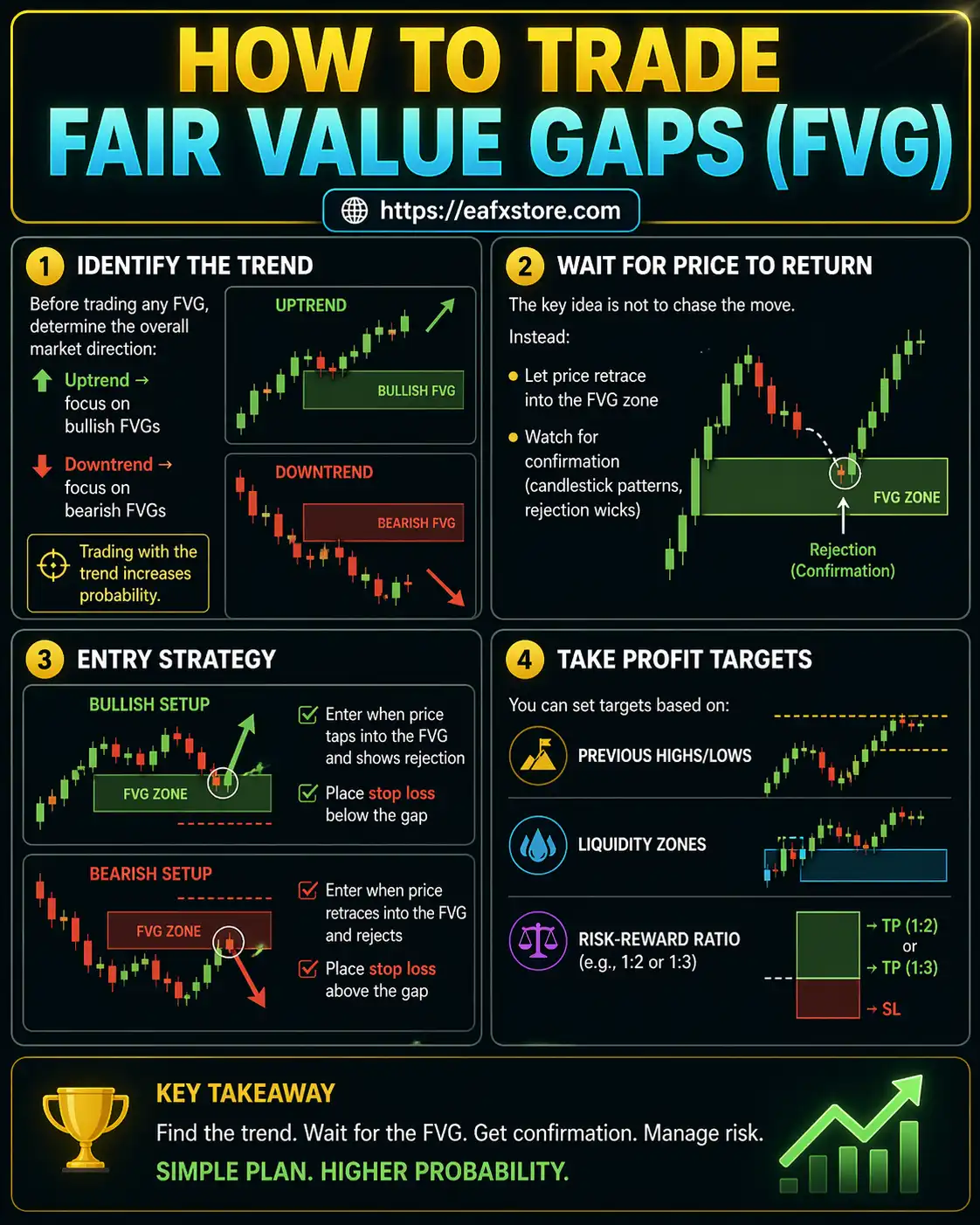
🎯 Identify the Trend
Before trading any FVG, determine the overall market direction:
- Uptrend → focus on bullish FVGs
- Downtrend → focus on bearish FVGs
Trading with the trend increases probability.
🎯 Wait for Price to Return
The key idea is not to chase the move.
Instead:
- Let price retrace into the FVG zone
- Watch for confirmation (candlestick patterns, rejection wicks)
🎯 Entry Strategy
For a bullish setup:
- Enter when price taps into the FVG and shows rejection
- Place stop loss below the gap
For a bearish setup:
- Enter when price retraces into the FVG and rejects
- Place stop loss above the gap
🎯 Take Profit Targets
You can set targets based on:
- Previous highs/lows
- Liquidity zones
- Risk-reward ratio (e.g., 1:2 or 1:3)
Example of an FVG Trade Setup
Let’s say EUR/USD is in an uptrend:
- A strong bullish candle creates a gap
- Price continues higher
- Later, price retraces into the gap
- You enter a buy position inside the FVG
- Price resumes upward movement
This is a classic trend continuation FVG trade.
Common Mistakes to Avoid
Even though FVG is powerful, many traders misuse it. Here are common pitfalls:
🎯 Trading Every Gap
Not all gaps are meaningful. Focus on:
- Strong impulsive moves
- Clear market structure
🎯 Ignoring Market Context
FVGs work best when combined with:
- Support and resistance
- Trend analysis
- Liquidity zones
🎯 Entering Too Early
Always wait for:
- Price to return to the gap
- Confirmation signals
🎯 Poor Risk Management
Never trade without:
- Stop loss
- Defined risk-reward ratio
Combining FVG with Other Concepts
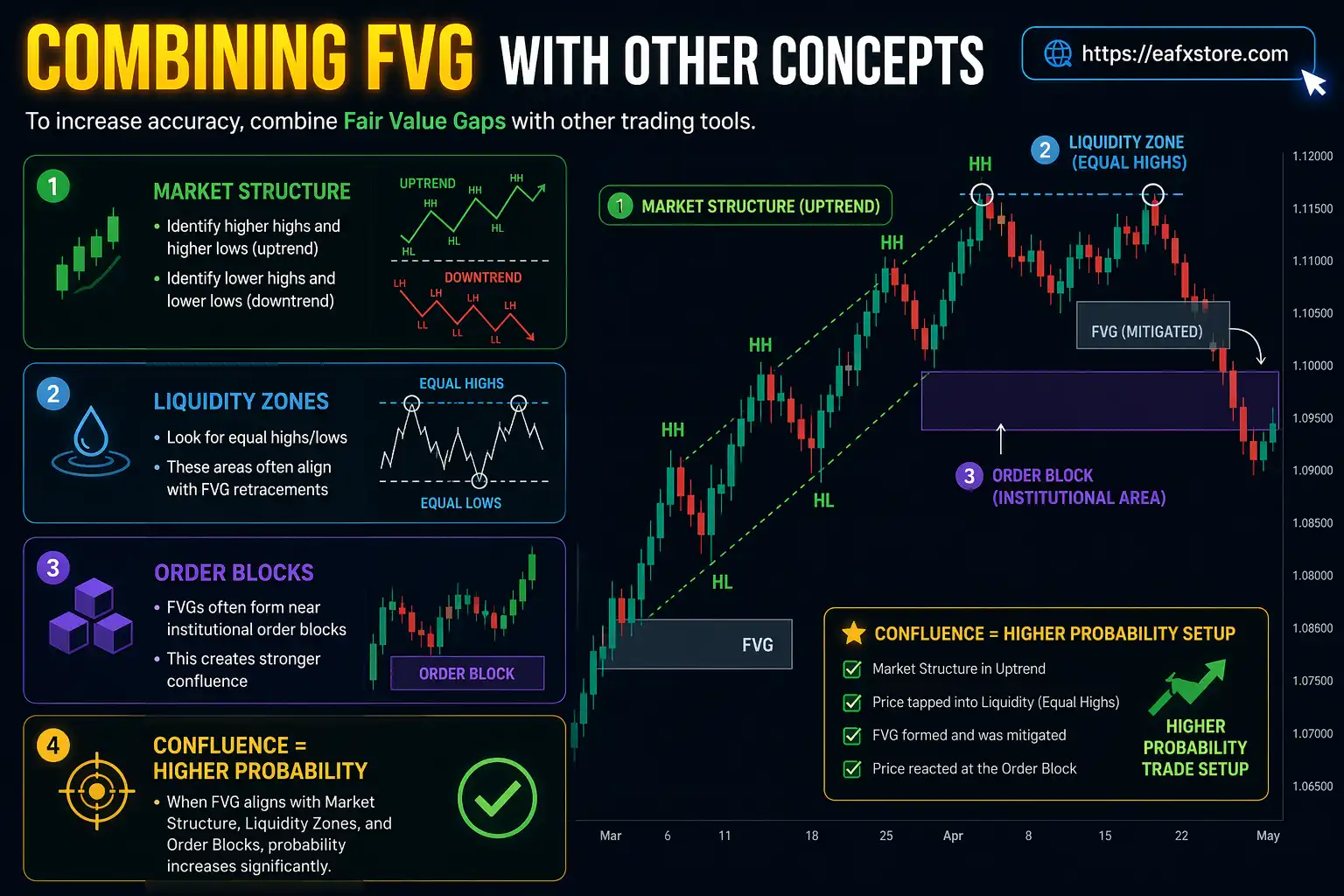
To increase accuracy, combine Fair Value Gaps with other trading tools:
🎯 Market Structure
- Identify higher highs and higher lows (uptrend)
- Identify lower highs and lower lows (downtrend)
🎯 Liquidity Zones
- Look for equal highs/lows
- These areas often align with FVG retracements
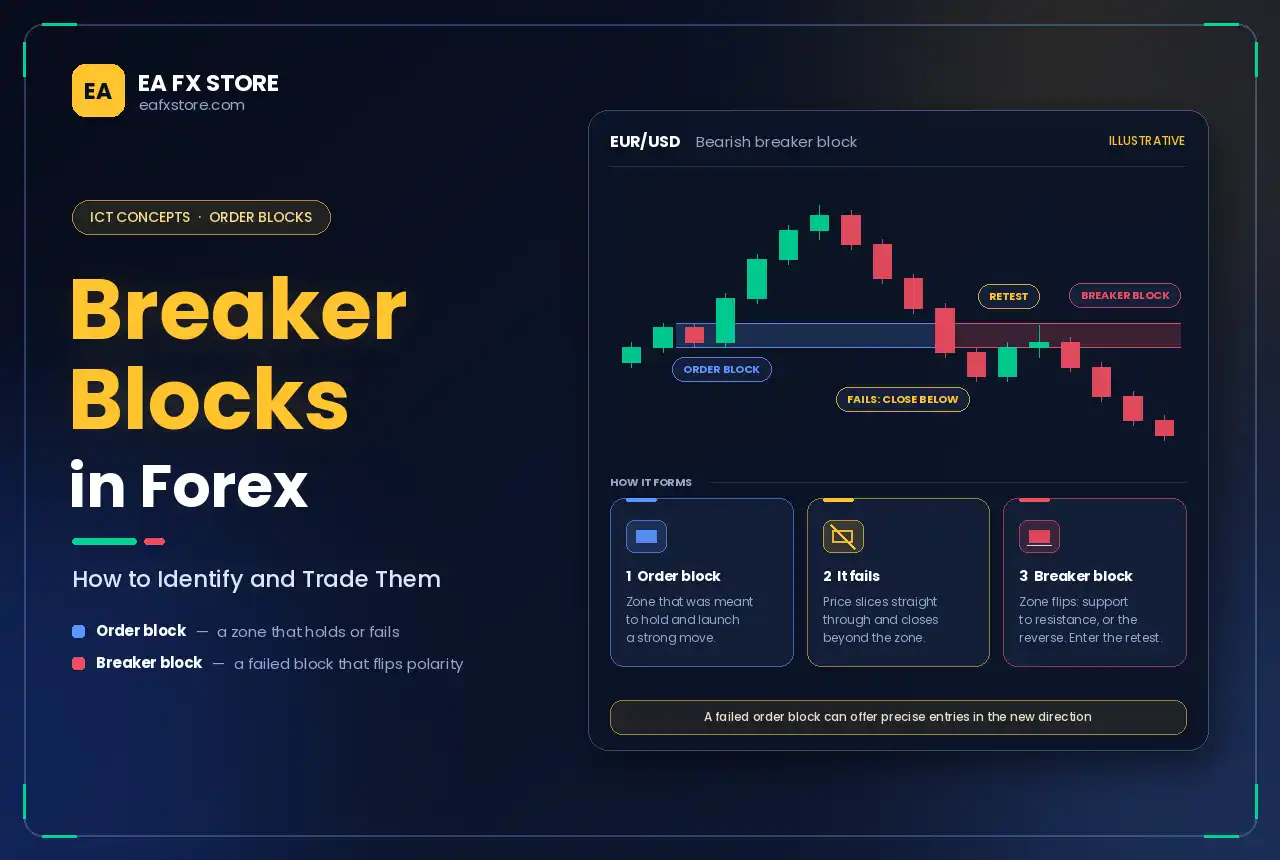
🎯 Order Blocks
- FVGs often form near institutional order blocks
- This creates stronger confluence
Benefits of Trading FVG
- High probability setups when used correctly
- Clear entry zones based on price imbalance
- Works across timeframes (scalping to swing trading)
- Aligns with smart money concepts
Limitations of FVG
- Not all gaps get filled
- Requires patience and discipline
- Can produce false signals in ranging markets
Understanding these limitations helps you avoid overconfidence.
Best Timeframes for FVG Trading
FVG works on all timeframes, but some are more reliable:
| Timeframe | Use Case |
|---|---|
| M5–M15 | Scalping |
| H1–H4 | Intraday trading |
| Daily | Swing trading |
Higher timeframes generally provide stronger signals.
Final Thoughts
Fair Value Gaps offer a powerful way to understand how price moves and where high-probability trading opportunities may exist. By focusing on price imbalances, you’re essentially tracking the footprints of institutional traders.
However, FVG is not a standalone strategy. The real edge comes from combining it with:
- Market structure.
- Liquidity concepts.
- Risk management.
If you approach it with patience and discipline, Fair Value Gaps can become a valuable addition to your Forex trading toolkit.