
Forex trading can feel overwhelming for beginners, especially when trying to identify precise entry and exit points. Among the many tools available, Fibonacci retracement stands out as one of the most widely used and effective methods for technical analysis. Rooted in mathematics yet highly practical in financial markets, Fibonacci tools help traders anticipate price movements with surprising accuracy.
In this guide, you’ll learn what Fibonacci is, how it applies to forex trading and how to use it to improve your entry timing and overall strategy.
What Is Fibonacci and Why Does It Matter in Forex?
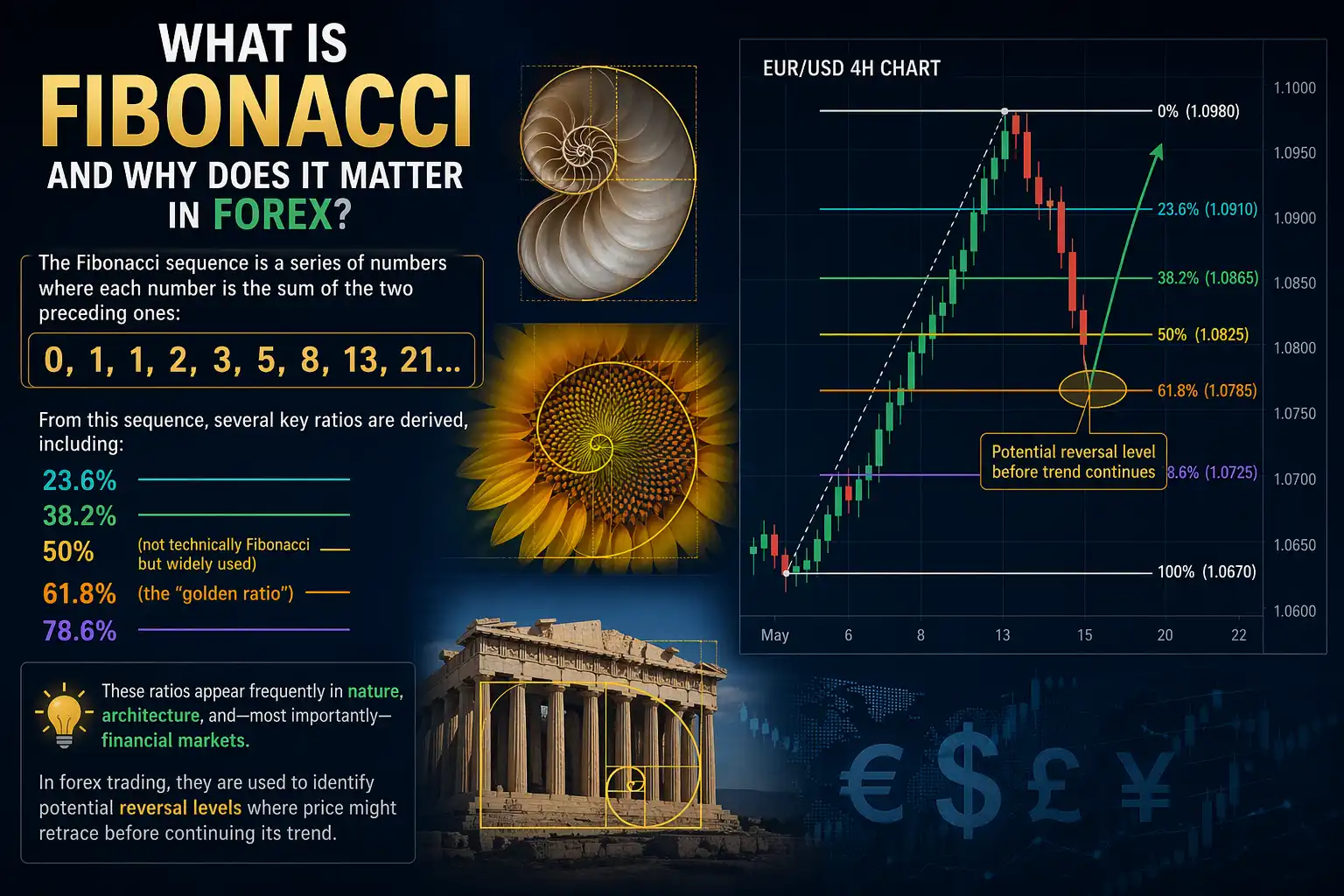
The Fibonacci sequence is a series of numbers where each number is the sum of the two preceding ones:
0, 1, 1, 2, 3, 5, 8, 13, 21…
From this sequence, several key ratios are derived, including:
- 23.6%
- 38.2%
- 50% (not technically Fibonacci but widely used)
- 61.8% (the “golden ratio”)
- 78.6%
These ratios appear frequently in nature, architecture, and—most importantly—financial markets. In forex trading, they are used to identify potential reversal levels where price might retrace before continuing its trend.
Understanding Fibonacci Retracement in Forex
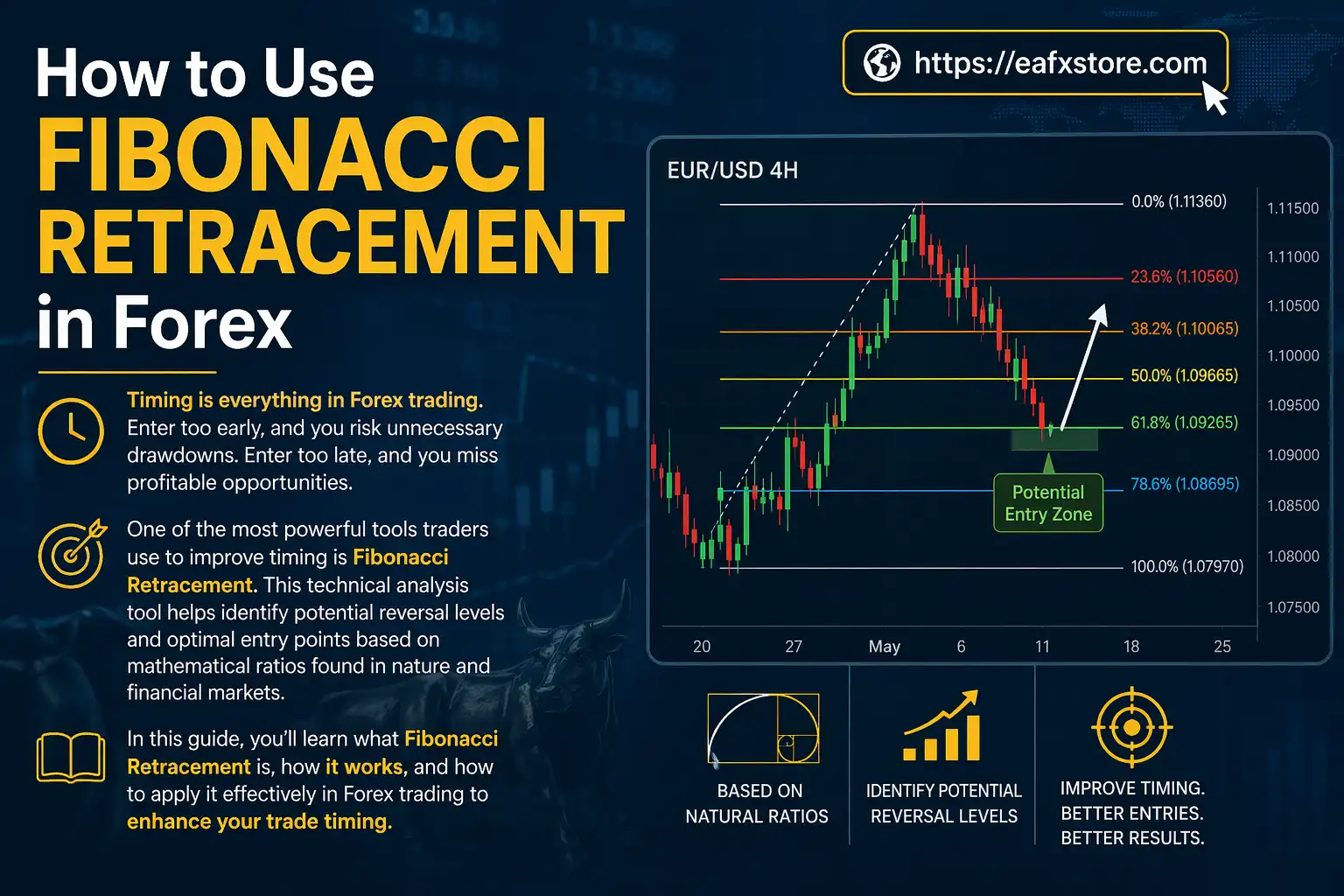
Fibonacci retracement is a technical analysis tool that helps traders identify potential support and resistance levels. These levels are drawn by measuring the distance between a significant high and low on a price chart.
Once plotted, horizontal lines appear at key Fibonacci levels, indicating where price corrections may pause or reverse.
Why Traders Use Fibonacci Retracement:
- Predict entry points: Helps identify where to enter a trade during a pullback
- Set stop-loss levels: Provides logical areas to limit risk
- Determine take-profit zones: Helps anticipate where price might reverse
How to Draw Fibonacci Retracement Correctly
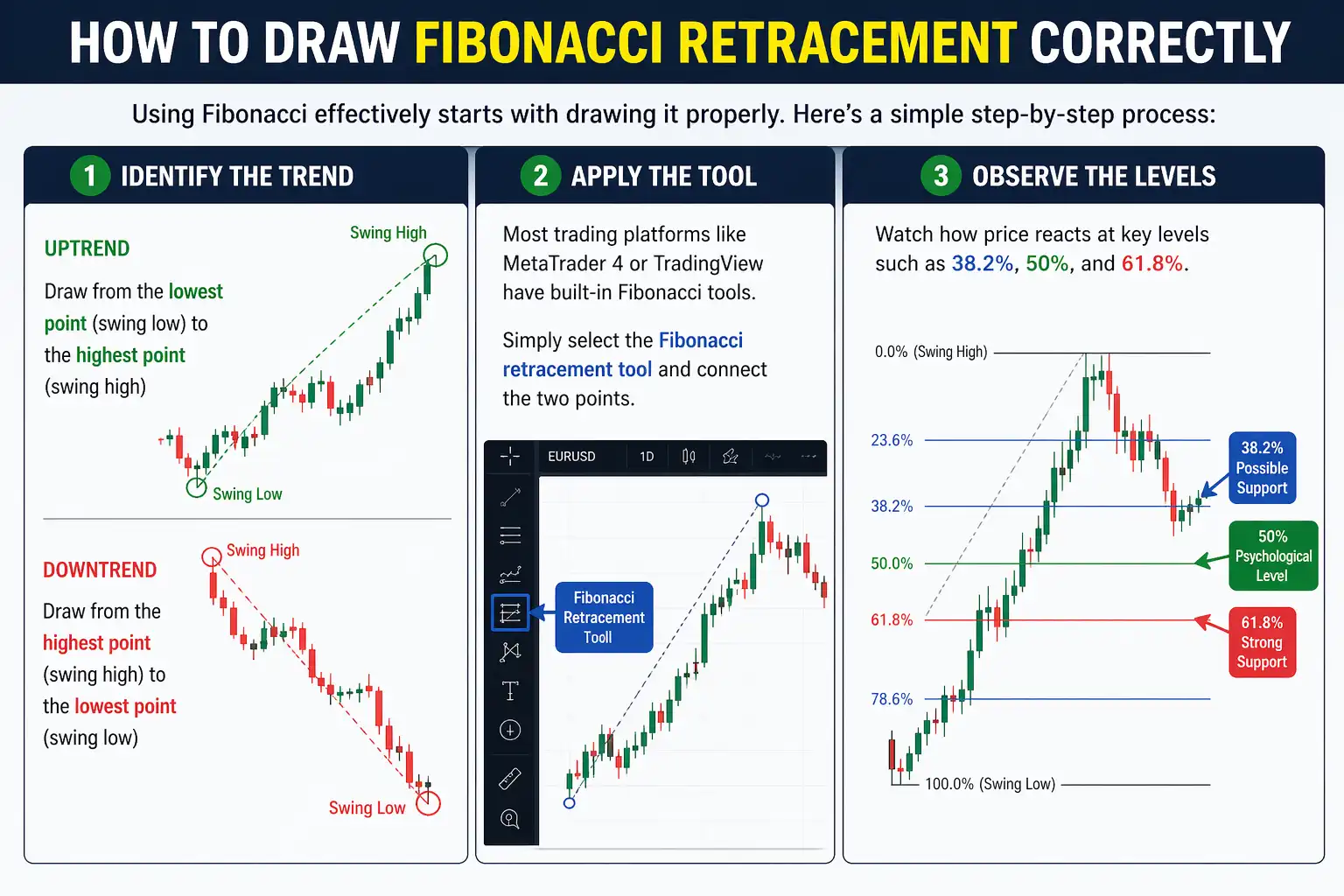
Using Fibonacci effectively starts with drawing it properly. Here’s a simple step-by-step process:
1. Identify the Trend
- In an uptrend, draw from the lowest point (swing low) to the highest point (swing high)
- In a downtrend, draw from the highest point to the lowest point
2. Apply the Tool
Most trading platforms like MetaTrader 4 or TradingView have built-in Fibonacci tools. Simply select the Fibonacci retracement tool and connect the two points.
3. Observe the Levels
Watch how price reacts at key levels such as 38.2%, 50%, and 61.8%.
Key Fibonacci Levels and Their Meaning
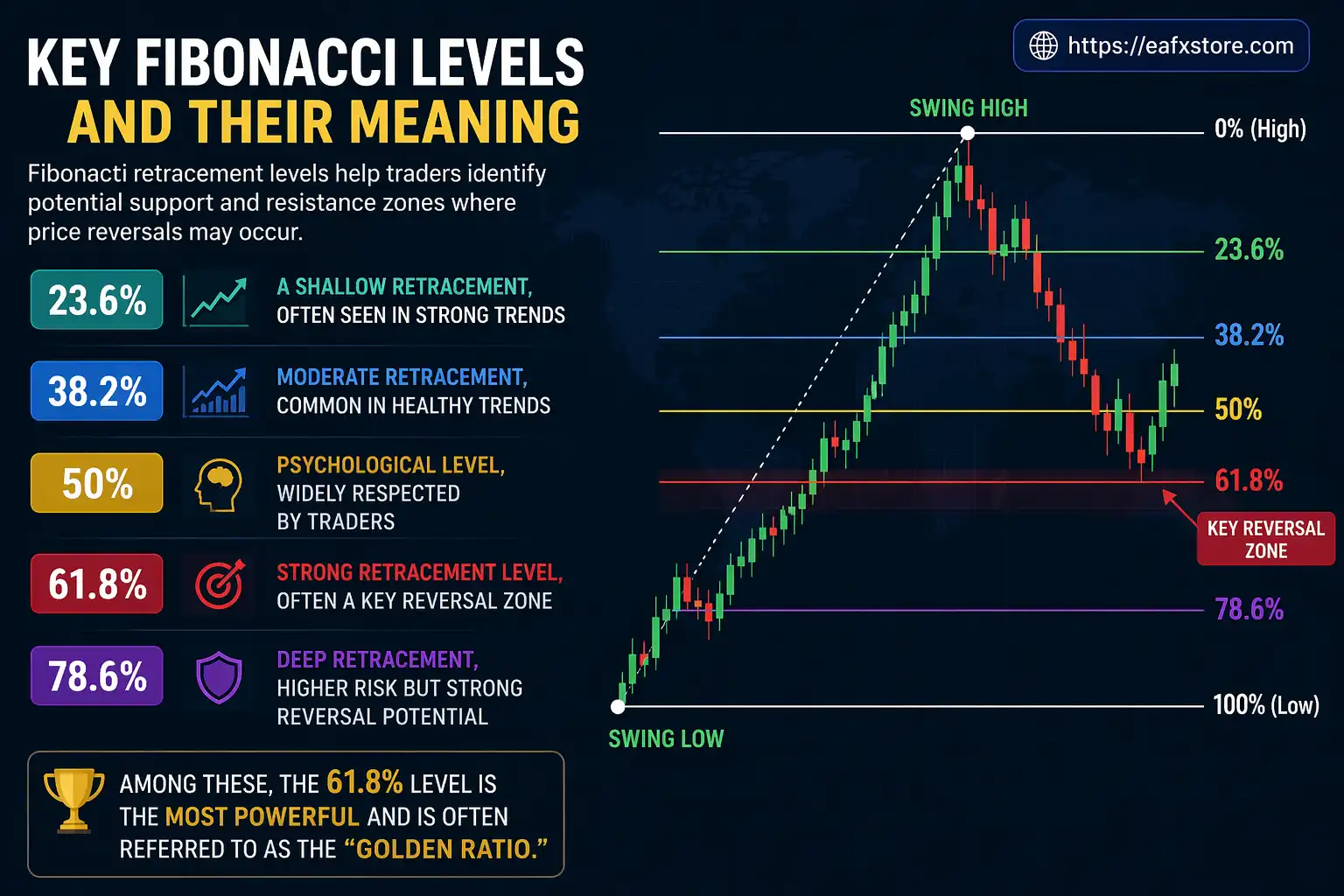
Each Fibonacci level has its own significance in forex trading:
- 23.6%: A shallow retracement, often seen in strong trends
- 38.2%: Moderate retracement, common in healthy trends
- 50%: Psychological level, widely respected by traders
- 61.8%: Strong retracement level, often a key reversal zone
- 78.6%: Deep retracement, higher risk but strong reversal potential
Among these, the 61.8% level is considered the most powerful and is often referred to as the “golden ratio.”
How to Use Fibonacci for Accurate Entry Points
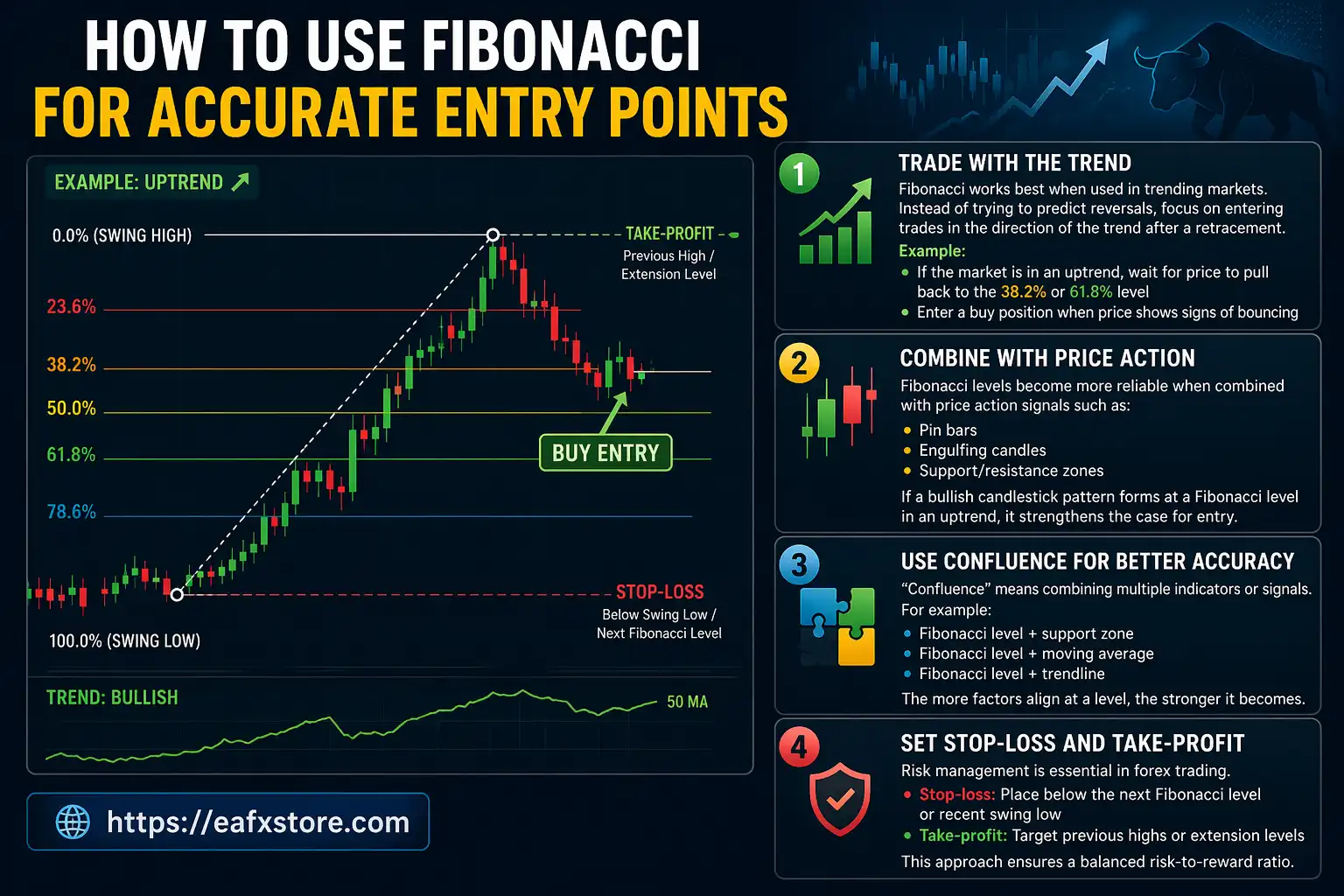
1. Trade with the Trend
Fibonacci works best when used in trending markets. Instead of trying to predict reversals, focus on entering trades in the direction of the trend after a retracement.
Example:
- If the market is in an uptrend, wait for price to pull back to the 38.2% or 61.8% level
- Enter a buy position when price shows signs of bouncing
2. Combine with Price Action
Fibonacci levels become more reliable when combined with price action signals such as:
- Pin bars
- Engulfing candles
- Support/resistance zones
If a bullish candlestick pattern forms at a Fibonacci level in an uptrend, it strengthens the case for entry.
3. Use Confluence for Better Accuracy
“Confluence” means combining multiple indicators or signals. For example:
- Fibonacci level + support zone
- Fibonacci level + moving average
- Fibonacci level + trendline
The more factors align at a level, the stronger it becomes.
4. Set Stop-Loss and Take-Profit
Risk management is essential in forex trading.
- Stop Loss (SL): Place below the next Fibonacci level or recent swing low
- Take Profit (TP): Target previous highs or extension levels
This approach ensures a balanced risk-to-reward ratio.
Fibonacci Extensions for Profit Targets
While retracement helps identify entry points, Fibonacci extensions are used to project profit targets.
Common extension levels include:
- 127.2%
- 161.8%
- 261.8%
For example, after entering a trade at the 61.8% retracement, you might set your take-profit near the 161.8% extension level.
Common Mistakes Beginners Should Avoid
Even though Fibonacci is powerful, misuse can lead to poor results. Here are some common mistakes:
1. Drawing Fibonacci Incorrectly
Using the wrong swing points can produce misleading levels.
2. Ignoring the Trend
Fibonacci works best in trending markets, not sideways conditions.
3. Over-reliance on Fibonacci Alone
It should be used alongside other tools, not as a standalone strategy.
4. Entering Trades Without Confirmation
Always wait for price action or confirmation signals before entering.
Practical Example of Fibonacci in Forex
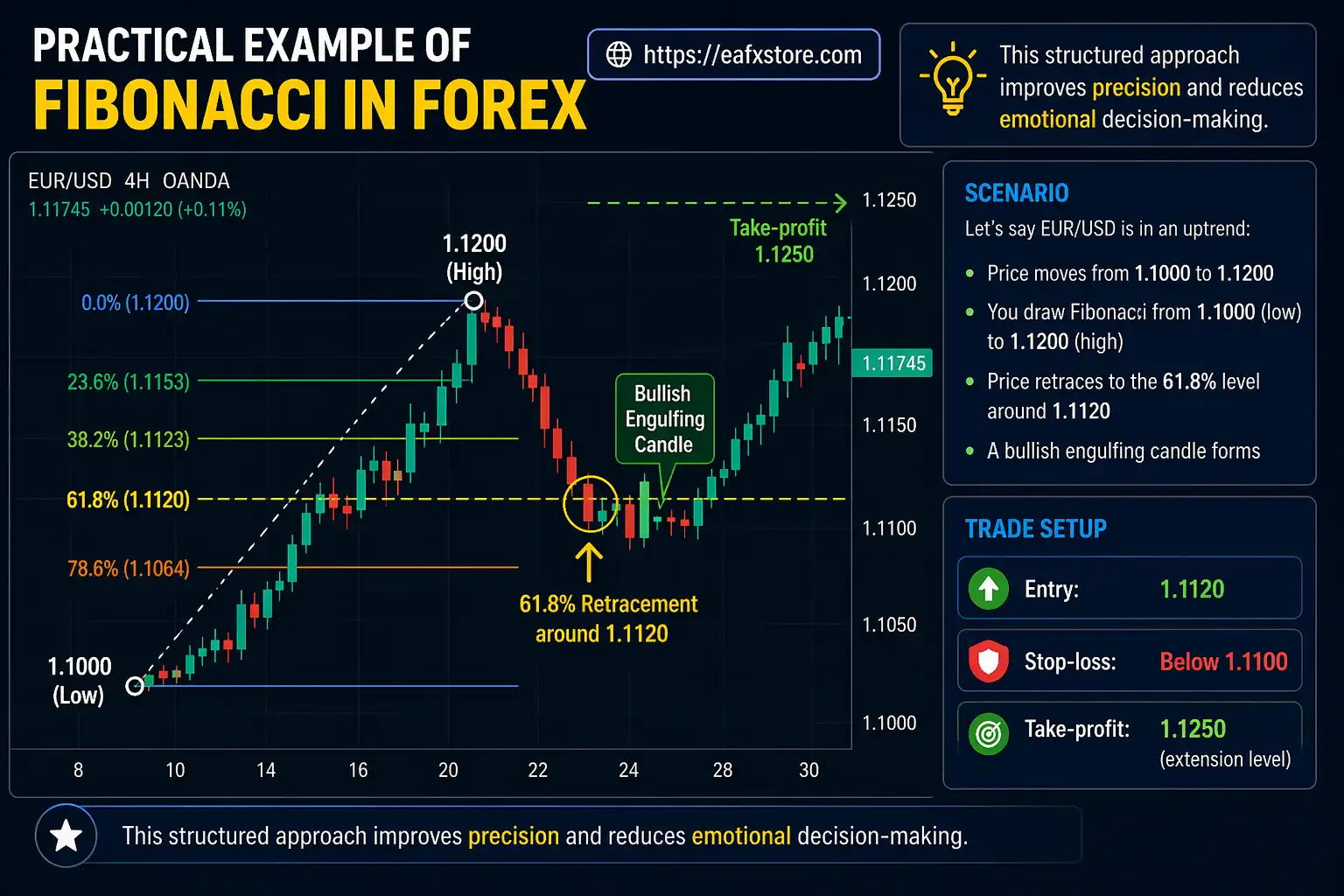
Let’s say EUR/USD is in an uptrend:
- Price moves from 1.1000 to 1.1200
- You draw Fibonacci from 1.1000 (low) to 1.1200 (high)
- Price retraces to the 61.8% level around 1.1120
- A bullish engulfing candle forms
Trade setup:
- Entry: 1.1120
- Stop-loss: Below 1.1100
- Take-profit: 1.1250 (extension level)
This structured approach improves precision and reduces emotional decision-making.
Advantages of Using Fibonacci in Forex
- Easy to use and widely available on trading platforms
- Works across all timeframes
- Helps identify high-probability entry points
- Enhances risk management
Limitations to Keep in Mind
- Not always accurate in volatile or sideways markets
- Requires experience to identify correct swing points
- Should not be used in isolation
Understanding these limitations will help you use Fibonacci more effectively.
Tips for Mastering Fibonacci Trading
- Practice on demo accounts before trading live
- Combine with other indicators like RSI or MACD
- Focus on higher timeframes for stronger signals
- Keep your charts clean—avoid overcomplication
Consistency and discipline matter more than the tool itself.
Conclusion
Fibonacci retracement is one of the most valuable tools in forex trading, especially for beginners seeking accurate entry points. By understanding key levels, aligning with the trend, and combining Fibonacci with other technical signals, you can significantly improve your trading decisions.
However, like any strategy, success depends on practice, patience and proper risk management. Start simple, refine your approach over time, and you’ll find Fibonacci becoming a reliable part of your trading toolkit.