
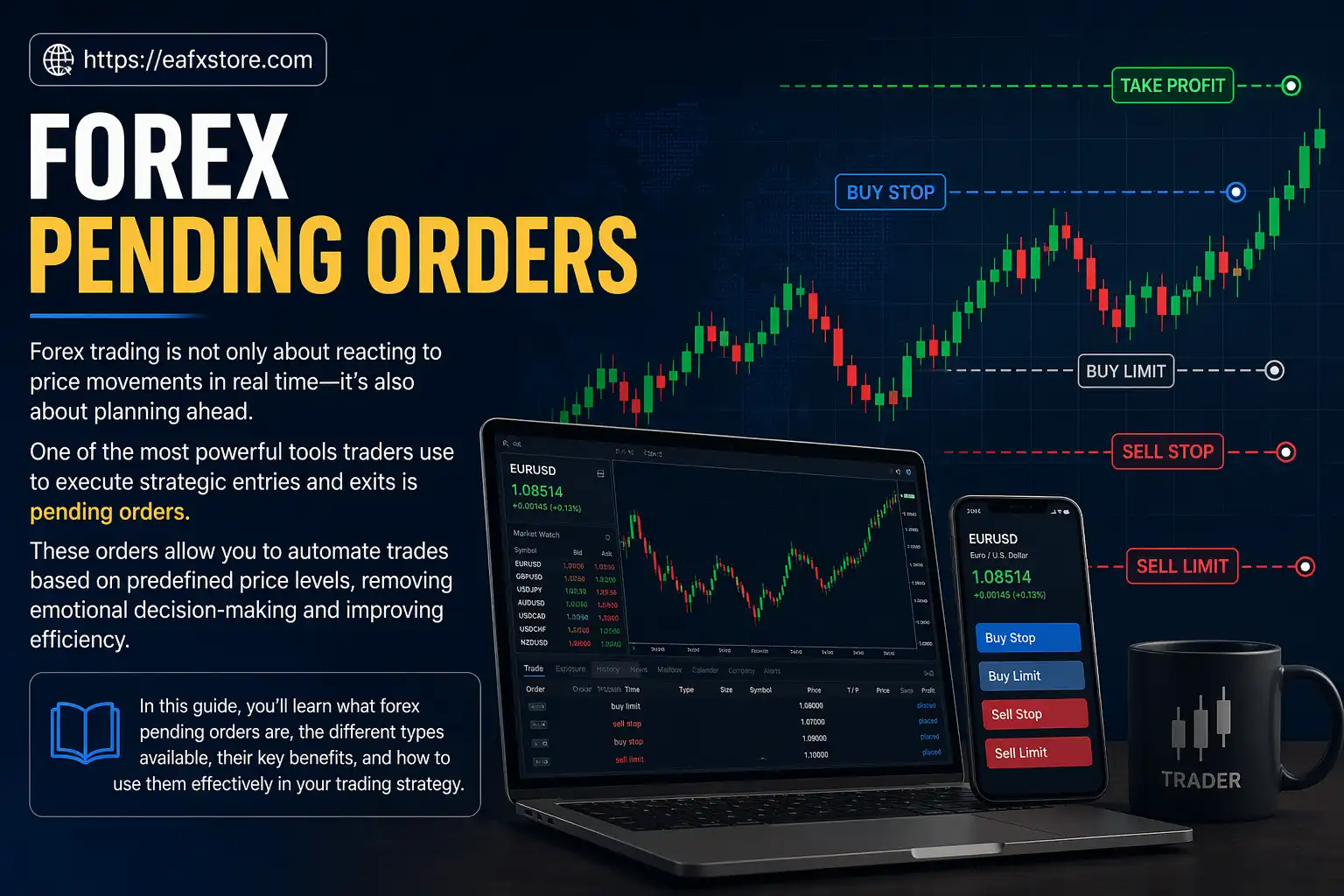
Forex trading is not only about reacting to price movements in real time—it’s also about planning ahead. One of the most powerful tools traders use to execute strategic entries and exits is pending orders. These orders allow you to automate trades based on predefined price levels, removing emotional decision-making and improving efficiency.
In this guide, you’ll learn what forex pending orders are, the different types available, their key benefits and how to use them effectively in your trading strategy.
What Are Forex Pending Orders?
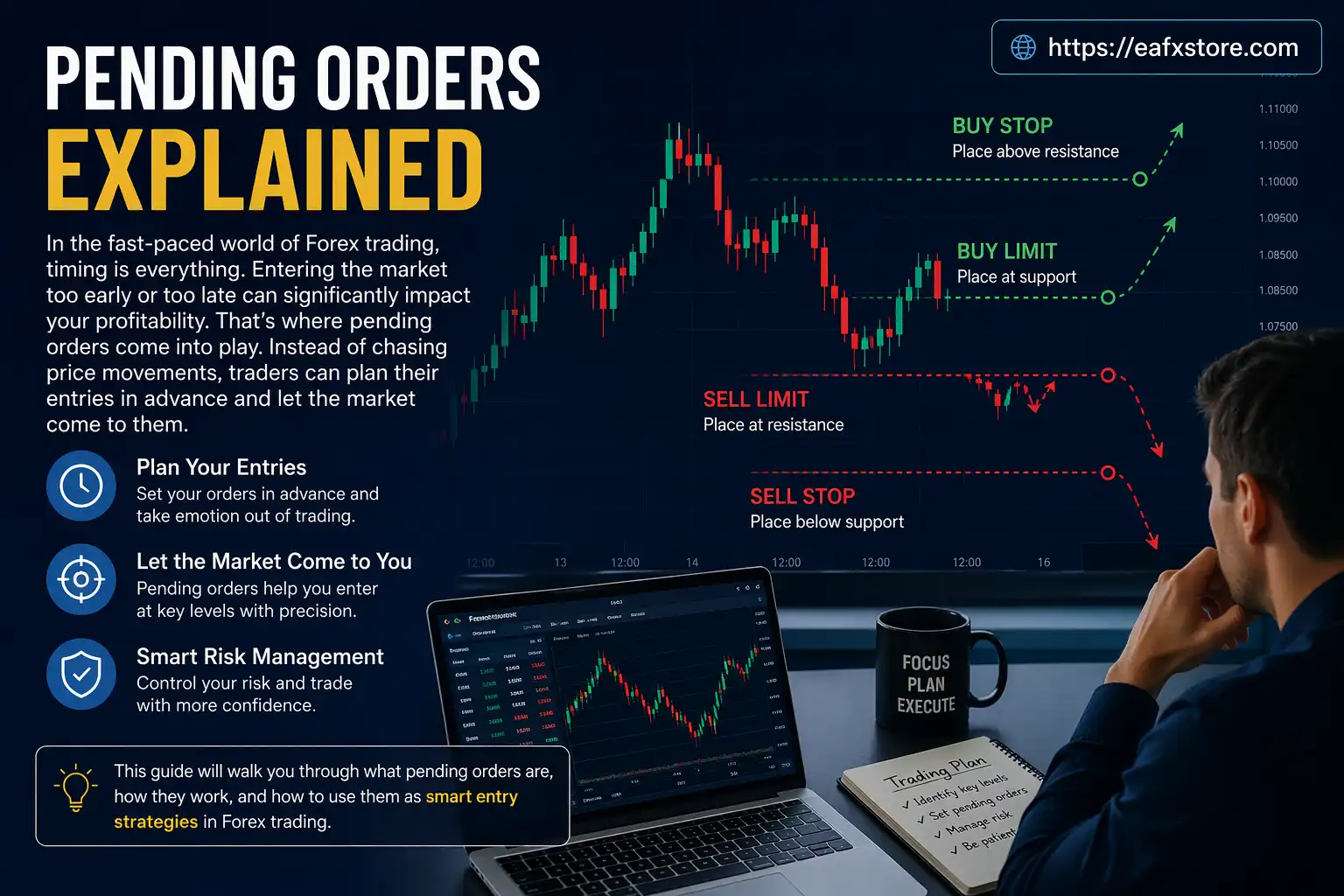
A Pending Order in forex is an instruction you give your broker to execute a trade at a specific price level in the future. Unlike market orders—which are executed instantly at the current market price—pending orders only activate when the market reaches your desired price.
This means you don’t have to sit in front of your screen waiting for the right moment. Instead, you set your conditions in advance and let the market do the rest.
Types of Forex Pending Orders
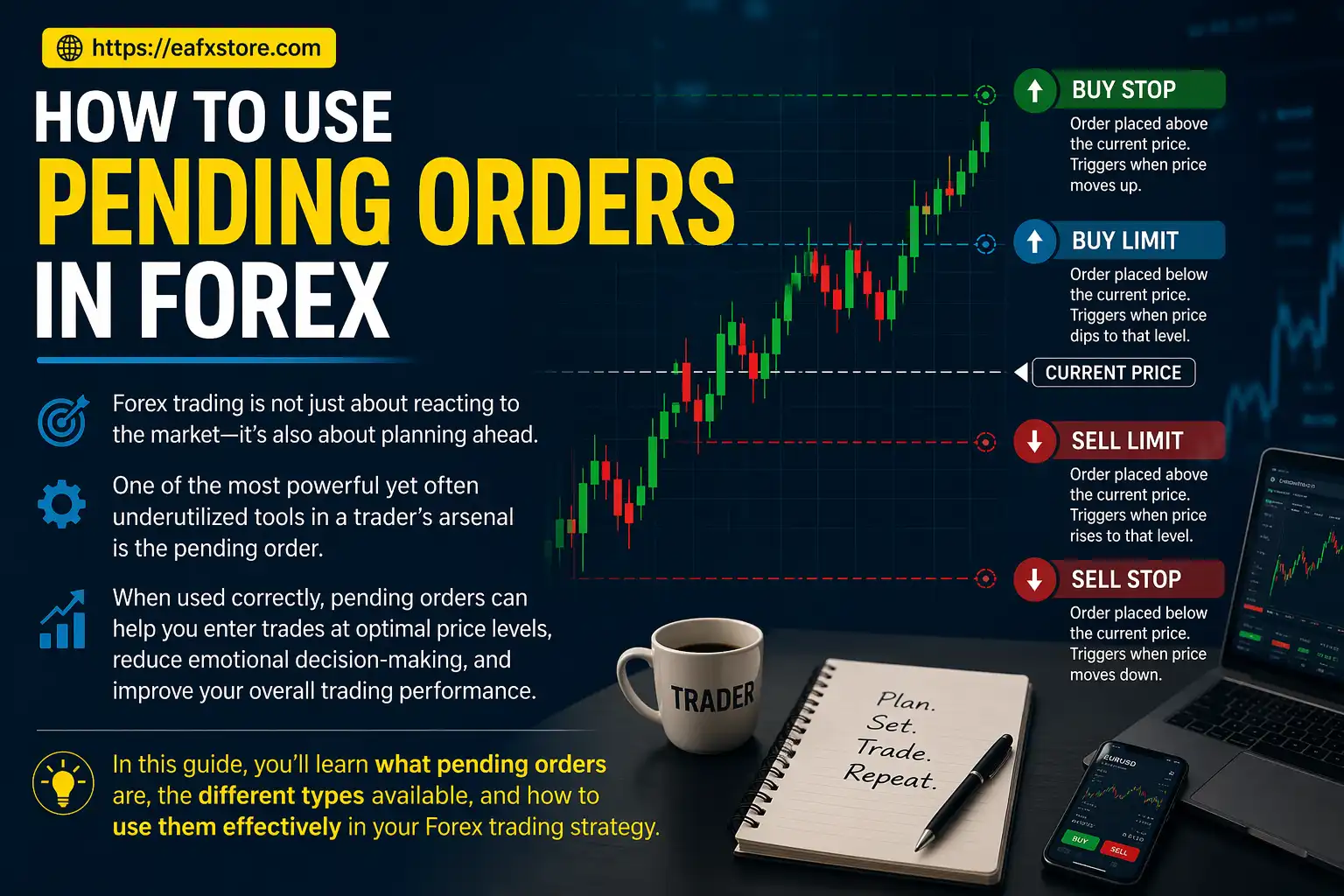
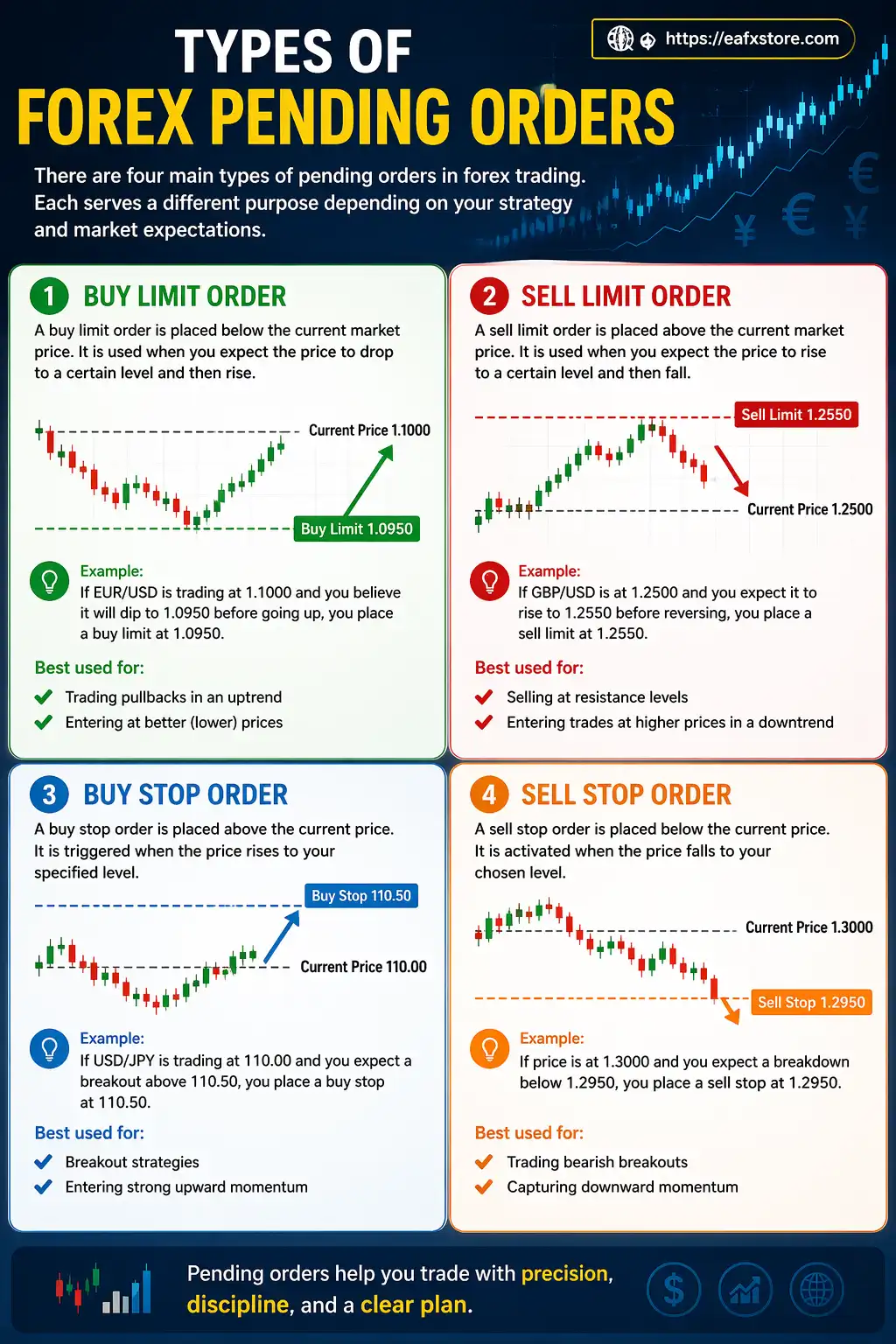
There are four main types of pending orders in forex trading. Each serves a different purpose depending on your strategy and market expectations.
1. Buy Limit Order
A buy limit order is placed below the current market price. It is used when you expect the price to drop to a certain level and then rise.
Example:
If EUR/USD is trading at 1.1000 and you believe it will dip to 1.0950 before going up, you place a buy limit at 1.0950.
Best used for:
- Trading pullbacks in an uptrend.
- Entering at better (lower) prices.
2. Sell Limit Order
A sell limit order is placed above the current market price. It is used when you expect the price to rise to a certain level and then fall.
Example:
If GBP/USD is at 1.2500 and you expect it to rise to 1.2550 before reversing, you place a sell limit at 1.2550.
Best used for:
- Selling at resistance levels.
- Entering trades at higher prices in a downtrend.
3. Buy Stop Order
A buy stop order is placed above the current price. It is triggered when the price rises to your specified level.
Example:
If USD/JPY is trading at 110.00 and you expect a breakout above 110.50, you place a buy stop at 110.50.
Best used for:
- Breakout strategies.
- Entering strong upward momentum.
4. Sell Stop Order
A sell stop order is placed below the current price. It is activated when the price falls to your chosen level.
Example:
If price is at 1.3000 and you expect a breakdown below 1.2950, you place a sell stop at 1.2950.
Best used for:
- Trading bearish breakouts.
- Capturing downward momentum.
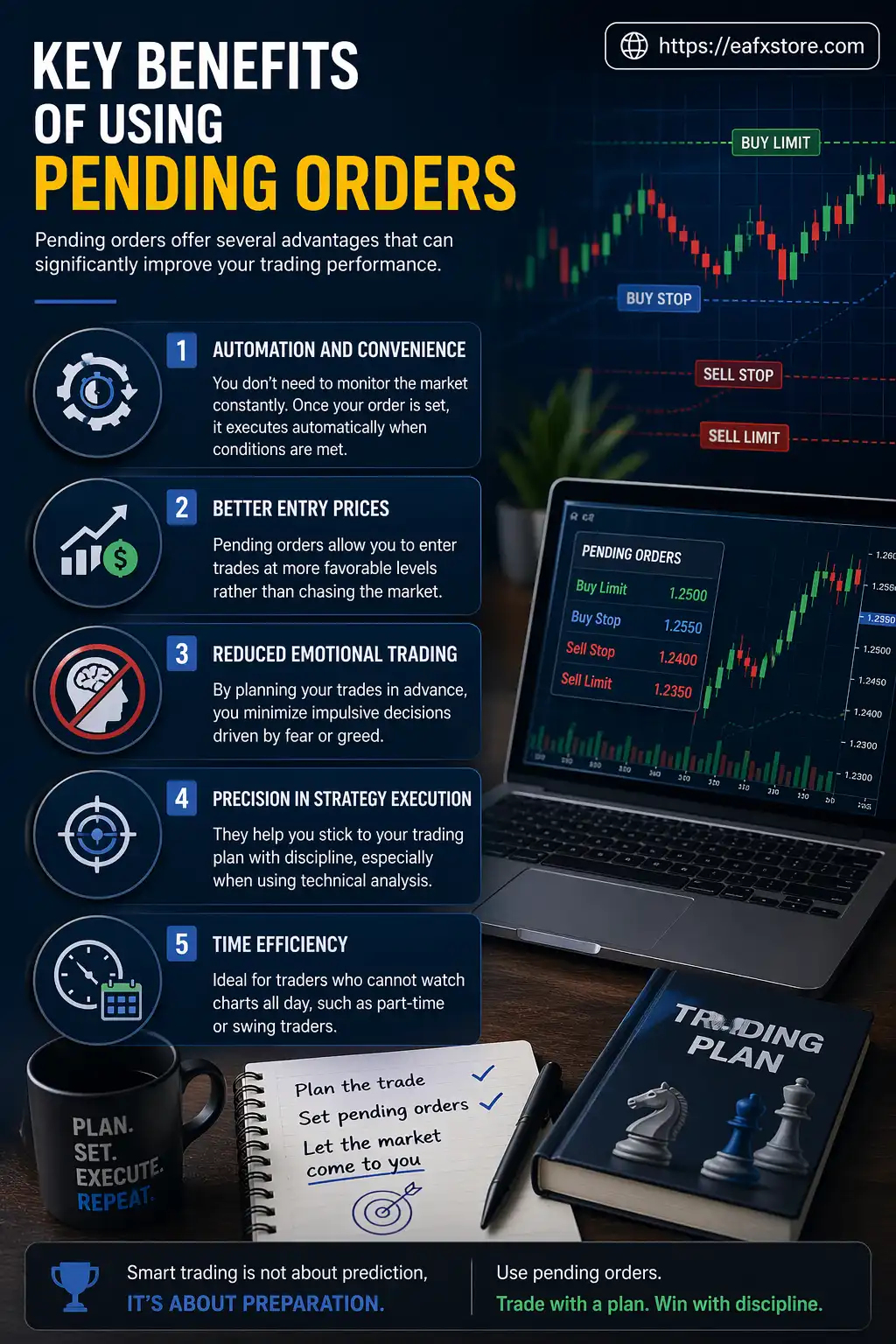
Key Benefits of Using Pending Orders
Pending orders offer several advantages that can significantly improve your trading performance.
- Automation and Convenience: You don’t need to monitor the market constantly. Once your order is set, it executes automatically when conditions are met.
- Better Entry Prices: Pending orders allow you to enter trades at more favorable levels rather than chasing the market.
- Reduced Emotional Trading: By planning your trades in advance, you minimize impulsive decisions driven by fear or greed.
- Precision in Strategy Execution: They help you stick to your trading plan with discipline, especially when using technical analysis.
- Time Efficiency: Ideal for traders who cannot watch charts all day, such as part-time or swing traders.
How to Use Pending Orders Effectively
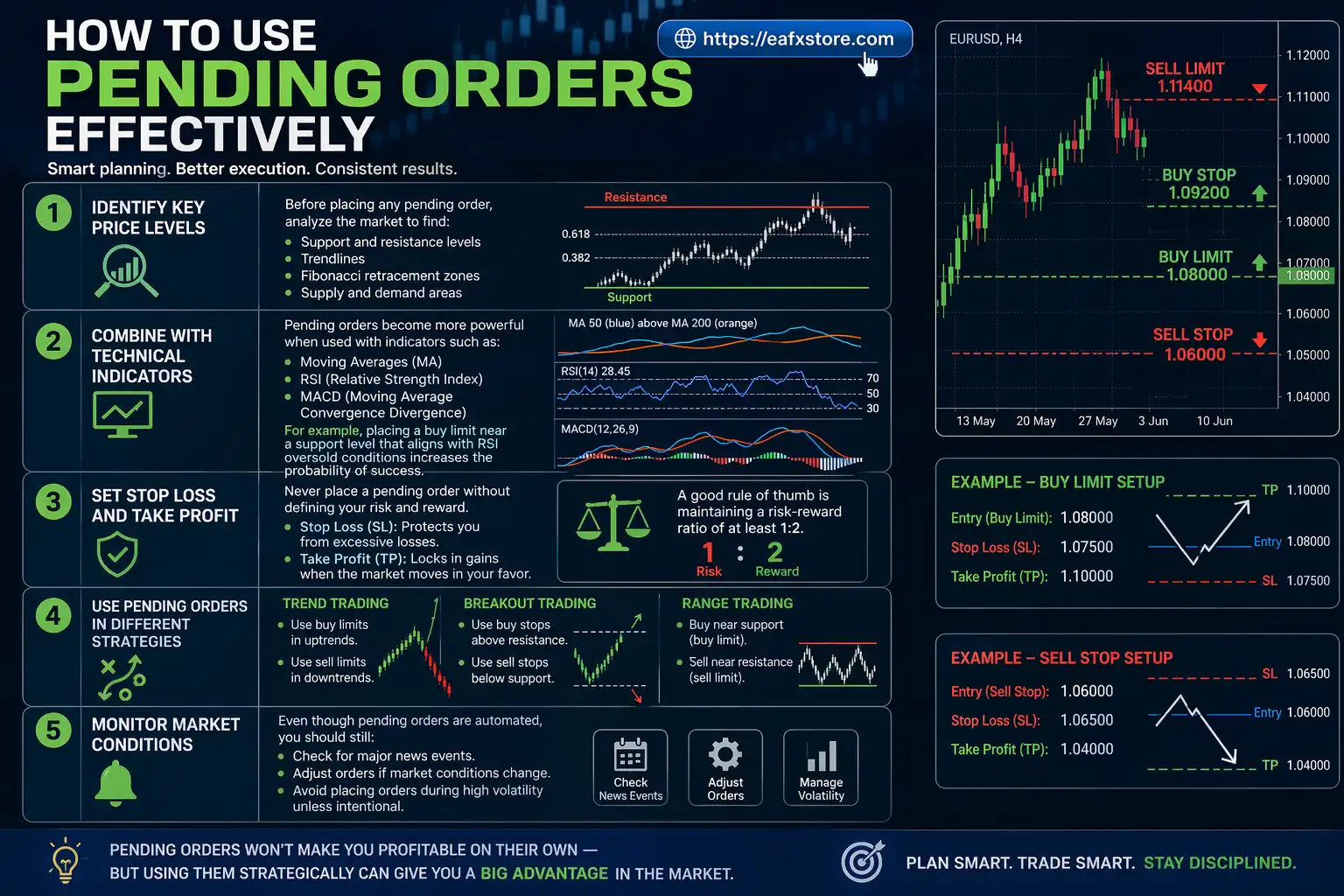
Using pending orders correctly requires more than just placing them randomly. Here are some practical steps to help you maximize their effectiveness.
1. Identify Key Price Levels
Before placing any pending order, analyze the market to find:
- Support and resistance levels.
- Trendlines.
- Fibonacci retracement zones.
- Supply and demand areas.
These levels act as logical points for placing pending orders.
2. Combine with Technical Indicators
Pending orders become more powerful when used with indicators such as:
- Moving Averages (MA).
- RSI (Relative Strength Index).
- MACD (Moving Average Convergence Divergence).
For example, placing a buy limit near a support level that aligns with RSI oversold conditions increases the probability of success.
3. Set Stop Loss and Take Profit
Never place a pending order without defining your risk and reward.
- Stop Loss (SL): Protects you from excessive losses.
- Take Profit (TP): Locks in gains when the market moves in your favor.
A good rule of thumb is maintaining a risk-reward ratio of at least 1:2.
4. Use Pending Orders in Different Strategies
Trend Trading:
- Use buy limits in uptrends.
- Use sell limits in downtrends.
Breakout Trading:
- Use buy stops above resistance.
- Use sell stops below support.
Range Trading:
- Buy near support (buy limit).
- Sell near resistance (sell limit)
5. Monitor Market Conditions
Even though pending orders are automated, you should still:
- Check for major news events.
- Adjust orders if market conditions change.
- Avoid placing orders during high volatility unless intentional.
Common Mistakes to Avoid
While pending orders are useful, misuse can lead to losses. Here are some common pitfalls:
- Placing Orders Without Analysis: Randomly setting pending orders without technical or fundamental reasoning is risky.
- Ignoring Market News: Economic announcements can cause sudden price spikes that trigger orders unexpectedly.
- Setting Orders Too Close to Current Price: This can lead to premature execution due to normal market fluctuations.
- Forgetting to Set Stop Loss: Even a well-placed pending order can go wrong without proper risk management.
- Overusing Pending Orders: Too many open pending orders can create confusion and overexposure.
Practical Example of a Pending Order Setup
Let’s say EUR/USD is in an uptrend and currently trading at 1.1000.
- You identify a support level at 1.0950.
- RSI indicates oversold conditions near that level.
- You place a buy limit at 1.0950.
- Set stop loss at 1.0920.
- Set take profit at 1.1050.
This setup allows you to enter the market at a better price with a defined risk-reward ratio.
When Should You Use Pending Orders?
Pending orders are especially useful when:
- You have a clear trading plan.
- You cannot monitor the market continuously.
- You want to trade breakouts or pullbacks.
- You aim to reduce emotional decision-making.
They are suitable for both beginners and experienced traders, as long as they are used with proper analysis and discipline.
Final Thoughts
Forex pending orders are essential tools that help traders plan ahead, execute strategies with precision and manage risk effectively. By understanding the different types—buy limit, sell limit, buy stop, and sell stop—you can adapt to various market conditions and trading styles.
The key to success lies in combining pending orders with solid technical analysis, proper risk management and continuous learning. When used correctly, they can significantly improve your trading efficiency and consistency.