
Introduction to Awesome Oscillator (AO)
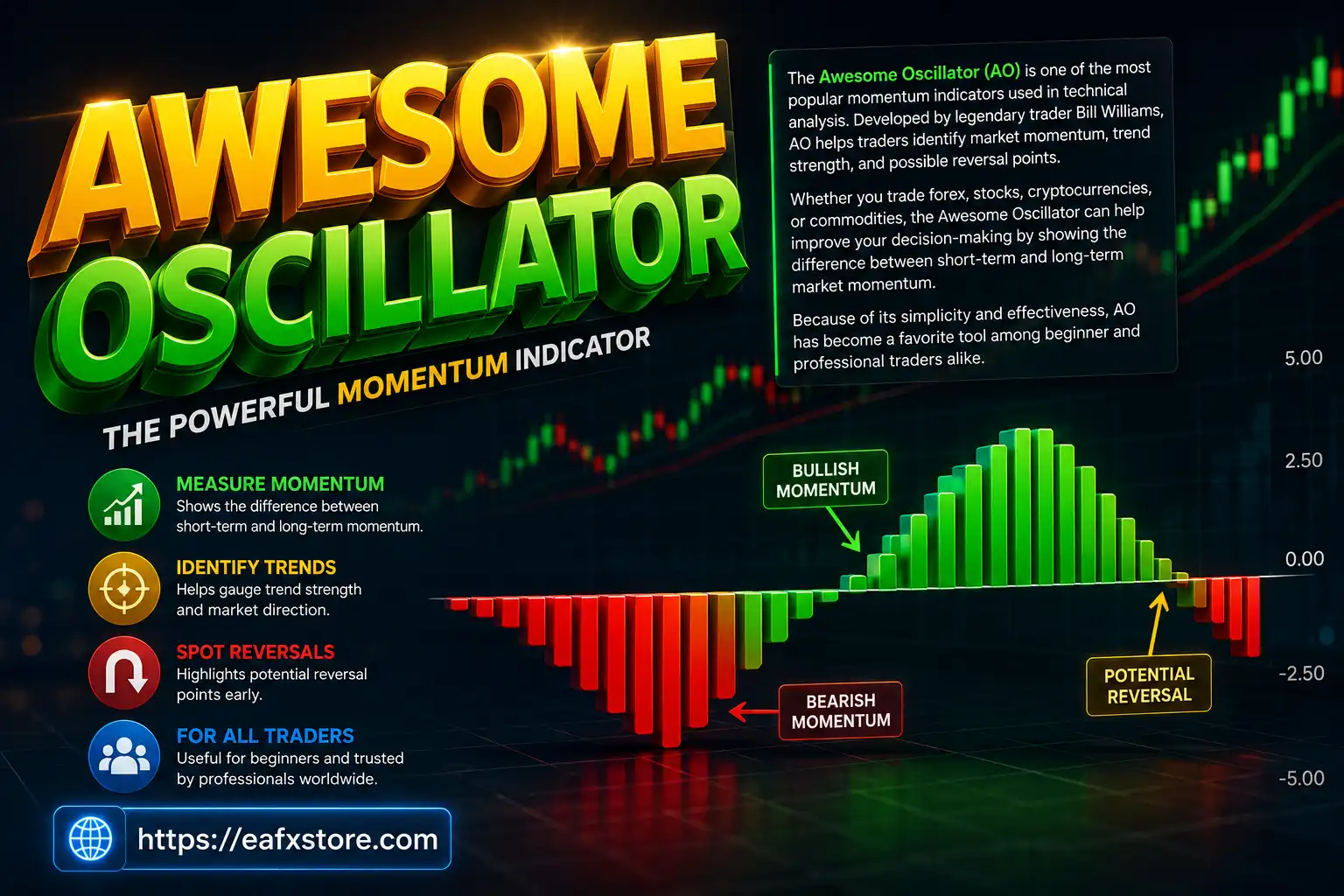
The Awesome Oscillator (AO) is one of the most popular momentum indicators used in technical analysis. Developed by legendary trader Bill Williams, AO helps traders identify market momentum, trend strength, and possible reversal points.
Whether you trade forex, stocks, cryptocurrencies, or commodities, the Awesome Oscillator can help improve your decision-making by showing the difference between short-term and long-term market momentum. Because of its simplicity and effectiveness, AO has become a favorite tool among beginner and professional traders alike.
What Is the Awesome Oscillator?
The Awesome Oscillator is a histogram-based technical indicator that measures market momentum. It compares recent market momentum with a broader momentum period to determine whether buyers or sellers are gaining control.
The indicator appears below the price chart as bars that fluctuate above and below a zero line.
- Green bars indicate increasing momentum.
- Red bars indicate decreasing momentum.
- Bars above zero suggest bullish momentum.
- Bars below zero suggest bearish momentum.
AO is widely used to confirm trends and identify potential reversals before major price movements happen.
How the Awesome Oscillator Works
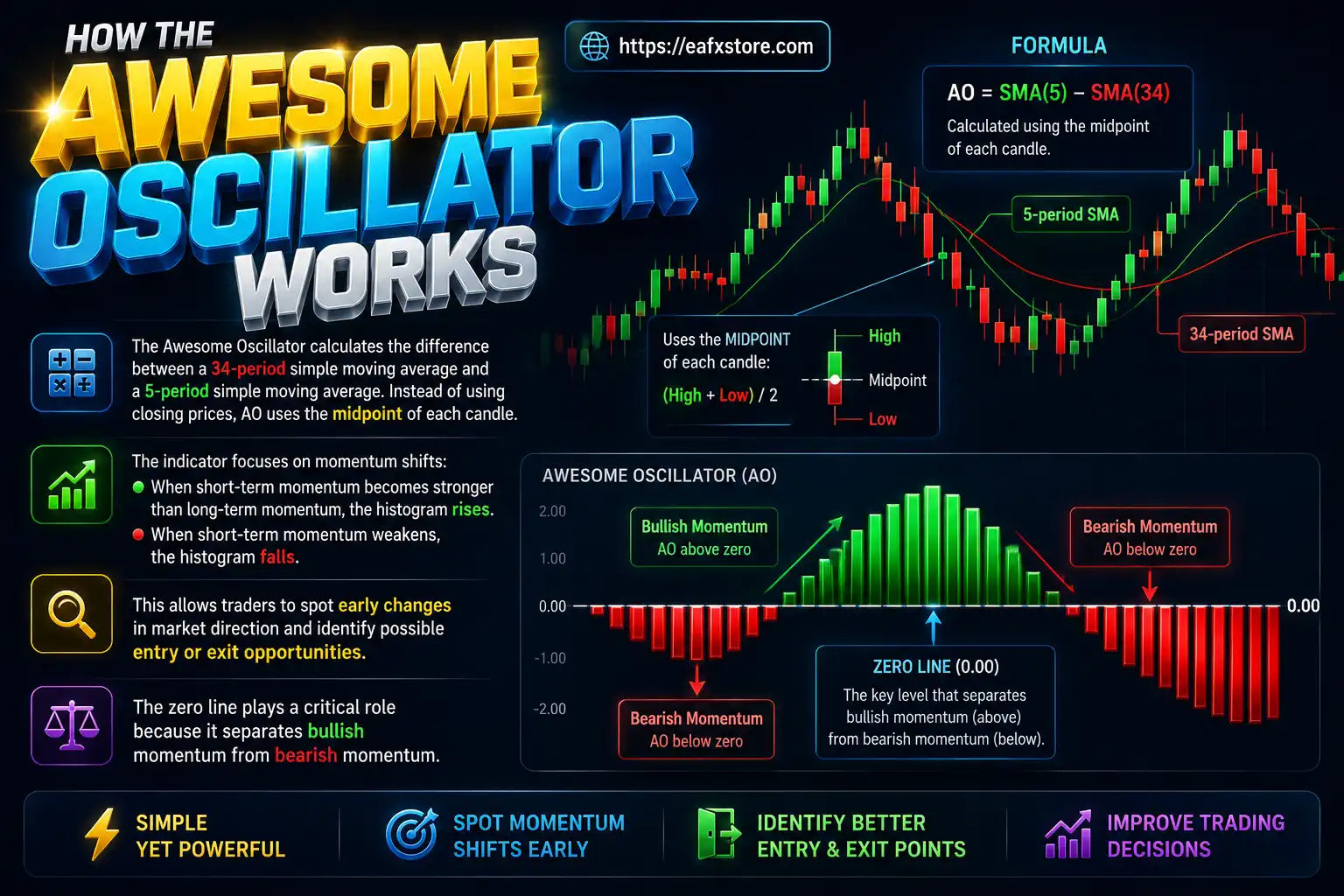
The Awesome Oscillator calculates the difference between a 34-period simple moving average and a 5-period simple moving average. Instead of using closing prices, AO uses the midpoint of each candle.
The indicator focuses on momentum shifts:
- When short-term momentum becomes stronger than long-term momentum, the histogram rises.
- When short-term momentum weakens, the histogram falls.
This allows traders to spot early changes in market direction and identify possible entry or exit opportunities.
The zero line plays a critical role because it separates bullish momentum from bearish momentum.
AO Formula and Calculation
The Awesome Oscillator formula is relatively simple:
Components of the Formula:
| Component | Description |
|---|---|
| SMA 5 | 5-period Simple Moving Average |
| SMA 34 | 34-period Simple Moving Average |
| Midpoint Price | (High + Low) ÷ 2 |
The difference between these two moving averages creates the histogram displayed on the chart.
Although most trading platforms calculate AO automatically, understanding the formula helps traders interpret the indicator more effectively.
How to Read the Awesome Oscillator
Reading the Awesome Oscillator is straightforward once you understand its core principles.
🎯 Bars Above Zero
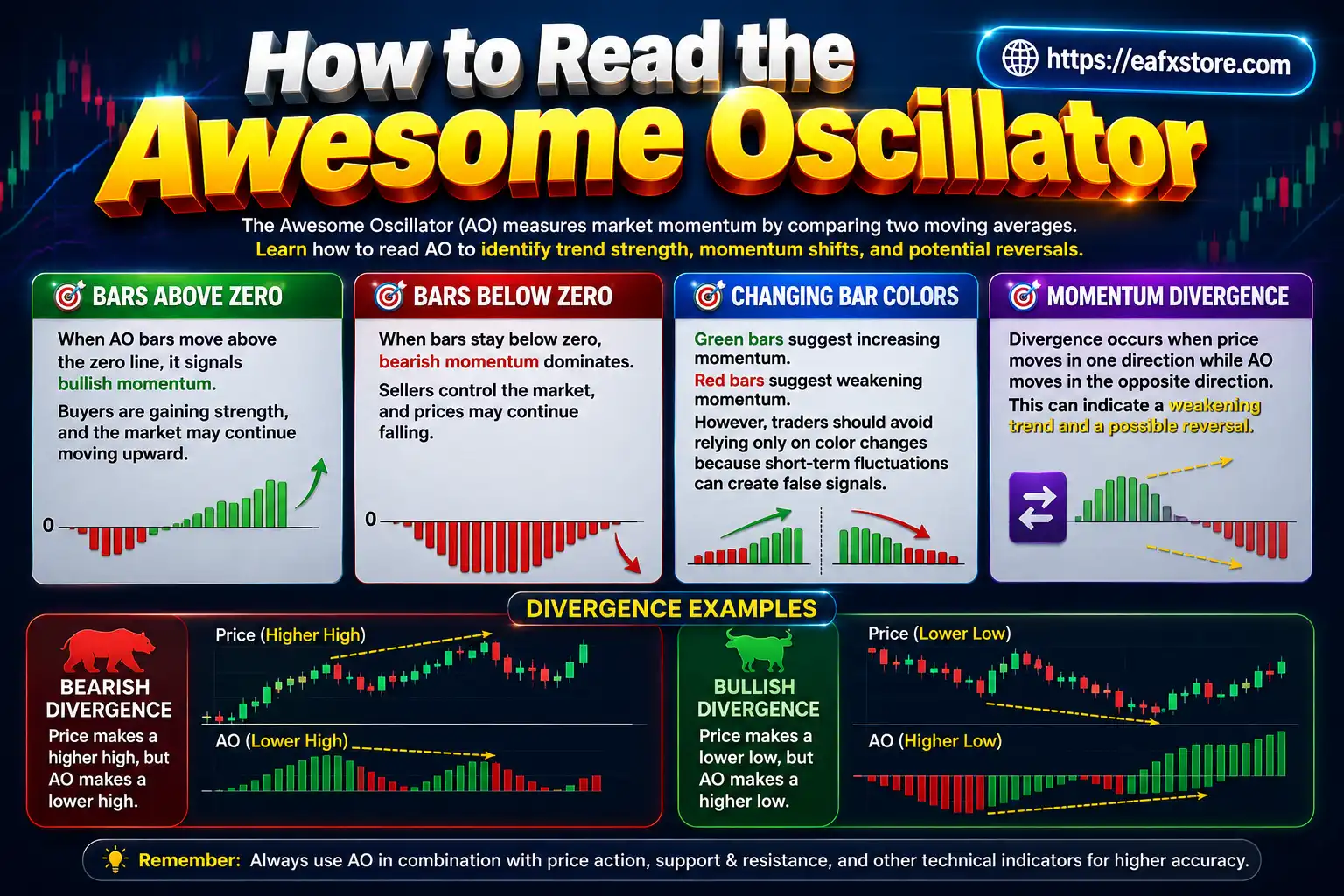
When AO bars move above the zero line, it signals bullish momentum. Buyers are gaining strength, and the market may continue moving upward.
🎯 Bars Below Zero
When bars stay below zero, bearish momentum dominates. Sellers control the market, and prices may continue falling.
🎯 Changing Bar Colors
- Green bars suggest increasing momentum.
- Red bars suggest weakening momentum.
However, traders should avoid relying only on color changes because short-term fluctuations can create false signals.
🎯 Momentum Divergence
Divergence occurs when price moves in one direction while AO moves in the opposite direction. This can indicate a weakening trend and a possible reversal.
For example:
- Price makes a higher high, but AO makes a lower high → bearish divergence.
- Price makes a lower low, but AO makes a higher low → bullish divergence.
Popular Awesome Oscillator Trading Signals
The Awesome Oscillator provides several well-known trading signals that traders use to identify opportunities.
🎯 Saucer Signal
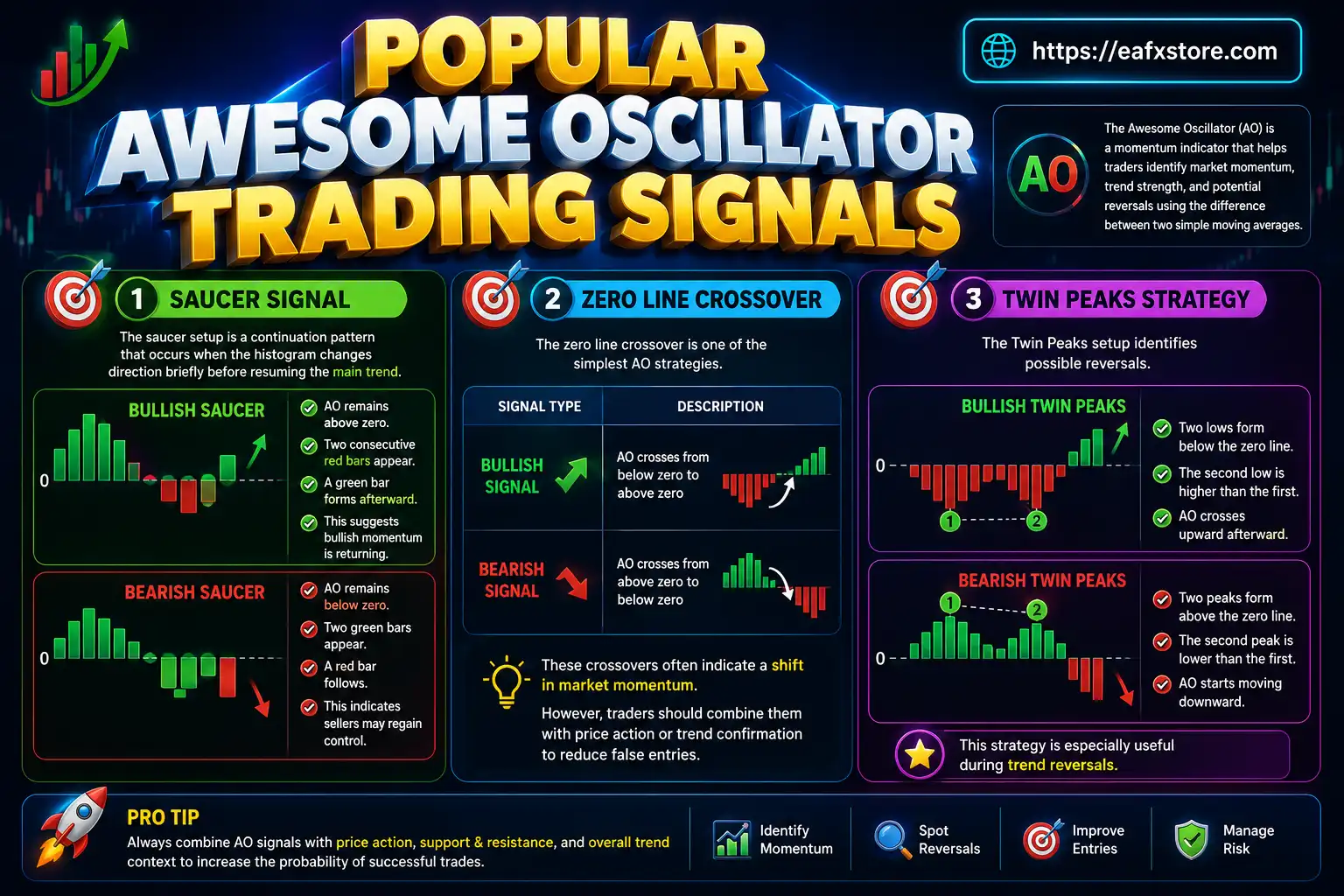
The saucer setup is a continuation pattern that occurs when the histogram changes direction briefly before resuming the main trend.
Bullish Saucer:
- AO remains above zero.
- Two consecutive red bars appear.
- A green bar forms afterward.
This suggests bullish momentum is returning.
Bearish Saucer:
- AO remains below zero.
- Two green bars appear.
- A red bar follows.
This indicates sellers may regain control.
🎯 Zero Line Crossover
The zero line crossover is one of the simplest AO strategies.
| Signal Type | Description |
|---|---|
| Bullish Signal | AO crosses from below zero to above zero |
| Bearish Signal | AO crosses from above zero to below zero |
These crossovers often indicate a shift in market momentum.
However, traders should combine them with price action or trend confirmation to reduce false entries.
🎯 Twin Peaks Strategy
The Twin Peaks setup identifies possible reversals.
Bullish Twin Peaks:
- Two lows form below the zero line.
- The second low is higher than the first.
- AO crosses upward afterward.
Bearish Twin Peaks:
- Two peaks form above the zero line.
- The second peak is lower than the first.
- AO starts moving downward.
This strategy is especially useful during trend reversals.
Best Trading Strategies Using AO
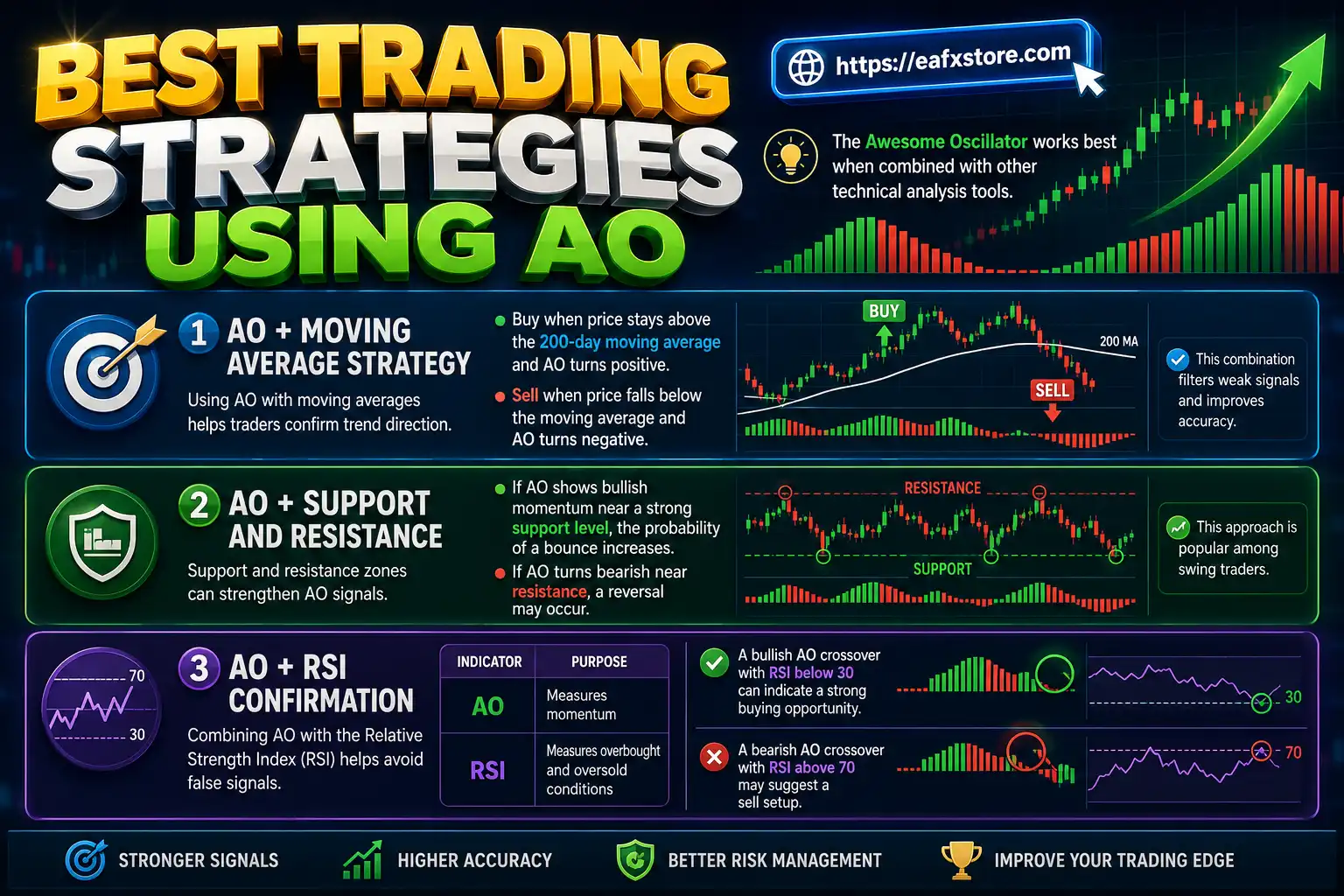
The Awesome Oscillator works best when combined with other technical analysis tools.
🎯 AO + Moving Average Strategy
Using AO with moving averages helps traders confirm trend direction.
For example:
- Buy when price stays above the 200-day moving average and AO turns positive.
- Sell when price falls below the moving average and AO turns negative.
This combination filters weak signals and improves accuracy.
🎯 AO + Support and Resistance
Support and resistance zones can strengthen AO signals.
Example:
- If AO shows bullish momentum near a strong support level, the probability of a bounce increases.
- If AO turns bearish near resistance, a reversal may occur.
This approach is popular among swing traders.
🎯 AO + RSI Confirmation
Combining AO with the Relative Strength Index (RSI) helps avoid false signals.
| Indicator | Purpose |
|---|---|
| AO | Measures momentum |
| RSI | Measures overbought and oversold conditions |
For instance:
- A bullish AO crossover with RSI below 30 can indicate a strong buying opportunity.
- A bearish AO crossover with RSI above 70 may suggest a sell setup.
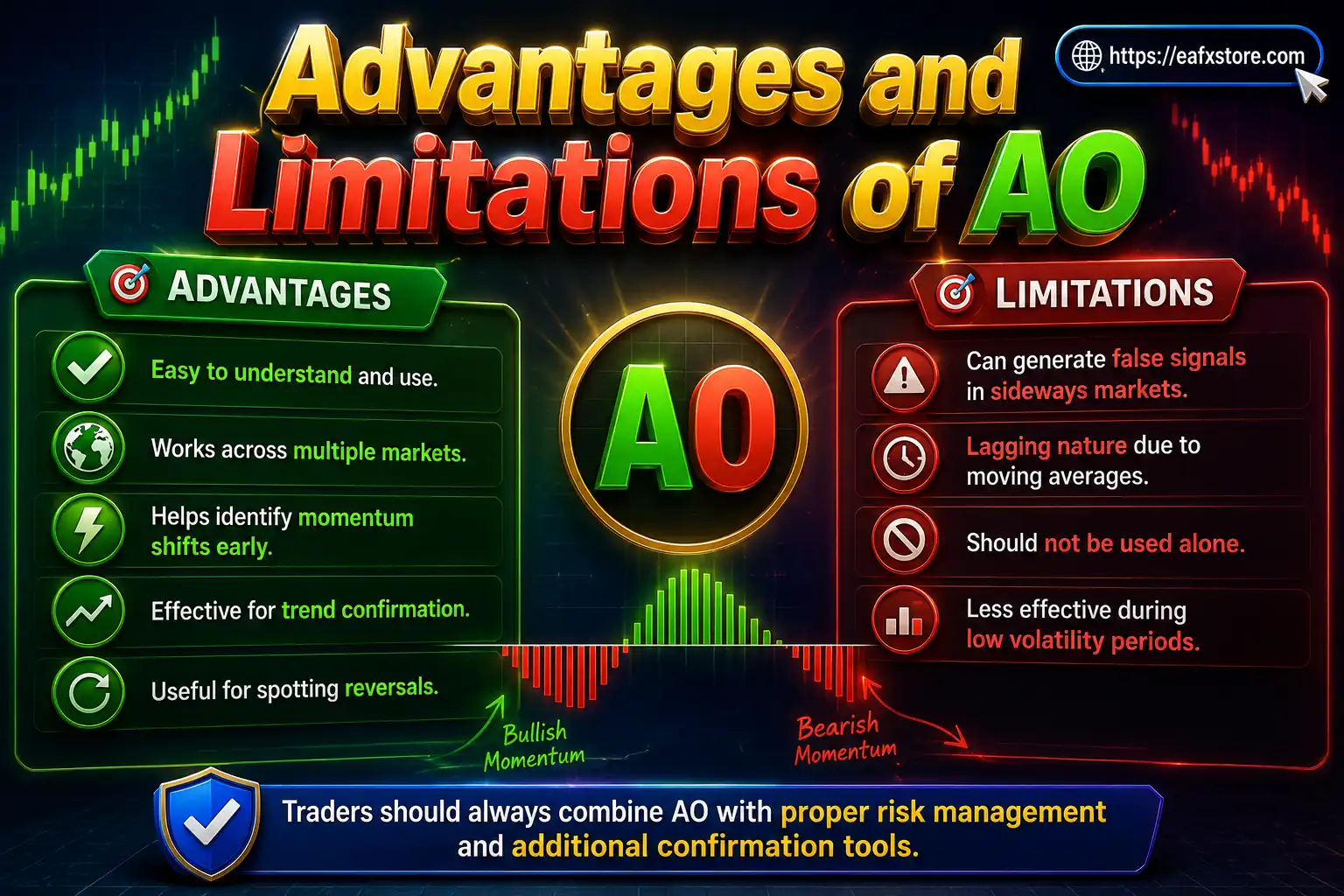
Advantages and Limitations of AO
Like all indicators, the Awesome Oscillator has strengths and weaknesses.
🎯 Advantages
- Easy to understand and use.
- Works across multiple markets.
- Helps identify momentum shifts early.
- Effective for trend confirmation.
- Useful for spotting reversals.
🎯 Limitations
- Can generate false signals in sideways markets.
- Lagging nature due to moving averages.
- Should not be used alone.
- Less effective during low volatility periods.
Traders should always combine AO with proper risk management and additional confirmation tools.
AO vs MACD: Key Differences
Both AO and MACD are momentum indicators, but they function differently.
| Feature | Awesome Oscillator | MACD |
|---|---|---|
| Display Type | Histogram only | Histogram + signal lines |
| Moving Averages | Simple Moving Averages | Exponential Moving Averages |
| Complexity | Simple | More advanced |
| Main Focus | Momentum shifts | Trend + momentum |
AO is generally easier for beginners, while MACD offers more detailed analysis for experienced traders.
Tips for Using AO Effectively
Using the Awesome Oscillator properly requires discipline and confirmation.
Here are some practical tips:
- Trade in the direction of the larger trend.
- Avoid using AO alone.
- Combine AO with support/resistance analysis.
- Use Stop-loss (SL) orders to manage risk.
- Test strategies on demo accounts before live trading.
- Focus on high-volume markets for better signal quality.
Successful trading depends on consistency and proper risk management rather than relying on a single indicator.
Conclusion
The Awesome Oscillator is a powerful momentum indicator that helps traders identify trend strength, reversals, and market momentum shifts. Its simple histogram design makes it easy to understand, while its flexibility allows it to work across different trading markets and timeframes.
Although AO can provide valuable signals, traders should combine it with other technical tools such as moving averages, RSI and Support/Resistance levels for better accuracy.
By mastering the Awesome Oscillator and applying sound risk management principles, traders can improve their overall trading performance and make more informed decisions in volatile markets.
FAQs
❓ What is the Awesome Oscillator used for?
The Awesome Oscillator is used to measure market momentum and identify possible trend reversals or continuation patterns.
❓ Is the Awesome Oscillator good for beginners?
Yes. AO is considered beginner-friendly because of its simple histogram format and easy-to-understand signals.
❓ Can the Awesome Oscillator be used for crypto trading?
Absolutely. AO works well in cryptocurrency markets, as well as forex, stocks, and commodities.
❓ What timeframe works best for AO?
The Awesome Oscillator can be used on multiple timeframes, but many traders prefer the 1-hour, 4-hour, and daily charts for more reliable signals.
❓ Should I use AO alone for trading decisions?
No. It is best to combine AO with other indicators and price action analysis to reduce false signals and improve accuracy.