

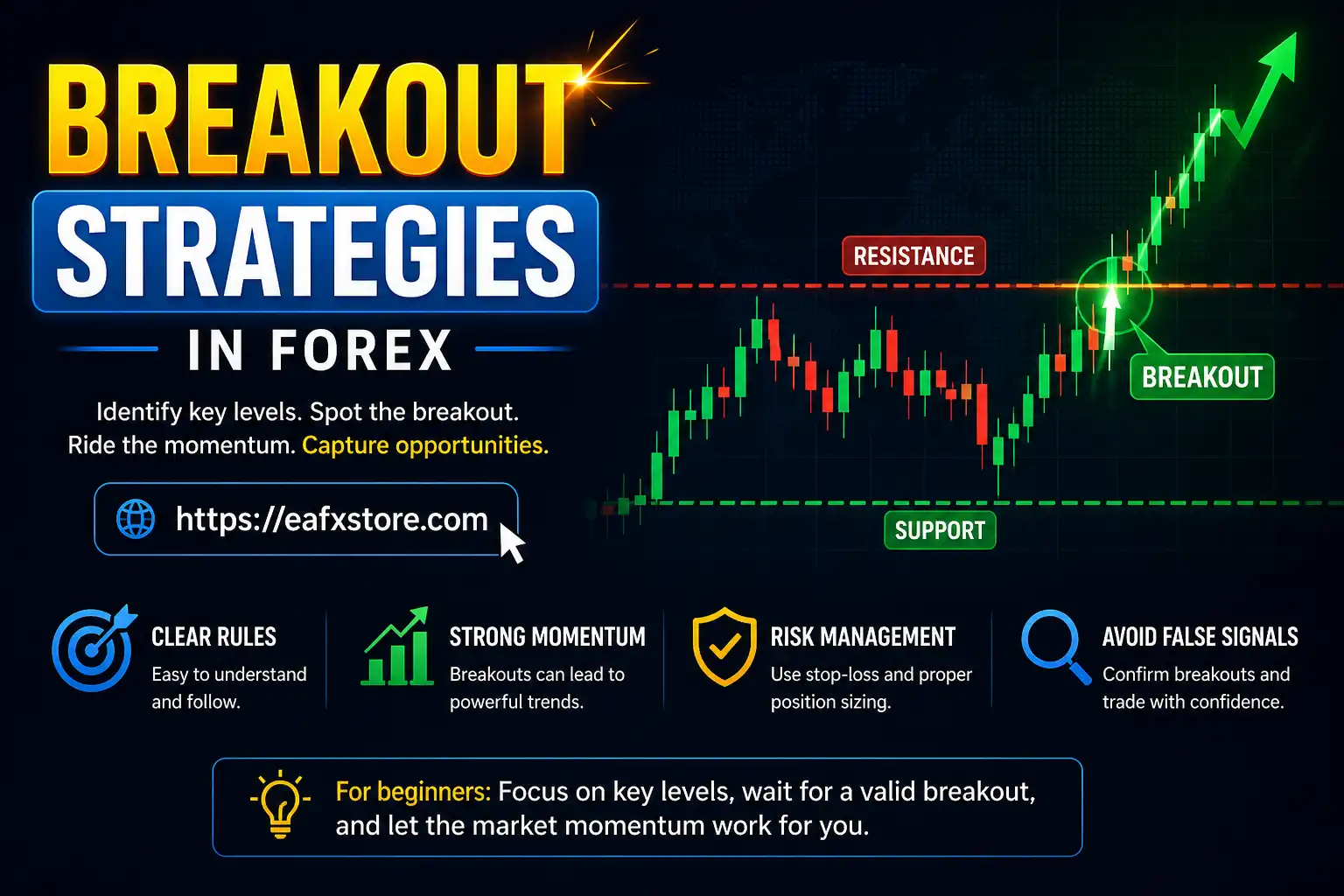
Introduction to Breakout Trading in Forex
Breakout trading is one of the most popular strategies among Forex traders, especially beginners. It focuses on identifying key price levels—such as support and resistance—and entering trades when the price breaks beyond these levels. The idea is simple: when price breaks out, it often leads to strong momentum in that direction, creating potential profit opportunities.
For beginners, breakout strategies are attractive because they rely on clear rules and visible chart patterns rather than complex indicators. However, understanding how to identify valid breakouts and avoid false signals is essential for success.
What Is a Breakout in Forex?
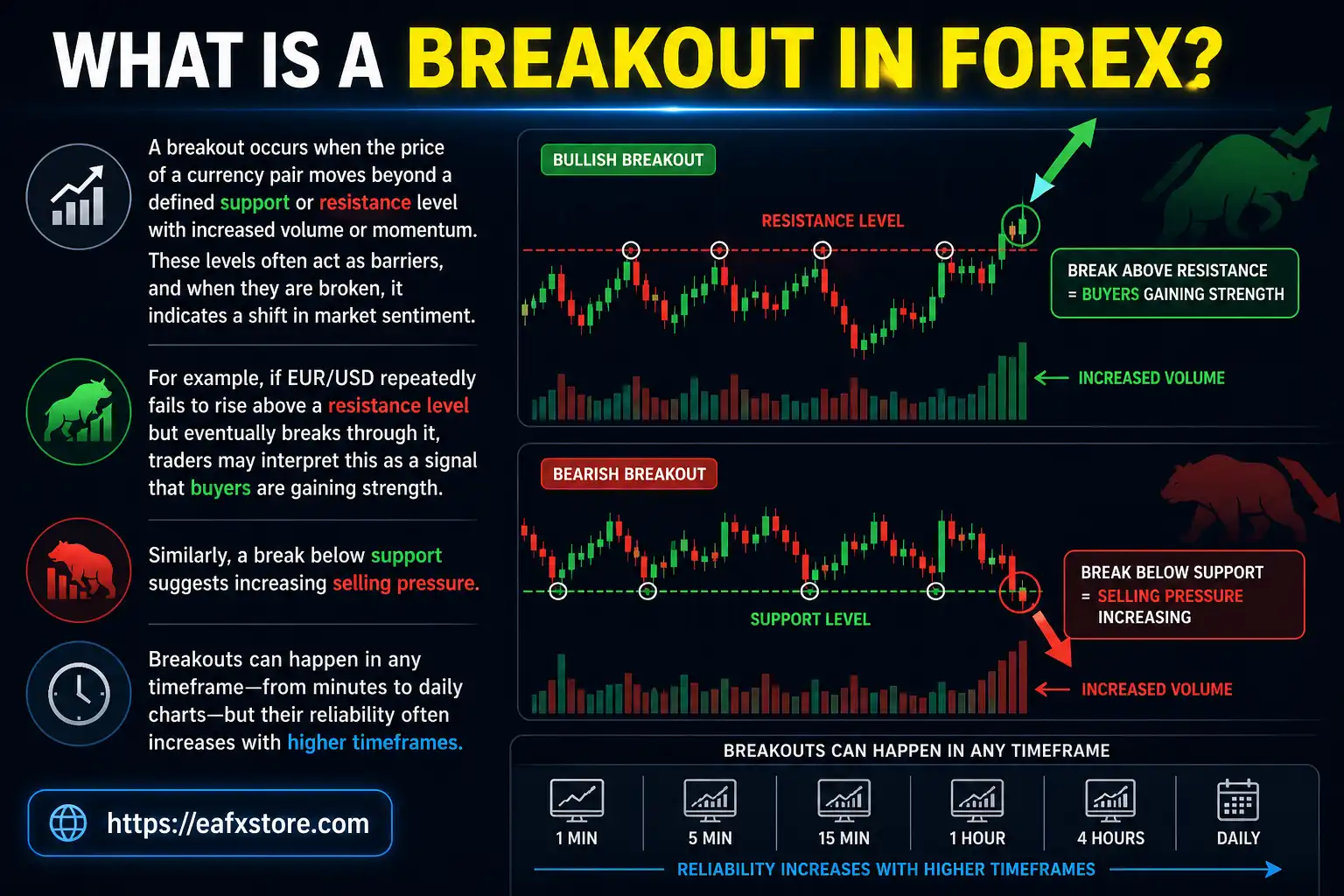
A breakout occurs when the price of a currency pair moves beyond a defined support or resistance level with increased volume or momentum. These levels often act as barriers, and when they are broken, it indicates a shift in market sentiment.
For example, if EUR/USD repeatedly fails to rise above a resistance level but eventually breaks through it, traders may interpret this as a signal that buyers are gaining strength. Similarly, a break below support suggests increasing selling pressure.
Breakouts can happen in any timeframe—from minutes to daily charts—but their reliability often increases with higher timeframes.
Types of Breakout Strategies
There are several types of breakout strategies in Forex trading. Each one is suited to different market conditions and trading styles.
1. Support and Resistance Breakouts
This is the most common breakout strategy. Traders identify horizontal levels where price has historically reversed and wait for a breakout above resistance or below support.
2. Trendline Breakouts
Trendlines are drawn along the highs or lows of a trending market. A breakout occurs when price moves beyond this line, signaling a potential reversal or acceleration of the trend.
3. Range Breakouts
When price moves within a defined range, traders wait for a breakout from the top or bottom of that range. This often leads to strong directional movement.
4. News-Based Breakouts
Major economic news releases can cause sudden volatility and breakouts. Traders use this strategy to capitalize on sharp price movements triggered by news events.
| Strategy Type | Best Market Condition | Risk Level | Difficulty |
|---|---|---|---|
| Support/Resistance | Sideways | Medium | Easy |
| Trendline | Trending | Medium | Medium |
| Range Breakout | Consolidation | Low | Easy |
| News-Based | High Volatility | High | Advanced |
How to Identify a Valid Breakout
Not all breakouts are reliable. False breakouts (also called “fakeouts”) are common and can lead to losses if not properly managed.
To identify a valid breakout, traders should look for:
- Strong momentum: Large candles with minimal wicks
- Increased volume: Confirms participation from major market players
- Retest of breakout level: Price breaks and then retests the level before continuing
- Higher timeframe confirmation: Breakouts on larger timeframes are more reliable
A breakout without confirmation is risky. Waiting for additional signals can help reduce false entries.
Entry and Exit Rules for Breakout Trading
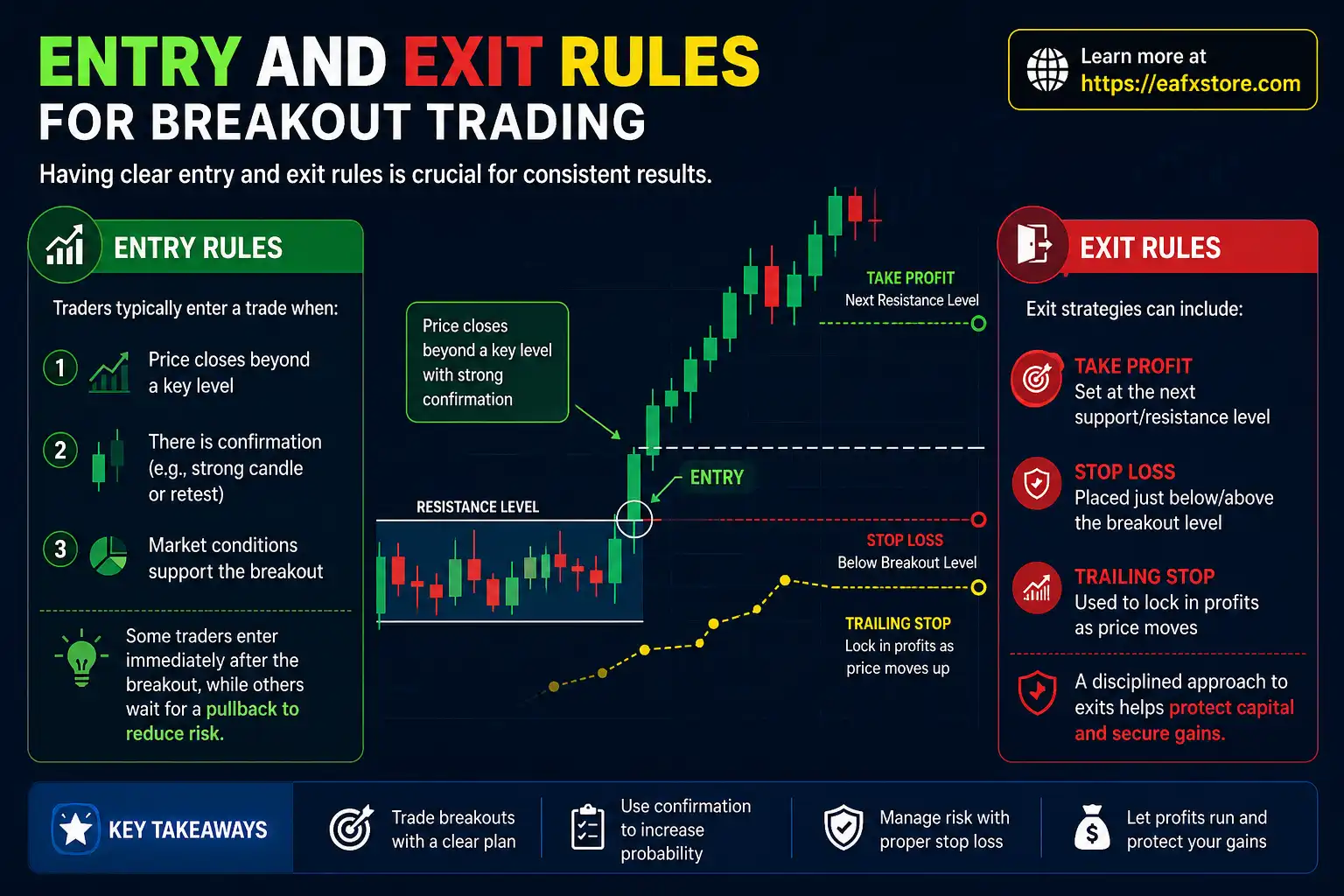
Having clear entry and exit rules is crucial for consistent results.
Entry Rules
Traders typically enter a trade when:
- Price closes beyond a key level
- There is confirmation (e.g., strong candle or retest)
- Market conditions support the breakout
Some traders enter immediately after the breakout, while others wait for a pullback to reduce risk.
Exit Rules
Exit strategies can include:
- Take profit: Set at the next support/resistance level.
- Stop loss: Placed just below/above the breakout level.
- Trailing stop: Used to lock in profits as price moves.
A disciplined approach to exits helps protect capital and secure gains.
Common Mistakes Beginners Make
Breakout trading may seem straightforward, but beginners often fall into common traps.
- Chasing breakouts too late: Entering after a large move increases risk
- Ignoring false breakouts: Not all breakouts lead to trends
- Overtrading: Taking too many trades without proper analysis
- Lack of risk management: Not using stop losses
Avoiding these mistakes requires patience, discipline, and consistent practice.
Risk Management in Breakout Strategies
Risk management is essential in Forex trading, especially for breakout strategies where volatility can be high.
Key principles include:
- Risk only 1–2% per trade
- Use proper position sizing
- Always set a stop loss
- Avoid trading during uncertain market conditions
Breakouts can generate significant profits, but they can also lead to rapid losses if risk is not controlled.
Tools and Indicators for Breakout Trading
While breakout strategies can be traded using price action alone, several tools can improve accuracy:
- Bollinger Bands: Identify volatility expansion.
- Moving Averages: Confirm trend direction.
- RSI (Relative Strength Index): Detect overbought/oversold conditions.
- Volume indicators: Validate breakout strength.
These tools should be used as confirmation rather than primary signals.
Advantages and Disadvantages of Breakout Trading
Understanding both the pros and cons helps traders set realistic expectations.
Advantages
- Simple and easy to understand
- Works in multiple market conditions
- Can capture strong trends early
Disadvantages
- Prone to false breakouts
- Requires patience and discipline
- Market noise can trigger premature entries
Balancing these factors is key to long-term success.
Tips for Beginners
If you are new to breakout trading, consider these practical tips:
- Start with a demo account.
- Focus on one or two currency pairs.
- Trade higher timeframes for better reliability.
- Keep a trading journal.
- Avoid emotional decision-making.
Consistency matters more than quick profits.
Conclusion
Breakout strategies in Forex offer a powerful and beginner-friendly approach to trading. By focusing on key price levels and market momentum, traders can identify high-probability opportunities. However, success depends on proper confirmation, disciplined risk management and continuous learning.
While no strategy guarantees profits, mastering breakout trading can provide a solid foundation for your Forex journey. With practice and patience, beginners can gradually build confidence and improve their trading performance over time.