

Timing is one of the most critical elements in trading. Enter too early, and you risk getting caught in a false move. Enter too late, and most of the profit potential may already be gone. The pullback trading strategy offers a balanced approach by allowing traders to enter positions during temporary retracements within a larger trend. This method improves entry precision while maintaining alignment with the overall market direction.
In this article, we’ll break down how the pullback strategy works, why it’s effective, and how you can apply it manually or through automated trading systems.
What is a Pullback Trading Strategy?
A pullback trading strategy involves entering a trade when the price temporarily moves against the prevailing trend before continuing in its original direction. Instead of chasing price movements, traders wait for a “discount” entry point.
In an uptrend, this means buying when the price dips. In a downtrend, it involves selling when the price rallies temporarily. Pullbacks are natural market behaviors caused by profit-taking, liquidity shifts or short-term sentiment changes.
This strategy is popular because it aligns with the principle of “trend following” while improving entry price and risk-reward ratio.
Why Pullback Trading Works
Pullback trading works because markets rarely move in straight lines. Even in strong trends, price action consists of waves—impulses and corrections. These corrections create opportunities.
There are three main reasons why pullbacks occur:
- Profit-taking: Traders close positions after strong moves.
- Market imbalance correction: Price returns to fair value zones.
- Liquidity gathering: Large players accumulate positions.
By entering during pullbacks, traders avoid buying at peak prices or selling at the bottom, which significantly reduces risk exposure.

Identifying a Valid Trend
Before applying a pullback strategy, you must confirm the presence of a clear trend. Without a trend, pullbacks become meaningless and risky.
A valid trend typically includes:
- Higher highs and higher lows (uptrend)
- Lower highs and lower lows (downtrend)
- Strong momentum with consistent direction
Common tools used to identify trends include:
- Moving Averages (e.g., 50 EMA, 200 EMA).
- Trendlines.
- Market structure analysis.
The key is to trade with the trend, not against it. Pullbacks only make sense when the broader direction is well-defined.
How to Identify Pullback Zones
Once a trend is confirmed, the next step is to identify where pullbacks are likely to occur. These zones act as potential entry points.
Common Pullback Indicators:
| Indicator Type | Description |
|---|---|
| Moving Averages | Price retraces to dynamic support/resistance |
| Fibonacci Levels | Key retracement levels (38.2%, 50%, 61.8%) |
| Support/Resistance | Historical price reaction zones |
| Trendlines | Diagonal support or resistance levels |
These tools help traders anticipate where price may reverse back into the trend.
Entry Techniques for Pullback Trades
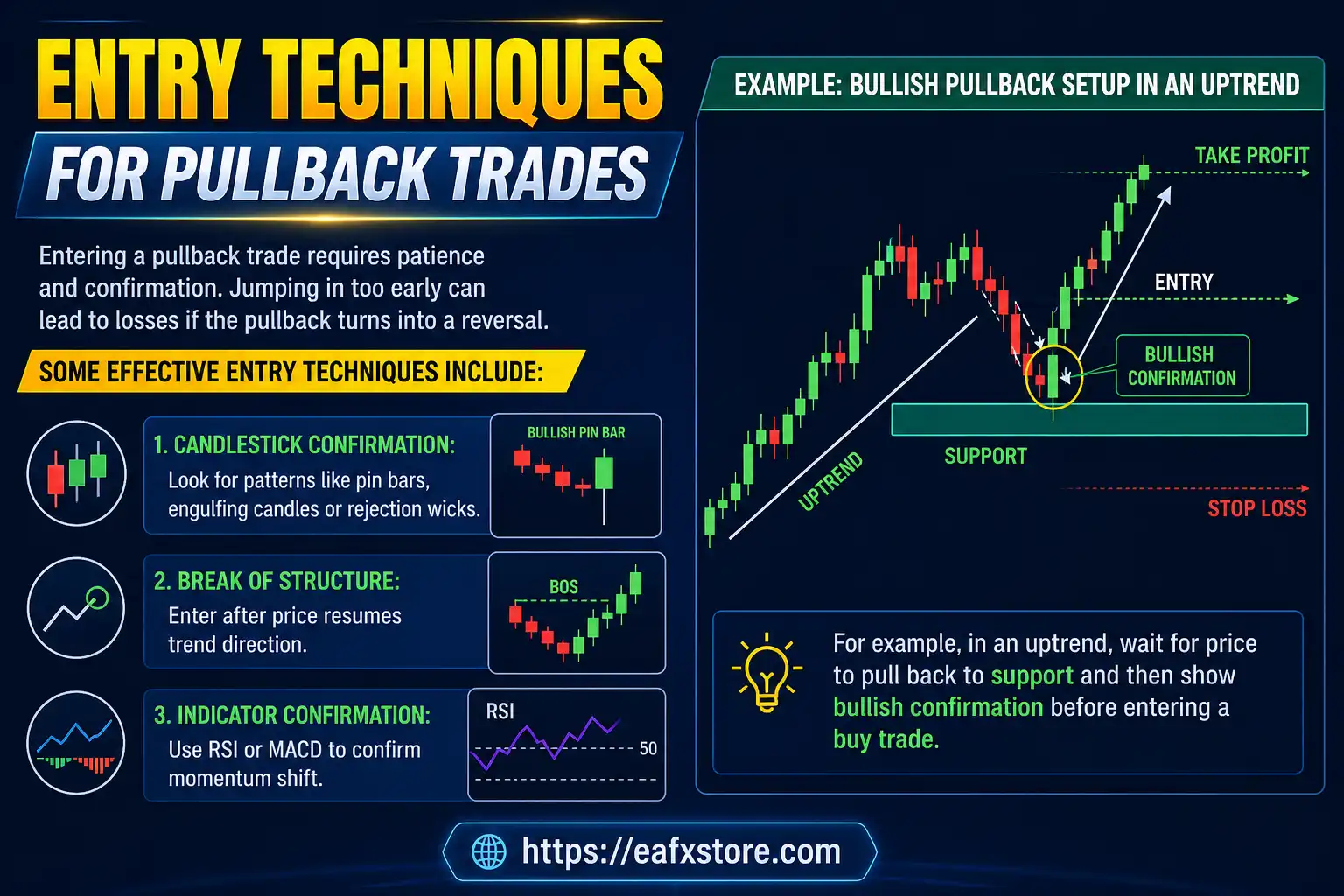
Entering a pullback trade requires patience and confirmation. Jumping in too early can lead to losses if the pullback turns into a reversal.
Some effective entry techniques include:
- Candlestick confirmation: Look for patterns like pin bars, engulfing candles or rejection wicks.
- Break of structure: Enter after price resumes trend direction.
- Indicator confirmation: Use RSI or MACD to confirm momentum shift.
For example, in an uptrend, wait for price to pull back to support and then show bullish confirmation before entering a buy trade.
Risk Management in Pullback Trading
Even with good timing, risk management remains essential. No strategy guarantees success on every trade.
Key risk management principles:
- Place stop-loss below recent swing lows (in uptrends).
- Use position sizing based on account risk (e.g., 1–2%).
- Aim for favorable risk-reward ratios (minimum 1:2).
Pullback strategies naturally offer tighter stop-loss placements, which improves overall trade efficiency.
Applying Pullback Strategy in Automated Trading
One of the most powerful applications of the pullback strategy is in automated trading systems (algorithmic trading or trading bots).
Automation removes emotional bias and ensures consistent execution.
How to Build an Automated Pullback System
| Component | Description |
| Trend Detection | Use moving averages or trend filters |
| Pullback Condition | Price retraces to predefined levels |
| Entry Trigger | Confirmation via indicators or price action |
| Risk Management | Automated stop-loss and take-profit |
| Execution | Bot executes trades based on rules |
Example Logic for Automation
- Identify trend using 200 EMA.
- Wait for price to pull back to 50 EMA.
- Confirm with RSI (e.g., oversold in uptrend).
- Execute buy order.
- Set stop-loss below recent low.
- Set take-profit at next resistance level.
Benefits of Automation
- Eliminates emotional trading.
- Ensures discipline.
- Enables backtesting and optimization.
- Works 24/7 in global markets.
However, automated systems require careful testing and ongoing monitoring to adapt to changing market conditions.
Tips for Improving Pullback Trading
To maximize success with pullback strategies, consider the following:
- Focus on strong trends only.
- Avoid trading during major news events.
- Combine multiple indicators for confirmation.
- Backtest your strategy thoroughly.
- Keep a trading journal to track performance.
Consistency and refinement are key to long-term profitability.
Conclusion
The pullback trading strategy is a powerful method for entering trades with better timing and reduced risk. By waiting for temporary retracements within a trend, traders can improve entry precision and overall performance.
Whether used manually or through automated systems, this approach emphasizes discipline, patience and structured decision-making. When combined with solid risk management and proper analysis, pullback trading can become a reliable component of any trading strategy.